
Lowest Price Guaranteed
Pages
700
Last Updated
September 2026
View Count
40596
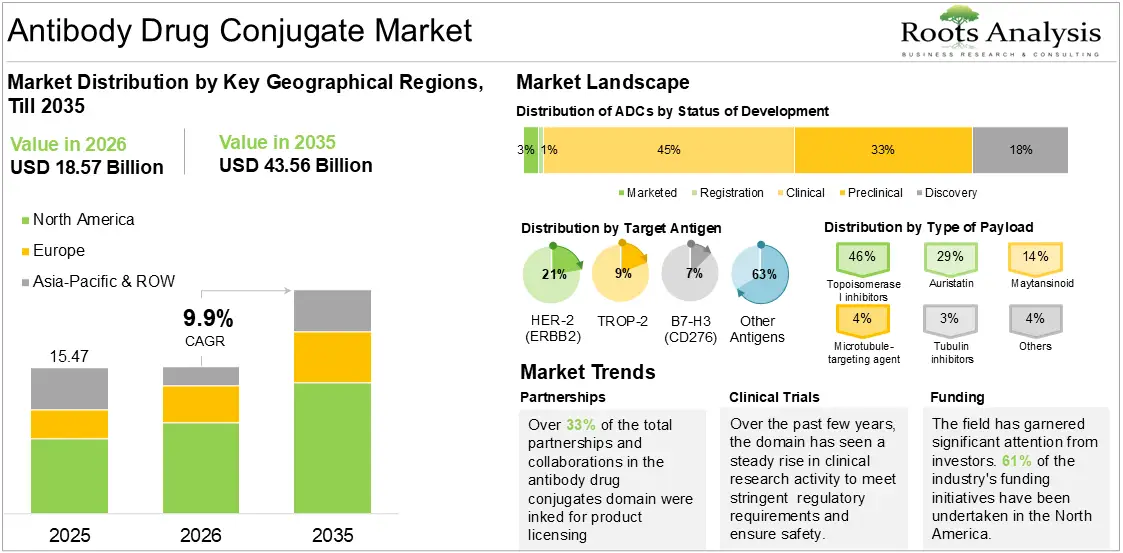
The antibody drug conjugates market, valued at USD 15.47 billion in 2025, is projected to reach USD 18.57 billion in 2026 and USD 43.56 billion by 2035, representing a CAGR of 9.9% during the forecast period 2026 to 2035. Market growth is expected to be supported by the expanding global oncology therapeutics landscape, increasing commercialization of targeted cancer therapies, sustained industry investment, and the rising adoption of advanced treatment modalities across healthcare systems.
To learn more about this report, request a free sample copy
Antibody drug conjugates (ADCs) have emerged as one of the most promising classes of targeted oncology therapeutics, combining the specificity of monoclonal antibodies with the potency of cytotoxic agents to improve selective tumor targeting. This targeted therapeutic approach has expanded treatment options across multiple cancer indications by improving selective drug delivery while addressing limitations associated with conventional chemotherapy. As oncology treatment increasingly shifts toward biomarker-driven care, ADCs are gaining strategic importance within both clinical practice and pharmaceutical innovation.
The market has evolved considerably over the past decade through advances in antibody engineering, linker chemistry, conjugation technologies, and payload development. These innovations have improved the therapeutic performance of ADCs and broadened research beyond early HER2-focused therapies to include a wider range of tumor-associated targets. As a result, ADCs are no longer viewed as a niche therapeutic class but as a versatile platform supporting continued innovation across the oncology pipeline.
Supported by sustained scientific innovation, expanding clinical applications, and continued investment across the global oncology ecosystem, the antibody drug conjugates market is expected to maintain strong long-term growth momentum over the forecast period. Ongoing advances are expected to broaden the therapeutic potential of ADCs, while increasing commercialization activities and evolving competitive dynamics continue to reinforce their strategic importance within the future landscape of precision oncology.
Alongside rapid scientific progress, the antibody drug conjugates market has evolved into a highly collaborative ecosystem where competitive advantage transcends drug discovery. A diverse network of stakeholders collectively drives ADC innovation and commercialization. This ecosystem brings together pharma and biotech companies, antibody engineering specialists, linker and payload technology providers, CROs, CDMOs, companion diagnostics developers, regulatory agencies, and commercialization partners. As platform technologies mature and cross-border collaborations increase, the market is transitioning toward platform-led competition, where scientific differentiation, manufacturing capabilities, and strategic partnerships are expected to define long-term industry leadership.
| Company | HQ | Core ADC Platform / Expertise | Key ADC Pipeline Assets | Current Strategic Focus and Market Implication |
| Daiichi Sankyo | Japan | Proprietary DXd ADC platform utilizing a topoisomerase I inhibitor payload | Enhertu®, Datroway®, HER3-DXd, Ifinatamab Deruxtecan | Daiichi Sankyo is expanding the DXd franchise through new target indications, global co-development and pipeline diversification, reinforcing proprietary platform ownership as a durable competitive advantage. |
| AbbVie | US | Oncology-focused ADC portfolio strengthened through the ImmunoGen acquisition and internal development | Elahere®, ABBV-400, Telisotuzumab Vedotin | AbbVie emphasizes strengthening its oncology portfolio by integrating acquired ADC technologies and advancing late-stage assets, highlighting acquisition as a route to faster |
| Roche / Genentech | Switzerland / US | HER2-targeted ADC development supported by precision oncology and biomarker expertise | Kadcyla®, next-generation HER2-directed ADC programs | Roche is extending its HER2 franchise through biomarker-led development, label expansion and continued ADC innovation, underscoring precision oncology's role in sustaining product differentiation |
| Kelun Biotech | China | Proprietary ADC discovery platform integrating novel linker and payload technologies | SKB264 (Sacituzumab Tirumotecan) and diversified multi-target ADC pipeline | Kelun Biotech is expanding globally through platform licensing, clinical collaborations and accelerated pipeline development, broadening cross-border access to differentiated ADC technologies and assets |
| DualityBio | China | Next-generation ADC platform featuring differentiated conjugation technologies and targeted payload innovation | DB-1303, DB-1311, DB-1305 and other clinical-stage ADC candidates | DualityBio is advancing differentiated conjugation technologies and multiple clinical candidates through global development, reinforcing next-generation platform innovation as a primary source of future advantage |
| Pfizer (Seagen) | US | Clinically validated ADC discovery, conjugation, manufacturing, and commercialization capabilities | Adcetris®, Padcev®, Tivdak®, other multiple clinical-stage ADC programs | Pfizer is integrating Seagen's ADC capabilities across discovery, manufacturing and commercialization, demonstrating how acquisition-led platform integration can accelerate oncology scale and market positioning. |
The ADC landscape is evolving from a historical emphasis on HER2-directed therapies towards a broader portfolio targeting antigens such as TROP2, FOLR1, c-MET, BCMA, Nectin-4, and PD-L1. Recent regulatory approvals of TROP2-directed therapies, together with expanding late-stage clinical programs targeting multiple solid tumors, demonstrate growing confidence in applying ADC platforms beyond traditional HER2-positive indications. For instance, Sacituzumab govitecan (Trodelvy) became the first third-generation ADC to achieve market approval for metastatic triple-negative breast cancer.
This trend is accelerating pipeline diversification, reducing dependence on individual target classes, and creating new commercialization opportunities as developers compete across a broader spectrum of biomarker-defined oncology indications.
Technology differentiation is increasingly centered on optimized linker chemistry, novel payloads, and advanced conjugation platforms designed to improve therapeutic efficacy and safety. The growing adoption of topoisomerase I inhibitor payloads, exemplified by the expansion of Daiichi Sankyo's DXd technology platform into multiple clinical programs, reflects an industry-wide shift toward next-generation ADCs capable of supporting broader therapeutic applications. Parallel advances in site-specific conjugation and drug-to-antibody ratio optimization continue to enhance platform performance.
These innovations are strengthening intellectual property portfolios, driving platform-based licensing strategies, and increasing competitive differentiation as companies seek sustainable advantages through proprietary ADC technologies.
Clinical development is increasingly focused on evaluating ADCs in earlier treatment lines and in combination with immunotherapies and other targeted agents. Growing clinical evidence supporting these approaches, including the FDA approval of Padcev (enfortumab vedotin) and Keytruda (pembrolizumab) for first-line advanced urothelial cancer, reflects a strategic shift toward maximizing the clinical utility of ADCs across earlier treatment settings and, where supported by disease context and clinical evidence, potentially curative-intent strategies. As programs move into broader patient populations, clinical differentiation is increasingly assessed through endpoints such as objective response rate (ORR), duration of response (DoR), progression-free survival (PFS) and overall survival (OS), alongside treatment-emergent toxicity and biomarker-defined patient response.
Modern oncology research has shifted its focus from single-product efficacy to dynamic, multi-modal approaches. Ongoing platform and basket trials are increasingly relying on comprehensive multi-omic profiling, longitudinal circulating tumor DNA (ctDNA) tracking, and advanced biomarker identification to sequence ADCs strategically. These trials utilize ADCs to target heterogeneous resistance mechanisms or pair them with agents designed to modulate the tumor microenvironment, thereby rendering tumors more responsive to immune checkpoint blockade.
This clinical evolution is expected to drive the pipeline toward next-generation therapies, including bispecific ADCs and dual-payload platforms designed explicitly for combination synergy. By expanding indications beyond singular biomarker constraints (e.g., simple PD-L1 expression) and integrating tightly with advanced liquid biopsy diagnostics, these combination strategies will expand clinical adoption, extend product lifecycles, and sustain commercial growth throughout the forecast period.
The findings in this report were developed through a structured research approach combining secondary research, market and competitive analysis, and primary stakeholder interviews. The antibody-drug conjugate (ADC) market is likely to benefit from rapid advancements in linker-payload technologies and the aggressive strategic scaling of precision oncology portfolios.
Highlighting this paradigm shift following their landmark acquisition, Dr. Albert Bourla (Chairman and Chief Executive Officer, Pfizer) stated, "With Seagen's proprietary, world-leading Antibody-Drug Conjugate (ADC) technology, together with the scale and strength of Pfizer's capabilities and expertise, we are poised to change the cancer treatment paradigm." This convergence of proprietary bio-engineering and global commercial capabilities is positioning ADCs as a primary growth driver in the modern therapeutic landscape.
Primary discussions with multiple stakeholders across the ADC value chain informed the qualitative insights presented in this study. The antibody drug conjugates market report (9th edition) includes transcripts from the executives and specialists spanning biotechnology and pharmaceutical companies, CMOs/CDMOs, business development, chemistry, regulatory affairs, R&D and commercial functions, including the following roles:
In addition, the antibody drug conjugates market report (9th edition) includes transcripts of the following other third-party discussions:
Based on the research, we have segmented the antibody-drug conjugates market into various key segments, outlined below.
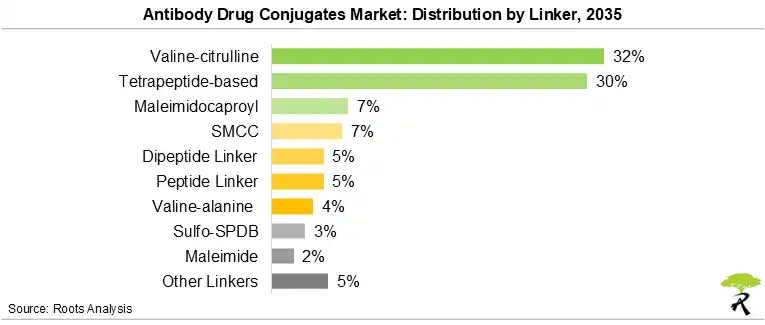
Valine-citrulline linkers account for close to 40% share within the global antibody drug conjugates market owing to their proven balance between systemic stability and efficient intracellular payload release following lysosomal cleavage. Their successful application in commercially established ADCs such as Adcetris, Padcev, Polivy, and Tivdak has demonstrated consistent clinical performance across multiple hematological and solid malignancies. This extensive commercial experience has reduced development risk for manufacturers while establishing valine-citrulline chemistry as a preferred platform for successive generations of ADCs. Continued confidence in this linker technology is expected to sustain its market leadership as developers seek clinically validated conjugation strategies capable of supporting scalable manufacturing and global commercialization.
Peptide linkers are expected to witness the fastest growth as ADC developers increasingly prioritize linker engineering to improve tumor-selective payload release, minimize premature systemic cleavage, and support increasingly potent cytotoxic payloads. Recent advances in enzymatically cleavable peptide architectures, together with growing adoption of site-specific conjugation technologies by platform innovators including Tubulis, GeneQuantum, and MediLink Therapeutics, highlight the industry's focus on improving therapeutic index through molecular engineering rather than payload modification alone. As next-generation ADC platforms become more sophisticated, peptide linker innovation is expected to play a central role in technology differentiation, licensing activity, and future platform competitiveness.
Breast cancer accounts for more than 45% of the ADC market, supported by the largest portfolio of commercially approved therapies and continuous regulatory expansion across HER2-positive, HER2-low, HER2-ultralow, and triple-negative disease settings. Recent approvals and label expansions for Enhertu, together with commercial adoption of Trodelvy, Datroway, and Kadcyla, have substantially increased eligible patient populations while reinforcing ADCs as a standard targeted treatment approach. This regulatory maturity lowers development risk, encourages investment in lifecycle management, companion diagnostics, and next-generation candidates, and strengthens competitive barriers for established developers. As biomarker-defined treatment strategies broaden, breast cancer will continue to shape platform evolution, commercialization priorities, and future licensing activity across the ADC market.
Head and neck cancer is projected to register the fastest growth during the forecast period as developers increasingly investigate ADCs targeting EGFR, HER3, B7-H3, and TROP2 to address significant unmet therapeutic needs. Companies including Merck, DualityBio, and several emerging biotechnology innovators are advancing differentiated clinical programs designed for biomarker-selected patient populations. Expanding precision oncology capabilities and improved target validation are lowering scientific barriers that previously limited ADC development in this indication. This momentum is expected to stimulate new licensing opportunities, diversify late-stage pipelines, and strengthen the strategic importance of head and neck oncology within the evolving ADC market.
Solid tumors account for more than 80% of the ADC market because most commercial approvals have been achieved across breast, lung, ovarian, gastric, urothelial, cervical, and other solid malignancies. Products including Padcev, Elahere, Tivdak, and Datroway demonstrate how advances in tumor-specific antigen identification have enabled ADCs to become established therapeutic options across multiple solid tumor settings. Broad regulatory acceptance has encouraged developers to prioritize high-incidence cancers where larger patient populations justify continued investment in clinical development and manufacturing infrastructure. This commercial concentration reinforces solid tumors as the principal source of revenue generation while influencing portfolio expansion, manufacturing scale-up, and long-term competitive positioning across the ADC industry.
Solid tumors are also projected to record the highest growth as ADC developers expand into earlier treatment settings and increasingly pursue novel targets including c-MET, Claudin 18.2, HER3, and B7-H3. Recent pipeline expansion by AbbVie, BioNTech, Kelun Biotech, and Hengrui Pharma demonstrates growing confidence in extending established ADC platforms across multiple tumor types rather than single disease indications. This strategy improves platform scalability, broadens commercial opportunities, and intensifies competition around differentiated target biology. Continued diversification of solid tumor pipelines is expected to guide future investment decisions and reinforce the strategic importance of platform-based ADC development.
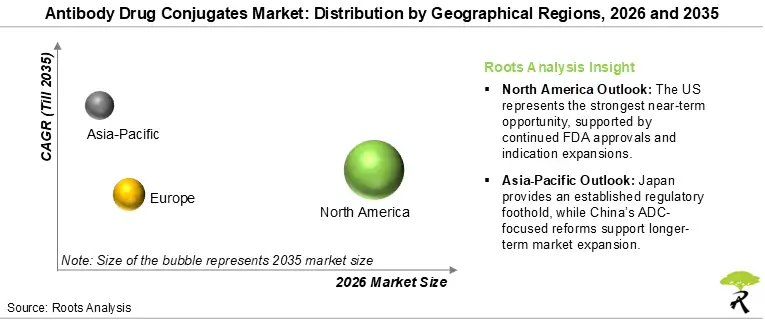
North America dominates (more than 65%) the global ADC market, supported by advanced oncology research infrastructure, integrated biomarker testing capabilities, and the presence of leading developers including Pfizer, Merck, Genentech, AbbVie, and Gilead Sciences. The U.S. FDA Oncology Center of Excellence (OCE) has further accelerated commercialization through initiatives such as Project Orbis and coordinated companion diagnostic review pathways, enabling faster evaluation of biomarker-driven oncology therapies while facilitating international regulatory collaboration. These mechanisms reduce commercialization timelines, strengthen investor confidence, and support earlier global market adoption of ADCs. Continued regulatory innovation and strategic partnerships are expected to reinforce North America's leadership in ADC commercialization, platform development, and cross-border licensing.
Asia-Pacific is projected to grow at the fastest rate (10.9% CAGR) as regional developers increasingly transition from domestic innovation to global commercialization. Companies including Hengrui Pharma, Kelun Biotech, RemeGen, Lepu Biopharma, DualityBio, and Henlius are expanding proprietary ADC pipelines while securing international licensing partnerships with multinational pharmaceutical companies. Simultaneously, regulatory reforms introduced by China's National Medical Products Administration (NMPA), together with Japan's Pharmaceuticals and Medical Devices Agency (PMDA) participation in international initiatives such as Project Orbis, are improving review efficiency and regulatory convergence. These developments are transforming Asia-Pacific from an emerging manufacturing hub into a significant source of ADC innovation, positioning the region to contribute an increasing share of future clinical development, licensing activity, and global market growth.
Across regions, commercial adoption of ADCs is also influenced by payer coverage, reimbursement pathways, biomarker-testing availability and treatment-center readiness. As ADCs expand into earlier treatment lines and larger patient populations, market-access teams increasingly need to access the relationship between clinical benefit, comparison-diagnostic requirements, treatment cost and reimbursement conditions. These factors can influence launch sequencing, eligible patient access and the commercial uptake of newly approved ADCs.
Growth opportunities within the antibody drug conjugates market vary significantly across therapeutic applications, technology platforms, and geography. The analysis is designed to support pharmaceutical and biotechnology companies, business-development and licensing teams, R&D and portfolio-strategy teams, manufacturing and CDMO decision-makers, market-access professionals, investors and competitive-intelligence teams. It helps these stakeholders compare markets using validated industry research, primary stakeholder interviews and robust data triangulation. The resulting intelligence supports capital allocation, portfolio prioritization, and market expansion decisions with a level of confidence that extends beyond publicly available market estimates.
Maintaining a competitive advantage requires more than tracking individual companies; it demands a connected view of the evolving ADC landscape. By integrating insights on pipeline maturity, licensing activity, partnerships, commercialization strategies, and competitive positioning, the report helps organizations benchmark competitors, identify potential collaborators, evaluate market entry risks, and strengthen portfolio decisions with confidence.
Commercial leadership in the ADC market is increasingly shaped by technology choices made early in development. The report connects advances in antibody engineering, linker chemistry, payload design, target biology, and next-generation ADC platforms with their clinical progress, regulatory acceptance, and commercial adoption. This perspective helps organizations prioritize R&D investments, evaluate licensing opportunities, and focus resources on technologies with the strongest potential to create durable competitive advantage.
The strongest strategic decisions are built on an integrated view of market, competitive, technology, and commercial intelligence rather than isolated data points. By integrating these perspectives into a single analytical framework, the report enables business leaders to evaluate investment priorities, manufacturing expansion, partnership opportunities, and regional growth strategies while reducing uncertainty in a rapidly evolving antibody drug conjugates market.
| Key Report Attributes | Details | |
| Historical Trends | Since 2023 | |
| Forecast Period | Till 2035 | |
| Market Size 2026 | USD 18.57 Billion | |
| Market Size 2035 | USD 43.56 Billion | |
| CAGR (till 2035) | 9.9% | |
| Forecasted Regions |
|
|
| Key Companies Profiled |
|
|
| PowerPoint Presentation (Complimentary) |
|
|
| Customization Scope |
|
|
| Excel Data Packs (Complimentary) |
|
|
The report was authored by Simriti Gupta who has over 10 years of industry expertise and is part of Roots Analysis's healthcare and pharma research practice, covering biologics discovery, development, and manufacturing market studies.
This report is an independent work of market research and analysis published by Roots Analysis. It is not affiliated with, sponsored by, endorsed by, or reviewed by AbbVie, ADC Therapeutics, AstraZeneca, Pfizer, Merck, or any other pharmaceutical company, drug brand, or regulatory body referenced within it. No content in this report should be construed as medical advice. Roots Analysis maintains its own proprietary primary research process, and does not receive compensation from any company profiled within the report, in exchange for inclusion or favorable characterization.