


 Download Free Sample
 Buy Now
Market Size
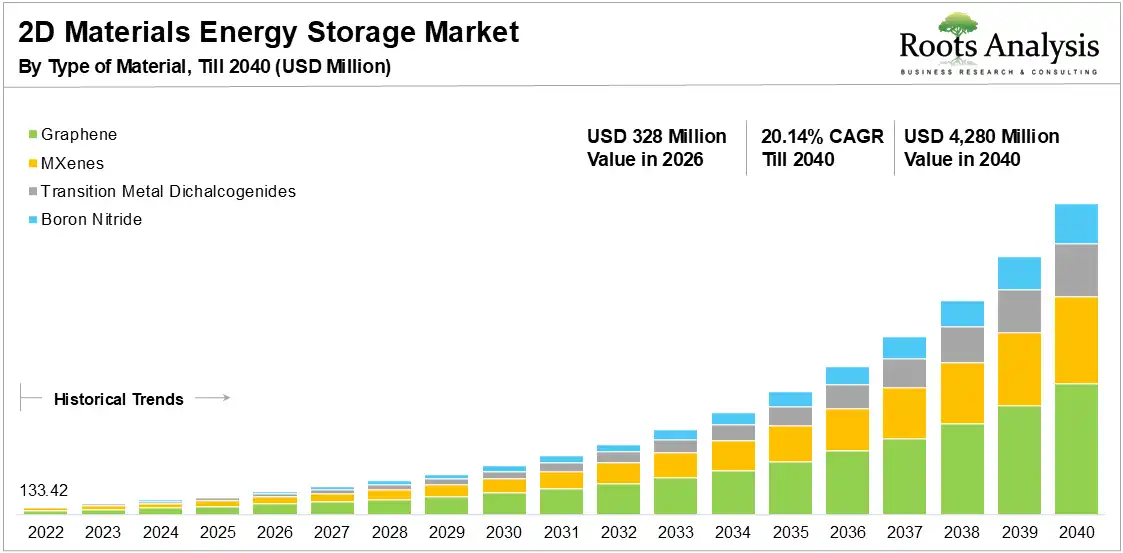
The global 2D materials energy storage market is projected to reach USD 328 million in 2026 and USD 4,280 million by 2040, representing a CAGR of 20.14% during the forecast period 2026 to 2040.
See What’s in the Full Report – Request Your Complimentary Insights!
Market Overview
The 2D materials for energy storage refer to atomically thin materials such as graphene, MXenes, and transition metal dichalcogenides, packed within advanced energy storage systems. The scope spans their deployment as electrode materials, conductive additives, or structural supports to improve capacity, charging rates, and cycle durability. Market value is created by elevating the performance of lithium-ion batteries, solid-state batteries, and supercapacitors used in environments where high power density and mechanical stability are essential.
2D materials for batteries market growth is propelled by the need for higher energy density and faster charging across electric vehicles and advanced consumer electronics. Automotive and grid storage operators increasingly seek materials that tolerate rapid charge and discharge while extending service life, reinforcing adoption drivers for 2D materials. Current momentum is evident in recent announcements of new pilot lines for advanced supercapacitors utilizing MXene electrodes, signalling progress toward scalable manufacturing tailored to high power density use cases and reinforcing near-term commercialization signals across the energy storage value chain.
Market innovation is increasingly focused on scalable, cost-efficient synthesis of graphene and MXenes, alongside resolving integration issues within battery production lines to secure long-term stability. The industry outlook shows a transition from laboratory research toward commercial execution in high performance areas, including solid state battery anodes. The future growth evidence includes several companies announcing plans for commercial pilot facilities in the next 18 months, pointing to scalable deployment in industrial supercapacitors and high-performance anodes.
Market Report: Key Takeaways
- Leading Players in the Market: Key players including Talga Group, Graphene Manufacturing Group, Skeleton Technologies, and Applied Graphene Materials are undertaking strategic initiatives, such as material innovations and strategic partnerships to strengthen their market position.
- Startup Initiatives: Startup company Group14 Technologies secured USD 463 million in a funding round led by SK and existing investors, such as Porsche Investments, OMERS, ATL, Decarbonization Partners, Lightrock Climate Impact Fund, Microsoft Climate Innovation Fund, and others. The funds will be utilized for continuous manufacturing scale-up of Group14 makes silicon batteries material, SCC55, in the US and South Korea.
- Fundings and Investments: The global 2D materials energy storage industry analysis highlighted that the industry is backed by robust funds and investments by industrial players. In May 2025, VFlowTech successfully raised USD 20.5 million in its latest funding round to scale long-duration energy storage and strengthen AI-driven energy management. They are integrating advanced 2D materials into vanadium flow batteries to enhance the efficiency of long-duration energy storage.
- Major Market Pulls: The global 2D materials energy storage market attracts distinct buyers due to emerging drivers with different values. Some of the significant drivers include flexible electronics energy storage solutions, advanced materials for next-generation batteries, carbon-based nanomaterials for energy storage, R&D pipeline for 2D materials in battery technology.
- Future Market Opportunities & Trends: Advancements in supercapacitors and high-power applications, such as regenerative braking systems in EVs, uninterruptible power supplies, and high-speed rails as well as market penetration in flexible and wearable electronics are opening a gateway for investments and partnerships.
Recent Industry Developments
- In November 2025, a team of scientists predicted 2D topological telluride materials that could boost the performance and stability of future lithium-ion and sodium-ion batteries. This study combines cutting-edge theoretical modeling with global collaboration and led by the team of researchers at Tianjin University in China.
- In September 2025, Australian researchers identified new graphene oxide super-material, allowing supercapacitors to store as much energy as lead-acid batteries store.
- In July 2025, the EU invested more than €40 million in the area of graphene and other 2-dimensional materials. This investment will accelerate technological development and support the emergence of robust European supply chains in energy storage, 2D material-based composites, 2D materials-based devices, sensors and systems.
Get an Instant Quote in 10 Minutes. Lowest Price Guaranteed
Market Dynamics
Key Market Drivers
- Demand for Ultra-Fast Charging and High-Power Density: Intensifying expectations for rapid charging across electric vehicles and consumer electronics are reshaping material requirements at the electrode level. This push elevates the importance of 2D materials, including MXenes and graphene variants that enhance interfacial kinetics, deliver high surface area and superior electrical conductivity, enabling faster ion diffusion and electron transport.
- Enabling Next-Generation Anode Architectures (Silicon Integration): Conventional lithium-ion batteries built on graphite anodes are approaching their theoretical performance, driving industry-wide exploration of higher-capacity silicon anodes. However, silicon expands significantly during charging, leading to mechanical failure. To solve this, 2D materials are used as a structural buffer to stabilize the anode and extend battery life, thereby driving market growth.
- Supply Chain Diversification and Material Independence: Reliance on geographically concentrated graphite supplies exposes battery manufacturers to pricing volatility and geopolitical risk. 2D materials, including graphene, MoS², and MXenes offer credible alternatives to traditional carbon inputs. Their adoption supports broader material diversification, enables customized formulations, and reduces dependence on constrained raw material channels, strengthening long-term supply chain resilience.
Market Restraints
- High Cost of Production and Lack of Economies of Scale: Production costs for 2D materials remain significantly higher than those of established battery-grade graphite and conventional carbon additives. While scalable methods such as liquid-phase exfoliation show potential, consistently manufacturing high-purity, low-defect materials at gigafactory volumes continues to be cost-prohibitive for price-sensitive applications such as electric vehicles and grid-scale storage.
- Lack of Standardization and Quality Variance: The absence of widely accepted standards for grading, specification, and quality control creates uncertainty across the supply base. Variability in key parameters, such as layer count, morphology, and purity may complicates the integration for Tier 1 battery manufacturers. This inconsistency increases qualification burdens, elevates supply chain risk, and slows adoption timelines.
- Integration Challenges within Existing Manufacturing Processes: Incorporating 2D materials into established slurry-based electrode manufacturing presents technical hurdles. Preserving dispersion, preventing agglomeration, and avoiding restacking during mixing, coating, and calendaring are difficult to control at scale. When these challenges are not addressed, the materials’ intrinsic advantages can be diluted in the final electrode architecture.
Market Share Insights
Regional Forecast: North America Holds the Largest Share in the 2D Materials Industry
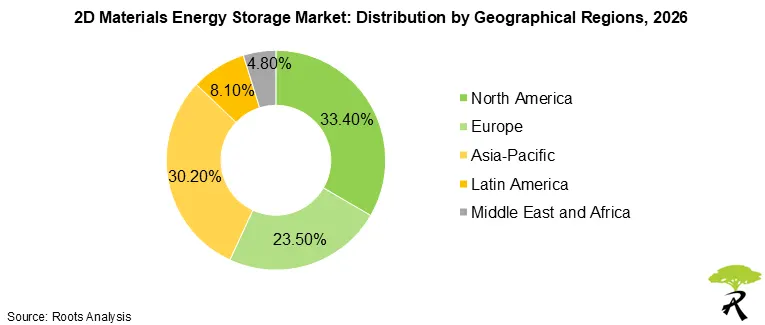
Based on the 2D materials energy storage market forecast, North America currently dominates the market with a share of 33.40%. North America is home to the world’s leading 2D material research hubs (Penn State's 2D Crystal Consortium and UT Austin) and leading players, such as NanoXplore and Global Graphene Group. Buyers are gaining confidence as these companies move from "lab-scale" to "ton-scale" production, lowering the cost per kilogram and making integration commercially viable for the first time. Some other notable reasons for the highest share have been outlined below:
- Federal Policy & The "IRA Effect": The Inflation Reduction Act (IRA) of 2022 is the single largest catalyst of the 2D materials energy storage market in this region. It offers massive tax credits for standalone energy storage and, crucially, provides "bonuses" for localized supply chains. With the implementation of this effect, the procurement officers are incentivized to move away from Chinese-processed graphite to the advanced graphene. North American are producing 2D alternatives to qualify for these credits.
- Solving the "Range & Charge" Anxiety: In the North American automotive market, graphene and MXenes have been adopted on a large scale due to its exceptional electrical conductivity and surface area. By integrating them into battery anodes / cathodes, manufacturers can enable "extreme fast charging" (XFC), potentially charging an EV to 80% in under 10 minutes.
Graphene Holds the Highest Share of 2D Materials Energy Storage Market
- The global 2D materials energy storage market report indicates that graphene holds the largest share of the market. This highest share reflects its advanced level of commercialization, superior electrical conductivity, and established use in battery electrodes and supercapacitors across energy storage value chains. Its early integration into lithium-ion batteries and broad patent and revenue exposure continues to position graphene as the dominant material choice.
- It is worth mentioning that MXenes are anticipated to grow at a faster pace (CAGR of 28.0%) during the forecast period till 2040. This lucrative growth is driven by the rising energy storage investments, reported 25-34% growth trajectories, and accelerating partnerships aimed at electric vehicles and next-generation supercapacitor deployment are likely to drive the market growth in the coming years.
Want Information on Specific Region / Segment?
Key Market Insights
Competitive Landscape of 2D Materials for Energy Storage Sector
As of early 2026, the competitive landscape for 2D materials in energy storage has evolved significantly from a graphene-only focus into a diverse ecosystem of high-performance materials. The key players in 2D material production for energy storage are leveraging technological innovations to develop high-performance 2D materials that can solve the "energy-power trade-off", combining the high energy of batteries with the rapid charging of supercapacitors. Some of the key initiatives from the top players have been outlined below:
- Nanoramic Laboratories: In 2025, Nanoramic Laboratories shifted focus toward scaling its Neocarbonix® technology, which uses 2D nanocarbons to eliminate the requirement for traditional binders, such as PVDF. Moreover, in November 2025, Nanoramic Laboratories secured USD 54 million in Series 1 funding round to bring Neocarbonic® technology to mass production by 2027.
- Haydale Graphene: The company focuses on energy storage using 2D materials to manage the intense heat generated by high-power devices. In October, the company partnered with Hydratech to commercialize the graphene-enhanced heat-transfer fluids. These fluids are essential for cooling next-generation EV power devices and data centers. Moreover, in December 2025, the company has also acquired SaveMoneyCutCarbon to create a direct B2B sales engine for their graphene-enabled energy efficiency products, such as JustHeat™ system.
- RIC2D & Drexel University: The company has launched an international partnership between the Research & Innovation Center for Graphene and 2D Materials in the UAE and Drexel University. This three-year USD 5 million multinational collaboration aims for industrial-scale production of MXene nanomaterials by 2028.
How 2D Materials Market Will Evolve in Europe and Asia-Pacific Regions?
- Europe is anticipated to be the fastest-growing region, driven by its aggressive environmental mandates and the "Graphene Flagship" community. Moreover, the opening of the Leipzig SuperFactory (€220 million investment) by Skeleton Technologies is the single most important industrial event of 2025. It creates a facility capable of producing 12 million cells per year, resolving long-standing supply constraints for European grid operators.
- Asia-Pacific leads in adoption of these 2D materials, particularly in the consumer electronics and mid-range EV sectors. China is a powerhouse in the TMD market due to its vast semiconductor manufacturing base. The government's "Made in China 2025" initiative continues to promote the domestic development of 2D semiconductors for battery management systems.
2D Materials Energy Storage Market Trends and Outlook
- Advanced Supercapacitors and High-Power Applications: Certain 2D materials, such as MXenes and tailored graphene structures, offer a pathway to combine high power delivery with improved energy storage characteristics. This positions them well for applications where rapid charge-discharge and long cycle life are critical, including regenerative braking systems, high-speed rail, and uninterruptible power supplies, where performance takes precedence over cost sensitivity.
- Market Penetration in Flexible and Wearable Electronics: The mechanical flexibility and ultra-thin form factor of 2D materials align closely with the needs of wearable devices and flexible electronics. These markets face inherent limitations with rigid battery designs. Integrating 2D materials enables flexible energy storage components that accommodate complex geometries while maintaining performance and safety standards.
- Solid-State Battery Architectures: 2D materials are emerging as strategic enablers in solid-state battery development. Their use as interfacial layers or flexible solid electrolytes can reduce interfacial resistance and improve contact between electrodes and solid electrolytes. Addressing these interface challenges directly targets one of the most persistent barriers to solid-state battery commercialization.
Have Questions? Let's Get Them Answered
2D Materials Energy Storage Market: Scope of the Report
| Key Report Attributes | Details | |
| Historical Trend | Since 2022 | |
| Forecast Period | Till 2040 | |
| Market Size 2026 | $ 328 Million | |
| Market Size 2040 | $ 4,280 Million | |
| CAGR (Till 2040) | 20.14% | |
| Segments Covered |
|
|
Market Segmentation
Based on the research, we have segmented the 2D materials energy storage market into type of material, type of battery, type of production method, application area, end use, geographical regions, and leading players.
Market Share by Type of Material
- Graphene
- MXenes
- Transition Metal Dichalcogenides (TMDs)
- Boron Nitride (h-BN)
Market Share by Type of Production Method
- Chemical Vapor Deposition (CVD)
- Mechanical Exfoliation
- Solution-Based Methods
Market Share by Application Area
- Batteries
- Supercapacitors
- Fuel Cells
Market Share by Type of Battery
- Lithium-Ion Batteries
- Solid-State Batteries
- Sodium-Ion Batteries
Market Share by End Use
- Consumer Electronics
- Automotive
- Industrial
- Aerospace & Defense
- Healthcare
- Others
Market Share by Geographical Regions
- North America
- US
- Canada
- Mexico
- Rest of North America
- Europe
- Austria
- Belgium
- Denmark
- France
- Germany
- Ireland
- Italy
- Netherlands
- Norway
- Russia
- Spain
- Sweden
- Switzerland
- UK
- Rest of Europe
- Asia-Pacific
- Australia
- China
- India
- Japan
- New Zealand
- Singapore
- South Korea
- Rest of Asia-Pacific
- Latin America
- Brazil
- Chile
- Colombia
- Venezuela
- Rest of Latin America
- Middle East and Africa (MEA)
- Egypt
- Iran
- Iraq
- Israel
- Kuwait
- Saudi Arabia
- UAE
- Rest of MEA


