
Lowest Price Guaranteed
Slides
206
Last Updated
August 2026
View Count
11320
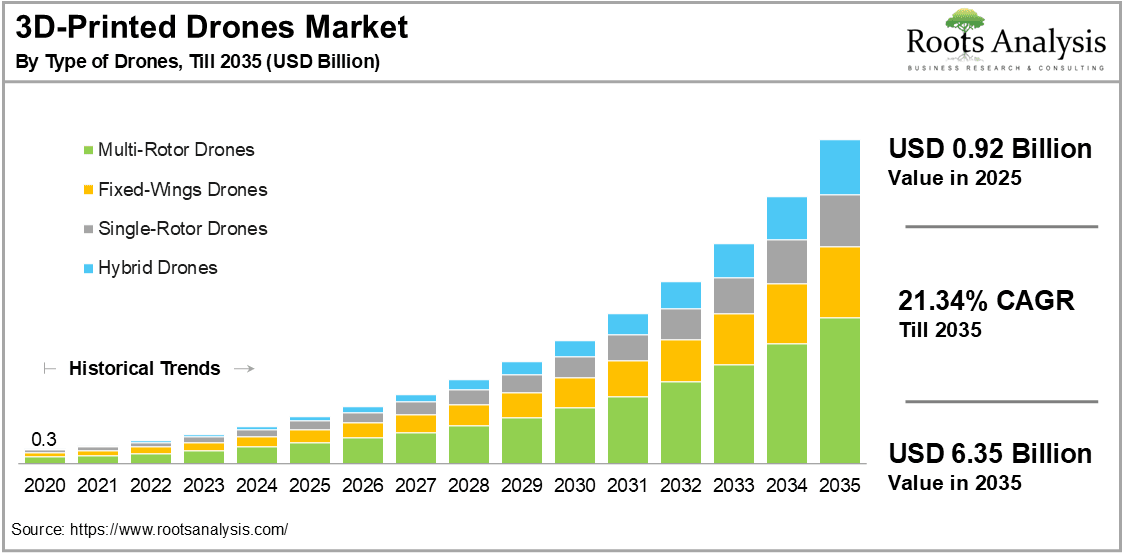
The 3D printed drones market size is projected to grow from USD 0.92 billion in 2025 to USD 6.35 billion by 2035, representing a CAGR of 21.34% during the forecast period till 2035.
 |
The new research study consists of 3D printed drones market and trends analysis, detailed market forecast analysis, and provide actionable strategic recommendations.
3D printing technology is reshaping the drone manufacturing market. 3D printed drones are unmanned aerial vehicles (UAVs) that are manufactured by using 3D printing technology which is also known as additive manufacturing. This innovative technology has transformed the UAV manufacturing industry and allowed the creation of drone components or entire drone frames by layering materials, such as plastics, composites, or metal based on digital 3D models. Its benefits in customization, rapid drone prototyping, lightweight, complex geometries, and efficiency, drive the market demand.
Driven by this, the 3D printed drone market is projected to grow exponentially during this forecast period due to several key factors, such as continuous technological advancements in 3D printing, and soaring demand for lightweight and high-performance drones. Beyond the military & defense, the leading application in terms of revenue, 3D printed drones are gaining substantial demand across various applications. In this context, innovation in drone applications such as urban air mobility and swarm technology are accelerating the additive manufacturing drones market scope.
As a consequence, aerospace & defense companies and drone manufacturers coupled with emerging startups are investing in the industry and striving to capitalize on the growing adoption of the technology. For instance, in March 2024, Firestorm Labs secured $12.5 million in seed funding led by Lockheed Martin Ventures and prominent defense investors. This investment would allow the company’s drone manufacturing to leverage 3D printed and modular airframe technology. In this connection, the CEO of Firestorm, Dan Magy stated that Firestorm is thrilled to secure this round of funding which would accelerate its growth, advancing UAS battlefield needs and revolutionizing defense manufacturing.
Moreover, despite these key drivers, the market may face some challenges such as material limitations and the high cost of products that can lead to impediments to the overall growth of the market which needs to be addressed to overcome these challenges in order to retain a sustainable growth rate during the projection period.
The 3D printed drones market report presents an in-depth analysis of the various companies that are involved in offering 3D printed drones, across different segments, as defined in the table below:
| Key Report Attributes | Details | |
| Historical Trend | Since 2020 | |
| Forecast Period | Till 2035 | |
| Current Market Size | $ 0.92 Billion | |
| Market Size Value by 2035 | $ 6.35 Billion | |
| CAGR (Till 2035) | 21.34% | |
| Type of Component |
|
|
| Type of Drones |
|
|
| Type of Technology |
|
|
| Type of Application |
|
|
| Geographical Regions |
|
|
| Leading Market Players |
|
|
| PowerPoint Presentation (Complimentary) |
Available | |
| Customization Scope | 15% Free Customization | |
| Excel Data Packs (Complimentary) |
|
|
The global 3D printed drones market features various components including airframe, landing gears, mount & holders, propellers, wings, and others. According to the 3D printed drone component market analysis, the airframe has been leading the segment and is projected to hold (~47%) share of the market by 2035. The airframe is the physical structure of the drone, which houses all other components and determines the drone’s shape, size, weight, and drone’s performance, thereby spurring the market demand.
Furthermore, the wings components are gaining substantial growth and are likely to foster the market demand at an outstanding (23.19%) CAGR over this forecast period. The key factor of the segment’s growth is the significance of the wings in providing lift and enabling fixed-wing drones to glide and fly efficiently without constant power from motors.
Based on the type of drones, the market is segmented into fixed-wing drones, hybrid drones, multi-rotor drones, and single-rotor drones. As per 3D printed UAV market research, multi-rotor drone is the leading segment and is expected to occupy (~43%) of the market share by 2035. Multi-rotor drones are the popular and widely used type of drones across industries. They are categorized by their multiple rotors (4,6, or 8) and ability to hover, maneuver, and take off/land vertically.
Furthermore, the fixed-wing drone segment is growing at a rapid pace and is likely to register (24.67%) CAGR in the upcoming years owing to its innovative features such as resembling airplanes, with single rigid wings. These drones offer longer flight times and greater range compared to multi-rotor drones along with higher speed and efficiency for covering large areas.
Based on the type of technology, the fused deposition modeling technology dominates the segment and is poised to capture (~44%) of the current market share. This dominance will likely continue owing to its cost-effectiveness, material versatility, and ease of use. It also allows rapid prototyping scalable production and creation of strong components. Moreover, stereolithography is gaining higher demand driven by its superior precision and material properties. As a result, the stereolithography segment is anticipated to grow at a higher CAGR of (25.32%) during this projection period.
The 3D printed drones market is distributed into various applications wherein military & defense application holds a leading position and escalates the market growth with the acquisition of (~47%) of the current market share. This can be ascribed to the elevating demand for drones to fulfill the need for surveillance, reconnaissance, and tactical operations. Besides this, commercial applications are fueling the demand for 3D printed drones significantly for agriculture, logistics, and inspection use. Therefore, the commercial application segment is projected to expand at a faster(24.71%) growth rate over this forecast period.
This segment highlights the distribution of the 3D printed drones market across various geographical regions, such as North America, Europe, Asia, Latin America, the Middle East and North Africa, and the rest of the world. With regard to 3D printed drone component market, North America is projected to acquire (~49%) of the market and will lead the segment till 2035.
Besides, the market in Asia is expanding rapidly and is expected to grow at an excellent (26.11%) CAGR throughout this projection period. With expanding economies in China, India, Japan, and South Korea are heavily investing in advanced technologies and boosting their manufacturing industries. Being a global manufacturing powerhouse, these countries in the region are embracing 3D printing technology for drone innovation to enhance production efficiency and reduce costs. Moreover, Governments are supporting technological advancements and investing in R&D for the development of 3D printing technology. Private firms are forming partnerships with global companies to augment innovation in unmanned aerial vehicles. For instance, in July 2024, Taiwan collaborated with the US aerospace firm RapidFlight to explore 3D printing for fast UAV production, aiming to reinforce drone manufacturing amid rising threats from China.
The “3D Printed Drones Market, Till-2035: Industry Trends and Global Forecasts” report features an extensive study of the current market landscape, market size and future opportunities within the 3D printed drones market, during the given forecast period. The market report highlights the efforts of several stakeholders involved in this rapidly emerging segment of the service providers industry. Key takeaways of the 3D printed drones market report are briefly discussed below.
Technological advancements in 3D printing are one of the primary key drivers to propel the 3D printed drone manufacturing market growth. Innovation in 3D printing techniques such as FDM, SLS, and others enable the production of high-precision, complex, and lightweight drone designs and components. It also allows the development of advanced materials similar to carbon fiber, or titanium that provide enhanced performance and durability in these drones.
Further, the increasing demand across various industries is also uplifting the market growth. Not only in military & defense, but these drones are also gaining extensive demand from commercial applications and consumer markets for delivery services and recreational activities. Moreover, growing government support & funding along with a rise in the adoption of autonomous and AI-powered drones are also attributed to maximizing the potential growth of the market in the near future.
The competitive landscape of the market is fragmented into established aerospace and defense companies, drone manufacturers, 3D printing companies, and innovative startups. Leading key players in the market including Lockheed Martin, Boeing, BAE Systems and others are stimulating market development through technological innovation, strategic partnership, and high investment in R&D for production differentiation. Meanwhile, drone manufacturers such as Parrot Drones, AeroVironment, Skydio, and Draganfly are striving to stay ahead in the 3D printing for drone manufacturing market competition by focusing on industry-specific products.
Material limitations and high costs are one of the key challenges in the 3D printed drone market. 3D printing requires specialized high-performance materials to meet strength, and durability, along with lightweight. Also, the cost of advanced 3d printing equipment and materials can prohibit SMEs or budget-constrained organizations. As a result, the limited availability of advanced materials that offer heat-resistant metals, better strength composites, and high cost can restrict design possibilities and mass drone production which may directly obstruct the market growth.
North America has been leading the market for 3D printed drones and is projected to capture the highest (~49%) share by the forecast period. The strong defense and military spending of the US is the major factor of the region’s dominance. Significantly, key players such as Lockheed Martin, Northrop Grumman, General Atomic, and others based in North America are industry leaders in military drone technology which drives market growth.
Apart from the military, commercial and industrial sectors are also increasingly adopting 3D printed drones for their ability to provide customized, lightweight, and cost-effective solutions for industries. Additionally, the high investment in R&D for both aerospace 3D printing and drone technologies has led to breakthroughs in drone materials, manufacturing processes, and drone capabilities that give a competitive edge in the global marketplace.
Examples of key players involved in the market for 3D printed drones (which have also been captured in this market report, arranged in alphabetical order) include AeroVironment (US), Airbus (Netherlands), BAE Systems (UK), Boeing (US), Draganfly Innovation (Canada), Dronamics Global (Bulgaria), Firestorm Labs (US), Flyability (Switzerland), General Atomics (US), Kratos Defense & Security Solutions (US), Lockheed Martin Corporation (US), Northrop Grumman Systems (US), Parrot Drones (France), Skydio (US), and Thales (France). This market report includes an easily searchable excel database of all the companies who have adopted the 3D printed drone market.
The market report presents an in-depth analysis, highlighting the capabilities of various companies engaged in this domain, across different segments. Amongst other elements, the market report includes:
At Roots Analysis, we genuinely care about your success and understand that your business requirements are unique. While our market research reports provide valuable insights, we recognize that they might not cover every aspect you need to make well-informed strategic decisions. To account for that, we offer 15% free report customization tailored to your specific needs. Whether you require additional quantitative analysis, qualitative insights, or any other information related to the 3D printed drone market, reach out us today at: support@rootsanalysis.com