Acoustic Electric Vehicle Alerting Systems Market Overview
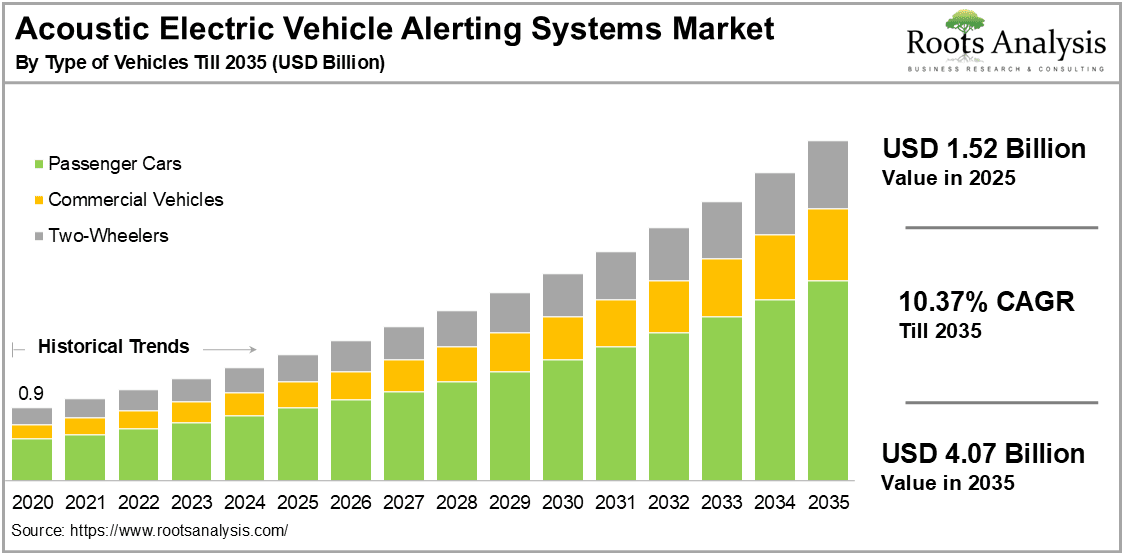
The global acoustic electric vehicle alerting systems market, valued at USD 1.4 billion in 2024, is projected to reach USD 1.52 billion in 2025 and USD 4.07 billion by 2035, representing a CAGR of 10.37% during the forecast period.
The new research study consists of global acoustic electric vehicle alerting systems analysis, mega trends, patent analysis, porter five forces, SWOT analysis, value chain analysis and other strategic frameworks.
The acoustic electric vehicle alerting system (AEVAS) is an important safety feature designed to make electric vehicles more noticeable to pedestrians. Since electric vehicles are so quiet, especially at low speeds, AEVAS generates sounds similar to those of conventional internal combustion engine (ICE) vehicles. It operates when the vehicle is moving forward at speeds up to 30 kilometers per hour and reversing at up to 6 kilometers per hour, ensuring that pedestrians and other vulnerable road users can detect the presence of electric vehicles nearby. This system is particularly useful in busy urban areas, where the quiet nature of EVs might otherwise be difficult to detect.
What’s driving the growth of the AEVAS market is the increasing popularity of electric and hybrid vehicles. The quiet operating feature of these vehicles, while great at reducing noise pollution, can create a potential hazard for pedestrians, especially the visually impaired. To address this safety concern, governments around the world are introducing regulations that now require electric and hybrid vehicles to be equipped with AEVAS. Furthermore, these systems don’t just improve safety; they also enhance the driving experience by managing outside noise and refining the interior's environment of the vehicle.
In reference to this, the lead sound designer and creative sound director of General Motors, Jay Kapadia stated that with advancements in EV technology, the need for diverse sounds has magnified, especially considering the near silence of EV operation. This poses a challenge for pedestrian safety, leading to the development of Acoustic Vehicle Alert Systems (AVAS) that produce sounds proportional to the vehicle’s speed to help alert pedestrians.
Acoustic Electric Vehicle Alerting Systems Market Share Insights
The acoustic electric vehicle alerting systems market report presents an in-depth analysis of the various companies that are involved in offering acoustic electric vehicle alerting systems services, across different segments, as defined in the table below:
Acoustic Electric Vehicle Alerting Systems Market: Report Attributes / Market Segmentations
| Key Report Attributes |
Details |
| Historical Trend |
Since 2020 |
| Forecast Period |
Till 2035 |
| Current Market Size |
$ 1.52 Billion |
| Market Size 2035 |
$ 4.07 Billion |
| CAGR till 2035 |
10.37% |
| Type of Vehicle |
- Commercial Vehicles
- Passenger Cars
- Two-Wheelers
|
| Type of Propulsion |
- Battery Electric Vehicles (BEV)
- Hybrid Electric Vehicles (HEV)
- Plug-in Hybrid Electric Vehicles (PHEV)
|
| Type of Mounting Position |
|
| Type of Component |
- Control Unit
- Sensor
- Speaker
|
| By Sales Channels |
- Aftermarket
- Original Equipment Manufacturer (OEM)
|
| Type of Technology |
- Actual Sound System
- Synthesized Sound System
|
| Type of Enterprise |
- Large Enterprises
- Small and Medium Enterprises
|
| Geographical Regions |
- North America
- US
- Canada
- Mexico
- Other North American countries
- Europe
- Austria
- Belgium
- Denmark
- France
- Germany
- Ireland
- Italy
- Netherlands
- Norway
- Russia
- Spain
- Sweden
- Switzerland
- UK
- Other European countries
- Asia
- China
- India
- Japan
- Singapore
- South Korea
- Other Asian countries
- Latin America
- Brazil
- Chile
- Colombia
- Venezuela
- Other Latin American countries
- Middle East and North Africa
- Egypt
- Iran
- Iraq
- Israel
- Kuwait
- Saudi Arabia
- UAE
- Other MENA countries
- Rest of the World
- Australia
- New Zealand
- Other countries
|
| Leading Market Players |
|
| PowerPoint Presentation (Complimentary) |
Available |
| Customization Scope |
15% Free Customization |
| Excel Data Packs (Complimentary) |
- Competitive Landscape
- Company Competitive Analysis
- Patent Analysis
- Funding Analysis
- Recent Developments
|
Acoustic Electric Vehicle Alerting Systems Market Segmentation
Which Type of Vehicle Will Dominate the AEVAS Market?
When it comes to the global acoustic electric vehicle alerting systems market, the passenger cars segment is set to take the lead, holding a significant market share of over 54.56% for the next decade. This market growth is largely a result of improved battery technology, expanding charging infrastructure, and stricter emission regulations. Additionally, with more government incentives and a wider variety of electric models available, it’s a given that passenger cars are bound to be excelling in this segment.
Which Type of Propulsion will Witness the Fastest Growth Rate?
When it comes to the acoustic electric vehicle alerting systems market analysis, the battery electric vehicles (BEV) segment is expected to grow the fastest with a projected CAGR of 11.8% during the forecast period. Here’s why: BEVs are generally more affordable compared to HEVs, and PHEVs, which is a big reason automakers are heavily investing in the production of BEVs. In addition to this, BEVs are also environmentally friendly as they produce zero tailpipe emissions, making them a personal favorite for eco-conscious customers, further fueling market growth.
Which Type of Mounting Position is Most Popular?
The market is segmented into various types of mounting position, such as integrated and separated. According to our analysis, the integrated segment is clearly the most popular choice. It’s expected to boost the market share of acoustic electric vehicle alerting systems by an impressive 84.6% during the forecast period. What exactly makes them appealing is the fact that integrated AEVAS are designed as a part of the vehicle’s existing infrastructure, seamlessly embedded during manufacturing. This makes the AEVAS more streamlined which means that they can utilize the vehicle’s current components including speakers and control units. It also tends to be more efficient in terms of space utilization and system coordination.
How is the Speaker Segment Dominating Types of Components?
When we look at the components of acoustic electric vehicle alerting systems market, its segmented into control unit, sensor, and speaker. Among these, the speaker segment really stands out as the dominant player. In fact, it’s expected to increase the market share of acoustic electric vehicle alerting systems by 64.62% during the forecast period. Here’s how; the speaker is the core component responsible for producing the artificial sounds that alerts pedestrians and other road users. Furthermore, as the market for electric vehicles continues to grow, thanks to increasing sales and stricter regulatory requirements, the demand for speakers in AEVAS is expected to remain strong, solidifying their position as the leading segment.
Why is the OEM Segment Gaining Traction in Type of Sales Channel Segment?
The acoustic electric vehicle alerting systems market by sales channel is segmented into aftermarket, and original equipment manufacturer (OEM), where the OEM segment is gaining the highest traction. According to our analysis, this segment will increase the market share of acoustic electric vehicle alerting systems by 44.67% during the forecast period. A big part of this growth is largely due to stringent government regulations that strictly require the installation of acoustic vehicle alerting systems in new electric and hybrid vehicles to enhance pedestrian safety. As these systems become standard features in vehicles, manufacturers are increasingly focused on integrating advanced acoustic technologies into their designs, leading to a significant demand for OEM solutions.
Why is Asia Leading the AEVAS Market?
According to our regional analysis, the Asia acoustic electric vehicle alerting systems market currently exhibits dominance with 37.69% of overall market share. This is mainly because the region’s automobile industry is growing rapidly. As incomes rise and more people can afford cars, countries like China, India and Indonesia are seeing a big jump in car sales. With more vehicles on the road, there’s a greater need for AEVAS to protect pedestrians. In addition to the booming automobile market, governments in Asia are introducing stricter rules which require electric and hybrid vehicles to have AVEAS to make roads safer for everyone.
Acoustic Electric Vehicle Alerting Systems Market Key Insights
The “Acoustic Electric Vehicle Alerting Systems Market, Till-2035: Industry Trends and Global Forecasts” report features an extensive study of the current market landscape, market size and future opportunity within the acoustic electric vehicle alerting systems market forecast period. The market report highlights the efforts of several stakeholders involved in this rapidly emerging segment of the service providers industry. Key takeaways of the market report are briefly discussed below.
Market Drivers and Trends
How are Government Regulations Along with Pedestrian Safety Driving AEVAS Adoption?
Government regulations are playing a crucial role in driving the AEVAS adoptions. Policymakers around the world are mandating these systems to address the risks associated with near-silent electric vehicles (EVs). For instance, the European Union requires all new EVs to include AEVAS since 2019, while countries like the U.S., Japan, and China are following suit to protect pedestrians, particularly the visually impaired. These regulations are compelling automakers to integrate AEVAS into new vehicles, which in turn is making the OEM segment dominant due to compliance requirements.
Concurrently, pedestrian safety measures are central to market growth, as EVs’ quiet operation at low speeds (below 30 km/h) increases collision risks in urban areas with high foot traffic. This has led to an increased demand for systems that can emit standardized or customizable sounds, not just ensuring that the pedestrians are aware of the approaching vehicle but also considering noise pollution concerns. In regions like Asia, rapid EV adoption-driven by government incentives like subsidies-is also amplifying the need for AEVAS, further linking regulatory frameworks and safety priorities to market expansion.
What Strategies are Companies Using to Gain AEVAS Market Share?
Companies in the AEVAS market are using smart strategies to stay ahead. Big players are focusing on partnerships, acquisitions, joint ventures, and innovations to strengthen their position while also investing in R&D to bring innovative and novel products to the market. Launching new technologies and expanding into regions where electric vehicle adoption is growing are key moves helping them capture more market share.
What Are the Technical Challenges in AEVAS Implementation?
The acoustic electric vehicle alerting systems (AEVAS) market faces several technical challenges that can hinder its development and implementation. One major challenge is dealing with diverse global regulations. Each region has its own rules about sound frequencies and levels that must be emitted by these systems, which makes it tricky for manufacturers to design a product that works everywhere.
Another challenge is finding the right balance between safety and noise pollution. AEVAS needs to be loud enough to alert pedestrians but not too noisy that it disturbs both pedestrians and the surrounding environment. This requires innovative approaches, such as advanced speaker placement, beamforming techniques, and adaptive sound generation systems to direct sounds appropriately without causing unnecessary auditory disruption.
Who Are the Key Players in the AEVAS Market?
Examples of leading acoustic electric vehicle alerting systems manufacturers (which have also been captured in this market report, arranged in alphabetical order) include Brigade Electronics Group, Continental Engineering Services, DENSO ELECTRONICS, Harman, HELLA, Kendrion, Mercedes-Benz, Microchip Technology, STMicroelectronics, Thor.
Recent Developments in Acoustic Electric Vehicle Alerting Systems Market
- In March 2025, Toyota Innova Hycross got a new safety feature for pedestrian safety including a suite of ADAS features.
- In July 2024, Brose developed acoustic warning system for electric vehicles, which generates artificial driving noise at speeds below 50kmph.
- In January 2024, LAPIS Technology developed the industry’s first speech synthesis ICs- ML22120xx series (ML22120TB, ML22120GP) that is designed for AVAS in xEVs.
Glossary of Acoustic Vehicle Alerting System Market
- Acoustic Vehicle Alerting System (AVAS): A safety feature in electric and hybrid vehicles that produces artificial sounds to alert pedestrians and other road users of the vehicle's presence, especially at low speeds.
- Battery Electric Vehicle (BEV): A type of electric vehicle that is powered entirely by electricity stored in batteries, with no internal combustion engine.
- Electric Vehicle (EV): A broad category of vehicles that are fully or partially powered by electricity. This includes various types of electric cars, such as battery electric vehicles (BEVs) and hybrid electric vehicles (HEVs).
- Hybrid Electric Vehicle (HEV): A vehicle that combines a conventional internal combustion engine with an electric propulsion system, allowing it to operate on both gasoline and electricity.
- Internal Combustion Engine (ICE): The traditional engine type found in most non-electric vehicles, which generates power by burning fuel, such as gasoline or diesel. ICEs are characterized by their reliance on fossil fuels for operation.
- Plug-in Hybrid Electric Vehicle (PHEV): A hybrid vehicle that can be recharged from an external power source and typically has a larger battery than standard hybrids, allowing for extended electric-only driving ranges.
- Pedestrian Safety: Measures and practices aimed at protecting pedestrians from accidents involving vehicles, particularly in urban environments where foot traffic is high.
- Regulatory Compliance: The adherence to laws and regulations set by government bodies that govern vehicle safety standards, including the mandatory installation of AEVAS in electric vehicles.
Acoustic Electric Vehicle Alerting Systems Market Report Coverage
The market report presents an in-depth analysis, highlighting the capabilities of various companies engaged in this domain, across different segments. Amongst other elements, the market report includes:
- A preface providing an introduction to the full report, acoustic electric vehicle alerting systems market, 2020-2024 (Historical Trends) and 2025-2035 (Forecasted Estimates).
- An outline of the systematic research methodology adopted to conduct the study on the acoustic electric vehicle alerting systems market, providing insights on the various assumptions, methodologies, and quality control measures employed to ensure the accuracy and reliability of our findings.
- An overview of economic factors that impact the overall acoustic electric vehicle alerting systems market, including historical trends, currency fluctuation, foreign exchange impact, recession, and inflation measurement.
- An executive summary of the insights captured during our research. It offers a high-level view of the current state of the acoustic electric vehicle alerting systems market and its likely evolution in the mid-long term.
- A detailed assessment of the acoustic electric vehicle alerting systems market landscape, based on several relevant parameters, including year of experience, company size, location of headquarters, and ownership structure.
- Elaborate profiles of prominent players engaged in the acoustic electric vehicle alerting systems market, featuring information on their year of establishment, location of headquarters, company size, company mission, company footprint, management team, contact details, financial information, operating business segments, acoustic electric vehicle alerting systems market portfolio, moat analysis, recent developments, and an informed future of acoustic electric vehicle alerting systems.
- A qualitative assessment of the various megatrends ongoing in the acoustic electric vehicle alerting systems market, including rising adoption of electric vehicles, technological advancements, and government regulations and safety standards.
- An analysis highlighting the key unmet needs across acoustic electric vehicle alerting systems market industry, featuring market research on acoustic electric vehicle alerting systems industry insights generated from real-time data on unmet needs as identified from social media posts, recent publications, industry blogs and the views of key opinion leaders expressed on online platforms.
- An in-depth analysis of various patents that have been filed / granted related to acoustic electric vehicle alerting systems market and its components, based on various parameters, such as type of patent, patent publication year, patent age and leading players
- A detailed analysis of recent developments in the acoustic electric vehicle alerting systems market domain, based on relevant parameters such as year of initiative, type of initiative (partnerships and collaborations, expansions, funding and product launches), geographical distribution and most active players (in terms of number of recent developments).
- Key winning strategies framework that helps in analyzing the level of competition within an industry, by tracing the key market activities including partnership, funding, expansion of leading players
- A qualitative analysis, highlighting the five competitive forces prevalent in acoustic electric vehicle alerting systems market industry, including threats for new entrants, bargaining power of suppliers, bargaining power of customers, threats of substitution and rivalry among existing competitors.
- A discussion on affiliated global acoustic electric vehicle alerting systems market trends, key drivers and challenges, under a SWOT framework, which are likely to impact the industry’s evolution, along with a Harvey ball analysis, highlighting the relative effect of each SWOT parameter on the overall acoustic electric vehicle alerting systems market.
- A value chain analysis featuring a discussion on various stakeholders involved in the development of the acoustic electric vehicle alerting systems market, from suppliers to end-users.
- A detailed estimate of the current market size and the potential growth future of acoustic electric vehicle alerting systems market initiatives over the next decade. Based on multiple parameters we have provided an informed estimate on the market evolution during the forecast period 2025-2035. The report also features the likely distribution of the current and forecasted opportunity within the acoustic electric vehicle alerting systems market. Further, in order to account for future uncertainties and to add robustness to our model, we have provided three forecast scenarios, namely conservative, base, and optimistic scenarios, representing different tracks of the industry’s growth.
- Detailed projections of the current and future market across various types of vehicles such as commercial vehicles, passenger cars and two-wheelers.
- Detailed projections of the current and future market across various types of propulsions such as battery electric vehicles (BEV), hybrid electric vehicles (HEV), plug-in hybrid electric vehicles (PHEV).
- Detailed projections of the current and future market across various types of mounting position, such as integrated and separated.
- Detailed projections of the current and future market across various types of components, such as control unit, sensor, and speaker.
- Detailed projections of the current and future market across various types of sales channels, aftermarket, and original equipment manufacturer (OEM).
- Detailed projections of the current and future market across various types of technology, such as actual sound system, and synthesized sound system.
- Detailed projections of the current and future market across various types of enterprises such as large enterprises and small and medium enterprises.
- Detailed projections of the current and future acoustic electric vehicle alerting systems market across various geographical regions, such as North America (US, Canada, Mexico and other North American countries), Europe (Austria, Belgium, Denmark, France, Germany, Ireland, Italy, Netherlands, Norway, Russia, Spain, Sweden, Switzerland, UK and other European countries), Asia (China, India, Japan, Singapore, South Korea and other Asian countries), Middle East and North Africa (Egypt, Iran, Iraq, Israel, Kuwait, Saudi Arabia, UAE and other MENA countries), Latin America (Brazil, Chile, Colombia, Venezuela and other Latin American countries) and rest of the world (Australia, New Zealand and other countries).
Author: Ronit Sharma and Anmol Bali
Customization Opportunities
At Roots Analysis, we genuinely care about your success and understand that your business requirements are unique. While our acoustic electric vehicle alerting systems market research reports provide valuable insights, we recognize that they might not cover every aspect you need to make well-informed strategic decisions. To account for that, we offer 15% free report customization tailored to your specific needs. Whether you require additional quantitative analysis, qualitative insights, or any other information related to the acoustic electric vehicle alerting systems market, reach out us today at: support@rootsanalysis.com
Frequently Asked Questions
What is an acoustic electric vehicle alerting system?
The acoustic electric vehicle alerting system (AEVAS) is a crucial safety device that generates sounds similar to those of conventional internal combustion engine (ICE) vehicles.How big is the acoustic electric vehicle alerting systems market?
In 2025, the acoustic electric vehicle alerting systems market size is estimated to be worth $1.52 billion. How do AEVAS work to enhance pedestrian safety?
By producing a recognizable and pleasant sound, AEVAS helps inform the public of an approaching electric vehicle, such as an all-electric bus, thereby reducing the risk of accidents and improving overall road safety.Why are AEVAS mandatory for electric vehicles?
These systems are crucial because electric vehicles are quieter than their combustion engine counterparts, making it difficult for pedestrians to detect them. To address this safety concern, governments worldwide are mandating the installation of AVAS in electric vehicles, which generate sounds to alert pedestrians of their presence.What is the projected global acoustic electric vehicle alerting systems market growth forecast?
According to acoustic electric vehicle alerting systems market revenue forecast, the market is expected to grow at a compounded annual growth rate (CAGR) of over 10.37% during the forecast till 2035.Who are the market players in the acoustic electric vehicle alerting systems market industry?
Leading players include Brigade Electronics Group, Continental Engineering Services, DENSO ELECTRONICS, Harman, HELLA, Kendrion, Mercedes-Benz, Microchip Technology, STMicroelectronics, Thor.What is the leading region in the acoustic electric vehicle alerting systems market?
Currently, Asia is dominating the acoustic electric vehicle alerting systems market.