
Lowest Price Guaranteed
Slides
167
Last Updated
May 2026
View Count
14447
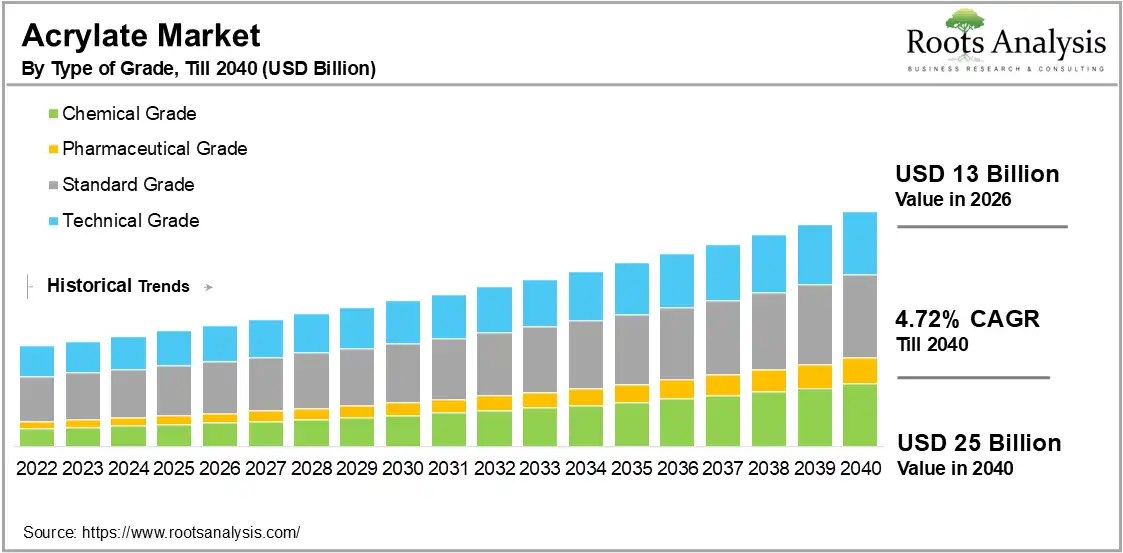
The acrylate market size is projected to grow from $13 billion in 2026 to $25 billion by 2040, representing a CAGR of 4.72% during the forecast period 2026-2040.
 |
To learn more about this report, request a free sample copy
The new research study consists of industry trends, detailed market analysis, key market trends of the acrylate market, SWOT analysis and value chain analysis. The growth of the acrylate market is driven by increasing demand for acrylic monomers, the building blocks of the acrylate family. In other words, acrylates are a part of chemical series that are derived from acrylic acid.
Owing to their unique properties such as durability, resistance, and transparent material, acrylates are largely used in the production of polymers and copolymers. The market has a variety of acrylates which include ethyl acrylates, butyl acrylates, methyl acrylates, and others. Each type of acrylate has an exceptional quality that serves various purposes in different applications. Primarily, these compounds are widely found in adhesives, paints & coatings, and other industrial products.
The global acrylate market growth is driven by increasing demand from construction, automotive and packaging industries that are reshaping the industry landscape. Acrylates are versatile chemical compounds widely used in adhesives, coatings, and polymer production from paints to adhesive and superabsorbent polymers. The market is expected to grow rapidly due to rising demand across multiple industries such as construction, automotive, and consumer goods.
However, growing strict environmental regulations and volatility of raw materials may cause challenges for market expansion in the long term. Hence it compels manufacturers to innovate to retain their competitive edge. To navigate this dynamic trajectory, more and more market players are investing in research and development to create new improved acrylate-based products that cater to the evolving needs of their customers. Overall, emerging industry trends and such driving factors are projected to accelerate the growth of the market throughout the forecast period.
The market report presents an in-depth analysis of the various service providers that are involved in offering acrylate market, across different segments, as defined in the table below:
| Key Report Attributes | Details | |
| Historical Trend | Since 2022 | |
| Base Year | 2025 | |
| Forecast Period | 2026-2040 | |
| Market Size Value in 2026 | $ 13 Billion | |
| Market Size Value by 2040 | $ 25 Billion | |
| Growth Rate | CAGR of 4.72% from 2026 to 2040 | |
| Type of Product |
|
|
| Type of Grade |
|
|
| Type of Application |
|
|
| Type of End User |
|
|
| Geographical Regions |
|
|
| Leading Market Players |
|
|
| PowerPoint Presentation (Complimentary) | Available | |
| Customization Scope | 15% Free Customization | |
| Excel Data Packs (Complimentary) |
|
|
The global market is distributed into different types of products including 2-ethylhexyl acrylate, butyl acrylate, ethyl acrylate, and methyl acrylate. According to our projection, butyl acrylate will uplift the growth of the segment with the majority of the acrylate market share. The common use of butyl acrylate in adhesives and sealants drives the segment growth as these are high in demand in the construction and automotive sectors owing to their robust adhesive properties.
Also, for heat-sealable coating, butyl acrylate is one of the preferable choices, it is highly used for food packaging and in the construction sector to produce sealants and caulks and offers excellent flexibility, durability and better performance. However, the methyl acrylate segment is expected to experience a significant growth rate in the upcoming decade owing to its broad use in coating and adhesive driven by the demand for high performance material specifically water-based and eco-friendly products.
This segment explains the global acrylate market distribution based on the type of grade which includes chemical grade, pharmaceutical grade, standard grade, and, technical grade. As per market research, the chemical grade segment is projected to fuel the segment growth driven by the extensive use in industrial applications such as plastics, coating, textiles, and sealants. Therefore, the segment is expected to grow at a higher CAGR during this forecast period.
The global market is segmented into a variety of applications such as adhesives & sealants, fabrics, paints & coating, papers & paperboard, personal care products, plastics, textiles, and others. According to the market review, the paints & coating segment is poised to acquire the highest acrylate market share and will propel market growth throughout this projection period. The key growth factor of the segment is the high demand for acylate from the construction and automotive industries where efficient coating is crucial.
Water-based and solvent based paints and coating are generally made of acrylates which provide outstanding adhesion, flexibility, and resistance to weather and chemicals. Additionally, the growing inclination towards eco-friendly and low-volatile organic compound coatings has influenced the utilization of acrylates, thereby driving the market growth.Besides, adhesive & sealant applications are likely to expand at a faster CAGR during this projection timeframe owing to acrylates' benefits in offering strong bonding and flexibility.
On the basis of types of end-users, the global acrylate market is segmented into automotive, construction, consumer goods, electronics, healthcare, packaging, and textiles. As per our research, the construction industry is likely to dominate the segment with the major market share.
The extensive use of adhesive and sealant in construction activities is a major factor behind the segment growth where acrylates play an important role in the making of adhesives. However, the automotive industry is considered to rise at a higher growth rate due to the widespread use of acrylate-based coatings in vehicle exteriors and interiors which offer protection against corrosion, ultraviolate radiation, and mechanical damage along with lightweight plastics and adhesives.
This segment highlights the distribution of the market across various geographical regions such as North America, Europe, Asia, Latin America, the Middle East, North Africa, and the rest of the world. As per research, in terms of revenue, Asia captures the largest acrylate market share in the global market. The fastest growing economy and speedy industrialization and strong demand from application industries are expected to continue to augment the growth of the market in the region. Furthermore, North America is likely to grow at a steady growth rate owing to robust automotive and construction sectors which continue to raise the market demand in the region.
With the rising global shift towards sustainability and lower carbon emissions, several industry players are employing environmentally friendly products and technologies. In response to this, the market is witnessing a trend of bio-based acrylates. The surging awareness of environmental impact and regulatory pressures has compelled manufacturers to develop acrylates from bio-based sources. These acrylates are mostly derived from renewable sources that aid in reducing the dependency on petrochemicals and lowering the carbon footprint.
Specifically, companies in North America and Europe region are increasingly following this trend due to strict environmental regulations. Besides, continuous technological advancements have led to the development of new formulations and better product facilities. Thus, several industries are adopting innovative acrylate alternatives which is expected to expand the market outlook in the upcoming decade.
Owing to the rising expansion of the acrylate market, there are a growing number of companies including global, regional, large and small startups that contribute to fueling the competitive landscape of the market. Significantly, companies such as BASF, DOW, Arkema and Nippon Shokubai are some of the leading chemical companies that fuel the market competition with their large distribution network across different regions, and high capital investment in innovation and research and development.
Especially, with the increasing focus on sustainable practices, major industry players are constantly developing eco-friendly acrylate products. Bio-based acrylates and water-based acrylic products derived from renewable sources. As a result, prominent key players are attributed to dominating the market with their highest acquisition of market share in the global marketplace.
Essentially, the continuous demand for adhesives and sealants from the automotive and construction sectors which needs high-performance adhesives, is one of the key drivers of the acrylate market growth. Acrylates are largely used in adhesives and sealants owing to their unique properties that offer strong bonding, and resistance to water, thereby propelling the market demand.
Further, acrylates serve as a precursor in the synthesis of water-based paints and coating which is gaining popularity due to its lower environmental impact as compared to solvent-based alternatives. Therefore, as demand for paints and coating rises so does acrylate. Moreover, growing environmental rules and regulations, technological advancements in acrylate formulation, coupled with growth of the personal care product industry are some considerable factors that will likely support the market to reach its full potential growth over this projection period.
Based on the highest production, Asia region dominates the acrylate market. The region is going through rapid industrialization, urbanization and infrastructure development which notably accelerate the demand for acrylate. Under this industrial development, key end use industries including automotive, construction, and electronics expand the potential growth of the market. Also, the expansion of the textile industry due to the growing population is accredited to fuel the market growth. In addition to this, the abundance of raw materials and low cost of workers attract investors to increase the manufacturing plant in the region which is attributed to drive the market expansion at a higher growth rate in Asia.
Examples of key service providers involved in the acrylate market (which have also been captured in this market report, arranged in alphabetical order) include Alpha Chemika (India), Arkema (France), BASF (Germany), Dow (USA), Evonik (Germany) Formosa Plastics (Taiwan), Hexion (USA), KH Chemical (South Korea), Kuraray (Japan), LG Chem (South Korea), Lucite International (UK), Mitsubishi (Japan), Nippon Shokubai (Japan), Sasol (Johannesburg, South Africa), Shenyang Chemical (China), SIBUR (Russia), Sumitomo (Japan), and Wenhua Chemical (China). This market report includes an easily searchable Excel database of all the companies who have adopted the market.