


 Download Free Sample
 Buy Now
Market Size
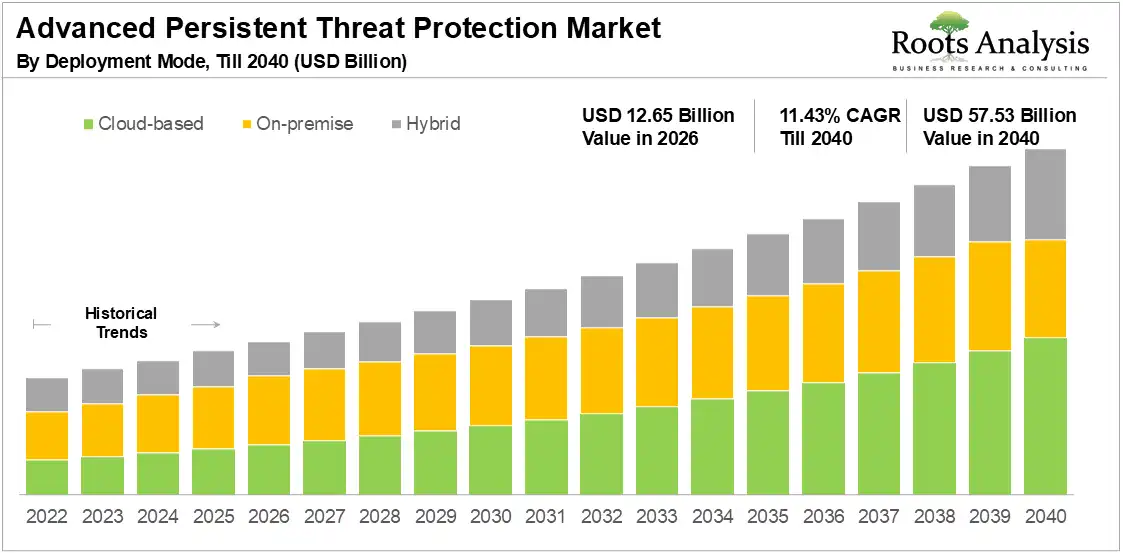
The advanced persistent threat protection market, valued at USD 12.65 billion in 2026, is expected to reach USD 57.53 billion by 2040, growing at a CAGR of 11.43%, during the forecast period 2026-2040.
See What’s in the Full Report – Request Your Complimentary Insights!
Market Report: Key Takeaways
- Solutions dominate the market with 68.5% share in 2026, driven by their central role in real-time threat detection and response across different environments.
- Cloud security remains the premier growth sector, fueled by accelerated cloud transitions and expanding hybrid IT architectures.
- Large enterprises account for the majority share, owing to higher budgets, regulatory exposure, and advanced threat targeting.
Advanced Persistent Threat Protection Market Outlook
The APT protection market is shifting from traditional boundary security and known-threat detection toward integrated, intelligence-led frameworks. This change is driven by highly skilled adversaries using covert, multi-stage tactics that bypass older security programs. Consequently, organizations are prioritizing behavioral analytics and advanced detection platforms to improve their overall security strength.
Market growth is supported by rising geopolitical tensions and stricter regulatory mandates, which are compelling organizations to invest in advanced cybersecurity infrastructure. The expansion of cloud computing, remote work environments, and IoT ecosystems is significantly broadening the range of digital vulnerabilities, driving demand for unified and scalable security solutions. Additionally, the growing use of AI in cyberattacks is accelerating the adoption of AI-powered defense mechanisms.
Looking ahead, the market is expected to consolidate around unified security platforms with enhanced automation and predictive capabilities. These platforms aim to proactively detect and mitigate threats, positioning APT protection as a critical component of enterprise resilience strategies.
Advanced Persistent Threat Protection Market Segmentation Analysis
Market Segment by Component
The APT protection market is primarily led by the solutions segment, which holds the dominant share due to its central role in enabling real-time threat detection and response across enterprise environments. Core solution categories include endpoint protection, network security, cloud security, threat intelligence, and security information and event management (SIEM) platforms, all of which form the foundation of modern security architectures. Within this segment, cloud security is emerging as the fastest-growing sub-segment, driven by rapid cloud adoption and the expansion of hybrid infrastructures. In contrast, the services segment (comprising managed security services, consulting, and implementation), plays a supporting but critical role by addressing operational complexity and enabling effective deployment.
Market Segment by Organization Size
Large enterprises dominate the APT protection market due to their substantial financial resources, advanced IT infrastructures, and heightened exposure to sophisticated cyber threats, enabling them to invest in comprehensive, integrated security platforms. These organizations typically deploy multi-layered defenses across endpoint, network, and cloud environments. Meanwhile, small and medium enterprises (SMEs) represent the fastest-growing segment, supported by the increased availability of SaaS-based security and rising regulatory pressure. These factors, alongside heightened risk awareness, are driving essential technology adoption through more accessible, cost-effective investment models.
Market Segment by Industry Vertical
The BFSI sector leads the APT protection market, driven by the high value of financial data, stringent regulatory requirements, and the need for continuous monitoring of sophisticated threats. Financial institutions invest heavily in advanced security frameworks to protect transactions and sensitive customer information. In contrast, the healthcare sector is the fastest-growing vertical, fueled by rapid digitization of patient records, increased adoption of connected medical devices, and a sharp rise in ransomware and targeted cyberattacks, necessitating enhanced security investments.
Market Segment by Deployment Mode
On-premises deployment currently holds the largest market share, particularly in highly regulated industries such as government, defense, and BFSI, where data sovereignty, control, real-time processing speeds. However, the market is witnessing a clear shift toward hybrid deployment models, which are emerging as the fastest-growing segment. Hybrid architecture enables organizations to harmonize localized oversight with cloud-driven elasticity.
Pay Only for What You Need – The Best Way to Optimize
Advanced Persistent Threat Protection Market Dynamics
Market Drivers:
- Increasing sophistication of state-sponsored cyber warfare: The key driver for the adoption of APT protection solutions is the increasing frequency and sophistication of attacks conducted by well-funded, state-backed cyber threat groups and advanced cybercriminal organizations.
- Intensified regulatory pressure on critical infrastructure protection: Governments worldwide are implementing stricter mandates (such as NIS2 in Europe, specific CISA guidelines in the US) requiring higher cybersecurity standards for critical infrastructure sectors like energy, finance, and healthcare.
- Expansion of the attack surface due to digital transformation: The rapid migration to cloud environments (SaaS, IaaS), remote work models, and increased reliance on IoT devices expands the potential entry points for APT actors beyond the traditional network perimeter.
Market Opportunities:
- Integration Of Artificial Intelligence (AI) for Predictive Analytics and Behavioral Modeling: The implementation of AI and machine learning offers significant growth opportunities by enabling solutions to move beyond signature-based detection. AI allows for the real-time analysis of network traffic and user behavior.
- Adoption of Managed Detection and Response (MDR) for Skill Gap Mitigation: The growing lack of cybersecurity skills creates a strong commercial opportunity for vendors offering MDR services. By offering a "security-as-a-service" model, vendors provide expert monitoring and threat hunting that removes the need for large internal teams. This approach lowers the entry barrier for smaller enterprises, granting them access to high-end APT protection without significant capital investment.
Market Challenges
- Rapid Evolution of APT Tactics and Evasion Techniques: The core challenge in the APT protection market is the constant, rapid evolution of attacker tactics. APT groups continuously refine their methods, developing new techniques to evade detection by advanced protection systems.
- Lack of Standardization and Interoperability Between Solutions: While XDR aims to solve integration issues, many enterprises still utilize non-integrated tools from different vendors, leading to fragmentation and poor data sharing. The lack of standardized communication protocols and data formats between various security products creates operational friction and reduces overall visibility, hindering effective APT detection and response.
Regional Analysis
The advanced persistent threat (APT) protection market demonstrates distinct regional dynamics, shaped by variations in cybersecurity maturity, regulatory frameworks, and digital infrastructure development. North America represents the largest market, accounting for approximately 32.0% share in 2026, supported by a highly developed cybersecurity ecosystem, significant investment in advanced security technologies, and strong government and enterprise-level initiatives. The region’s high exposure to sophisticated, state-sponsored cyber threats and the presence of leading cybersecurity vendors further reinforce its dominant position.
Europe follows as a well-established market, driven by stringent regulatory mandates such as data protection and cybersecurity directives that compel organizations to adopt advanced threat protection solutions. The region benefits from a strong industrial base and increasing emphasis on compliance and risk management, although growth remains moderate due to its relatively mature market landscape.
Asia-Pacific is the fastest-growing region, projected to expand during the forecast period. Rapid digital transformation, increasing cloud adoption, and rising frequency of cyberattacks are driving demand for APT protection solutions, in this region. Governments across countries such as China and India are strengthening cybersecurity regulations and investing in national security infrastructure, accelerating market adoption.
Latin America and the Middle East & North Africa (MENA) are emerging markets, supported by increasing digitalization, rising awareness of cybersecurity risks, and growing investments in critical infrastructure protection. While these regions currently hold smaller market shares, they are expected to witness steady growth due to evolving regulatory frameworks and expanding enterprise adoption of advanced security solutions.
Your Business is Unique – Why Shouldn’t Your Report Be?
Leading Players Competitive Footprint
- Palo Alto Networks: Palo Alto Networks completed the acquisition of IBM's QRadar software assets to accelerate its AI-driven security operations and integrate SIEM capabilities for enhanced threat detection and response.
- CrowdStrike: CrowdStrike announced new generative AI capabilities for the Falcon platform, leveraging large language models (LLMs) to enhance automated threat detection and response against sophisticated adversaries.
- Microsoft Security: Microsoft launched Microsoft Copilot for Security, an AI-powered security assistant designed to rapidly detect, analyze, and respond to threats across the digital estate.
- SentinelOne: SentinelOne enhanced its Singularity platform by integrating generative AI capabilities for advanced threat hunting and automated remediation of sophisticated attacks.
- Check Point Software: Check Point introduced its new "Quantum Force" series of security gateways, leveraging AI-powered threat prevention capabilities to block zero-day and multi-stage APT attacks in real time.
- Trellix: Trellix announced a strategic partnership with Netskope to integrate data loss prevention (DLP) capabilities with threat detection to improve protection against sophisticated attacks.
Advanced Persistent Threat Protection Market: Scope of the Report
| Key Report Attributes | Details | |
| Historical Trend | Since 2022 | |
| Forecast Period | Till 2040 | |
| Market size 2025 | USD 10.54 Billion | |
| Market size 2026 | USD 12.65 Billion | |
| Market size 2040 | USD 57.53 Billion | |
| CAGR (Till 2040) | 11.43% | |
| Report coverage |
|
|
| Key companies profiled |
|
|
| Segments covered |
|
|
| Countries covered |
|
|


