


 Download Free Sample
 Buy Now
Market Size
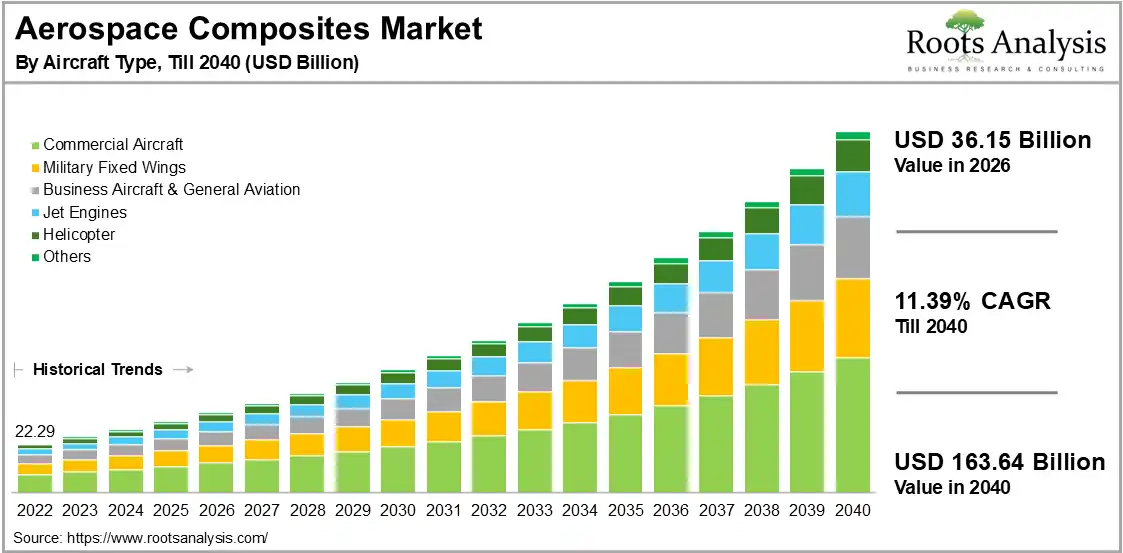
The global aerospace composites market, valued at USD 32.03 billion in 2025, is projected to reach USD 36.15 billion in 2026 and USD 163.64 billion by 2040, with a 11.39% CAGR during the forecast period 2026 to 2040.
See What’s in the Full Report – Request Your Complimentary Insights!
Market Report: Key Takeaways
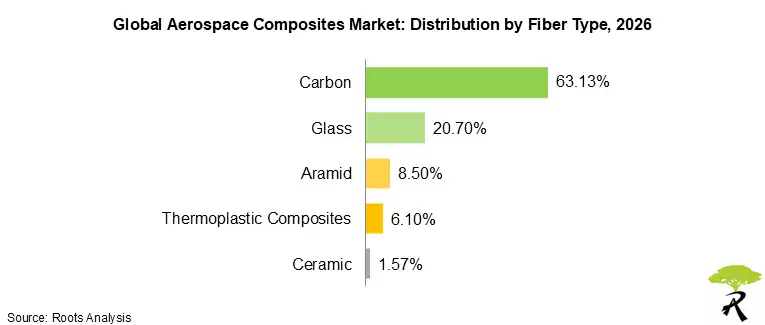
- In terms of fiber type, carbon fiber secures 63.13% of the overall revenue share of the global market.
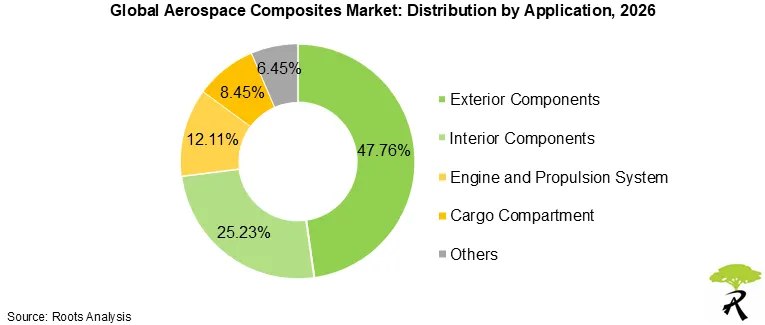
- In terms of application, exterior components hold the largest share (47.76%) of aerospace composites market.
- In terms of leading region, North America holds the largest share with 38.33% share of the market.
- Market growth of aerospace composites market is driven by rising demand for lightweight and fuel-efficient aircraft as well as the increasing use of aerospace composites in UAM.
Market Overview
Aerospace composites represent advanced engineered materials that integrate reinforcements such as carbon, glass, or aramid fibers within polymer, metal, or ceramic matrices. These yield synergistic properties like high specific strength, stiffness, and fatigue resistance that surpass those of monolithic metals. These heterogeneous structures leverage the tensile prowess of fibers to bear primary loads while matrices protect against environmental degradation and distribute stresses, enabling precise tailoring of anisotropic performance for aerospace demands.
Composite materials for aircraft manufacturing are used in primary airframe elements like fuselages, wingskins, and empennages in wide-body jets, where carbon-fiber-reinforced polymers reduce structural mass by up to 25% compared to aluminum alloys. Aircraft structural composite applications also include aircraft fairings, nacelles, and cabin interiors that prioritize vibration damping and thermal insulation. Engine components, including fan blades and casings, benefit from hybrid composites blending thermoplastics for impact tolerance, while emerging uses of aerospace composites for next-gen unmanned aerial vehicles (UAVs) and hypersonic vehicles exploit ceramic matrix variants for ultra-high-temperature resilience.
Market expansion is propelled by aviation’s pivot toward net-zero emissions, where lighter composites slash fuel burn and lifecycle CO2 by optimizing aerodynamics and enabling electric/hybrid propulsion integration.
Concurrent aerospace composite technology innovation in out-of-autoclave curing, thermoplastic welding, and bio-based resins address scalability and recyclability challenges, fostering adoption in sustainable fleets like hydrogen-powered aircraft, amid regulatory pushes for greener aerospace composite supply chain.
Recent Developments
- In December 2025, Syensqo, a Belgian chemical company, a long-term supplier partnership to supply advanced composites for Vertical Aerospace’s VX4 electric aircraft.
- In October 2025, BEML and Kineco partnered to develop advanced composites for defense and aerospace.
- In June 2025, Otto Aviation launched Phantom 3500 business jet with all-composite airframe from Leonardo.
- In June 2025, Lohia Aerospace Systems showcased India’s composite manufacturing prowess at Paris Air Show 2025.
- In March 2025, Industrial Summit Technology (IST) introduced IMIDETEX, an advanced polyimide fiber engineered to meet the demanding challenges of the aerospace and satellite industries.
Pay Only for What You Need – The Best Way to Optimize
Market Share Insights
Carbon Fiber to Lead the Aerospace Composites Market
The aerospace composites market report suggests that carbon fiber dominates the fiber type segment of the market, capturing around 63.13% share due to its unmatched strength-to-weight ratio, superior stiffness, fatigue resistance, and corrosion immunity.
This makes it ideal for primary structures like fuselages, wings, and empennages in commercial jets, such as the Boeing 787 and Airbus A350. This enables 20-25% weight reductions due to the use of aerospace composites for improved fuel efficiency and performance.
This carbon fiber composites aerospace market is further fueled by mature supply chains, proven scalability in high-volume production, and alignment with OEM demands for performance under extreme aerodynamic and thermal loads, outpacing glass fiber's cost-effectiveness for secondary parts or aramid's impact resistance.
Exterior Components to Shape the Future of Aerospace Composites Industry
Exterior components dominate the application segment of the aerospace composites market, commanding the largest share (47.76%). This growth is due to their extensive use in primary airframe structures like fuselages, wings, empennages, and tail assemblies. In these structures aerospace grade carbon fiber delivers optimal strength-to-weight ratios, enabling 20-25% mass reductions over aluminum for superior fuel efficiency and range in wide-body jets such as the Boeing 787 and Airbus A350.
This leadership reflects the high volume of material required for these load-bearing exteriors, which face relentless aerodynamic forces, fatigue, and corrosion, alongside mature manufacturing scalability via automated fiber placement for high-rate production. This also fuels the aerospace composite structures market. On the other hand, engine & propulsion systems show the fastest CAGR, driven by innovations in lightweight nacelles, fan blades, and casings for next-gen turbofans and hybrid-electric propulsion in sustainable aviation.
Regional Aerospace Composites Market Forecast Suggests Dominance of North America
North America dominates the global aerospace composites market, commanding the largest share of 38.33% due to its robust ecosystem of leading OEMs like Boeing and Lockheed Martin. Further, extensive R&D investments in defense modernization and next-generation commercial aircraft, and established supply chains for high-volume production are also fueling the market growth. Apart from this, the leadership stems from surging demand for fuel-efficient designs amid rising air traffic, alongside government-backed programs in space exploration and UAVs that prioritize lightweight materials for performance gains.
Want Information on Specific Region / Segment?
Market Dynamics
Market Drivers
- Demand for Lightweight and Fuel-efficient Aircraft: Aerospace composites for lightweight aircraft structures are in high demand to boost fuel efficiency and comply with stringent emission standards. OEMs and airlines favor these materials to lower operational expenses and advance objectives for sustainability in aerospace composites.
- Growth in Commercial and Defense Aviation: Expanding global air passenger traffic, ongoing fleet upgrades, and surging defense expenditures fuel production of new aircraft such as single-aisle jets, wide-bodies, business aircraft, and UAVs. This heightens the adoption of composite materials in military and commercial aviation.
- Increased Use in Advanced Aircraft Design and Urban Air Mobility: Next-generation platforms like eVTOL vehicles, drones, and urban air mobility options (like air taxis) leverage composites for superior strength-to-weight ratios, enhanced aerodynamics, and versatile design capabilities, accelerating their integration into emerging aerospace innovations.
Market Challenges
- Scaling High-rate, Automated Composite Manufacturing: Achieving elevated production rates for next-generation aerospace platforms demands advancements in automation technologies, precise process controls, and streamlined supply chain challenges in aerospace composites market, particularly for fabricating large-scale, intricate airframe structures.
- Life-cycle Environmental Impact and End-of-life Management: Thermoset composites pose recycling challenges at end-of-life, with inadequate infrastructure for recovering fibers and resins from decommissioned aircraft, complicating efforts to minimize environmental footprints.
- Talent Shortages and Training Needs: The industry faces acute shortages of skilled professionals in composites engineering, manufacturing, repair techniques, and certification processes, potentially hindering growth without targeted workforce development initiatives.
Key Market Insights
Competitive Landscape of Key Market Players
The aerospace composites market competitive landscape features intense rivalry among established leaders like Hexcel, Toray, and Spirit AeroSystems, who dominate through innovations in carbon fiber reinforcements, automated manufacturing processes, and integrated supply chains for primary airframe structures.
Hexcel excels in high-performance polymer composites and resins and prepregs for commercial jets, Toray commands the carbon fiber segment with superior tensile properties for wings and fuselages, while Spirit AeroSystems leverages OEM partnerships for large-scale assembly of composite-intensive fuselages and empennages, collectively driving over 40% market share amid rising demand for lightweight designs, further fueling the lightweight composites aerospace market.
Market Trends in Carbon Fiber Reinforced Polymer (CFRP) Aerospace Applications
- Increasing adoption in primary structures like fuselages and wings for 20-50% weight reduction in jets such as Boeing 787 and Airbus A350.
- Shift toward thermoplastic CFRP for faster production, recyclability, and weldability in high-rate manufacturing.
- Integration in eVTOL, UAVs, and hypersonics for enhanced aerodynamics and thermal resistance.
- Hybrid CFRP-metal designs improving damage tolerance and repairability amid sustainability mandates.
- Automation via AFP/ATL boosting scalability for rising aircraft deliveries.
Regulatory Standards for Aerospace Composite Material Certification
- FAA AC 20-107B mandates design, testing, and allowable for composite structures under FAR Part 25.
- EASA CS-25 equivalent requires damage tolerance, environmental durability, and full-scale testing validation.
- MIL-HDBK-17 provides guidelines for polymer matrix composites in military applications, emphasizing fatigue and impact data.
- ISO 14692 for filament-wound composites focuses on pressure vessels in aerospace propulsion.
- Recent updates prioritize sustainability, with FAA / EASA pushing recyclable resins and lifecycle assessments for net-zero compliance.
Your Business is Unique – Why Shouldn’t Your Report Be?
Market Segmentation
Aerospace Composites Market: Scope of the Report
| Key Report Attributes | Details | |
| Historical Trend | Since 2022 | |
| Forecast Period | Till 2040 | |
| Market Size 2026 | USD 36.15 Billion | |
| Market Size 2040 | USD 163.64 Billion | |
| CAGR (Till 2040) | 11.39% | |
| Segments Covered |
|
|
| Key Players Profiled |
|
|
| PowerPoint Presentation (Complimentary) |
Available | |
| Customization Scope | 15% Free Customization | |
| Excel Data Packs (Complimentary) |
|
|
Market Segments
Based on research, we have segmented the aerospace composites market into fiber type, resin type, manufacturing process, aircraft type, matrix type, application, geographical regions, and key players.
Market Share by Fiber Type
- Aramid
- Carbon Fiber
- Glass Fiber
- Thermoplastic Composites
Market Share by Resin Type
- Epoxy
- Phenolic
- Polyester
- Polyether Ether Ketone (PEEK)
- Polyetherimide (PEI)
- Polyimides
- Polysulfone (PSU)
- Thermoset Composites
Market Share by Manufacturing Process
- Automated Tape Laying
- Filament Winding
- Hand Layup
- Resin Transfer Molding
Market Share by Aircraft Type
- Business Aircraft & General Aviation
- Commercial Aircraft
- Helicopter
- Jet Engines
- Military Fixed Wings
- Others
Market Share by Matrix Type
- Ceramic Matrix
- Metal Matrix
- Polymer Matrix
Market Share by Application
- Cargo Compartment
- Engine & Propulsion Systems
- Exterior Components
- Interior Components
- Others
Market Share by Geographical Regions
- North America
- US
- Canada
- Mexico
- Rest of North America
- Europe
- Austria
- Belgium
- Denmark
- France
- Germany
- Ireland
- Italy
- Netherlands
- Norway
- Russia
- Spain
- Sweden
- Switzerland
- UK
- Rest of Europe
- Asia-Pacific
- Australia
- China
- India
- Japan
- New-Zealand
- Singapore
- South Korea
- Rest of Asia-Pacific
- Latin America
- Brazil
- Chile
- Colombia
- Venezuela
- Rest of Latin America
- Middle East and Africa (MEA)
- Egypt
- Iran
- Iraq
- Israel
- Kuwait
- Saudi Arabia
- UAE
- Rest of MEA


