
Lowest Price Guaranteed
Slides
188
Last Updated
May 2026
View Count
11229
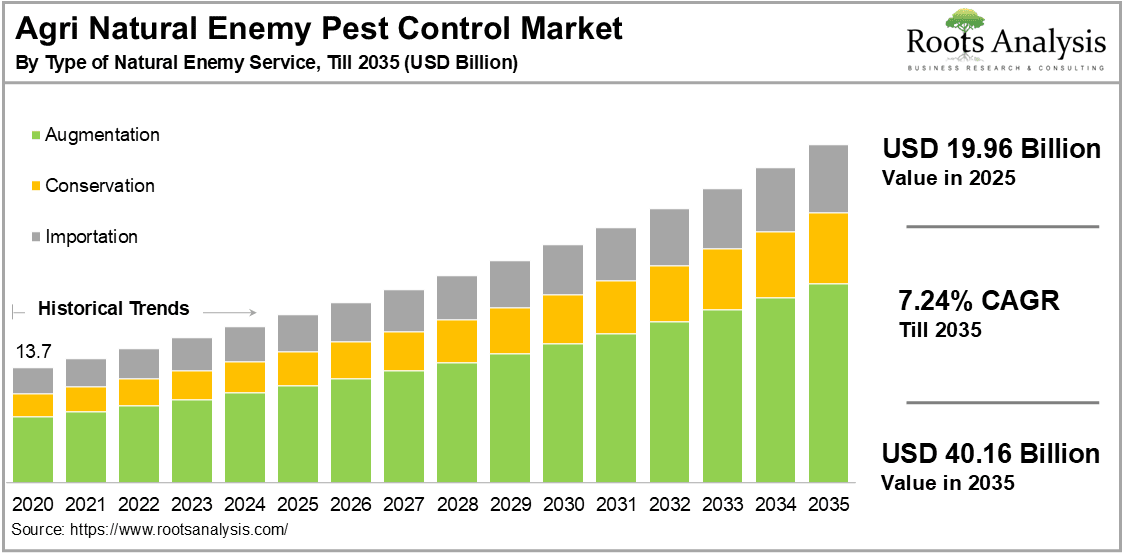
The global agri natural enemy pest control market, valued at USD 18.5 billion in 2024, is projected to reach USD 19.96 billion in 2025 and USD 40.16 billion by 2035, representing a CAGR of 7.24% during the forecast period.
 |
To learn more about this report, request a free sample copy
The new research study consists of global agri natural enemy pest control analysis, mega trends, patent analysis, porter five forces, SWOT analysis, value chain analysis and other strategic frameworks.
Agri natural enemy pest control is a farming method that utilizes beneficial organisms to manage pests. This approach involves introducing predators, such as ladybugs and lacewings, parasitoids like tiny wasps, and pathogens including bacteria, viruses, and fungi to target harmful organisms. As a crucial part of integrated pest management (IPM), it emphasizes protecting crops in an environmentally friendly manner. By leveraging these natural methods, farmers can significantly reduce their reliance on synthetic chemical-based pesticides, which are known to have detrimental effects on the environment.
This natural pest control strategy is not only safer for the environment but also helps prevent pests from developing resistance to treatments. It is effectively used against a variety of pests, including thrips, mealybugs, and whiteflies, making it beneficial for both field crops and greenhouse or ornamental plants.
A major factor driving the adoption of this method is the increasing awareness among farmers and consumers about the adverse health impacts associated with synthetic pesticides. Research highlighting the link between chemical pesticide use and health issues, such as cancer and neurological disorders have led to stricter regulations worldwide. Governments and international organizations are actively promoting biological pest control methods through incentives like subsidies, tax benefits, and educational campaigns. Furthermore, the growing popularity of organic farming solutions and consumer preference for chemical-free produce have substantially increased the demand for natural enemy pest control solutions.
Climate change is another significant factor propelling the growth of this market. Changes in temperature, precipitation patterns, and the frequency of extreme weather events are altering pest behaviors and their geographical distribution. This necessitates the use of adaptive pest control strategies, with natural enemies offering a dynamic and sustainable solution for farmers.
The agri natural enemy pest control market report presents an in-depth analysis of the various companies that are involved in offering pest control solutions, across different segments, as defined in the table below:
| Key Report Attributes | Details | |
| Historical Trend | Since 2020 | |
| Forecast Period | Till 2035 | |
| Market Size Value by 2025 | $ 19.96 Billion | |
| Market Size Value by 2035 | $ 40.16 Billion | |
| CAGR (Till 2035) | 7.24% | |
| Areas of Application |
|
|
| Type of Natural Enemy Service |
|
|
| Type of Control Agent |
|
|
| Type of Enterprise |
|
|
| Geographical Regions |
|
|
| Leading Market Players |
|
|
| PowerPoint Presentation (Complimentary) |
Available | |
| Customization Scope | 15% Free Customization | |
| Excel Data Packs (Complimentary) |
|
|
The global agri natural enemy pest control market is segmented into various areas of application such as ant control, beetle control, bird control, insects control, mosquitoes & flies control, rat & rodent control. On the basis of global agri natural enemy pest control market size analysis, the ant control segment will augment the segment's growth with the largest market share of over 32.56% by the next decade.
This dominance is largely due to the widespread impact of insect pests on crops and the effectiveness of natural enemies in managing these pests. Insects such as thrips, mealybugs, and whiteflies are common targets for natural enemy pest control methods, which include predators like ladybugs and lacewings, and parasitoids like tiny wasps. The segment's dominance is also supported by its alignment with integrated pest management (IPM) strategies, which emphasize eco-friendly pest control methods.
The market is segmented into various types of natural enemy service such as augmentation, conservation, and importation. According to the agri natural enemy pest control growth forecast, the augmentation segment will augment the segment's growth with the largest market share of over 75.6% by the next decade. Augmentation involves the mass rearing and release of natural enemies into target environments to supplement existing populations or provide temporary control.
This approach is commonly used when natural enemy populations are insufficient to achieve effective pest control on their own. Augmentation is favored due to its immediate impact on pest populations and its ability to be tailored to specific pest management needs.
On the other hand, it is worth highlighting that the conservation segment is expected to witness the fastest CAGR of around 8.93%. This dominance can be attributed to the conservation service aligning with broader trends towards sustainable agricultural practices and environmental conservation. The emphasis on maintaining biodiversity and reducing chemical pesticide use supports the growth of this segment as consumers increasingly demand environmentally friendly practices in agriculture.
The market is segmented into various types of control agent such as bacteria, fungi, oomycota, parasitoids, pathogens, and predators. According to our agri natural enemy pest control market analysis, the predators segment will dominate the market by securing over 41.6% of the market share by the next decade. Predators, such as ladybugs and lacewings, are widely used due to their effectiveness in controlling pest populations.
They are integral components of integrated pest management (IPM) strategies and are favored for their ability to target specific pests without harming beneficial organisms. The dominance of predators is attributed to their ease of use, immediate impact on pest populations, and the extensive research supporting their efficacy in various agricultural settings.
On the other hand, the fungi segment is expected to witness the fastest CAGR of around 8.43% during the forecasted period. Fungi is gaining traction due to its specificity and effectiveness in controlling pests. Advancements in biotechnology and genetic engineering are enhancing the adaptability and pest-specific action of fungal pathogens, making them more attractive for farmers seeking sustainable pest management solutions.
The market is fragmented into two types of enterprises, namely large and small and medium enterprises. Currently, the large enterprise segment is expected to dominate the segment with 71.34% of the market share as demand for agri natural enemy pest control is rising among large enterprises.
However, small and medium enterprise segments are expected to witness a relatively higher (9.78%) growth rate until 2035. This is ascribable to their agility, innovation, focus on niche markets, and ability to adapt to changing customer preferences and market conditions.
This segment highlights the distribution of agri natural enemy pest control market share by regions, such as North America, Europe, Asia, Latin America, Middle East and North Africa, and the rest of the world. Based on our regional analysis, North America currently exhibits dominance with 37.69% of overall market share. Early adoption of biological pest control methods has given North America a strong foundation in this sector. The region's emphasis on organic farming practices, particularly in the United States, has further augmented the demand for natural enemy pest control solutions.
The “Agri Natural Enemy Pest Control Market, Till-2035: Industry Trends and Global Forecasts” report features an extensive study of the current market landscape, market size and future opportunity within the agri natural enemy pest control market forecast period. The market report highlights the efforts of several stakeholders involved in this rapidly emerging segment of the service providers industry. Key takeaways of the global agri natural enemy pest control market report are briefly discussed below.
The global agri natural enemy pest control market growth is expected to be driven by several key factors. Growing awareness among farmers and consumers about the harmful effects of synthetic pesticides has led to increased demand for natural pest control solutions. This awareness is supported by studies linking chemical pesticide use to health issues such as cancer and neurological disorders, prompting governments to implement stringent regulations and promote biological pest control methods through incentives.
Additionally, the rising popularity of organic farming and consumer preference for chemical-free produce are significant drivers. Climate change also plays a crucial role, as it alters pest behaviors and necessitates adaptive pest control strategies, making natural enemies a dynamic and sustainable option. Furthermore, advancements in biotechnology and precision agriculture technologies enhance the effectiveness and efficiency of natural enemy pest control methods, further boosting market growth.
According to the agri natural enemy pest control market competitive landscape analysis, with the presence of several small and large companies, the market is experiencing intense competition and changing market dynamics. From large multinational companies to local players, companies are striving to enhance their competitive edge. In terms of market share, large enterprises and multinational companies are dominating the market. The key players are using strategies such as partnerships, acquisitions, ventures, innovations, novel product launches, R&D and geographical expansions to solidify their position in the industry.
Despite the strong market growth projection, there are several challenges in the agri natural enemy pest control market. One of the primary hurdles is the limited awareness among farmers and consumers about the benefits of biological pest control methods, leading to a persistent reliance on traditional chemical pesticides due to familiarity and historical precedence. Additionally, stringent regulatory frameworks governing the use of biological control agents pose significant barriers, as they require rigorous testing and registration processes, which can be time-consuming and costly.
The commercial availability of natural enemies is also limited, making it difficult for farmers to access these beneficial organisms on a large scale. Furthermore, environmental sensitivities and the need for precise conditions to maintain the effectiveness of natural enemies add complexity to their implementation. These challenges necessitate concerted efforts to educate stakeholders and improve the accessibility and scalability of natural enemy pest control solutions.
With respect to regional industry insights, North America is likely to dominate the market for the forecasted period. The dominance of this region is majorly influenced by the regulatory environments that encourage sustainable practices and limit the use of chemical pesticides which have prompted farmers to seek alternative methods, like natural enemy pest control. Further, the large agricultural land area and supportive policies also play a significant role in maintaining its leading position in the global market.
Examples of leading agri natural enemy pest control manufacturers (which have also been captured in this market report, arranged in alphabetical order) include Advanced Integrated Pest Management, AlphaBio, Andermatt Biocontrol, Andermatt, Anatis Bioprotection, Anticimex, Applied Bio-nomics, AstraZeneca, BASF Agricultural Specialities, Bayer, Biobest, BioBee Biological Systems, Bioline AgroSciences, BioPlanet, Biorend, Biota Biosciences, Certis, Cook's Agri Natural Enemy Pest Control, Corteva Agriscience, Crop Defenders, Dow, Ecolab, Fargro, FMC, GreenMethods, Integrated Pest Management Pest Control, Isagro, Koppert Biological Systems, Marrone Bio Innovations, MB Integrated Pest Control, Natural Enemies Pest Management, Natural Insect Control, Novartis, Novozymes A/S, Rincon Vitova Insectaries, SGS SA, Syngenta AG, Wageningen University & Research.
The market report presents an in-depth analysis, highlighting the capabilities of various companies engaged in this domain, across different segments. Amongst other elements, the market report includes:
At Roots Analysis, we genuinely care about your success and understand that your business requirements are unique. While our agri natural enemy pest control market research reports provide valuable insights, we recognize that they might not cover every aspect you need to make well-informed strategic decisions. To account for that, we offer 15% free report customization tailored to your specific needs. Whether you require additional quantitative analysis, qualitative insights, or any other information related to the agri natural enemy pest control market, reach out us today at: support@rootsanalysis.com