


 Download Free Sample
 Buy Now
Market Outlook
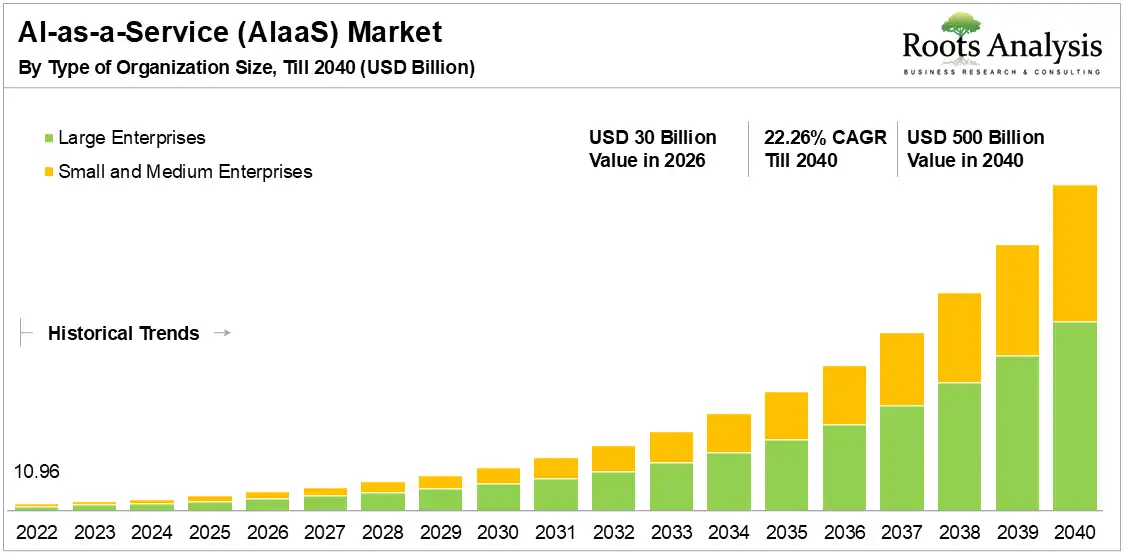
The global AI-as-a-service (AIaaS) market is projected to reach USD 30 billion in 2026 and USD 500 billion by 2040, representing a CAGR of 22.6% during the forecast period 2026 to 2040.
See What’s in the Full Report – Request Your Complimentary Insights!
AI-as-a-service (AIaaS) is a cloud-based delivery model that provides ready-to-use artificial intelligence tools and capabilities to businesses and individuals via the internet. By integrating pre-trained models, specialized APIs, and hosted development environments, organizations can deploy AI without heavy internal infrastructure investment. The model broadens access to advanced analytics, machine learning, and generative AI, allowing rapid integration into existing workflows and products. Market scope spans across natural language processing, computer vision, predictive analytics, and process automation.
Notably, the AI-as-a-service market growth is propelled by the high capital costs of building AI in-house and the fast cadence of generative AI advances. To shorten time-to-market and reduce operational complexity, enterprises across finance, healthcare, and retail are increasingly adopting AIaaS for fraud detection, customer service automation, and predictive maintenance.
The industry outlook is shaped by a shift toward fine-tuned and specialized models designed for defined business requirements rather than broad, general-purpose use. Market trends include sovereign AI initiatives that localize infrastructure and data governance to protect privacy and strategic autonomy, alongside stronger compliance expectations such as the EU AI Act. Supported by customization, ethical frameworks, and regulatory clarity, the AIaaS market is expected to expand as offerings mature.
Market Report: Key Takeaways
- Top Industry Giants: Leading players of the AI-as-a-service market, such as Microsoft Azure, Amazon Web Services (AWS), and Google are undertaking strategic initiatives to strengthen their market position. Recently, Microsoft Azure invested USD 17.5 billion to build sovereign-ready hyperscale infrastructure in the India (Hyderabad region), indicating regional services expansion.
- Broad Base for Startups: Globally, the startup ecosystem is pivoting toward "vertical SaaS" and specialized AI services. As the "novelty" of generative AI fades, startups are finding success by solving domain-specific problems in regulated industries. Startup companies like Exaforce raised USD 75 million in Series A funding round to revolutionize security and operations with Agentic AI.
- Key Market Drivers: The primary driver for AIaaS market is the massive reliance on the cloud-based deployment models to achieve operation efficiency. As organizations face mounting pressure to innovate, AIaaS provides a cost-effective, scalable, and flexible means to access technologies like deep learning and computer vision. In addition, sectors like manufacturing are adopting AIaaS for predictive maintenance, which has been shown to reduce operational costs by 20% and downtime by 50%.
- Funding and Investment Analysis: Tech giants, such as Amazon Web Services, Microsoft, and Google are investing heavily to expand their services portfolio. In July 2025, Amazon Web Services announced additional investment of USD 100 million in the pre-build machine learning pipelines to help enterprises reinvent their operations through AIaaS.
- The Rise of AI Sovereign AI Funding: Governments are increasingly acting as investors in the AIaaS ecosystem. For instance, Indian government launched USD 1.2 billion IndiaAI mission. Government has allocated strategic resources for 10,000 GPU compute capacity for startups through subsidized access (INR 65 / hour) and provides funding for 10,000 AI startups through 2027. Likewise, the European government allocated EUR 1.5 billion to scale AI infrastructure, expected to offer unprecedented opportunities to investors.
- Future of AI-as-a-Service Market Outlook: The key focus will be on no-code and low code tools democratizing AI access for non-technical users because enterprises prioritize usability, deployment speed, and integration flexibility. This trend expands total addressable markets by enabling departmental AI adoption beyond IT-led initiatives. In addition, edge AI and IoT integration to improve response times, reduces latency, and enhance data privacy by minimizing cloud dependency. This architectural shift creates opportunities for specialized edge AI providers and expanding cloud AI services market growth.
Pay Only for What You Need – The Best Way to Optimize
Recent Industry Developments
- In December 2025, IBM and Confluent signed a definitive agreement to acquire outstanding share of Confluent with an investment of USD 11 billion. This acquisition will expand IBM’s capabilities in data infrastructure, which is essential for AI-driven applications.
- In November 2025, NVIDIA has invested USD 2 billion in Synopsys (chip design software maker). This investment is a key part of an expanded multi-year tie-up to jointly develop new tools for designing specific products across industries using its AI technology.
- In July 2025, Oracle invested USD 2 billion over the next five years to meet the increasing demand for its AI and cloud infrastructure in Germany, and Oracle Cloud Frankfurt Region.
Market Dynamics
Key Market Drivers
- Democratization of Advanced AI Capabilities: AIaaS lowers structural entry barriers for small and mid-sized enterprises by removing the need for upfront investments in specialized hardware and scarce AI talent. The shift from capital-intensive ownership to a flexible operating expense model broadens access to advanced generative AI and machine learning capabilities, enabling wider participation and more balanced competitive dynamics.
- Alleviation of Acute AI Talent Shortage: Persistent shortages of experienced data scientists and machine learning engineers make in-house AI development costly and slow for most organizations. AIaaS mitigates this constraint by delivering pre-trained models and fully managed services, allowing enterprises to embed AI functionality without building or sustaining large, highly specialized internal teams.
- Cost-Effective Scaling of Computational Resources: Training and deploying modern AI models requires high-performance GPUs, whose acquisition and maintenance costs continue to rise. AIaaS provides on-demand access to these resources, enabling organizations to scale capacity in line with usage patterns, reduce idle infrastructure, and achieve more efficient utilization across fluctuating workloads. This increasing AIaaS adoption rate by industry vertical for cost-effective scaling of computation resources is a key driver for the market growth.
- Acceleration of Time-to-Market for New Use Cases: Competitive pressure is pushing organizations to move faster from experimentation to deployment. AIaaS platforms offer API-driven access to ready-to-use foundational models, significantly shortening development cycles and enabling rapid prototyping and rollout of new AI-powered features within compressed timelines.
Market Restraints
- Data Privacy and Governance Concerns: Organizations remain cautious about transferring sensitive or proprietary data to third-party AI platforms, particularly in regulated sectors. Requirements related to data residency, sector-specific compliance, and privacy regulations drive demand for controlled deployment models, constraining the adoption of fully public cloud based AIaaS solutions.
- Vendor Lock-in and Interoperability Challenges: Dependence on proprietary models and APIs offered by individual hyperscalers increases the risk of long-term lock-in. Migrating workloads across providers can be complex and costly, limiting strategic flexibility when pricing structures change or alternative models offer superior performance.
- Uncertainty in Long-Term Operational Costs: Although AIaaS lowers initial adoption thresholds, inference and usage-based pricing can escalate quickly at scale. For organizations with sustained, high-volume requirements, the lack of predictable operating costs complicates budgeting and can slow enterprise-wide deployment decisions.
Market Share Insights
Software Dominates the AI-as-a-Service (AIaaS) Market
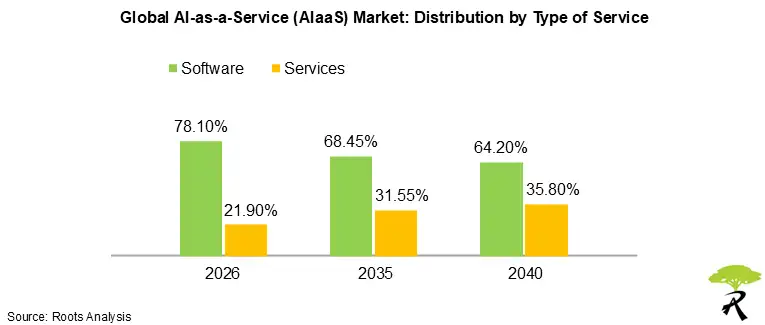
- Based on AIaaS market revenue analysis, software leads the market with a share of 78.10%. This dominance is driven by the SaaS-ification of AI and pre-trained AI software models that are being used across various industries, such as IT & Telecom, healthcare, financial services & insurance for data evaluation and real-time learning with speech and movements, which is crucial for intellectual thinking.
- Services, however, represent the fastest-growing sub-segment, expanding at a higher CAGR through 2040, as enterprises increasingly require integration support, MLOps, customization, governance, and lifecycle management to operationalize AI at scale. This growth trajectory is reinforced by expanding managed AI engineering and platform support offerings introduced by providers to address persistent skills shortages and regulatory compliance requirements.
Regional Analysis: North America AIaaS Market Report
North America continues to lead in both adoption and transaction value. The region accounted for 43.60% of the market share in 2026. This leadership is driven by the density of hyperscalers and a massive capital expenditure on data centers and AI-optimized hardware. Major AI providers in this region include IBM, Google, and Microsoft, benefiting from early AI adoption in healthcare, finance, and retail. Several other reasons that solidify the highest share of North America are listed below:
- Prioritize Inference for Sustained ROI: As the market shifts from training models to running them, profitability will be found in efficient inference workloads. Several business organizations are adopting cloud AI services to optimize their "AI Factory" designs to handle real-time workloads at scale.
- The Agentic Framework Transformation: The move toward autonomous AI agents represents the single largest opportunity for operational cost reduction. In February 2025, IBM launched novel AI integration services to help enterprises automate end-to-end business processes with agentic AI capable of problem-solving with minimal human input.
Want Information on Specific Region / Segment?
How the AI-as-a-Service (AIaaS) Market is Growing in Asia-Pacific?
Asia-Pacific is expected to expand at the fastest rate, achieving a higher CAGR through 2040, fueled by rapid digital transformation, cloud penetration, and strong government-backed AI initiatives in major economies such as China and India. Near-term growth signals support this trajectory, positioning Asia-Pacific ahead of other regions where regulatory complexity or slower enterprise modernization moderates growth momentum. Several other supporting market growth factors are as follows:
- China’s Next Gen AI Plan: Coordination and pledges for investments exceeding USD 150 billion by 2030.
- IndiaAI Mission: Adoption is expanding rapidly in fintech, healthcare, and e-commerce. The government’s "IndiaAI Mission" and initiatives like the Bhashini platform (real-time translation) are driving population-scale AI diffusion and expanding machine learning as a service (MLaaS) market.
- South Korea: Usage of generative AI tools grew from 26% to 30% of the population in late 2025, the fastest growth of any major nation.
- Robust Companies Foothold: Appier, Yellow.ai, H2O.ai, and Cinnamon AI distinguished themselves among startups in Asia Pacific by securing strong footholds, underscoring potential as emerging market leaders.
Market Ecosystem Insights
AIaaS Industry Analysis and Growth Trends
- Growth of Industry-Specific AI Verticalization: Market momentum is shifting toward AIaaS offerings tailored to distinct industry requirements rather than generic models. Verticalized solutions built on domain expertise and specialized datasets enable higher-value applications and create differentiation beyond increasingly commoditized foundational models.
- Expansion of Hybrid and On-Premise AIaaS Solutions: To overcome data sovereignty and compliance constraints, providers are extending AIaaS architectures into hybrid and on-premise environments. This deployment flexibility allows enterprises to retain control over sensitive data while still benefiting from managed services, updates, and scalable AI capabilities.
- Development of AI Governance and Explainability Tools: Rising regulatory scrutiny and internal risk management priorities are driving demand for governance-focused AI services. AIaaS platforms can expand their value proposition by embedding tools for model monitoring, bias mitigation, and explainability, supporting compliance and increasing confidence in AI-driven outcomes.
AI-as-a-Service Market Share and Competitive Landscape
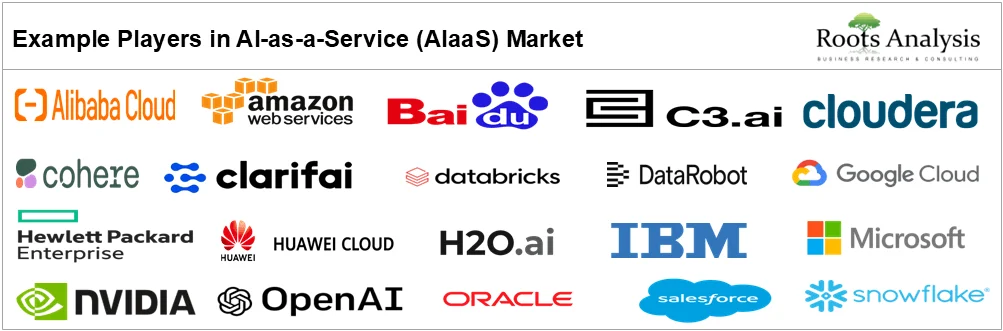
The AIaaS market exhibits a bifurcated leadership structure, witnessing the presence of technology giants, industrial leaders, and small enterprises. These market players are widely leveraging technological innovations, fundings, investments, and collaborations to strengthen product portfolio and expand market share.
While market players, such as Amazon Web Services launched pre-built machine learning pipelines and automation tools for easy deployment, LayerX raised USD 100 million in Series B led by Technology Cross Ventures to expand AI platform automating enterprise back-office functions. This robust penetration of market players along with increasing funding activities have made this industry immensely competitive.
Global AIaaS Market Opportunities in Healthcare and Fintech Sectors
Healthcare is currently the fastest growing vertical for AIaaS. The shift from "experimental pilots" to “enterprise-wide implementation” is the defining theme of 2026. Notably, the healthcare AI investment reflects sector-specific regulatory complexity, data requirements, and outcome validation needs that create barriers to entry alongside premium valuations.
Companies like OpenEvidence raised USD 200 million Series C at USD 6 billion valuation for medical field AI chatbot development. On the other hand, similar trend is noticed in fintech sector to scale the workload.
- Infrastructure Plays: Cloud providers and GPU-as-a-Service platforms supporting massive compute requirements.
- Vertical AI Solutions: Industry-specific AIaaS platforms with deep domain expertise and pre-built models
- Edge AI Integration: AIaaS combined with IoT and edge computing for real-time processing and reduced latency
- Compliance and Security Solutions: Platforms addressing data privacy, regulatory compliance, and sovereign AI requirements.
Have Questions? Let's Get Them Answered
AI-as-a-Service (AIaaS) Market: Scope of the Report
| Key Report Attributes | Details | |
| Historical Trend | Since 2022 | |
| Forecast Period | Till 2040 | |
| Market Size 2026 | $ 30 Billion | |
| Market Size 2040 | $ 500 Billion | |
| CAGR (Till 2040) | 22.26% | |
| Segments Covered |
|
|
Market Segmentation
Based on the research, we have segmented the AI-as-a-service (AIaaS) Market into type of offering, type of technology, type of deployment mode, type of service, application area, end use industry, geographical regions, and leading players.
By Type of Offering
- Infrastructure as a Service
- Platform as a Service
- Software as a Service
By Type of Technology
- Computer Vision
- Deep Learning
- Machine Learning (ML)
- Natural Language Processing (NLP)
- Generative AI
By Type of Deployment Mode
- Public Cloud
- Private Cloud
- Hybrid Cloud
By Type of Service
- Software
- Data Storage and Archiving
- Modeler and Processing
- Cloud and Web-Based Application Programming Interface (APIs)
- Others
- Services
By Application Area
- Data Analytics
- Customer Service Management
- Business Intelligence
- Predictive Modeling
By Organization Size
- Large Enterprises
- Small & Medium Enterprises
By End Use Industry
- BFSI
- Healthcare
- Retail & E-commerce
- IT & Telecom
- Manufacturing
- Government
- Media & Entertainment
By Geographical Regions
- North America
- US
- Canada
- Mexico
- Rest of North America
- Europe
- Austria
- Belgium
- Denmark
- France
- Germany
- Ireland
- Italy
- Netherlands
- Norway
- Russia
- Spain
- Sweden
- Switzerland
- UK
- Rest of Europe
- Asia-Pacific
- Australia
- China
- India
- Japan
- New Zealand
- Singapore
- South Korea
- Rest of Asia-Pacific
- Latin America
- Brazil
- Chile
- Colombia
- Venezuela
- Rest of Latin America
- Middle East and Africa (MEA)
- Egypt
- Iran
- Iraq
- Israel
- Kuwait
- Saudi Arabia
- UAE
- Rest of MEA


