AI Server Market by Type of Processor (GPU (Graphics Processing Unit), CPU (Central Processing Unit), ASIC (Application-Specific Integrated Circuit), FPGA (Field-Programmable Gate Array)), Type of Deployment (On-Premise, Cloud, and Edge), Type of Server, Type of Cooling Technology, Type of Form Factor, Application Area, Enterprise Size, End Use Industry, Geographical Regions, and Leading Players – Trends and Forecasts 2026-2040
Market Size
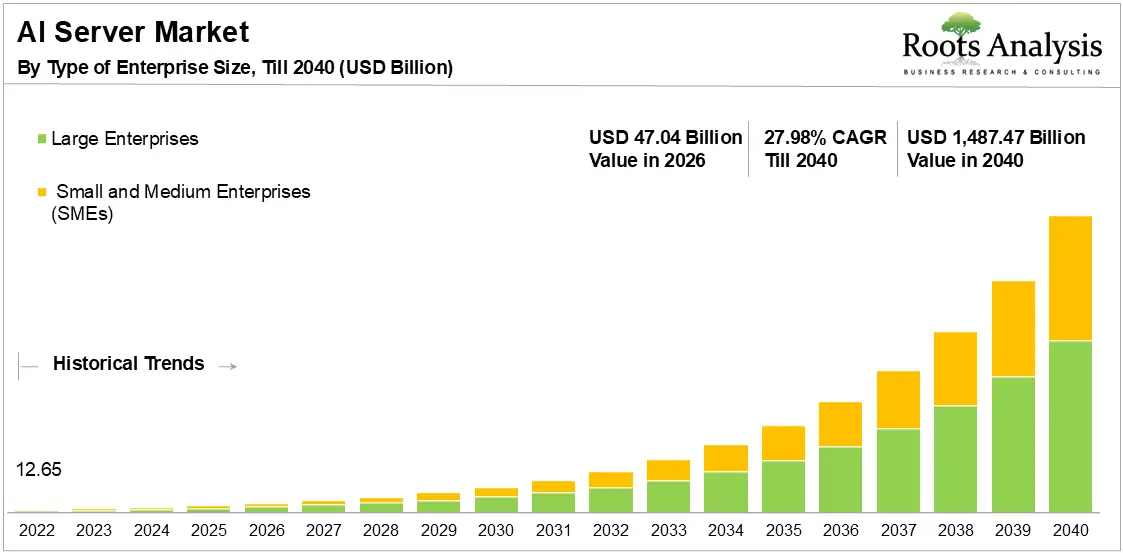
The global AI server market is projected to reach USD 47.04 billion in 2026 and USD 1,487.47 billion by 2040, representing a CAGR of 27.98% during the forecast period 2026 to 2040.
See What’s in the Full Report – Request Your Complimentary Insights!
The AI server market refers to purpose-built high-performance computing systems engineered to support intensive machine learning training and inference at scale. These systems combine dedicated accelerators, such as GPUs, ASICs, and FPGAs with fast interconnects and tuned memory designs to handle complex workloads efficiently. Their primary role is to improve compute performance and utilization for advanced analytics, natural language processing, and generative AI. These are most commonly deployed in hyperscale cloud data centers and large enterprise IT environments where scalability and reliability define market boundaries.
Market growth is being propelled by the rapid spread of generative AI applications and large language models that require exceptional compute capacity for training and refinement. Adoption is expanding across healthcare, finance, and automotive sectors, where AI supports data-intensive analysis and automation at operational scale. Current momentum is reinforced by aggressive infrastructure spending from leading technology companies seeking long-term capacity advantages. Recent AI infrastructure market outlook highlight, Meta's significant investment in acquiring high-end GPUs to expand its compute infrastructure, aimed at advancing internal model development and supporting open-source initiatives, such as Llama 3.
Looking ahead, growing emphasis on sovereign AI initiatives worldwide points to more regionally anchored infrastructure strategies, potential supply chain fragmentation, and heightened competition for high-performance computing resources, reinforcing a positive long-term market outlook driven by sustained demand for next-generation AI models.
Market Report: Key Initiatives
- Leading Players in the Industry: Industry is highly consolidated with tech giants, such as NVIDIA, HPE, Dell Technologies, OpenAI, and Supermicro. While Supermicro launched 6U SuperBlade powered by dual Intel Xeon 6900 Series processors, achieving 93% cable reduction and 50% space savings, OpenAI committed more than USD 1.4 trillion to cloud infrastructure across Oracle, Microsoft, Google, Amazon, and CoreWeave, indicating a broad future of AI.
- Startup Companies Major Investments: AI server market opportunity analysis highlights major investments by startup companies in AI infrastructure. Startup companies like Modular secured USD 250 million in September 2025, led by the US Technology Fund to continue its mission of building AI's unified compute layer, a hypervisor for AI. Likewise, Groq, Upscale AI raised USD 750 million and USD 100 million to meet with surging inference demand.
- The Rise of Sovereign AI Giants: The Gulf Cooperation Council (GCC) countries are leading the global race for Sovereign AI. In May 2025, the UAE launched "Stargate UAE," a USD 10 billion initiative to deploy 1 gigawatt of AI data center capacity in partnership with G42, OpenAI, and Oracle. The first 200 megawatts are expected to be operational by late 2026. The rise of sovereign AI is attracting companies for significant investments and innovations.
- Partnerships and Collaborations: With rapidly growing demand for AI servers, the market players are leveraging partnerships and collaborations to innovate advanced products and expand services. Companies like Together AI in partnership with 5C, operates AI factory featuring NVIDIA B200 GPUs with expansion planned across multiple US locations in 2026.
- Funding and Investments: Companies are leveraging venture capital funds to drive innovation and AI server service expansion. Databricks closed USD 4+ billion Series L in December 2025, accelerating its AI-powered data lakehouse platform development.
- AI Server End-User Industries (e.g., Healthcare, BFSI, Retail): IT & Telecommunications captures top share at 25.7-26.0%, driven by data center / telecom AI for optimization / 5G.
Pay Only for What You Need – The Best Way to Optimize
Recent Industry Developments
- January 2026: NVIDIA unveiled its next-generation Rubin platform, featuring the Vera Rubin NVL144. This architecture delivers a 3× increase in AI attention acceleration over Blackwell Ultra. Industry leaders, including Dell, HPE, Lenovo, Supermicro, and Cisco will launch Rubin-based systems in H2 2026, specifically prioritizing hyperscale and government AI factory deployments.
- January 2026: CoreWeave announced plans to integrate NVIDIA Rubin-based systems into its AI cloud platform beginning H2 2026, enabling customers to deploy multi-architecture environments supporting training, inference, and agentic workloads.
- November 2025: Supermicro launched 10U air-cooled server incorporating AMD Instinct MI355X GPUs, delivering breakthrough AI and inference workload performance.
- October 2025: NVIDIA expanded its collaboration with system makers to launch comprehensive AI Factory reference designs. These architectures prioritize public sector and regulated industries by integrating BlueField-4 DPUs and Spectrum-X networking to secure and accelerate mission-critical workloads.
Market Dynamics
Key Market Drivers
- Widespread Adoption of Generative AI Models: The rapid expansion in the scale and architectural complexity of large language models and diffusion models has sharply increased compute intensity for training and fine-tuning. Meeting these requirements necessitates high-density AI servers configured with multiple top-tier GPUs, driving sustained demand for infrastructure capable of supporting foundation model development and iterative optimization.
- Hyperscaler Investments in AI Infrastructure: Leading cloud service providers continue to channel substantial capital into AI server deployments to strengthen AI-as-a-Service portfolios and preserve competitive positioning. Growing enterprise preference for on-demand compute consumption over hardware ownership has translated into large, recurring procurement cycles as hyperscalers expand and refresh global data center capacity.
- Rising Demand for Real-Time Inference at Scale: As AI transitions from experimentation to production, real-time inference workloads are scaling rapidly across multiple sectors. Use cases requiring low-latency, high-throughput processing are accelerating adoption of inference-optimized servers designed to deliver consistent performance under continuous, mission-critical operating conditions.
- Proliferation of Edge Computing and Industrial IoT: AI workloads are increasingly distributed closer to data sources to minimize latency and address data sovereignty and privacy requirements. This shift is expanding demand for compact, ruggedized AI servers purpose-built for localized inference and analytics across environments, such as smart manufacturing, autonomous systems, and remote industrial assets.
Get an Instant Quote in 10 Minutes. Lowest Price Guaranteed
Market Restraints
- High Capital Expenditure and Cost of Key Components: The elevated cost of high-performance AI servers, driven largely by advanced GPUs and high-bandwidth memory, creates meaningful adoption barriers. Significant upfront investment and extended payback periods constrain participation for smaller organizations and delay deployment decisions where ROI visibility remains uncertain.
- Supply Chain Bottlenecks for Advanced Packaging: Limited availability of advanced packaging technologies required to integrate GPUs with high-bandwidth memory constrains overall server production capacity. These bottlenecks restrict market supply, extend delivery timelines, and contribute to near-term pricing pressure amid accelerating demand.
- Ecosystem Lock-in and Vendor Dependence: Strong reliance on proprietary software ecosystems has increased switching costs for enterprises and developers. Deep integration with dominant programming frameworks reduces hardware flexibility, reinforcing vendor concentration and limiting competitive entry despite growing interest in alternative platforms.
Market Share Insights
AI Server Market Segmentation by Processor Type (NVIDIA, AMD, Custom ASICs)
Based on the global AI server market report, GPU holds the largest share (39%) of the market in 2026. This dominance is underscoring their crucial role in training large-scale AI and deep learning models that require high parallel processing performance. Moreover, the sustained hyperscaler demand and vendor prioritization of GPU-based server shipments, which continue to anchor large model training workloads, are driving the demand for GPUs.
On the other hand, ASICs are projected to expand at an estimated CAGR of 32% through 2040. This growth outlook is driven by superior inference efficiency, lower cost per workload, and hyperscaler-led adoption of custom accelerators, including TPU deployments designed to optimize large language model inference. The divergence between GPU-led training and ASIC-led inference underpins the competitive dynamics within this segment, while CPUs and FPGAs remain constrained by comparatively weaker scale and performance signals.
Regional Analysis: While North America Lead the Market, Asia-Pacific Will Show Robust Growth
North America: The Epicenter of Innovation and Policy
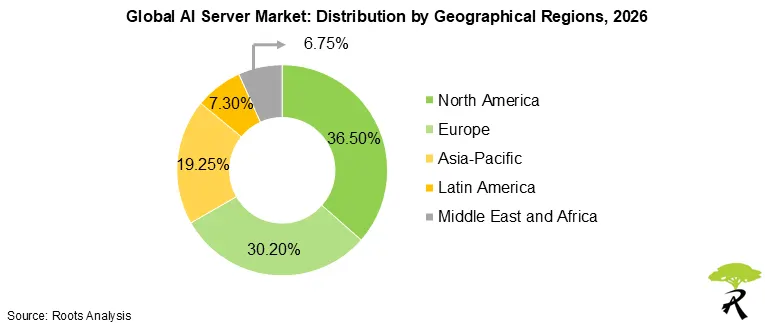
Based on the AI server market forecast, North America is leading the market, holding a 36.5% of the overall market share. The highest share is supported by the concentration of hyperscale data centers, leading AI technology vendors, and sustained public and private sector investment in AI infrastructure.
In addition, the US strategy for 2026 is defined by the "America First AI Action Plan," which emphasizes the export of the US tech stacks as a cornerstone of international strategy.
- The US has successfully set the bar with a total of USD 159 billion AI funding, secured by the US based companies. Notably, the San Francisco Bay Area alone raised USD 122 billion (over three quarters) of AI funding in the US.
- Robust investment by government in AI infrastructure advancements and defense AI is driving the opportunities for the market players.
- The US government allowed NVIDIA to export its advanced H200 chips to China, a tactical move to ensure the world remains dependent on American technology while maintaining a "compute edge" through the retention of the most advanced (Blackwell and Rubin) systems for domestic use.
APAC and India: The Manufacturing Hub and the IndiaAI Mission
The Asia-Pacific region is the fastest-growing market, registering a CAGR of 40% based on the AI server industry analysis. This is driven by aggressive national AI strategies, rapid data center construction, and accelerating enterprise digitalization across major economies. Large-scale manufacturing capacity and policy-led AI adoption initiatives reinforce Asia-Pacific’s long-term growth outlook.
India has emerged as a major region through the “IndiaAI Mission,” which received a USD 1.25 billion (INR 10,371 crore) budget outlay over five years.
- Government Support: Digital India initiatives driving AI infrastructure investments.
- Technology Services: Global IT services hub requiring AI server infrastructure, indicating massive growth of AI server industry in Asian region.
Want Information on Specific Region / Segment?
Market Ecosystem Insights
AI Server Competitive Landscape
The global AI server market competitive landscape is currently undergoing a power flip. While major original equipment manufacturers, such as Dell and HPE concentrated on partnerships and collaborations, the startup companies are leveraging funds and investments from venture capitals to strengthen their services and product portfolio. Some of the recent initiatives of the industrial players to maintain competitive edge are mentioned below:
- NVIDIA: Dominant AI accelerator provider with 90%+ GPU market share for AI workloads, anchoring entire ecosystem through CUDA software and platform partnerships.
- Dell Technologies: Leading the market as the biggest AI-centric infrastructure provider (IDC ranking), driving Dell AI Factory with NVIDIA across full solution stack
- HPE: Leading secure AI factory deployments with emphasis on hybrid cloud, confidential computing, and government applications.
- Supermicro: Pure-play AI server specialist with first-to-market liquid cooling innovations and modular data center building block solutions.
- Lenovo: Third-largest server vendor globally, leveraging Neptune liquid cooling and hybrid AI positioning from cloud to edge.

AI Server Market Opportunity Analysis
- Emergence of Custom Silicon and ASICs by Hyperscalers: Hyperscalers (AWS, Microsoft Azure, and Google Cloud) are accelerating development of proprietary AI accelerators tailored to internal workloads, reshaping procurement dynamics. This shift opens pathways for chip designers and system manufacturers to deliver customized, high-volume solutions aligned with hyperscaler performance, efficiency, and cost objectives.
- Verticalization of AI Workloads in Enterprise: AI server adoption is expanding into industry-specific deployments with distinct performance, data, and compliance requirements. Sector-focused workloads are creating demand for tailored server configurations and software stacks optimized for domain-specific inference and Edge AI server applications.
- Advancements in Liquid Cooling Technology for AI Servers: Rising power densities in AI servers are exceeding the practical limits of conventional air cooling, elevating operational strain. Adoption of liquid-based cooling approaches presents a clear opportunity to improve thermal efficiency, manage operating overhead, and support higher-performance hardware deployments.
Your Business is Unique – Why Shouldn’t Your Report Be?
AI Server Market: Scope of the Report
| Key Report Attributes | Details | |
| Historical Trend | Since 2022 | |
| Forecast Period | Till 2040 | |
| Market Size 2026 | $ 47.04 Billion | |
| Market Size 2040 | $ 1,487.47 Billion | |
| CAGR (Till 2040) | 27.98% | |
| Segments Covered |
|
|
Market Segmentation
Based on the research, we have segmented the AI server market into type of processor, type of deployment, type of server, type of cooling technology, type of form factor, application, enterprise size, end use industry, geographical regions, and key players.
By Type of Processor
- GPU (Graphics Processing Unit)
- CPU (Central Processing Unit)
- ASIC (Application-Specific Integrated Circuit)
- FPGA (Field-Programmable Gate Array)
By Type of Deployment
- On-Premise
- Cloud
- Edge
By Type of Server
- AI Data Server
- AI Training Server
- AI Inference Server
- Others
By Type of Cooling Technology
- Air Cooling
- Liquid Cooling
- Hybrid Cooling
By Type of Form Factor
- Rack-Mounted Servers
- Blade Servers
- Tower Servers
By Application Area
- Natural Language Processing (NLP)
- Computer Vision
- Predictive Analytics
- Generative AI
By Enterprise Size
- Large Enterprises
- Small and Medium Enterprises (SMEs)
By End Use Industry
- Automotive & Transportation
- IT & Telecommunications
- Healthcare & Life Sciences
- BFSI (Banking, Financial Services, and Insurance)
- Others
By Geographical Regions
- North America
- US
- Canada
- Mexico
- Rest of North America
- Europe
- Austria
- Belgium
- Denmark
- France
- Germany
- Ireland
- Italy
- Netherlands
- Norway
- Russia
- Spain
- Sweden
- Switzerland
- UK
- Rest of Europe
- Asia-Pacific
- Australia
- China
- India
- Japan
- New-Zeeland
- Singapore
- South Korea
- Rest of Asia-Pacific
- Latin America
- Brazil
- Chile
- Colombia
- Venezuela
- Rest of Latin America
- Middle East and Africa (MEA)
- Egypt
- Iran
- Iraq
- Israel
- Kuwait
- Saudi Arabia
- UAE
- Rest of MEA


