


 Download Free Sample
 Buy Now
Market Size
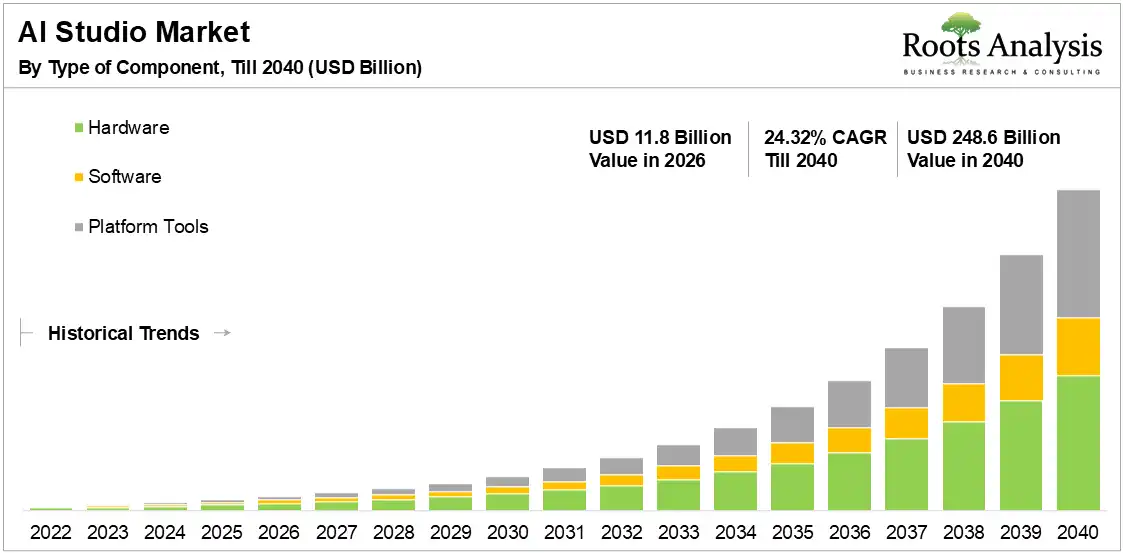
The global AI Studio market reached USD 11.8 billion in 2026 and is projected to grow to USD 248.6 billion by 2040, registering a CAGR of 24.32% over the forecast period 2026 to 2040, driven by enterprise-scale generative AI workflow automation.
See What’s in the Full Report – Request Your Complimentary Insights!
Market Report: Key Takeaways
- Based on component, software captures 48.0% market share in 2026, whereas platform tools register a 29.24% CAGR through 2040, driven by enterprise agent orchestration demand.
- On the basis of deployment mode, cloud captures 52.0% market share in 2026, likewise Cloud registers a 27.4% CAGR through 2040, driven by hyperscale AI infrastructure expansion.
- With respect to enterprise size, large enterprises capture 68.0% market share in 2026, whereas small and medium-sized enterprises (SMEs) register a 29.12% CAGR through 2040, enabled by low-code AI deployment.
- Based on application, predictive modeling and forecasting captures 21.0% market share in 2026, whereas AI agent development registers a 33.8% CAGR through 2040, driven by autonomous enterprise workflows.
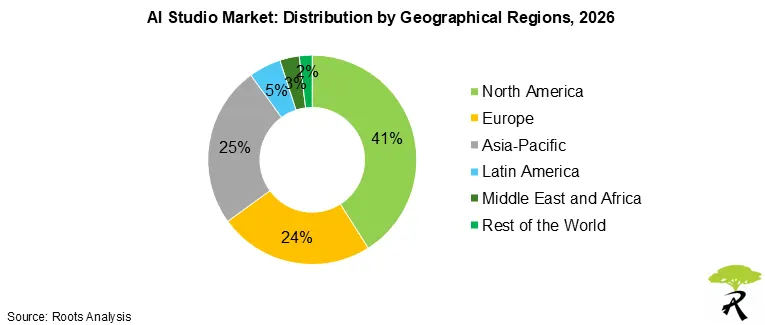
- Based on geographical regions, North America captures 41% market share in 2026, whereas Asia-Pacific registers a 30.0% CAGR through 2040, supported by accelerating regional AI digitization.
AI Studio Market Outlook
The AI Studio market has shifted from isolated developer sandboxes to integrated enterprise platforms in under three years. Foundation model providers, hyperscalers, and data platform vendors now compete inside the same buyer accounts. Earlier deployments centered on model training experiments, while current spending targets agent orchestration, governance, and production deployment. Compute supply remains tight for top-tier GPUs, and enterprises increasingly select platforms based on managed inference economics rather than feature breadth alone.
Enterprise demand for production-ready generative AI drives current growth across deployment, components, and applications. Regulatory pressure on AI governance also pushes buyers toward vendors with built-in audit, lineage, and risk controls. The EU AI Act has accelerated compliance-led procurement across European enterprises. In May 2026, SAP launched a unified AI and automation suite combining AI agents, enterprise data, and workflow orchestration tools. Bundled platform purchases now displace point-tool procurement.
The AI Studio market will expand from USD 11.8 billion in 2026 to USD 248.6 billion by 2040, registering a 24.32% CAGR. Agent frameworks, multimodal generation, and managed inference will reshape platform economics across the period. In January 2026, IBM expanded watsonx.ai studio features with enhanced governance and enterprise-grade AI lifecycle tooling. The market remains high-growth through 2030, then moderates as enterprise deployment matures and pricing normalizes.
AI Studio Market Size Estimation Methodology
- As a starting point, the research team identified historical AI Studio market revenue from 2022 to 2025. Data sources included hyperscaler AI platform disclosures, foundation model provider revenue filings, server shipment data, and independent industry datasets. Reported AI Studio market estimates from credible sources ranged from USD 4.6 billion to USD 8.6 billion between 2023 and 2025. Forecast CAGRs across these sources varied between 36% and 40% in initial coverage.
- Moving forward, the team normalized values across sources by isolating AI studio platform revenues from broader generative AI software and infrastructure categories. Extreme bullish forecasts above 40% long-term CAGR were partially discounted during this step. These projections assumed full-stack generative AI market inclusion rather than AI studio platform revenues specifically. Normalization also removed double-counting between AI infrastructure spending and AI Studio software licensing revenue streams.
- Building on this, the team examined hyperscaler capex disclosures, foundation model pricing trends, and managed inference service revenue trajectories. Microsoft Azure AI Foundry, AWS SageMaker, Google AI Studio, and IBM watsonx.ai revenue signals informed cloud deployment share assumptions. Public software vendor filings from Salesforce, SAP, and Databricks were also reviewed for AI-attributable revenue segments. Pricing observations covered subscription tiers, credit consumption models, and enterprise contract sizes across 2024 and 2025.
- Drawing upon these signals, the team applied demand-side inputs from enterprise AI adoption surveys, IT spending forecasts, and segment-specific deployment rates. Application share assumptions reflect current pilot-to-production conversion ratios across BFSI, healthcare, and manufacturing accounts. Enterprise size split assumptions also incorporate observed SME platform pricing changes during 2025. Geographic share inputs drew from regional cloud capacity expansions, sovereign AI program funding, and country-level enterprise software penetration rates.
- The projected value was then generated using a bottom-up revenue model layered with segment cross-checks. Segment-level CAGR assumptions reflect infrastructure constraints, enterprise governance friction, monetization normalization, and gradual transition from experimentation toward operational deployment. The 24.32% consensus CAGR sits below near-term industry source projections but above macroeconomic IT spending baselines. Cross-checks compared projected revenue against expected enterprise AI penetration across large and mid-market accounts.
- Finally, the model output was cross-checked against independent data points and external industry baselines. Validation covered AI Studio platform pricing, hyperscaler AI revenue disclosures, and post-2025 enterprise AI adoption indicators. The final consensus value reached USD 11.8 billion in 2026 and USD 248.6 billion by 2040. Forecast assumptions will be revisited as foundation model pricing, governance regulation, and enterprise deployment economics evolve.
AI Studio Market Share Insights
Market Share by Type of Component
Presently, software segment dominates the market, accounting for 48% of the global market share in 2026. Software platforms dominate because enterprises still prioritize core AI model development, orchestration, and deployment capabilities. Most commercial adoption currently focuses on foundational workflow enablement rather than advanced composable tooling. In April 2025, Adobe expanded Firefly enterprise creative AI software capabilities across multimedia production workflows.
Meanwhile, platform tools will show robust growth momentum, anticipated to register a CAGR of 29.2% during the forecast period 2026-2040. Platform tools will expand rapidly because enterprises increasingly require reusable AI agents, low-code orchestration, and governance layers. Organizations also seek vendor-neutral tooling supporting multiple foundation models simultaneously. In May 2025, IBM introduced enhanced watsonx AI agent orchestration capabilities for enterprise environments.
Market Share by Application
According to our analysis, predictive modeling and forecasting occupies 21% of the overall revenue share in 2026. Predictive modeling and forecasting lead because enterprises prioritize operational optimization, risk management, and business planning automation. These workloads also integrate directly with existing analytics infrastructure and structured enterprise datasets. In February 2025, SAP expanded Joule AI forecasting capabilities across enterprise resource planning workflows.
Conversely, AI agent development segment is likely to grow at a CAGR of 33.8% during the forecast period through 2040. AI agent development will accelerate as enterprises deploy autonomous workflows for coding, research, operations, and customer interaction tasks. Improved reasoning models and orchestration frameworks are also enabling multi-agent enterprise automation. In April 2025, OpenAI introduced expanded agent-building capabilities inside its developer platform ecosystem.
Want Information on Specific Region / Segment?
Regional Analysis: North America Leads the Market and Asia-Pacific Growth at Higher CAGR
North America holds 41% market share in 2026
The region leads because it combines advanced cloud infrastructure, strong venture funding, and deep enterprise AI adoption maturity. Major hyperscalers and semiconductor vendors also continue expanding dedicated AI infrastructure capacity across the United States and Canada. In January 2025, Microsoft announced expanded AI infrastructure investments supporting next-generation AI workloads.
Asia-Pacific will Register a 30.0% CAGR Through 2040.
The region benefits from rapid enterprise digitization, expanding AI developer ecosystems, and government-backed AI investment strategies. India, China, Japan, and Southeast Asia are also accelerating enterprise AI deployment across manufacturing, finance, and telecommunications sectors. In February 2026, Anthropic confirmed strong enterprise AI adoption growth across India following regional expansion efforts.
Market Ecosystem Analysis
AI Studio Market Competitive Landscape
The AI Studio market is consolidating around vertically integrated enterprise AI platforms that combine foundation models, orchestration, observability, governance, and accelerated infrastructure within unified development environments. Hyperscalers and enterprise platform vendors increasingly bundle proprietary models, agent tooling, GPU infrastructure, and workflow automation into single commercial stacks, reducing integration complexity for enterprise deployments.
Platform convergence currently reshapes competitive behavior more than standalone model innovation. Vendors increasingly compete on enterprise-grade orchestration, agent lifecycle management, governance controls, and inference optimization rather than isolated model performance alone. Microsoft, Databricks, Google, OpenAI, and NVIDIA accelerated this transition through expanded AI studio environments, multi-model hosting, and enterprise AI operations capabilities during 2025 and early 2026.
Top Established Companies and Their Initiatives
Large cloud vendors increasingly integrate model hosting, orchestration, observability, and governance into centralized AI studio environments. On the other hand, data platform providers increasingly position AI studios directly alongside enterprise data orchestration and governance layers.
- Microsoft Corporation launched proprietary MAI-Transcribe-1, MAI-Voice-1, and MAI-Image-2 models through Foundry during April 2026. The release reduced Microsoft's dependence on external frontier model providers while increasing platform stickiness for enterprise developers building multimodal applications.
- Amazon Web Services continued expanding SageMaker's unified AI development environment across enterprise customers during 2025, while Google LLC accelerated Gemini AI Studio adoption through integrated generative AI workflows and developer APIs. Both vendors intensified competition around centralized AI development environments instead of standalone infrastructure provisioning.
- Databricks made Mosaic AI Gateway generally available during June 2025, centralizing governance and monitoring for enterprise generative AI models. The release addressed enterprise concerns surrounding observability, policy enforcement, and production-grade AI operations across distributed teams.
- Snowflake and Dataiku expanded enterprise AI development capabilities throughout 2025 by integrating AI workflow orchestration, collaborative modeling, and governance within broader enterprise analytics ecosystems. This convergence intensified competitive pressure on standalone AI development platforms.
Startup Companies and their Key Highlights
The AI studio market in 2026 has emerged as one of the most dynamic and heavily capitalized segments of the global technology landscape, driven by a new generation of startups that have transitioned from experimental prototypes to production-grade enterprise platforms. Leading organizations are increasingly adopting enterprise-wide AI strategies built around centralized “AI studios” integrated hubs that bring together reusable technology components, frameworks for assessing use cases, and the operational muscle required to deploy AI at scale.
The most prominent players include OpenAI, xAI, Anthropic, and Databricks, which collectively dominate valuation rankings, while fast-growing startups such as Anysphere, Cognition AI, and Harvey are rapidly scaling from early-stage ventures to unicorn status.
- Anthropic: Raised a $30 billion Series G funding round in February 2026, valuing the company at $380 billion, with participation from over 30 investors including Founders Fund, Coatue, and Nvidia.
- xAI (Elon Musk): Opened 2026 with a $20 billion Series E round in January, with investors including Valor Equity Partners, Fidelity, and the Qatar Investment Authority.
- Cursor (Anysphere): Reached $2 billion in annualized revenue by February 2026 and forecasts an ARR run rate above $6 billion by year-end, representing the fastest ARR growth trajectory in B2B software history.
Your Business is Unique – Why Shouldn’t Your Report Be?
Market Access Considerations
Compute Allocation and GPU Access
Access to high-performance accelerators directly determines who can train, fine-tune, and serve enterprise-grade AI models. Top-tier NVIDIA H100 and Blackwell allocation remains rationed across hyperscalers and large model labs through 2026. Smaller AI Studio vendors face longer deployment timelines without preferred cloud partner agreements. Scaling generative AI workloads also requires sustained capex on networking and liquid cooling. Compute access therefore caps near-term competitive positioning more than pricing or feature differentiation.
Data Residency and Sovereign AI Compliance
Data residency requirements are reshaping which AI Studio vendors can serve regulated buyers. The EU AI Act, India's DPDPA 2023, and Chinese cybersecurity rules require localized data processing for many enterprise workloads. Vendors without in-region inference capacity lose access to BFSI, healthcare, and public-sector accounts. Sovereign AI programs across the EU, UAE, and India also favor vendors with local infrastructure commitments. Regional cloud zone presence is now a baseline procurement filter.
AI Governance and Audit Requirements
AI governance frameworks are setting hard procurement thresholds inside large enterprises. Buyers increasingly require model lineage, prompt logging, evaluation traceability, and bias monitoring built into the AI Studio platform itself. The EU AI Act high-risk classification triggers additional documentation, conformity assessment, and post-market monitoring obligations. Vendors lacking native governance features either lose deals or absorb compliance costs onto integrators. Governance maturity now influences enterprise win rates more than raw model performance.
Foundation Model Licensing and Partner Access
Foundation model partnerships shape which AI Studio platforms enterprise buyers will consider. Exclusive or preferred-access agreements with OpenAI, Anthropic, Google, Mistral, and Meta create meaningful capability gaps between vendors. Platforms without multi-model access cannot meet enterprise interoperability requirements that emerged through 2025. Licensing costs, rate limits, and indemnification terms also vary widely across foundation model providers. Strategic partner depth therefore drives both speed-to-market and gross margin structure for AI Studio vendors.
How Stakeholders Benefit from the Key Focus Areas of Our AI Studio Market Report
AI Studio platforms have become the primary procurement category for enterprise AI deployment. The market will grow from USD 11.8 billion in 2026 to USD 248.6 billion by 2040. Foundation model commoditization, agent-centric workflows, and tightening AI governance regulation are reshaping vendor selection criteria across every major sector. This report supports strategic, investment, technology, and partnership decisions in a market still moving from experimentation to production deployment.
- Unmet Needs and Market Gaps in AI Studio: The report identifies underserved buyer segments and capability gaps across deployment models and applications. SMEs remain under-monetized despite a projected 29.1% CAGR through 2040 and growing pricing accessibility. Vertical-specific agent templates for healthcare, manufacturing, and BFSI are still scarce relative to demand. Strategy and product teams use this analysis to prioritize feature investment and target whitespace customer segments.
- Funding and Venture Investment Opportunities in AI Studio: The report maps capital allocation patterns across foundation model providers, MLOps platforms, agent frameworks, and governance tooling. AI Agent Development carries the highest segment CAGR at 33.8% through 2040, with multiple emerging-stage companies competing inside it. Generative AI and AI Agent Frameworks technology segments are also concentrating venture funding. Investment teams use the segment-level CAGR data and competitive maps to size opportunities and benchmark portfolio exposure.
- Technology Innovation and Adoption Trends: The report tracks adoption velocity across machine learning, NLP, computer vision, generative AI, reinforcement learning, and AI agent frameworks. Generative AI technology share rises from 20.0% in 2026 to 29.0% by 2040 at a 31.2% CAGR. AI Agent Frameworks expand from 9.0% to 15.0% over the same period. Technology leaders use this data to plan stack investments and align engineering roadmaps with adoption inflection points.
- AI Studio Market Competitive Landscape and Industry Analysis: The report profiles 25 vendors across Tier 1 leaders, Tier 2 specialists, and emerging-stage providers. Microsoft, Google, AWS, IBM, Oracle, SAP, Salesforce, Databricks, OpenAI, and NVIDIA hold Tier 1 positioning. DataRobot, C3 AI, H2O.ai, Dataiku, Altair, Snowflake, Hugging Face, Palantir, and Intel anchor the Tier 2 group. Strategy and corporate development teams use the landscape to benchmark positioning and identify acquisition or partnership candidates.
- Mapping Strategic Partnerships and Ecosystem Synergies: The report tracks partnership activity across hyperscalers, foundation model labs, semiconductor vendors, and system integrators. NVIDIA and Google Cloud expanded collaboration on generative AI infrastructure in March 2025, illustrating the depth of cross-stack alignment. Business development teams use the partnership maps to identify co-sell, OEM, and integration opportunities. The analysis also flags whitespace where ecosystem coverage is thin, and partner economics remain attractive.
AI Studio Market: Scope of the Report
| Key Report Attributes | Details | |
| Forecast Period | Till 2040 | |
| Market Size 2026 | USD 11.8 Billion | |
| Market Size 2040 | USD 248.6 Billion | |
| CAGR (Till 2040) | 24.32% | |
| Segments Covered |
|
|
| Geographical Regions Covered |
|
|
| Key Sections Covered |
|
|
Source: Roots Analysis
Market Segmentation
The AI studio market report presents an in-depth analysis, highlighting the capabilities of various stakeholders, based on different segments such, component, deployment model, enterprise size, application, technology type, end user industry, geographical regions, and leading players.
By Component
- Software
- Services
- Platform Tools
By Deployment Mode
- Cloud
- On-Premises
- Hybrid
By Enterprise Size
- Large Enterprises
- Small and Medium-Sized Enterprises (SMEs)
By Technology Type
- Machine Learning
- Natural Language Processing
- Computer Vision
- Generative AI
- Reinforcement Learning
- AI Agent Frameworks
By Application
- Predictive Modeling and Forecasting
- Customer Service Automation
- Sentiment Analysis
- Image Classification and Labeling
- Synthetic Data Generation
- Automatic Content Creation
- AI Agent Development
- Others
By End User Industry
- BFSI
- Healthcare and Life Sciences
- Retail and E-commerce
- Manufacturing
- IT and Telecommunications
- Media and Entertainment
- Government and Defense
- Automotive and Transportation
By Geographical Regions
- North America
- US
- Canada
- Mexico
- Rest of North America
- Europe
- Austria
- Belgium
- Denmark
- France
- Germany
- Ireland
- Italy
- Netherlands
- Norway
- Russia
- Spain
- Sweden
- Switzerland
- UK
- Rest of Europe
- Asia-Pacific
- Australia
- China
- India
- Japan
- New-Zealand
- Singapore
- South Korea
- Rest of Asia-Pacific
- Latin America
- Argentina
- Brazil
- Chile
- Colombia
- Venezuela
- Rest of Latin America
- Middle East and North Africa (MENA)
- Egypt
- Iran
- Iraq
- Israel
- Kuwait
- Saudi Arabia
- UAE
- Rest of MENA
- Rest of the World


