
Lowest Price Guaranteed
Slides
185
Last Updated
August 2026
View Count
12937
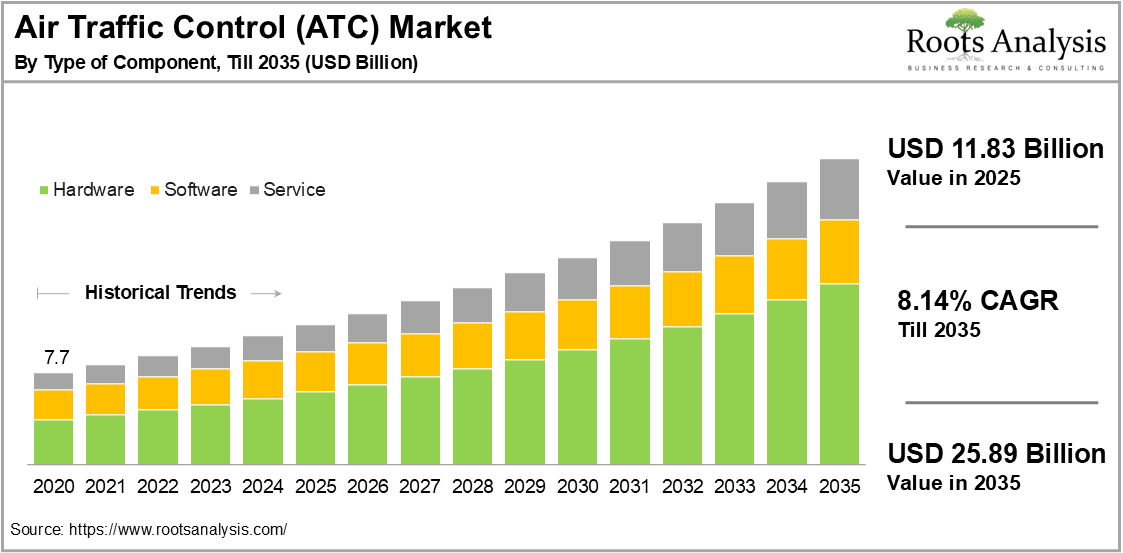
The air traffic control (ATC) market size is projected to grow from USD 11.83 billion in 2025 to USD 25.89 billion by 2035, representing a CAGR of 8.14% during the forecast period till 2035.
 |
The new research study consists of air traffic control (ATC) market and trends analysis, detailed market forecast analysis, and provides actionable strategic recommendations.
With the exceeding growth of air traffic around the world and increasing airport infrastructure modernization, the air traffic control (ATC) market is evolving rapidly. Air traffic control (ATC) refers to the service to manage an aircraft's safe and efficient movement within controlled airspace and on the ground. The major purpose of the ATC is to ensure that aircraft are safely separated, and guided during their flights and provide necessary instruction for take-off, landing, and taxiing. It incorporates communication between air traffic controllers and pilots to prevent collisions and manage air traffic flow. Driven by technological advancements, ATC offers advanced solutions and services that facilitate air traffic controllers to manage safe and orderly air traffic operations.
The significant applications across navigation, communication, and surveillance continue to drive global demand for advanced air traffic control (ATC) software solutions. Driven by rapid technological advancements, the integration of artificial intelligence (AI) and automation has significantly expanded the market outlook. Concurrently, deployment of next-generation communication systems within ATC networks remains critical to ensuring real-time, ultra-reliable data exchange between air traffic controllers and pilots. Also, the innovation in performance-based navigation systems enables more precise and efficient flight paths, transforming the industry by reducing fuel consumption and improving air traffic management. Besides this, the expanding unmanned aerial vehicle (UAV) integration, such as drones for commercial and recreational purposes is generating the need for ATC systems capable of integrating unmanned traffic.
As an impact, stakeholders and solution providers in the industry are actively investing in the development of advanced unmanned aerial systems.For instance, in April 2024, Japan’s Terra Drone a leader in drone and advanced air mobility technology collaborated with Unifly NV and Aloft Technologies to develop UAS Traffic Management systems for AAMs, aiming at global markets. Apart from this, the lack of skilled workforce and issues in the integration of the advanced solution with existing systems can be leading challenges that can impede the adoption of air traffic control automation solutions. Despite these hurdles, this integration is essential for improving ATC efficiency, safety, and scalability with skilled professionals. Consequently, the market is projected to flourish at an incredible growth rate driven by key drivers and the ongoing industry trend of integration of advanced technologies that are transforming the future of air traffic management.
The air traffic control market report presents an in-depth analysis of the various companies that are involved in offering air traffic control, across different segments, as defined in the table below:
| Key Report Attributes | Details | |
| Historical Trend | Since 2020 | |
| Forecast Period | Till 2035 | |
| Current Market Size | $ 11.83 Billion | |
| Market Size Value by 2035 | $ 25.89 Billion | |
| CAGR (Till 2035) | 8.14% | |
| Type of Component |
|
|
| Type of Airspace |
|
|
| Type of Application |
|
|
| Type of Sector |
|
|
| Type of Airport Size |
|
|
| Geographical Regions |
|
|
| Leading Market Players | ||
| PowerPoint Presentation (Complimentary) | Available | |
| Customization Scope | 15% Free Customization | |
| Excel Data Packs (Complimentary) |
|
|
This segmentation of the air traffic control market explains the type of component wherein the hardware has been a leading segment by holding (~49%) of the current market share. Hardware comprises vital systems ranging from radar systems, communication systems, and navigation systems that are essential for airspace management. Due to being the backbone of the ATC operations, the segment is expected to continue to elevate the market growth.
Additionally, the software segment is gaining traction in the market and is expected to rise at a (9.81%) CAGR during this projection period. This growth is attributed to the growing advancements in automation, artificial intelligence, and digitalization which are transforming the traditional air traffic safety systems into more efficient and adaptable platforms.
Based on the type of airspace, the air traffic control tower (ATCT) segment is projected to capture (~47%) of the market share by 2035. ATCT handles aircraft during the cruising phase of flights and typically dominates the market due to the extensive need for long-range radar systems for air traffic control. Furthermore, the terminal radar approach control (TRACON) segment is anticipated to rise at a substantial (10.54%) CAGR throughout this forecast period driven by its importance in handling a high volume of aircraft during critical phases from approach and departure which is essential for airspace safety and efficiency.
The distribution of the air traffic control market based on application is divided into automation, communication, navigation, and surveillance. According to our air traffic control industry analysis, the surveillance application is predicted to lead the segment with (~45%) of the market share by 2035. This growth can be accredited to the critical role of surveillance systems for safety where radar and ADS monitor aircraft position in real-time and ensure situational awareness and collision avoidance.
Moreover, communication applications are essential for real-time coordination between controllers, pilots, and ground staff. Growing advancements in technologies such as Controller Pilot Data Link Communications (CPDLC) enhance the prominence of communication systems. As a result, the communication segment is expected to grow at a notable (11.28%) growth rate over this forecast period.
This segment highlights the type of sectors in the market which are divided into commercial and military. According to this air traffic control market size forecast report, the commercial segment has been a dominating sector in the ATC market and is anticipated to retain this position driven by high traffic volume, economic impact, and expanding airport infrastructure. Also, commercial aviation leads in implementing cutting-edge technologies to manage increasing airspace congestion. Therefore, the segment will likely grow at (10.37%) CAGR throughout this projection timeframe.
On the basis of the type of airport size, the large size airport dominates the segment by capturing (~50%) of the current market share. Large international airports manage high air traffic and necessitate advanced ATC systems for complex operations and drive the demand for cutting-edge technologies similar to digital towers. In addition, their continuous growth and infrastructure investment strengthen the market demand. While the medium size airports are emerging significantly and propelling the demand for advanced air traffic control technologies. Consequently, the medium-sized airports are estimated to expand at a higher CAGR of (9.64%) during the projection period.
This segment highlights the distribution of the air traffic control (ATC) market across various geographical regions, such as North America, Europe, Asia, Latin America, the Middle East and North Africa, and the rest of the world. From a revenue perspective, North America is poised to capture the highest (~48%) of the market share by 2035.
Furthermore, Europe is expanding at a remarkable (10.72%) growth rate and is estimated to continue to rise during this forecast period. This growth is mainly attributed to the high air traffic density and leadership in aviation technology. Besides, the EU-led initiative integrates fragmented national systems into a unified airspace further pushing modernization and advanced technology adoption, thereby, accelerating the market growth. For instance, in December 2024, EUROCONTROL, the civil-military organization managing European aviation, launched the first air traffic management digital platform on a public cloud developed by Indra. This move is advancing the digitalization of Europe’s aviation network.
Apart from these regions, Asia is emerging as a strong market for air traffic management systems due to rapid growth in air travel and huge investments for airport infrastructure modernization in the region. For example, in December 2024, Kuala Lumpur International Airport, a major aviation hub in Southeast Asia, upgraded to IP with the R&S Series5200 radios and the R&S RCMS II monitoring system, improving its operations. These digital solutions are developed by Rohde & Schwarz’s advanced ATC technology.
The “Air Traffic Control (ATC) Market, Till-2035: Industry Trends and Global Forecasts” report features an extensive study of the current market landscape, market size, and future opportunities within the air traffic control market, during the given forecast period. The market report highlights the efforts of several stakeholders involved in this rapidly emerging segment of the service providers industry. Key takeaways of the air traffic control market report are briefly discussed below.
The global as well as regional air traffic growth is the primary driver that is escalating the ATC market progress. The aviation industry has experienced substantial growth in both passenger and cargo air traffic over the years. This surge is driven by the rising tourism and business travel and the expansion of low-cost carriers which has enhanced the need for more flights, requiring efficient ATC systems. Besides this, increasing airport expansion projects and the rise in investment in ATC infrastructure are also significantly contributing to the air traffic control market growth. Government and private stakeholders are investing in new upgraded airports thus, fueling the air traffic control equipment market demand. Additionally, increased implementation of artificial intelligence in air traffic management due to technological advancements expanding the demand for advanced air traffic control technologies and creating new opportunities for market expansion.
The air traffic control market is highly competitive with the presence of established global leaders as well as regional players and emerging startups. Companies such as Thales, Raytheon, Saab, Indra Sistemas, and many more are the major contributors to stimulating the growth of the market. These key players position themselves in the market through their technological innovation, product reliability, and service offerings. Meanwhile, newcomers are striving to gain momentum in the market by emphasizing sustainability initiatives and cyber security concerns. These companies are employing competitive strategies, forming partnerships, and following industry trends that support them to gain a competitive edge.
The significant challenge in the growth of the ATC market is the integration issue of advanced technologies and the shortage of skilled workforce. Illustratively, integrating advanced technologies such as AI, machine learning, and cloud-based systems into air traffic control infrastructure with legacy systems can be a challenge in modernizing ATC systems due to their complex implementation, extensive needs, and potential operational disruption. Apart from this, the scarcity of trained air traffic controllers and technical personnel to manage advanced systems can also hamper operational efficiency. Consequently, these factors highlight the need for innovation and investment that can be helpful to overcome such challenges and sustain market progress.
With regard to regional insights, North America occupies a top spot in the global market for air traffic control and is poised to be a front-runner during this forecast period. The significant dynamics such as high air traffic volume and advanced technological advancements are stimulating the market's growth in North America. The region owns some of the busiest airports and air routes worldwide which necessitate advanced and efficient air traffic control automation solutions to manage traffic safely and smoothly.
Here, it’s early adoption of cutting-edge technologies such as satellite-based navigation, and AI-powered systems aid in enhancing ATC operation. Further, the major companies such as Raytheon, L3Harris, and CAE established in the region are driving innovation in airspace management technologies and offering innovative solutions and services, augmenting market growth. For instance, in January 2025, CAE inaugurated its first Air Traffic Services training center in Montreal, Canada, and expanded its training portfolio to include air traffic controllers and flight service specialists through a partnership with NAV Canada.
Examples of key players involved in the market for air traffic control (which have also been captured in this market report, arranged in alphabetical order) include Advanced Navigation & Positioning (US), BAE Systems (UK), Cyrrus (UK), Honeywell (US), Indra Sistemas (Spain), L3Harris Technologies (US), Leonardo SPA (Italy), Lockheed Martin (US), NAV Canada (Canada), Northrop Grumman (US), Raytheon (US), Saab (Sweden), Thales (France), TRX Systems (US), and Westminster (UK). This market report includes an easily searchable excel database of all the companies who have adopted the air traffic control market.
The market report presents an in-depth analysis, highlighting the capabilities of various companies engaged in this domain, across different segments. Amongst other elements, the market report includes:
At Roots Analysis, we genuinely care about your success and understand that your business requirements are unique. While our market research reports provide valuable insights, we recognize that they might not cover every aspect you need to make well-informed strategic decisions. To account for that, we offer 15% free report customization tailored to your specific needs. Whether you require additional quantitative analysis, qualitative insights, or any other information related to the air traffic control market, reach out us today at: support@rootsanalysis.com