
Lowest Price Guaranteed
Slides
172
Last Updated
March 2026
View Count
17975
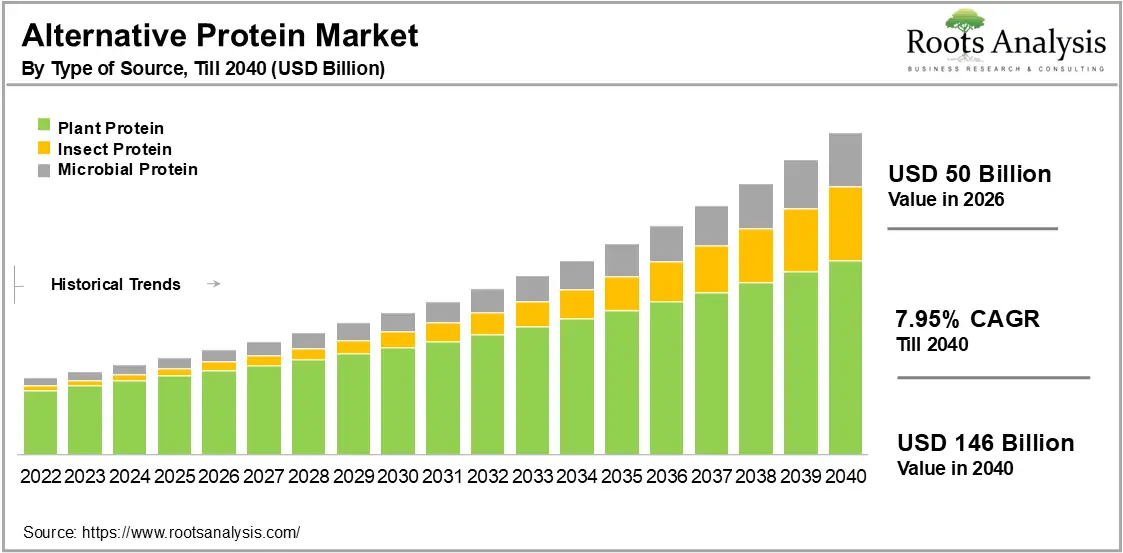
The alternative proteins market size is projected to grow from $50 billion in 2026 to $146 billion by 2040, representing a CAGR of 7.95% during the forecast period 2026-2040.
 |
To learn more about this report, request a free sample copy
The new research study consists of industry trends, detailed market analysis, key market trends of the alternative proteins market, SWOT analysis and value chain analysis.
Alternative proteins are new sources of protein derived from plants, including pea protein, or non-traditional techniques like fermentation. The purpose of these proteins is to reduce dependency on animal-based protein sources such as meat, dairy, seafood, and eggs and offer nutritional advantages to consumers with rich protein in plant-based food. Beyond providing similar meat protein nutrition, alternative proteins help reduce environmental effects and ethical considerations. Alternative protein can be obtained from various sources including plants, insects, and microbes.
Worldwide, the demand for meat and high protein products is mounting which is seemingly unattainable by current global meat production. According to a report, the annual global meat consumption is 350 million tons which pressurizes the earth’s ecosystems and this trend seems to continue in the future as well. Along with this, the continuously rising world population and their soaring need for high-value nutritional food are causing challenges for food security.
Correspondingly, alternative proteins are becoming a more appealing option to cater to this rising need. It offers high levels of essential nutrients, fiber, and healthy fats, along with eco-friendly production, make it an effective and balanced nutritious diet. Therefore, to leverage this lucrative opportunity, industry players are increasingly developing innovative products with enhanced quality, taste, and texture. As a consequence of this, the alternative proteins market is predicted to expand vigorously over this forecast period driven by the consumers' shift toward an eco-friendlier and plant-based diet, along with rising consumption of high-protein food ingredients and a growing focus on environmental impacts.
The market report presents an in-depth analysis of the various service providers that are involved in offering alternative proteins market, across different segments, as defined in the table below:
| Key Report Attributes | Details | |
| Historical Trend | Since 2022 | |
| Base Year | 2025 | |
| Forecast Period | 2026-2040 | |
| Market Size Value in 2026 | $ 50 Billion | |
| Market Size Value by 2040 | $ 146 Billion | |
| Growth Rate | CAGR of 7.95% from 2026 to 2040 | |
| Type of Source |
|
|
| Type of Application |
|
|
| Type of Nature |
|
|
| Type of Form |
|
|
| Geographical Regions |
|
|
| Leading Market Players |
|
|
| PowerPoint Presentation (Complimentary) |
Available | |
| Customization Scope | 15% Free Customization | |
| Excel Data Packs (Complimentary) |
|
|
The distribution of the global alternative proteins market is split into multiple types of sources namely insect protein, microbial protein, and plant protein. According to our projection, plant protein is poised to capture the maximum market share and will propel the segment growth over this forecast 2026-2040.
The key factor behind the growth of the segment is ascribed to the abundance of availability of raw materials like peas, canola, wheat, rice, oats, and potatoes than other sources. Also, cost efficiency for processing further supports the source demand. Whereas, the insect protein segment is likely to grow at a higher CAGR due to expanding demand for edible insects and eco-friendly high-protein for pet feeding and other purposes.
This segment highlights the variety of applications in the global alternative proteins market such as animal feed, convenience food, dairy alternatives, functional food, meat alternatives, and protein supplements. As per market research, meat alternative applications acquire the majority of the market share and are predicted to dominate the segment owing to the elevating demand for plant-based products and increasing focus on sustainable food production around the world. However, animal feed is anticipated to experience a significant CAGR during this forecast period. This can be ascribed to the rising livestock production and escalating demand for sustainable animal feed solutions.
Based on the type of nature, the global alternative proteins market is divided into conventional nature and organic nature. According to our research, conventional nature holds the highest market share and is expected to drive segment growth due to the wider accessibility of conventional products and the benefit of conventional production methods in established supply chains and economies of scale.
As for plant-based protein production, standard agricultural and manufacturing practices are used which use synthetic fertilizers or pesticides for the cultivation of sources like peas, and soy. A standard biotechnological process is used for the cultivated meat and fermentation-based protein. However, the organic segment is estimated to rise at a higher CAGR due to increasing demand for organic sources for the production of alternative protein as considered more healthy and environmentally friendly.
This segment explains the different types of forms in the global alternative proteins market which include dry and liquid. According to our analysis, the dry form of alternative protein captures the largest market share and dominates the segment. This dominance is likely to continue in the coming decade driven by high demand for protein powders, concentrates, and isolates. Their versatility, longer shelf life, and ease of use make it suitable for various applications. Furthermore, with the elevating popularity of liquid protein drinks, such as plant-based milk and ready-to-drink protein beverages, the liquid segment is projected to witness exceptional CAGR over this projection period.
This segment highlights the distribution of the market across various geographical regions such as North America, Europe, Asia, Latin America, the Middle East, North Africa, and the rest of the world. In terms of market revenue, North America holds the major alternative proteins market share and is expected to lead the market with the rising demand for nutritious plant-based food in the region. Additionally, Asia is expanding rapidly in the global market for alternative protein due to an upsurge in demand for rich-protein food with growing awareness of health and wellness. Thus, the region is expected to grow at the fastest CAGR during this forecast period.
By acknowledging the potential of the alternative protein market, industry players are more and more adopting collaboration strategies in the plant-based food industry which enable companies to combine expertise in the development of more alternative protein products and innovation in tastier plant-based food. Due to this, giant pea protein producers, cultivated meat firms, and food tech mycoprotein leaders are collaborating to avail this emerging opportunity. In addition, through collaboration, market players are reinforcing the greater alternative protein and ecosystem to scale technology and swiftly magnifying manufacturing to make alternative protein and plant-based food more cost-efficient.
The competitive landscape of the alternative proteins market is changing with the increasing number of companies in the market. Besides industry players, several food startups and biotech companies are entering and boosting the market dynamic. Mainly, established global companies dominate the market with their advanced product offerings, innovative technology, and highest market revenue.
Prominent companies constantly invest in research and development for novel alternative protein products to retain their position in the international marketplace. While, new food tech and biotech companies make efforts to develop alternative protein options and plant-based food for seafood and meat substitutes, beat the market competition. Additionally, with emergence of these protein sources, it necessitates the need for food safety and testing as well.
Primarily, the heightening demand for sustainable food and the spike in demand for plant-based protein is ascribed to be significant key drivers for the alternative proteins market growth. The sudden shift towards plant-based food production and alternative protein can be attributed to the increasing animal welfare concerns and the COVID-19 pandemic which has drastically reduced meat consumption during that period all over the world.
Additionally, a rise in the awareness of the benefits of alternative proteins which are often perceived as healthier because of lower cholesterol, saturated fats, and high- fiber as compared to animal-based proteins. Consequently, the market is likely to grow significantly driven by such factors throughout this forecast period.
With respect to regional insights, the market in North America is expanding rapidly due to which the region is likely to be a leading market for alternative protein. The higher awareness of the benefits of a healthy diet and their impact on health has led to the demand for nutritional supplements and alternative protein food in the region.
Also, consumers in North America are increasingly seeking plant-based food influenced by the rising emphasis on environmental concerns which has boosted the alternative protein demand. Additionally, the strong food & beverage industry coupled with advanced biotechnology, and the existence of biotechnology companies and research centers are attributed to reinforce the industry through their continuous research and development of novel alternative protein products, thereby, bolstering the alternative proteins market growth.
Examples of key service providers involved in the alternative proteins market (which have also been captured in this market report, arranged in alphabetical order) include ADM (US), AGT Food and Ingredients (Canada), Archer Daniel Midland (US), Axiom Foods (US), Cargill (US), Darling Ingredients (US), InnovaFeed (France), Kerry Group (Ireland), Lallemand (Canada), Puris (US), Quorn (UK), Roquette Frères (France), Tate & Lyle (UK), Wilmar International (Singapore), Ynsect (France). The Protein Brewery. This market report includes an easily searchable Excel database of all the companies who have adopted the market.