
Lowest Price Guaranteed
Slides
189
Last Updated
July 2026
View Count
19917
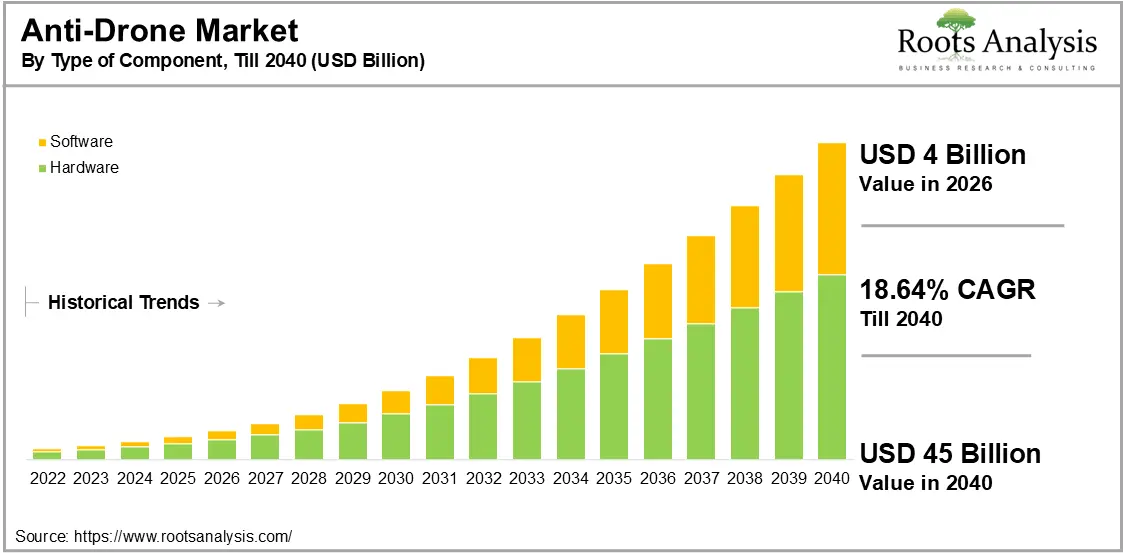
The anti-drone market size is projected to grow from USD 4 billion in 2026 to USD 45 billion by 2040, representing a CAGR of 18.64%, during the forecast period till 2040.
To learn more about this report, request a free sample copy
The new research study consists of anti-drone industry and trends analysis, detailed market forecast analysis and provide actionable strategic recommendations.
The inexpensive and easily accessible drone used in various sectors due to its reliability is now becoming a nightmare for security. These drones are being hacked by attackers and are used to breach security and exploit crucial information. Additionally, drones are also used to terminate public security. To neutralize them, types of anti-drone systems have surged. These systems are capable of searching, detecting, tracking and killing in real-time the drones that can be threats to security. Anti-Drones are specialized in differentiating between drones and other aerial objects, that equips the systems with intelligence of knowing what to kill. Few of the major advantages of these systems include enhanced fetching of information about the drone detected. Furthermore, anti-drone market offers various advanced system types, including ground-based, handheld, and UAV-based anti-drone systems.
The anti-drone market is emerging as a critical component in the global shift towards innovation and advancement of defensive services to reach higher security practices. Artificial intelligence (AI) and machine learning has played a pivotal role in demand for anti-drone systems in security, which improves rapid detection and quick responses. Additionally, advanced features such as thermal images provide effortless surveillance under any weather condition and RF scanner that allows to detect connection between drone and its controller. Consequently, with continuous technological advancements and rising investor attractions, the anti-drone market is anticipated to witness noteworthy growth during this forecast period.
The global anti-drone demand is expected to grow significantly over the forecast period due to the development of enhanced defensive systems such as anti-drone radars and thermal imaging. Notably, adoption of AI across various counter-UAVs for better mitigation strategies and accuracy will drive the market in the forecasted period.
Recently, in September 2024, Brian Schimpf, co-founder and CEO of Anduril Industries mentioned anti-drone systems will help the national security community understand and responsibly use this technology to keep our citizens safe and free.
The anti-drone market research report presents an in-depth analysis of the various companies that are involved in offering anti-drones, across different segments, as defined in the table below:
| Key Report Attributes | Details | |
| Historical Trend | Since 2022 | |
| Forecast Period | Till 2040 | |
| Market Size Value by 2026 | $ 4 Billion | |
| Market Size Value by 2040 | $ 45 Billion | |
| CAGR (Till 2040) | 18.64% | |
| Type of Anti-Drone |
|
|
| Type of Component |
|
|
| Type of Application |
|
|
| Type of Technology |
|
|
| End-Users |
|
|
| Geographical Regions |
|
|
| Leading Market Players |
|
|
| PowerPoint Presentation (Complimentary) |
Available | |
| Customization Scope | 15% Free Customization | |
| Excel Data Packs (Complimentary) |
|
|
Based on the types of anti-drone the global anti-drone market is split into ground based, handheld and UAV based. Among these categories, the ground-based segment is expected to gain the maximum market share (55.97%). Prominent reasons for this dominance include its rapid response and widespread area of coverage, making it ideal for the defense sector.
However, the UAV-based segment is expected to expand with the relatively higher CAGR of 29.47% till 2040. This can be attributed to its specialized working of searching, detecting, tracking and killing of the drone in real-time. Further, fetching of object details and RF spectrum display on GUI has boosted growth of UAVs and their impact on security concerns.
The anti-drone market is segmented into two types of components, namely hardware and software. According to our analysis, the hardware segment will augment the segment's growth with around 70.86% share in the anti-drone market. This can be attributed to rapid growth of components such as radars sensors, infrared systems and jammers. Further, ability to meet high-performance requirements, provide scalability and flexibility and enhanced solutions for applications of anti-drone technology in defense and law enforcement.
However, the software segment is anticipated to witness the fastest anti-drone market growth (29.49%) during the forecast period. The rising integration of AI in anti-drone systems and machine learning to enhance drone threat mitigation threats are some of the growth drivers.
The global anti-drone market is fragmented into multiple types of application, namely acoustic, detection radar, EO / IR and others. The detection radar segment is anticipated to dominate the segment with the highest market share of over 60%. Additionally, this segment is expected to grow with the highest CAGR of 30.02% in the forecasted period. This can be ascribed to its efficiency in neutralizing drones after detection, classification and identification. Furtherly, the system can identify any entry or exit of drone in a premises, showcasing benefits of anti-drone solutions for critical infrastructure.
On the basis of the type of technology, the anti-drone market is segmented into anti-drone radar, RF scan, thermal image, and others. As per our research, the anti-drone radar segment is projected to hold the majority of the market share (55%) and will drive the segment growth until 2040. This can be attributed to its accuracy of identifying between the drones and other aerial objects. Further, integration of AI has introduced mitigation of drone threats and future trends in counter-UAV technologies.
However, the thermal image segment is expected to grow with the highest CAGR of 28.95% in the forecasted period. Prominent reasons for this growth include its more efficient surveillance and ability of detection under any weather condition.
On the basis of end-users, the anti-drone market is bifurcated into commercial, defense and military, government, and others. As per our research, the defense and military segment is projected to hold the majority of the market share (60%) in 2026. This can be attributed to the continuous need for high-security integration provided by defense-grade anti-drone architectures. These systems are highly capable of identifying and neutralizing rogue drones across all weather conditions, which has heavily solidified their baseline adoption. However, the commercial segment is expected to register the fastest growth, advancing at a high CAGR over the forecast period 2026-2040. This rapid acceleration is primarily fueled by a surge in unauthorized drone incursions near commercial airports, critical infrastructure networks, and public event venues, necessitating immediate civilian airspace protection upgrades.
This segment highlights the distribution of anti-drone across various geographical regions, such as North America, Europe, Asia, Latin America, Middle East and North Africa, and the rest of the world. According to our analysis, North America exhibits dominance in the market with over 45% of the anti-drone market share in the global marketplace. This can be attributed to its large military budget and continuous development of defensive services
However, Asia is projected to drive the market at a higher CAGR of 29.87% during this forecast period due to rising demand of anti-drone systems in military and airports in developing countries, such as India, China and Japan.
The increasing focus on development of enhanced defensive systems, coupled with advancements in anti-drone technologies, such as anti-drone radars and thermal imaging is establishing anti-drone systems as a crucial innovation in modern security and defense infrastructure. Key driving factors include increasing adoption of AI across various counter-UAVs for better mitigation strategies and accuracy in identification of drones.
Industries such as defense and military and commercial organizations are now capable of overcoming the impact of security breaches by drones on public safety, resulted by drones. Further, the government regulations in the anti-drone sector have contributed to the rapid growth of the market. Notably, the ability to search, detect, track and neutralize in real-time has played a pivotal role in trends of anti-drones.
With the presence of several small and large anti-drone manufacturing companies, the market is experiencing intense competition and changing market dynamics. From large multinational companies to small anti-drone manufacturing players, companies are striving to enhance their competitive edge. In terms of market share, large enterprises and multinational companies are dominating the market with over 65% of the market share. While small anti-drone manufacturing players are continuously improving their products to cater to niche markets, or they are offering specialized services. These industry players are focusing on adopting competitive strategies, such as developing innovative AI solution techniques, forming strategic alliances and partnerships to expand their portfolios and global footprint, investing in recent developments and new feature launches to enhance their anti-drone offerings.
Despite strong market growth projection, anti-drone market trends face numerous challenges that impact its growth and innovation including vulnerable to hacking. These systems can be hacked and embedded with malicious software that may lead to flawed working and inaccuracy in neutralization that forwardly leads to major losses. Notably, the drone systems are being equipped with new various features that allow them to get through counter-drone systems making challenges in implementing anti-drone technologies. Further, market dynamics are influencing the adoption of anti-drone solutions.
Additionally major companies, such as Lockheed, Dedrone and DeTect are heavily influencing the market growth in the region. This concentration of tech giants fosters innovation and accelerates the deployment of AI technologies in anti-drone systems that are applicable across various sectors. Notably, there has been a strong funding attraction in the region, with ongoing government support to promote creation of anti-drone systems.
Examples of key players involved in the anti-drone market (which have also been captured in this market report, arranged in alphabetical order) include Blighter Surveillance Systems, Boeing, Dedrone, DeTect, DroneShield, Elbit Systems, Israel Aerospace, Liteye Systems, Lockheed Martin, Prime Consulting and Technologies, QinetiQ, Rafael Advanced Defense Systems, Raytheon Technology, RTX, Saab, Skylock and Thales. This market report includes an easily searchable excel database of all the companies who have adopted the anti-drone market.