
Lowest Price Guaranteed
Slides
171
Last Updated
August 2026
View Count
10569
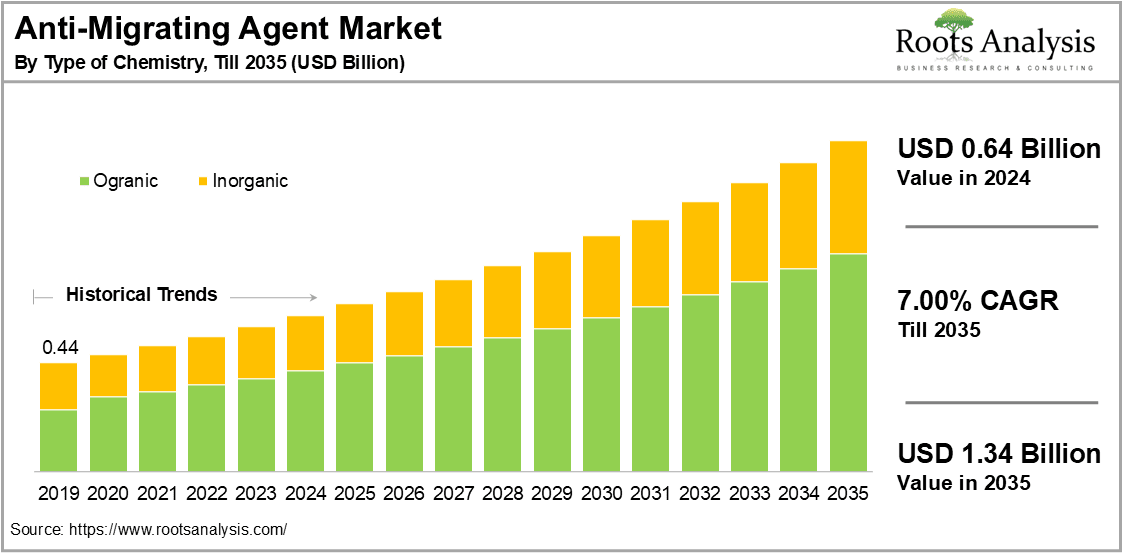
The anti-migrating agent market size is projected to grow from USD 0.64 billion in 2024 to USD 1.34 billion by 2035, representing a CAGR of 7.00% during the forecast period till 2035.
 |
To learn more about this report, request a free sample copy
The new research study consists of anti-migrating agent market and trends analysis, detailed market forecast analysis, and provides actionable strategic recommendations.
In recent years, the rapid growth of digital printing as well as the rising demand for high-quality textiles have boosted the scope of the anti-migrating agent market. Anti-migrating agents refer to chemical additives that are used to restrain the migration of dyes, pigments, inks, or other substances during or after processing which inhibit shade variation in the front, back, and center selvage. There are a variety of agents such as non-ionic, anionic, cationic, and amphoteric which are selected depending on the material and application needs.
Textile, plastics, coating, and printing are the key industries that use these agents to enhance product quality, durability, and appearance. This is due to the fact that these agents are highly used for ensuring colorfastness and uniformity in textiles even after washing or exposure to heat. Similarly, the extensive demand for adhesive and sealants is also expanding the market opportunities where they aid in offering better durability and appealing appearance of coated surfaces. Apart from these factors, the emerging trends, such as innovation in formulations and growing emphasis on bio-based agents are generating ample growth opportunities for the expansion of the market.
Bio-based agents are derived from renewable resources that align with the increasing demand for sustainable dyeing processes and products. As a consequence, manufacturers are prioritizing the development of agents that are biodegradable and have minimal environmental impact. Overall, considering the growth of the packaging industry and soaring demand for high-quality and durable fabric, the anti-migrating agent market is projected to sprout out vigorously during this forecast period.
The Anti-Migrating Agent Market report presents an in-depth analysis of the various companies that are involved in offering anti-migrating agents, across different segments, as defined in the table below:
| Key Report Attributes | Details | |
| Historical Trend | Since 2019 | |
| Forecast Period | Till 2035 | |
| Current Market Size | $ 0.64 Billion | |
| Market Size Value by 2035 | $ 1.34 Billion | |
| CAGR (Till 2035) | 7.00% | |
| Type of Agent |
|
|
| Type of Chemistry |
|
|
| Type of Application |
|
|
| Type of End User |
|
|
| Geographical Regions |
|
|
| Leading Market Players |
|
|
| PowerPoint Presentation (Complimentary) |
Available | |
| Customization Scope | 15% Free Customization | |
| Excel Data Packs (Complimentary) |
|
|
This segment of the global anti-migrating agent market features different types of agents including amphoteric, anionic, cationic, and non-ionic. As per market research, anionic segment is poised to capture the largest (~42%) of the market share by 2035. The superior dye binding quality and enhanced colorfastness are major factors in escalating the segment growth. Anionic agents are very effective on natural fibers like cotton and wool which are commonly used in the textile industry. Besides this, owing to the solubility and performance of aqueous solutions, anionic agents are significantly used in sustainable manufacturing practices.
Whereas the non-ionic segment is predicted to expand at a notable CAGR of (8.36%) during this forecast period. The wide compatibility with various substrates from plastic to coatings makes it versatile for diverse industrial applications, thereby propelling the market growth. Unlike ionic agents, these agents are effective across a broad range of pH levels which makes them suitable for requiring neutral conditions such as food packaging and sensitive textiles processing. Moreover, amphoteric anti-migrating agents are also gaining traction in the market due to their adaptability to different pH conditions which ensure superior dye migration prevention across a wide range of textile and industrial applications.
Based on the type of chemistry, the market is divided into inorganic and organic. According to our market research, the organic segment is expected to elevate the market growth with a maximum of (~64%) of the market share by 2035. The major factor behind this growth is the versatility of organic compounds that makes them highly compatible with textile, printing, and packaging applications due to their chemical adaptability. Organic variants encompass a diverse range of molecules such as polymers and dispersants that provide flexibility in formulation for different applications and super color fastness.
Additionally, the inorganic segment is anticipated to rise at a steady CAGR of (8.5%) throughout this projection period. This growth can be attributed to their superior thermal and chemical stability which makes them the popular agents in applications where materials are exposed to extreme conditions such as radiation or aggressive chemicals. Its cost-effectiveness in bulk applications and demand from specific industries will likely sustain the segment's growth.
Based on the type of application, the market is segmented into adhesive & sealants, dyeing process, and printing. With regard to market dynamics of dyeing and printing chemicals analysis, the dyeing process application is projected to occupy the largest (~44%) of the market share by 2035. Anti-migrating agents are the critical element in the dyeing process where they serve as a color fastness in textiles and provide high-quality fabric. Consequently, with the growing trend of fast fashion and e-commerce boom, the segment will continue to foster market demand in the future as well.
Moreover, the printing application segment is likely to witness a faster (9.17%) CAGR during this projection timeframe. This growth can be attributed to features of the chemical like stability, color consistency, and essentiality for quality print. These chemical agents are broadly used in the printing industry to prevent ink from migrating onto other areas of the material such as paper, plastics or textiles. These chemicals are indispensable for printing, thereby, surging the market growth.
This segment of the anti-migrating agent market explains various end users such as paper, plastic, and textile. According to our anti-migrating agent market analysis, the textile industry is projected to hold the largest (~45%) of the market share by 2035. The textile segment drives the market due to being the leading consumer where anti-migrating agents are crucial for dyeing and printing processes to prevent dye bleeding, migration, or unevenness during manufacturing. As a result, in the textile industry anti-migrating agents will continue to gain a higher demand with growing consumer preference for premium, aesthetically pleasing fabrics, and high-quality apparel.
Whereas, the plastic segment is expected to rise at a higher CAGR of (8.55%) during this forecast period. Plastic is also one of the major consumers of anti-migrating agents which are widely used in polymer applications, driving the market progress. Thus, as the demand for visually appealing and durable plastic rises, it will create the need for these chemical agents.
This segment highlights the distribution of the Anti-Migrating Agent Market across various geographical regions, such as North America, Europe, Asia, Latin America, the Middle East and North Africa, and the rest of the world. In terms of revenue, the Asia Pacific anti-migrating agent market is projected to capture the highest (~46%) share in the global marketplace by 2035. Furthermore, North America is expected to grow at a moderate CAGR of (9.02%) during this forecast period. This growth can be attributed to the existence of key industries and their greater demand for high-performance coatings, adhesives, and polymers that foster the anti-migrating agent market outlook in the region.
The “Anti-Migrating Agent Market, Till-2035: Industry Trends and Global Forecasts” report features an extensive study of the current market landscape, market size and future opportunities within the anti-migrating agent market, during the given forecast period. The market report highlights the efforts of several stakeholders involved in this rapidly emerging segment of the service providers industry. Key takeaways of the anti-migrating agent market report are briefly discussed below.
The anti-migrating agent market growth is anticipated to continue to rise due to various key drivers. One of the primary drivers is the bourgeoning demand from the textile industry. Anti-migrating agents are widely used as textile finishing chemicals in the industry to prevent color migration during dyeing and printing processes. Therefore, the mounting demand for high-quality textiles is elevating the market progress. Further, the expansion of the packaging industry with the boom of e-commerce and the retail sector is augmenting the need for advanced packaging solutions, supporting the market growth. Besides this, the heightening consumer preferences for sustainable textiles, and growing regulatory pressure to minimize volatile organic compounds are also likely to lift the demand for green solutions which will likely strengthen the market position in the upcoming decade.
Currently, numerous global and regional market players are changing the competitive landscape of the anti-migrating agent market dynamically. Due to being a niche market, each player is continuously striving to gain a competitive edge through innovation strategic partnership, acquisition, and mergers. However, established companies such as Archroma, FUJIFILM, Toyo, and others are top the key players in the anti-migrating agent market that stimulate market growth through their significant market share. Their strong emphasis on developing sustainable and eco-friendly formulations to meet environmental regulations boosts their market position. Moreover, their high capital investment in R&D for advancements in dye stabilization technology and collaboration with manufacturers in end-user industries like textiles, coating, and packaging help them to expand their global reach.
Along with the key drivers, there are some challenges such as high costs of raw materials and regulatory constraints which can hamper the potential growth of the market. The fluctuating prices of raw materials such as polymers, resins, and special chemicals can hike the product cost and make the end products more expensive, resulting in, can cause supply chain disruption. Also, the adverse environmental impact of chemical agents is one of the other considerable restraints which may also curb the market demand due to the availability of substitutes. However, these challenges can be addressed through innovation and sustainable practices to ensure steady growth of the industry.
With regard to anti-migrating agent market regional insights, the Asia region is estimated to dominate the market due to its strong textile industry and mounting demand for packaging. Asia is known for its great textile industry worldwide. Significant countries like China, India, and Bangladesh are the major consumers that widely use anti-migrating agents for manufacturing processes in the textile industry. In addition, the expansion of the automotive and e-commerce industries has widened the digital printing applications for anti-migrating agents that require these chemical agents, driving the market growth. Moreover, the growing inclination towards sustainable dyeing processes due to South Asian countries’ commitments to environmental protection is expected to amplify the demand for biodegradable anti-migrating solutions in the region which will likely contribute to the region’s dominance.
Examples of key anti-migrating agent companies involved in the anti-migrating agent market (which have also been captured in this market report, arranged in alphabetical order) include Archroma (Switzerland), Flexcrete (England), FUJIFILM (Japan), Hubergroup (Germany), ICL Performance (Israel), Koenig & Bauer (Germany), Rudolf (Germany), Sarex Chemicals (India), SNF (France), Thermo Fisher (USA), Tocris Bioscience (England), Toyo Ink (Japan), and Zschimmer & Schwarz Holding (Germany). This market report includes an easily searchable excel database of all the companies who have adopted the anti-migrating agent market.
The market report presents an in-depth analysis, highlighting the capabilities of various companies engaged in this domain, across different segments. Amongst other elements, the market report includes:
At Roots Analysis, we genuinely care about your success and understand that your business requirements are unique. While our market research reports provide valuable insights, we recognize that they might not cover every aspect you need to make well-informed strategic decisions. To account for that, we offer 15% free report customization tailored to your specific needs. Whether you require additional quantitative analysis, qualitative insights, or any other information related to the anti-migrating agent market, reach out us today at: support@rootsanalysis.com