API Testing Market by Component (API Testing Software / Tools and API Testing Services), Deployment Mode (Cloud and On-Premises), Type of Testing (Functional Testing, Security Testing, Performance Testing, Integration Testing, and Runtime and Error Detection Testing), Organization Size, Vertical (BFSI, Government, Healthcare and Life Sciences, IT and Telecommunications, Manufacturing and Industrial, and Retail and e-Commerce), Geographical Regions, and Key Players - Trends and Forecast 2026-2040
Market Size
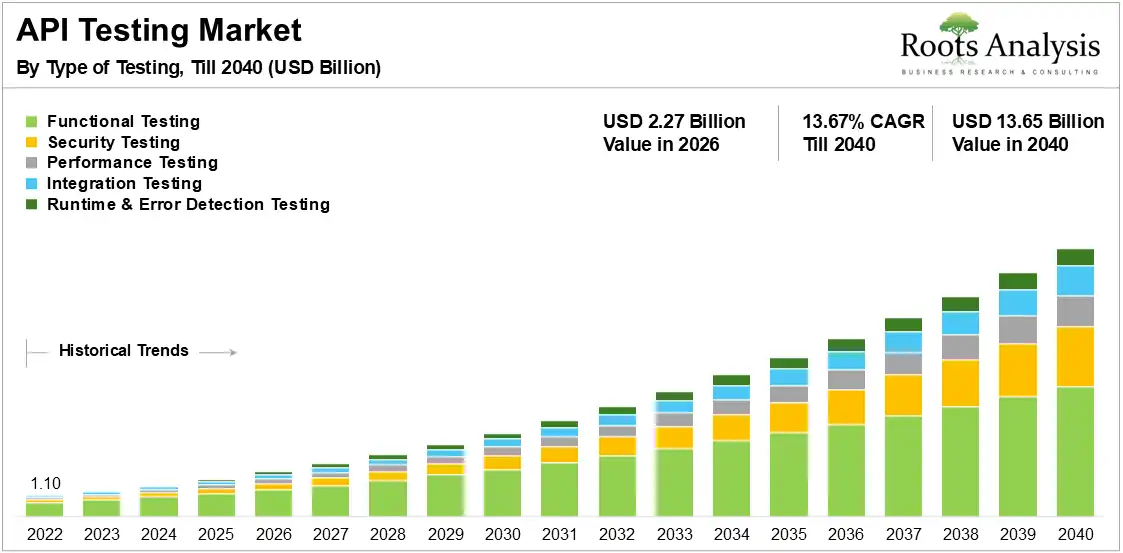
The global API testing market size is projected to grow from USD 2.27 billion in 2026 to USD 13.65 billion by 2040, representing a CAGR of 13.67% during the forecast period 2026 to 2040.
See What’s in the Full Report – Request Your Complimentary Insights!
Market Report: Key Takeaways
- In terms of components, API testing software / tools dominate the market, capturing a 72.0% share in 2026, driven by continuous pipeline integrations.
- With respect to cloud-based vs. on-premises deployment, cloud segment dominates the API testing industry (64.5%) in 2026 and is expected to grow at a higher CAGR of 14.2% till 2040.
- Based on type of testing, functional testing captures a 62.0% share in 2026, whereas security testing is poised to experience faster growth (with a 16.8% CAGR) through 2040 owing to increasing regulatory compliance requirements.
- Amongst organization sizes, large enterprises dominate the market in 2026; however, SMEs are expected to aggressively adopt scalable operational frameworks till 2040.
- Regionally, North America holds the largest share (38.5%) in 2026, while Asia-Pacific showcases faster growth at a 15.2% CAGR till 2040, rapidly expanding digital infrastructure.
- Focusing on end user industry, IT & telecommunications hold a 28.0% share in 2026, whereas healthcare sector is projected to grow at higher CAGR of 16.5% through 2040, requiring highly secure interoperability.
API Testing Market Outlook
The API testing market is transitioning from manual validation toward a continuous, AI-integrated ecosystem. This evolution addresses an operational shift, as 70% of enterprises now rely on APIs as their primary connective tissue, demanding context-aware validation for microservices.
Regulatory mandates and cloud-native architectures, comprising 55% of deployments, fundamentally reshape market dynamics. The European Union Artificial Intelligence Act, mandating strict pre-market risk assessments by August 2025, accelerates enterprise adoption of integrated threat modeling tools to secure high-velocity delivery pipelines.
Future expansion hinges on autonomous endpoints alongside the emerging model context protocol (MCP). As artificial intelligence tools utilizing large language models (LLMs) generate upcoming integration demand, deploying scalable quality frameworks and intelligent gateways becomes essential to reliably sustain the burgeoning agent economy.
API Testing Market Growth Drivers, Restraints, Challenges and Opportunities
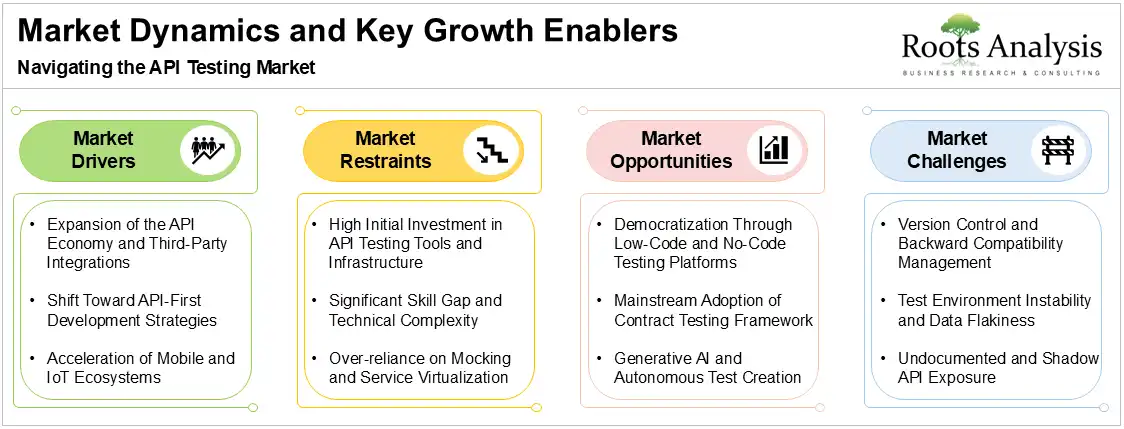
The API testing market navigates a complex interplay of structural drivers, restraints, opportunities, and challenges defining its trajectory. Accelerating IoT ecosystems drive adoption, while undocumented shadow interfaces hinder seamless integration. Strategically, autonomous test creation represents the defining opportunity to unlock scalable assurance ecosystems.
Pay Only for What You Need – The Best Way to Optimize
API Testing Market Size Estimation Methodology
- As a starting point, we defined the market scope by segmenting the API testing industry into core component types (including software tools and various services) across cloud and on-premises deployment models, while carefully categorizing supported architectures such as REST, SOAP, GraphQL, and gRPC.
- Subsequently, we analyzed enterprise demand patterns and historical software quality assurance (QA) spending, evaluating the maturity cycles of API-first development strategies alongside the accelerating adoption of microservices, continuous integration / continuous deployment (CI / CD) workflows, and the broader shift-left testing paradigm across major end-use sectors.
- Following this, we gathered comprehensive metrics on SaaS subscription volumes, open-source adoption signals, and average contract values (ACVs) through primary research with DevOps leaders, QA directors, and industry executives. We cross-validated these vendor pricing trends and enterprise licensing inputs using secondary sources, such as global IT budget reports and overall software development expenditure data.
- Synthesizing these data points, we calculated the global API testing market size and projected the long-term market opportunity. This was accomplished by employing a robust hybrid methodology that correlated validated bottom-up vendor baseline revenues with top-down algorithmic growth models, heavily driven by digital transformation metrics and enterprise cloud migration forecasts.
- The aggregate projected market value was then systematically distributed across specific components, deployment architectures, verticals and key geographic regions. This allocation was weighted by localized variables such as regional cloud infrastructure maturity, developer population density, and industry-specific mandates like Open Banking and healthcare interoperability standards.
- Finally, in order to assess the sensitivity of our assumptions, we conducted a multivariate sensitivity and scenario analysis (base, optimistic, and conservative) on some of the most important parameters of our forecast methodology, rigorously testing the market's resilience against macroeconomic shifts in IT budgets, the rapid acceleration of AI-augmented testing capabilities, and the varying pace of legacy system modernization.
API Testing Market Share Insights
API Testing Market Dominance and Growth Trajectories by Type of Testing
- Functional testing firmly commands the largest segment share, capturing exactly 62.0% of the 2026 market. This commanding position exists because these capabilities serve as the mandatory foundational quality checkpoint required across every single stage of modern enterprise software development lifecycles.
- Validating this structural dominance, fragmented microservice architectures exponentially multiply the number of communicating endpoints, creating a continuous, high-volume demand for baseline functional validation. Further, widespread adoption of intuitive codeless automation and aggressive shift-left methodologies actively lowers technical barriers, seamlessly embedding highly scalable regression coverage directly within high-velocity integration pipelines.
- Conversely, security testing rapidly emerges as the fastest-growing operational category, showcasing a projected 16.8% CAGR through 2040. This aggressive trajectory is directly fueled by rapidly expanding vulnerability perimeters alongside stringent global compliance mandates explicitly targeting critical data transmissions across complex enterprise architectures.
- Supporting this acceleration, the mainstream industrialization of DevSecOps effectively repositions vulnerability validation from delayed, late-stage audits into continuous operational workflows. As interfaces increasingly handle highly sensitive enterprise transactions, automated security protocols rapidly transition from defensive measures into strict, non-negotiable commercialization standards.
API Testing Market Size by Vertical: BFSI’s 2026 Dominance and Healthcare and Lifesciences Sector’s Rapid Growth through 2040
- IT and telecommunications sector commands the largest market share, capturing 28.0% in 2026. This is because these capabilities provide the mandatory foundational testing checkpoint necessary to reliably sustain complex 5G deployments and continuous cloud-scale operations.
- Massive IoT orchestration exponentially multiplies baseline testing demands, driving aggressive enterprise procurement of specialized network platforms. For example, Spirent’s early 2026 automated 5G core deployments seamlessly embed highly scalable regression coverage directly into high-velocity telecommunication integration pipelines across global ecosystems.
- Conversely, healthcare and life sciences sector is expected to experience the fastest growth (having a higher CAGR of 16.5%) during the forecast period 2026 to 2040. This aggressive expansion is directly fueled by stringent global compliance mandates explicitly targeting standardized patient data exchanges across highly digitized enterprise architectures.
- Regulatory interoperability frameworks now dictate localized procurement strategies over generic functional checks. Demonstrating this operational shift, the massive 2026 enforcement of CMS FHIR API electronic prior authorization rules transitions automated compliance protocols into strict, non-negotiable commercialization standards for modern healthcare providers.
Want Information on Specific Region / Segment?
API Testing Industry Forecast by Geographical Regions
North America API Testing Market Share Analysis 2026
- North America dominates the API testing market trajectory (with 38.5% market share), leveraging established technological infrastructure and a massive concentration of software innovators. This mature ecosystem empowers enterprises to seamlessly execute automated, industrial-scale continuous validation across highly complex, multi-layered cloud-native application architectures to guarantee operational resilience.
- Validating this structural dominance, the 2026 industrialization of CISA Secure by Design API frameworks aggressively mandates advanced shift-left vulnerability detection. Consequently, North American hyperscalers now explicitly require automated business-logic validation embedded directly into integration pipelines to successfully secure massive enterprise software supply chains.
API Testing Market Forecast for the Asia-Pacific Region
- The market in Asia-Pacific region is projected to grow rapidly (at a 15.20% CAGR) during the forecast period, driven by explosive digital transformation and surging microservices adoption across dynamic fintech and telecommunications ecosystems. Massive government mandates for technological self-reliance rapidly scale early-stage implementations, establishing a highly lucrative environment for commercial API validation maturity.
- Demonstrating this strict regulatory shift, the 2026 enforcement of the Monetary Authority of Singapore Technology Risk Management guidelines aggressively mandates robust interface encryption. This forces regional financial institutions to seamlessly automate complex API vulnerability testing across high-velocity, cross-border digital integration gateways.

Market Ecosystem Analysis
API Testing Market Competitive Landscape
The competitive landscape for application programming interface testing is defined by aggressive investments in autonomous capabilities. Market participants continuously upgrade testing infrastructure to address the severe complexities of microservices environments, prioritizing agentic security and cloud-native contract verification to capture enterprise market share.
Tier-One Market Leaders: Industrializing Autonomous Validation Frameworks
- Dominant incumbents aggressively expand strategic portfolios by integrating agentic artificial intelligence into core ecosystems. Postman officially launched full Model Context Protocol support in May 2025, subsequently upgrading its server in January 2026 to seamlessly equip autonomous agents with structured validation context.
- SmartBear deployed sophisticated AI-enhanced testing capabilities within ReadyAPI in early 2026, complementing new real-time drift detection for continuous Swagger contract verification.
- Checkmarx significantly fortified enterprise application posture in December 2025 by successfully acquiring Tromzo, embedding critical autonomous security management capabilities directly into the Checkmarx One platform to strictly govern complex, high-velocity deployment pipelines throughout the ongoing 2026 competitive cycle.
Startups and Innovator Companies in API Testing Industry: Engineering Next-Generation Agentic Security
- Niche innovators command highly specific enterprise market segments by deploying specialized, cloud-native validation tools engineered for modern continuous integration ecosystems. Testkube officially launched advanced autonomous capabilities in late February 2026 to host artificial intelligence agents within Kubernetes clusters, effectively automating complex failure analysis and remediation workflows.
- Escape rapidly captured market attention in March 2026 by securing major funding worth USD 18 million to expand scalable agentic pentesting architectures designed to continuously discover systemic vulnerabilities. Addressing critical runtime vulnerabilities, Salus, an emerging Y Combinator Winter 2026 startup, introduced a dedicated security layer to strictly govern automated endpoints, actively preventing unauthorized agent actions through immediate feedback loops.
API Testing Market Trends & Opportunities
Enterprise Architecture Evolution and Automation Demand
- The rapid shift toward microservices architecture adoption reconstructs integration pipelines, highlighting the profound impact of agile and DevOps on API testing market growth through continuous endpoint validation.
- Consequently, the commercial necessity for automated API testing tools expands exponentially, replacing manual execution bottlenecks with scalable infrastructure to guarantee uninterrupted interface functionality across complex enterprise ecosystems.
Next-Generation Intelligence and Protocol Security Mandates
- Utilizing artificial intelligence in software testing directly transforms API validation by dynamically generating complex operational scenarios, seamlessly accommodating hybrid environments that demand simultaneous REST and SOAP protocol support.
- Concurrently, escalating cyber security threats elevate API security and penetration testing from secondary compliance checklists into mandatory commercial priorities, creating massive revenue opportunities for advanced integration threat mitigation platforms.
Your Business is Unique – Why Shouldn’t Your Report Be?
Market Access Considerations
API Testing Data Privacy and Regulatory Compliance
Stringent data privacy mandates, including GDPR and HIPAA, heavily dictate platform architectures. Because testing frequently involves sensitive information, enterprise buyers demand robust data masking and on-premises deployment options. Consequently, compliance maturity acts as a critical commercial barrier, polarizing market access and favoring vendors possessing verified, enterprise-grade security frameworks.
Open-Source vs. Commercial Enterprise API Testing Tools
The ubiquitous presence of highly capable open-source alternatives establishes aggressive baseline expectations for core functionality. This economic dynamic compels commercial entrants to explicitly justify premium pricing structures through advanced analytics and dedicated support. Ultimately, this structural constraint necessitates product-led growth strategies to successfully bridge the gap toward lucrative enterprise commercialization.
Low-Code API Testing Interfaces and Developer Adoption
As organizations decentralize quality assurance, validation responsibilities rapidly transition toward non-specialist product and operations teams. This demographic shift makes intuitive, low-code development platforms absolute prerequisites for widespread adoption. Vendors successfully minimizing technical barriers without sacrificing analytical depth actively accelerate commercial scaling by penetrating much broader user bases within single enterprise ecosystems.
How Stakeholders Benefit from the Key Focus Areas of Our API Testing Industry Report
The API testing market commands critical strategic focus as enterprise microservices and cloud-native architectures scale exponentially. This comprehensive intelligence equips decision-makers with rigorously validated market data, enabling precise investment forecasting, targeted product expansion, and confident navigation of complex regulatory and technological shifts across the digital ecosystem.
- Unmet Needs and API Validation Gaps: This research isolates critical inefficiencies within automation scalability and enterprise security validation. By pinpointing exact underserved segments across complex integration pipelines, stakeholders can aggressively align product development strategies with validated demand-side realities, securing a distinct competitive advantage and accelerating targeted commercialization.
- Funding and Investment Opportunities in API Testing Industry: The study maps capital allocation trends, explicitly highlighting high-growth integration segments actively attracting strategic venture funding. Institutional investors and corporate planners leverage these financial baselines to assess risk-adjusted opportunities, validate operational business models, and confidently refine long-term financial positioning within the competitive ecosystem.
- API Testing Market Competitive Landscape and Industry Analysis: This section analyzes tier-one incumbents and agile innovators, providing key insights into their solutions / services portfolio. Executives utilize this intelligence to optimize pricing models, refine go-to-market execution, and execute highly informed mergers, acquisitions, and competitive response frameworks.
- Technology Innovation and AI Integration: Focusing strictly on commercial adoption drivers like artificial intelligence capabilities and continuous validation environments, the report identifies the technological adoption trends. Technology leaders utilize these predictive insights to align research pipelines with emerging buyer expectations, ensuring sustained product relevance and proactive infrastructure modernization.
- Mapping Strategic Ecosystem Partnerships and Alliances: This analysis explicitly details commercial synergies forged between standalone testing platforms, DevOps orchestration providers, and hyperscale cloud vendors. Stakeholders extract actionable blueprints for strategic collaborations, utilizing these validated ecosystem maps to rapidly expand market reach, enhance native product integrations, and accelerate innovation cycles.
- API Testing Market Revenue Forecast and Geographic Expansion Opportunities: Evaluating diverse deployment architectures and industry verticals across high-growth regions, this comprehensive API testing market opportunity analysis identifies maximum-yield commercial territories. Global strategists rely on these precise regional growth patterns to orchestrate targeted market penetration, allocate capital efficiently, and navigate localized regulatory complexities with absolute confidence.
Have Questions? Let’s Get Them Answered.
API Testing Market: Scope of the Report
| Key Report Attributes | Details | |
| Forecast Period | Till 2040 | |
| Market Size 2026 | USD 2.27 Billion | |
| Market Size 2040 | USD 13.65 Billion | |
| CAGR (Till 2040) | 13.67% | |
| Segments Covered |
|
|
| Geographical Regions Covered |
|
|
| Key Sections Covered |
|
|
Source: Roots Analysis
API Testing Market Segmentation
The global API testing market report presents an in-depth analysis, highlighting the capabilities of various stakeholders, based on different segments such as component, deployment mode, type of testing, organization size, vertical, geographical regions, and key players.
Market Share by Component
- API Testing Software / Tools
- API Testing Services
Market Share by Deployment Mode
- Cloud
- On-Premises
Market Share by Type of Testing
- Functional Testing
- Security Testing
- Performance Testing
- Integration Testing
- Runtime and Error Detection Testing
Market Share by Organization Size
- Large Enterprises
- Small and Medium Enterprises (SMEs)
Market Share by Vertical
- Banking, Financial Services, and Insurance (BFSI)
- Government
- Healthcare and Life Sciences
- IT and Telecommunications
- Manufacturing and Industrial
- Retail and e-Commerce
Market Share by Geographical Regions
- North America
- US
- Canada
- Mexico
- Rest of North America
- Europe
- Austria
- Belgium
- Denmark
- France
- Germany
- Ireland
- Italy
- Netherlands
- Norway
- Russia
- Spain
- Sweden
- Switzerland
- UK
- Rest of Europe
- Asia-Pacific
- Australia
- China
- India
- Japan
- New-Zealand
- Singapore
- South Korea
- Rest of Asia-Pacific
- Latin America
- Argentina
- Brazil
- Chile
- Colombia
- Venezuela
- Rest of Latin America
- Middle East and North Africa (MENA)
- Egypt
- Iran
- Iraq
- Israel
- Kuwait
- Saudi Arabia
- UAE
- Rest of MENA
- Rest of the World


