


 Download Free Sample
 Buy Now
Market Size
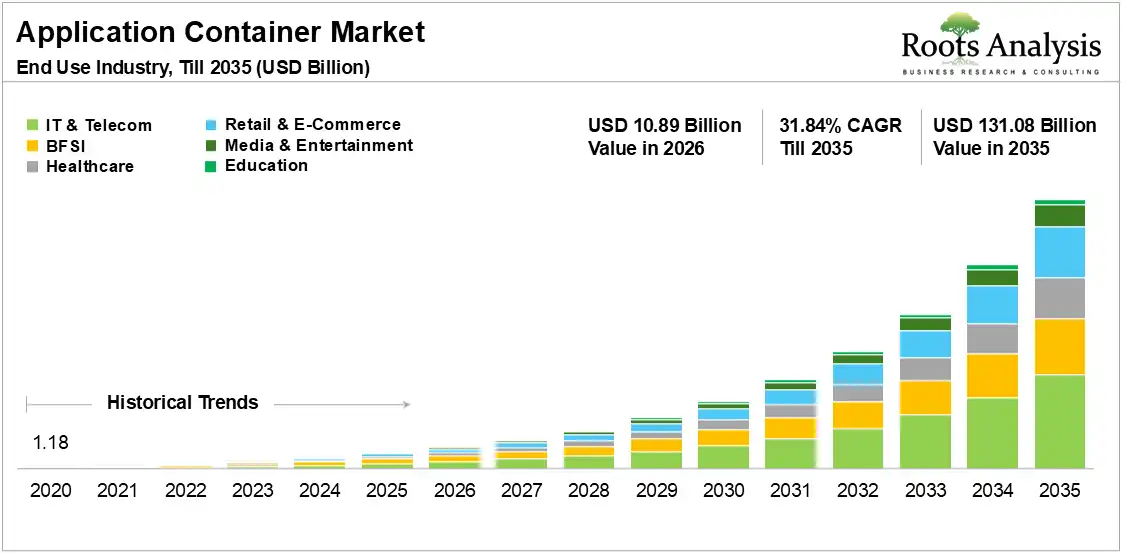
The global application container market, valued at USD 8.01 billion in 2025, is projected to reach USD 10.89 billion by 2026 and USD 131.08 billion by 2035, representing a CAGR of 31.84% during the forecast period 2026 to 2035.
See What’s in the Full Report - Request Your Complimentary Insights!
Market Report: Key Takeaways
- In terms of service, monitoring & security secures 31.78% of the overall revenue share within the global marketplace.
- In terms of end use industry, IT & Telecom holds the largest share (36.97%) of application container market.
- In terms of leading region, North America holds the largest share with 39.53% share of the market.
- Key market driver is the growing popularity of DevOps and CI / CD.
Market Overview
Application containers are lightweight, standalone, and executable software packages that encapsulate everything needed to run an application, including the code, runtime, system tools, system libraries, and settings. Unlike traditional virtualization, which involves running separate virtual machines, containers share the host operating system kernel but isolate the application environment at the process level. This approach ensures consistent application execution across different computing environments, making containers highly portable and efficient in terms of resource utilization.
Application containers find broad use across various domains including software development, microservices architecture in enterprise container platforms, continuous integration / continuous delivery (CI / CD) pipelines, and hybrid cloud deployments. They enable development teams to create reproducible environments that reduce discrepancies between development, testing, and production stages.
In microservices, containers allow independent deployment and scaling of application components, fostering agility and resilience. Additionally, containers facilitate automation and collaboration in DevOps practices by providing consistent runtime environments for building, testing, and deploying applications. Industries such as e-commerce, banking, healthcare, and gaming leverage containerization to achieve rapid scalability, regulatory compliance for containerized application workloads, and efficient management of complex application ecosystems.
The growth of the application container market is driven primarily by the increasing adoption of microservices and DevOps methodologies, which demand modular and rapid deployment frameworks. The rising cloud-native application container adoption trends, along with the need for efficient resource utilization and cost optimization in IT infrastructures, further propels container adoption. Containers enable higher server utilization, significant cost savings, and flexibility to run applications seamlessly across on-premises, cloud, and edge environments.
Pay Only for What You Need – The Best Way to Optimize
Market Dynamics
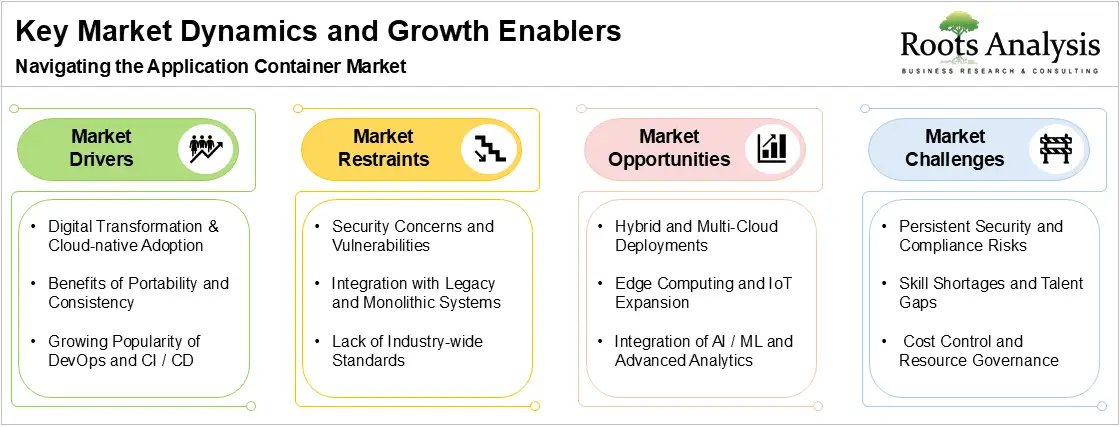
The industry is set to witness a lucrative growth phase, with the application container market shaped by a dynamic interplay of drivers, restraints, opportunities, and challenges that will influence its trajectory in the coming years.
Key Market Drivers
- Digital Transformation & Cloud-native Adoption: Businesses are rapidly adopting cloud architectures by migrating workloads to application containers which provide modularity, flexibility, and scalability.
- Benefits of Portability and Consistency: Application portability via containers allows working consistently across diverse environments as these containers abstract infrastructure differences, fostering faster deployment and reduction in compatibility issues.
- Growing Popularity of DevOps and CI / CD: As DevOps and continuous integration / continuous deployment become popular, the demand for container platforms is also increasing as these practices depend on containerized environments for fast and repeatable builds.
Market Challenges
- Persistent Security and Compliance Risks: The rapid adoption of containers, shared kernel architectures, and transient workloads make it difficult to comply with regulations (GDPR and HIPAA) while also creating hindrance in threat detection.
- Skill Shortages and Talent Gaps: The demand for expertise in Kubernetes, cloud-native security, and container lifecycle management fails to match with supply, making it harder to recruit and train individuals.
- Cost Control and Resource Governance: As container creation is an easy task, it could lead to excess production, making it difficult for organizations to keep a check on resources, monitor costs, and optimize workloads.
Market Segmentation
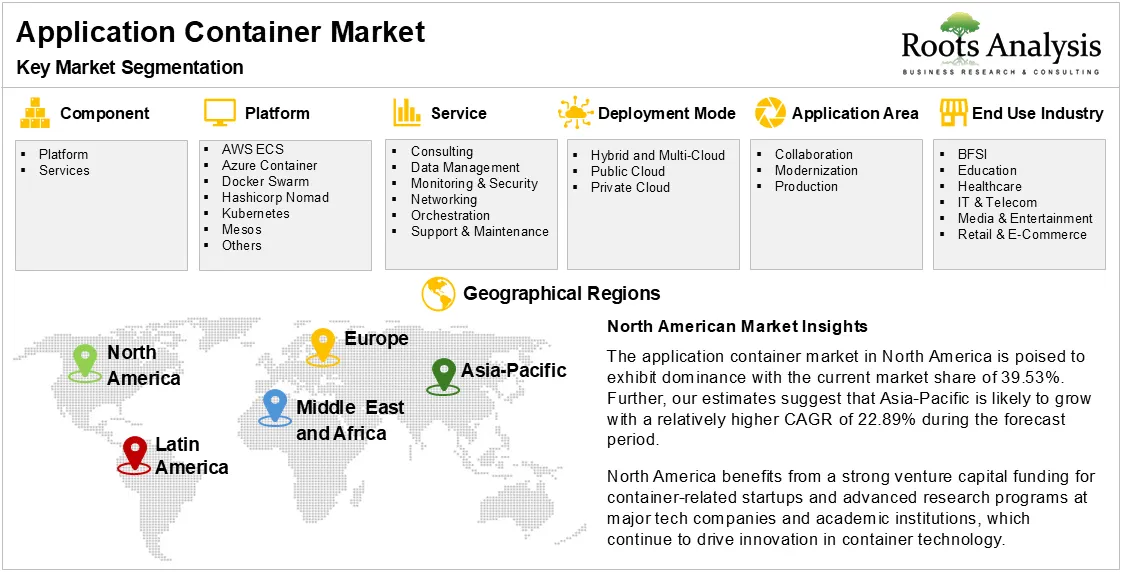
The application container market report presents an in-depth analysis of the various companies that are involved in offering container networking solutions, across different segments, as in the figure below:
Market Share Insights
Monitoring & Security to Hold the Largest Market Share in Service Segment
The monitoring & security sub-segment is set to hold the largest market share of 31.78% in the application container market due to this service being of critical importance in protecting container environments from vulnerabilities and managing runtime security.
Monitoring services also play an essential role in ensuring high availability, performance optimization, and proactive issue resolution for containerized applications, making them a lucrative and fundamental part of container service offerings.
Which End Use Industry is the Market Leader?
Application container market forecast suggests that the IT and Telecom sub-segment is expected to hold the largest share of 36.97% in the application container market. This dominance is driven by the sector’s need for rapid application deployment, modernization of legacy systems, and support for complex digital transformation projects that require scalable, portable, and highly automated infrastructure solutions. IT and Telecom companies frequently leverage containers to accelerate software lifecycle management, enable hybrid and multi-cloud strategies, and streamline delivery of cloud-native services.
On the other hand, the healthcare sub-segment is projected to have the fastest CAGR during the forecast period. The rapid expansion is fueled by the sector’s drive for secure, compliant, and efficient solutions to manage sensitive patient data and critical clinical applications, especially as regulations and the shift toward telemedicine accelerate digital adoption.
Regional Forecast Estimates: North America Leads the Application Container Market, Fueled by Rapid Proliferation of Cloud Tech
North America is projected to hold the most substantial share of 39.53% within the current global year. Advanced technology ecosystem, high rate of cloud adoption, and the presence of major container technology vendors and cloud service providers fuels the growth of containerized application development.
The region also benefits from a strong venture capital funding for container-related startups and advanced research programs at major tech companies and academic institutions, which continue to drive innovation in container technology.
Major cloud providers in the region are expanding their container-related services, further strengthening North America’s leadership in this fast-evolving technology space. Additionally, favorable government initiatives supporting cloud-native container deployments and cyber security frameworks have accelerated enterprise-level container adoption across North America's public and private sectors.
Want Information on Specific Region / Segment?
Key Market Insights
Which are the Top Players in the Application Container Market?
Examples of leading application container manufacturers (which have also been captured in this market report, arranged in alphabetical order) include Alibaba Group, Amazon Web Services, Broadcom, Cisco Systems, Docker, Google, IBM, Mirantis, Microsoft, Oracle, Portainer, Rancher Labs, Red Hat, SUSE, and VMware.

What Strategies are the Companies Using to Gain Application Container Market Share?
Companies are employing several strategies to gain market share in the application container market. They focus on continuous innovation by integrating advanced features such as AI-driven automation, application container security best practices and solutions, and seamless integration of CI / CD with container pipelines and DevOps.
Many are expanding cloud-native offerings and multi-cloud management of containerized applications to meet growing demands for hybrid cloud container adoption and scalable infrastructures. Emphasizing open-source involvement, especially around Kubernetes, helps build strong community adoption and developer engagement.
Strategic partnerships, acquisitions, and expanded service ecosystems allow companies to offer end-to-end container management solutions. Additionally, they prioritize customer education and support to simplify adoption and optimize container orchestration in diverse environments. These tactics collectively position companies to capitalize on the rapid digital transformation driving container adoption across industries.
Kubernetes-Powered Orchestration in Application Container Deployments
Kubernetes-powered orchestration has become the backbone of modern container deployments in the application container market. This universal presence stems from Kubernetes’ ability to manage container clusters efficiently, automating deployment, scaling, health monitoring, and networking across both public and private cloud environments.
Its declarative approaches enable organizations to use configuration files for seamless application rollouts, reliable scaling, and fast recovery, making it ideal for supporting CI / CD pipelines and modern DevOps workflows. Kubernetes clusters operate as fully managed environments, allowing businesses to standardize operations, improve development velocity, and reduce infrastructure complexity, whether applications run on-premises, in public cloud, or across hybrid architectures.
Hybrid Cloud Strategies Using Application Containers
Hybrid cloud strategies are now pivotal for deploying application containers, helping businesses balance flexibility, resilience, compliance, and cost-efficiency in their operations. Enterprises increasingly run mixed workloads, critical or regulated ones on-premises, elastic ones in the public cloud, while using containers to ensure portability and consistency in deployment.
Container orchestration platforms abstract away infrastructure details, enabling seamless workload movement between environments and assisting with disaster recovery and business continuity. This mainstream hybrid cloud adoption has evolved from a cost-saving tactic to a way of building resilient, compliant IT architectures, where containers provide standardized environments and Kubernetes automates migration, scaling, and governance.
Container Storage and Persistent Data Solutions
Container storage and persistent data solutions have advanced rapidly, supporting stateful workloads and ensuring data durability across container lifecycles in the application container market. Persistent storage integrations in Kubernetes allow databases and other stateful services to survive container restarts, rescheduling, and failures, ensuring data isn’t lost during lifecycle events.
They also help in enabling enterprise-grade applications, from MySQL to PostgreSQL, to run reliably in containerized environments. Solutions now offer features like replication, backups, and snapshotting for high availability and disaster recovery.
Container Lifecycle Management Automation Tools
Container lifecycle management automation tools are vital to maintain efficiency, security, and scalability in the application container landscape. Advanced tools such as ArgoCD (for CI / CD) and Dynatrace (for monitoring) automate daily tasks including deployment, version control, health monitoring, and incident response. AI-based platforms can discover, map, and track container dependencies in real time, pinpointing root causes of problems and connecting application performance with user experience.
Compliance-focused automation ensures containers meet industry regulations via continuous patching and security updates, helping organizations minimize vulnerabilities. Teams leverage automation to baseline performance, alert deviations, compare release versions, and even replay user sessions to diagnose issues quickly.

Application Container Market: Scope of the Report
| Key Report Attributes | Details |
| Historical Trend | Since 2020 |
| Forecast Period | Till 2035 |
| Market Size 2026 | $ 10.89 Billion |
| Market Size 2035 | $ 131.08 Billion |
| CAGR (Till 2035) | 31.84% |
| Segments Covered |
|
Unlock Deeper Insights – Schedule Your Personalized Workshop Today!
Market Segments
Based on the research, we have segmented the application container market into component, platform, service, deployment mode, application area, end use industry, geographical regions, and key players.
Market Share by Component
- Platforms
- Services
Market Share by Platform
- AWS ECS
- Azure Container
- Docker Swarm
- Hashicorp Nomad
- Kubernetes
- Mesos
- Others
Market Share by Service
- Consulting
- Data Management
- Monitoring & Security
- Networking
- Orchestration
- Support & Maintenance
Market Share by Deployment Mode
- Hybrid and Multi-Cloud
- Public Cloud
- Private Cloud
Market Share by Application Area
- Collaboration
- Modernization
- Production
Market Share by End Use Industry
- BFSI
- Education
- Healthcare
- IT & Telecom
- Media & Entertainment
- Retail & E-Commerce
Market Share by Geographical Regions
- North America
- US
- Canada
- Mexico
- Rest of North America
- Europe
- Austria
- Belgium
- Denmark
- France
- Germany
- Ireland
- Italy
- Netherlands
- Norway
- Russia
- Spain
- Sweden
- Switzerland
- UK
- Rest of Europe
- Asia-Pacific
- Australia
- China
- India
- Japan
- New-Zealand
- Singapore
- South Korea
- Rest of Asia-Pacific
- Latin America
- Brazil
- Chile
- Colombia
- Venezuela
- Rest of Latin America
- Middle East and Africa (MEA)
- Egypt
- Iran
- Iraq
- Israel
- Kuwait
- Saudi Arabia
- UAE
- Rest of MEA


