


 Download Free Sample
 Buy Now
Market Size
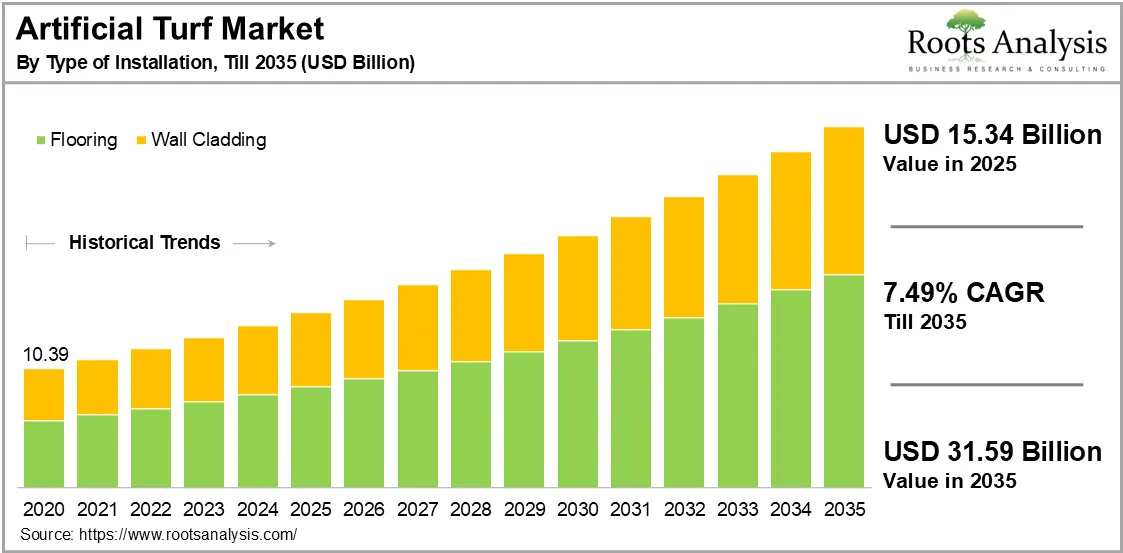
The global artificial turf market, valued at USD 15.34 billion in 2025, is projected to reach USD 23.66 billion by 2030 and USD 31.59 billion by 2035 with a CAGR of 7.49% during the forecast period 2025 to 2035.
Would Like to Preview the Actual Report?
Market Report: Key Takeaways
- In terms of type of material, polyethylene holds the highest share (52.34%) of the market.
- With respect to application area, contact sports dominate (61.34%) the current market, while landscaping is expected to experience the highest CAGR through 2035.
- In terms of type of installation, flooring dominates the industry. Notably, wall cladding to grow at a high CAGR during the forecast period 2025-2035.
- In terms of geographical regions, currently, Europe holds the highest market share (38.69%), while Asia is expected to grow at a relatively high CAGR.
- The 2025 artificial turf market landscape features innovations, such as smart sensors, AI-driven maintenance, advanced polymer blends, nano-ceramic UV coatings, and embedded cooling tech, enhancing durability, safety, and turf longevity.
Market Overview
Artificial turf is a synthetic fiber engineered to replicate the appearance and functionality of natural grass, primarily composed of polyolefin and polyamide. The material is extensively deployed across stadiums, sports arenas, and both residential and commercial environments due to its superior maintenance efficiency compared to natural grass alternatives. This growing adoption of artificial turf for landscaping applications is positioned to drive substantial market expansion in the coming years.
The material’s inherent versatility enables deployment across diverse applications, including residential backyards, landscape edging, and poolside installations. Further, artificial turf demonstrates particular prominence in contact sports such as soccer and rugby, establishing it as an optimal solution for constructing functional playgrounds across both commercial and residential sectors. Moreover, its exceptional durability (due to engineered UV-resistant properties) enables performance integrity across multiple years of continuous use.
As urbanization accelerates across developed and developing economies, artificial turf demand is anticipated to experience significant growth. Organizations and homeowners increasingly recognize the appeal of low-maintenance landscaping solutions, particularly in water-scarce regions and high-density urban environments. This shift reflects broader economic and environmental drivers, further propelling expansion across the construction and landscaping sectors globally.
The combination of benefits of artificial turf, including reduced water consumption, minimal upkeep, and year-round aesthetic consistency, positions the material as a strategic choice for sustainable outdoor space development in an era of resource constraints and climate awareness.
Recent Industry Developments
- In October 2025, the Synthetic Turf Council held its annual conference in Palm Beach Gardens, Florida, gathering global industry leaders to discuss emerging trends, innovative technologies, and sustainability practices shaping the future of synthetic turf.
- In July 2025, San Mamés Stadium commenced testing of an advanced smart turf sensor and monitoring solution developed by Sener in collaboration with Athletic Club. This system provides real-time data on pitch conditions, optimizing maintenance and enhancing turf performance.
- In June 2025, TenCate Grass acquired a majority stake in Sports & Leisure Group, an established UK-based artificial turf manufacturer and distributor. This strategic investment expands TenCate’s European footprint and strengthens its portfolio across sports, landscaping, and leisure applications.
- In December 2024, AstroTurf expanded its market presence by acquiring Coast to Coast Turf, a leading Seattle-based artificial turf installer. This strategic acquisition strengthens AstroTurf’s foothold in the Northwestern US market and enhances its installation capabilities.
- In December 2024, West Vancouver officially opened a new artificial turf field and track facility, named the West Vancouver Place for Sport, located at West Vancouver Secondary School. The project includes a six-lane track, known as the Harry Jerome Oval, and an artificial turf field with lighting.
Pay Only for What You Need – The Best Way to Optimize
Market Share Insights
Polyethylene Dominates the Artificial Turf Market While Nylon Materials Grow Rapidly Through 2035
Based on type of material, the global artificial turf market size is segmented into polyethylene, polypropylene, nylon, and other specialized materials. Among these categories, the polyethylene segment currently holds the dominant position, capturing 52.34% of total market share. This is driven by polyethylene’s distinctive material characteristics, such as exceptional durability, superior softness, and inherent resilience, that address diverse application requirements.
Polyethylene is widely deployed across both synthetic grass applications in sports fields and artificial turf for landscaping projects due to its ability to deliver realistic aesthetic replication of natural grass. Additionally, polyethylene offers excellent performance attributes including superior drainage capacity and cushioning comfort underfoot, making it the preferred material for high-traffic environments and user-intensive applications.
The nylon segment, conversely, is positioned to experience the fastest CAGR through 2035. This accelerated growth trajectory is due to nylon’s exceptional structural strength and durability properties, which establish it as the material of choice for contact sports applications including soccer and rugby, where intense wear and tear present significant operational challenges.
Nylon fibers demonstrate superior capacity to withstand sustained heavy foot traffic while maintaining comprehensive structural integrity across extended time horizons. This performance reliability has driven adoption among professional sports organizations and facility operators seeking materials capable of meeting rigorous performance demands while minimizing maintenance intervention and replacement cycles.
Market Share by Application Area: Why Contact Sports Dominate Current Industry While Landscaping Accelerates Through 2035
The contact sports sub-segment captures the maximum market share, representing 61.34% of total current market size, while the artificial turf for landscaping is expected to experience the highest CAGR during the forecast period. The divergent growth patterns between contact sports and landscaping demonstrate market diversification beyond traditional sports applications, reflecting broader adoption across diverse stakeholder segments and geographic markets.
The dominance of contact sports is driven by the increasing popularity of high-impact sports, including soccer, rugby, and hockey, which necessitate durable and high-performance playing surfaces that artificial turf uniquely provides. Further, synthetic turf installation delivers consistent playability, reduce injury risk through engineered shock absorption, and minimize weather-related disruptions, establishing contact sports as the cornerstone application driving artificial turf demand across industry.
The rising support from international sports leagues, governments, and educational institutions has further increased the global adoption of synthetic turf infrastructure over the past two decades. For instance, the Synthetic Turf Council documents ~16,000 established synthetic grass applications in sports fields, with around 1,500 new installations annually. Similarly, World Rugby Regulation 22 mandates minimum pile heights of 50mm and specific shock-pad specifications for rugby fields, creating continuous recurring revenue through maintenance contracts, and periodic system replacements.
Regional Market Growth: Europe Dominates the Current Artificial Turf Industry
The industry is distributed across North America, Europe, Asia, Latin America, Middle East and North Africa, and the rest of the world. Currently, Europe dominates the artificial turf market by capturing 38.69% market share. This is due to the region’s advanced industrial base, stringent environmental standards, and entrenched sports infrastructure investments.
Within Europe, Germany captures most of the market share, driven by high demand from professional sports facilities, premium field turf landscape installations, and expanding commercial development projects. Further, countries including the UK and France maintain significant market contributions through increased adoption of synthetic turf installation across world-class stadiums, university athletic facilities, and municipal recreational complexes.
Regulatory frameworks across Europe prioritize water conservation and environmental sustainability, actively favoring ecofriendly artificial turf solutions as part of broader sustainability mandates. In addition, European manufacturers such as TenCate Grass and Edel Grass leverage advanced manufacturing technologies and climate-adapted product innovations, establishing competitive advantages in performance durability and aesthetic authenticity that reinforce regional market leadership. In essence, European market growth is a result of incremental infrastructure upgrades and sustainability compliance.
Asia’s Artificial Turf Market Grows at a High CAGR Due to Urbanization and Infrastructure Development
Asia is expected to grow at a substantially faster pace during the forecast period, driven by accelerated urbanization, government-backed sports infrastructure mandates, and intensifying water scarcity across drought-prone regions. For instance, China’s “Healthy China 2030” national program mandates comprehensive sports infrastructure expansion across schools and public facilities, while India’s “Khelo India” initiative integrates artificial grass installation into public sporting complexes, establishing synthetic turf as institutional standard across educational and recreational contexts.
Asia’s sizeable manufacturing ecosystem, particularly in China, India, and South Korea, provides competitive advantages through cost efficiencies and localized production capabilities that accelerate synthetic grass applications in sports and landscaping adoption. Moreover, the benefits of artificial turf solutions in water-scarce countries, such as Vietnam, India and other ASEAN nations, combined with growing demand for residential artificial turf installation across both commercial and residential real estate, propel the region’s market growth through 2035.
Want Information on Specific Region / Segment?
Market Dynamics
Key Market Drivers
- Technological Innovation and Material Advancement: Advances in polyethylene and nylon polymer chemistry, combined with ongoing and anticipated innovations in future of synthetic turf technology, enhance durability, aesthetic realism, and performance characteristics. These factors together drive adoption across synthetic grass applications in sports and premium landscaping installations globally.
- Environmental Sustainability and Water Conservation Mandates: Water scarcity regulations in California, Colorado, and Australia mandate eco-friendly artificial turf solutions, spurring adoption of low-maintenance landscaping alternatives that reduce water consumption, pesticide usage, and maintenance labor while delivering year-round aesthetic consistency across residential and commercial properties.
- Government Infrastructure Investment and Urbanization: Government-backed sports development programs, including Japan’s “Sports for Tomorrow” initiative and South Korea’s National Sports Promotion Plan, support widespread institutional artificial turf installation across stadiums, schools, and recreational complexes. Concurrently, rapid urbanization drives growing residential demand for installing artificial turf yourself solutions and professional turf laying companies services to enhance urban living spaces efficiently.
Market Challenges
- High Initial Installation and Maintenance Costs: Artificial turf installation price and maintenance cost remain significant barriers for residential consumers, despite long-term savings. The substantial upfront capital is driven by material expenses, specialized labor for professional artificial turf laying, and site preparation requirements, limiting adoption among price-sensitive market segments.
- Environmental and Health Concerns: Growing concerns regarding microplastic shedding, chemical leaching, and heat island effects associated with synthetic surfaces create regulatory scrutiny and consumer hesitation, particularly regarding benefits of artificial turf claims and long-term environmental sustainability of synthetic installations versus natural alternatives.
- Limited Market Awareness and Installation Expertise: Consumer knowledge gaps regarding advantages of artificial grass and forevergreen artificial grass installation options, combined with fragmented supply chains and limited artificial grass specialists in emerging markets, constrain adoption rates. This creates inconsistent installation quality across residential vs commercial artificial turf applications globally.
Key Market Insights
Competitive Landscape of Key Players in Artificial Turf Market
The industry is fragmented and is experiencing intense competition and changing dynamics, with the presence of several small and large artificial turf companies. The industry spans from multinational conglomerates to specialized regional players, all striving to capitalize the benefits of artificial turf solutions and sustain their strong position in the global marketplace.
Large enterprises dominate the current market, leveraging established distribution networks, manufacturing scale, and brand recognition across sports and landscaping segments. On the other hand, small and mid-sized artificial turf companies are continuously improving their offerings to capture niche segments and specialized applications. These companies focus on advantages of artificial grass innovation, vertical integration, and localized artificial grass specialists services that cater to specific regional demands.
Major players in the artificial turf market include Act Global, Altus Sports & Leisure, AstroTurf, DuPont, Edel Grass, FieldTurf, Global Syn-Turf, Italgreen, Limonta Sport, Matrix Turf, SIS Pitches, Soccer Grass, Synthetic Turf International, Tarkett, and TenCate Grass. These companies are adopting aggressive competitive strategies centered on innovation, strategic alliances, and portfolio expansion. For instance, in November 2024, Italgreen launched Pro Biofill, a new line of natural infill materials for artificial turf systems, which offer enhanced drainage and are 100% microplastic-free, aligning with new sustainability regulations.
Similarly, in February 2025, TenCate launched Pivot Performance Turf, a revolutionary product engineered to replicate natural grass performance without traditional infill materials, reducing plastic shedding by 99% and extending lifespan by 50% compared to conventional systems. This dynamic ecosystem positions innovation, sustainability, and service integration as critical differentiators in capturing market share across diverse application segments.
Increasing Partnerships and Mergers & Acquisitions Activity Shaping the Industry
Strategic partnerships in the artificial turf market are accelerating innovation and driving sustainable solutions. For instance, in April 2025, BASF partnered with Hagihara Industries to develop advanced polyolefin yarns, leveraging Hagihara’s Tinuvin® formulations, that enhance weather resistance and longevity of synthetic turf. The partnership aims for successful deployments at J-League football practice fields in Japan.
Similarly, in April 2024, Dow announced collaborations with Sealed Air and Changchun FAWSN Automotive Technology Research and Development at Chinaplas 2024 (Asia’s largest plastics industry tradeshow) to develop circular and ecofriendly artificial turf solutions, utilizing REVOLOOP™ post-consumer recycled (PCR) resins.
Mergers and acquisitions are further reshaping market dynamics and expanding installation reach. For instance, in November 2022, Artificial Turf Supply’s acquisition by Blackford Capital signaled ongoing consolidation and growth in artificial turf installation services. Meanwhile, the ForeverLawn and Cleveland Browns alliance, announced in February 2023, highlights how strategic collaborations expand residential artificial turf installation capabilities and strengthen brand presence in highly competitive markets.
Key Artificial Turf Market Trends in North America
North America’s artificial turf market is experiencing a transformative shift driven by regulatory mandates, technological innovation, and evolving consumer preferences toward sustainable outdoor solutions. Market trends reflect convergence of water conservation imperatives, advanced synthetic turf installation technologies, and growing demand for environmentally responsible artificial turf for landscaping across residential and commercial segments.
- Water Conservation Mandates and Regulatory Compliance
Stringent water conservation policies across California, Arizona, and Colorado incentivize artificial grass installation in both residential and commercial landscapes. Regulatory frameworks prohibiting decorative turf drive adoption of eco-friendly artificial turf solutions, positioning synthetic alternatives as compliant landscaping choices. - Sports Infrastructure Modernization and Player Safety
Professional sports organizations and universities invest heavily in upgrading facilities with FIFA and NFL-approved synthetic turf installation technologies. Enhanced shock absorption, improved drainage systems, and durability standards prioritize player safety while advancing artificial turf for landscaping standards across stadiums and athletic complexes. - DIY Adoption and Professional Installation Services
Rising consumer interest in do-it-yourself (DIY) landscaping projects fuels demand for installing kits and accessible turf laying companies services. This democratization of artificial grass installation capabilities expands market reach beyond professional segments to price-conscious residential consumers. - Smart Turf Monitoring and Performance Analytics
Integration of IoT sensors and smart monitoring technologies enables real-time performance tracking, maintenance optimization, and usage analytics. These future synthetic turf technology innovations enhance benefits of artificial turf through predictive maintenance and extended lifespan optimization across sports and commercial applications.
Your Business is Unique – Why Shouldn’t Your Report Be?
Market Segmentation
Artificial Turf Market: Scope of the Report
| Key Report Attributes | Details | |
| Historical Trend | Since 2020 | |
| Forecast Period | Till 2035 | |
| Market Size 2025 | $ 15.34 Billion | |
| Market Size 2035 | $ 31.59 Billion | |
| CAGR (Till 2035) | 7.49% | |
| Segments Covered |
|
|
| Key Players Profiled |
|
|
| PowerPoint Presentation (Complimentary) |
|
|
| Customization Scope |
|
|
| Excel Data Packs (Complimentary) |
|
|
Market Segments
Based on research, we have segmented the artificial turf market into type of material, type of installation, application area, type of enterprise, geographical regions, and key players.
Market Share by Type of Material
- Polyethylene
- Polypropylene
- Nylon
- Others
Market Share by Type of Installation
- Flooring
- Wall Cladding
Market Share by Application Area
- Contact Sports
- Landscape
- Leisure
- Non-Contact Sports
- Others
Market Share by Type of Enterprise
- Large Enterprises
- Small and Medium Enterprises (SMEs)
Market Share by Geographical Regions
- North America
- US
- Canada
- Mexico
- Rest of North America
- Europe
- Austria
- Belgium
- Denmark
- France
- Germany
- Ireland
- Italy
- Netherlands
- Norway
- Russia
- Spain
- Sweden
- Switzerland
- UK
- Rest of Europe
- Asia
- China
- India
- Japan
- Singapore
- South Korea
- Rest of Asia
- Latin America
- Brazil
- Chile
- Colombia
- Venezuela
- Rest of Latin America
- Middle East and North Africa (MENA)
- Egypt
- Iran
- Iraq
- Israel
- Kuwait
- Saudi Arabia
- UAE
- Rest of the MENA
- Rest of the World
- Australia
- New Zealand
- Other countries


