


 Download Free Sample
 Buy Now
Market Size
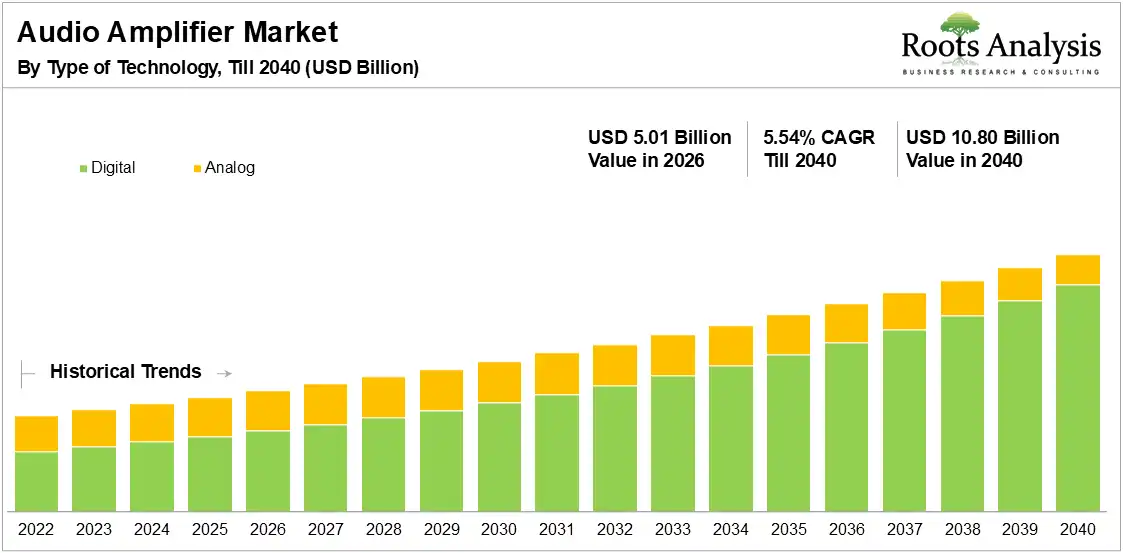
The global audio amplifier market is projected to reach USD 5.01 billion in 2026 and USD 10.80 billion by 2040, representing a CAGR of 5.54% during the forecast period 2026 to 2040.
See What’s in the Full Report – Request Your Complimentary Insights!
Market Report: Key Takeaways
- Leading Players Competitive Footprint: Market players, such as Infineon Technologies, NXP Semiconductors, Onkyo, Rohm Semiconductor, STMicroelectronics, and Texas Instruments, are leveraging technology innovations, and strengthening their partnerships for global expansion.
- Innovation Hotspots: Class-D advancement, GaN integration, AI-embedded DSP, 1L modulation, spatial audio multi-channel, and TWS SoC convergence are the leading innovations, offering enormous opportunities to the market players.
- Regional Insights: Asia-Pacific holds the largest share of the global audio amplifier market, a position underpinned by its unrivalled concentration of consumer electronics manufacturers, growing electronic vehicles manufacturing, and government initiatives, such as Made in China 2025.
- Market Growth Across Type of Class: Class-D amplifiers command the dominant market share in the market and is likely to grow at a higher CAGR. The key growth factors include superior power conversion efficiency, and compatibility with miniaturized SoC designs critical for TWS earbuds, smart speakers, and mobile devices.
Market Overview
The global audio amplifier market is undergoing a structural transformation, driven by a rapid shift toward high-efficiency architectures and deeper system integration. As manufacturers pivot from traditional Class AB designs to versatile Class D solutions, the industry is successfully balancing rigorous energy standards with the rising demand for compact and high-performance electronics. This transition is not merely a technical upgrade but a strategic move to embed advanced power management across mainstream consumer and automotive platforms.
Regulatory landscapes, particularly within the European Union, are acting as a primary catalyst for this evolution. Tightening standby power standards are forcing a move toward highly integrated circuit solutions that prioritize thermal performance and streamlined system design. By reducing energy consumption at the hardware level, the industry is meeting global sustainability targets while simultaneously optimizing the form factors of modern devices.
Significant growth drivers are emerging from the rapid electrification of the automotive sector and the expansion of smart audio ecosystems. Electric vehicle (EV) platforms require lightweight, high-efficiency audio systems to preserve battery life and maximize range. Consequently, leading suppliers are prioritizing integrated amplifier and digital signal processing (DSP) solutions to enable complex multi-zone audio environments while minimizing wiring complexity and component weight.
Looking toward the remainder of 2026, the market's trajectory remains tethered to semiconductor innovation, specifically the adoption of wide bandgap materials like Gallium Nitride (GaN). These advancements, paired with the integration of AI algorithms directly into amplifier chipsets for real-time acoustic optimization, represent a definitive forward shift. Amplifiers are no longer viewed as passive components; they have become intelligent processing hubs essential for product differentiation and superior user experiences.
Pay Only for What You Need – The Best Way to Optimize
Audio Amplifier Market Size Estimation Methodology
- As a starting point, we identified the core audio amplifier product types, Class A, Class B, Class AB, Class D, and operational amplifiers. These products are segmented by power output, channel configuration, and end-use applications.
- Then, a hybrid forecasting approach was applied, combining detailed bottom-up market sizing with demand-side adoption trends and top-down validation using broader economic indicators.
- Thereafter, we analysed the product demand, focused on tracking adoption trends and feature integration, including the shift from traditional Class AB amplifiers to more energy-efficient Class D designs across consumer electronics and automotive markets.
- By using these data points and implementing bottom-up method, we estimated market size, forecast and projected the future market opportunities by studying historical shipment volumes of end-use devices, such as smartphone, home audio systems, vehicles, and professional audio equipment average selling price.
- Segment analysis was then performed by distributing forecast values across product types, applications, and regions, based on segment-specific growth trends, market penetration levels, competitive intensity, and regulatory influences.
- Finally, sensitivity analysis was conducted to assess the impact of changes in pricing, supply chain conditions, consumer spending, and technology adoption rates, resulting in low, base, and high growth scenarios for the overall market forecast.
Market Share Insights
Market Share by Application: Automotive Dominates the Market
Based on the audio amplifier market segmentation analysis, automotive leads the market with a 34.0% share in 2026 and is projected to reach 38.5% by 2040, driven by structural electrification and cockpit digitalization trends. EV platform expansion, in-vehicle infotainment upgrades, and premium multi-channel audio integration are embedding high-performance amplification as a standard vehicle feature rather than an option. Regulatory support for EV adoption across major regions, combined with OEM differentiation through immersive cabin experiences, increases amplifier content per vehicle and strengthens competitive dynamics.
While Automotive remain dominant, home audio systems segment is likely to expand at a 22.4% CAGR through 2040. Growth outlook remains strong due to premium soundbar upgrades, spatial audio adoption, wireless home ecosystems, and smart home integration. Rising demand for Dolby Atmos-enabled setups and high-resolution streaming is accelerating adoption trends and lifting average selling prices, reinforcing commercialization momentum in this segment.
Geographical Regions Insight: Asia-Pacific Leads the Market
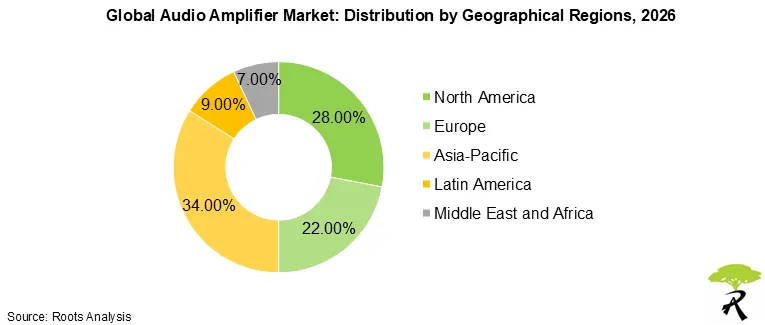
Asia-Pacific leads with a 34.0% audio amplifier market share in 2026 and is set to expand to 39.5% by 2040, supported by a strong 22.1% CAGR. The region’s dominance stems from its deeply integrated consumer electronics manufacturing base, large-scale semiconductor production, and expanding EV ecosystem in India and China.
Established amplifier IC fabrication, speaker assembly, and end-device integration create cost efficiencies and supply chain maturity that strengthen competitive dynamics. Capacity expansions in automotive-grade and low-power analog chips further reinforce its growth outlook.
Conversely, rest of the world is the fastest-growing segment, registering a 21.0% CAGR. Growth is driven by emerging ASEAN and African manufacturing hubs shifting toward higher-value electronics production, localization policies, and rising smart device penetration. Increasing contract manufacturing and automotive assembly from a low base are accelerating adoption trends, positioning these markets for sustained expansion through 2040.
Want Information on Specific Region / Segment?
Market Ecosystem Insights
Top 10 Market Leaders Shaping the Future of Audio Amplifier Industry
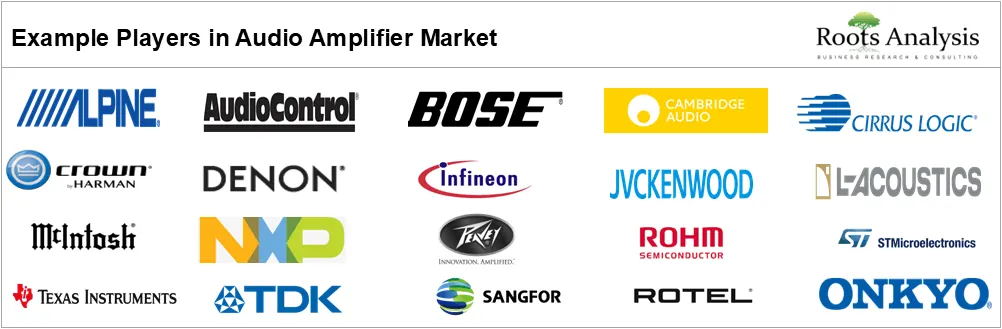
Based on audio amplifier competitive landscape report, the market is anchored by a mix of semiconductor IC specialists, consumer electronics conglomerates, and professional audio systems integrators. Top most active players, such as Texas Instruments, STMicroelectronics, Infineon Technologies are undertaking initiatives, such as product innovations, partnerships, and acquisitions to expand global footprints.
Examples of the key initiatives are mentioned below:
- Infineon Technologies: Recently, published "GaN Insights 2026" and ramped up 300mm GaN-on-Si wafer manufacturing to meet the 58% year-over-year growth in GaN power demand.
- STMicroelectronics: Signed a joint development agreement with Innoscience to accelerate GaN technology adoption and is leading the shift to SiC power devices in EVs.
- Texas Instruments: Introduced one-inductor modulation for Class D amplifiers, significantly reducing the external component count for cost-sensitive automotive audio.
- Harman International: Following its acquisition of Sound United, Harman is integrating the HEOS streaming platform across its professional and luxury audio brands.
Top 5 Startups Driving Innovation in Audio Amplifier Market
The audio amplifier startup ecosystem represents a vibrant layer of innovation that complements the established semiconductor giants. Startups in this space are pioneering AI-driven audio processing, GaN power electronics, spatial audio algorithms, and hardware-software integrated platforms, attracting significant venture capital and strategic investment from both financial and corporate investors.
For instance, in November 2025, Suno, an AI music generation platform, raised a USD 250 million Series C round, reflecting massive investor confidence in AI-driven audio creation. Similarly, Mirelo raised USD 41 million in seed funding to develop AI models that synchronize sound effects with video. Their hardware focus is on low-latency DSPs that can handle real-time context-aware audio generation.
Market Access Considerations
OEM Qualification and Design-In Cycles
Market access in high-volume segments depends on successfully navigating OEM design-in cycles. Automotive, home electronics, and smart device manufacturers impose strict performance and reliability standards, including AEC-Q100 in automotive applications. Lengthy qualification periods of one to three years create significant commercialization challenges for new entrants.
Securing long-term supply agreements and providing strong engineering support during integration are critical adoption drivers. These factors strengthen supplier lock-in and reinforce the competitive landscape, making early design wins essential for scalable growth.
Standardization and Interoperability Requirements
Market access requires strict compliance with established audio and connectivity standards. Amplifiers must integrate seamlessly with digital sources, processors, and speakers using protocols such as HDMI eARC, Bluetooth codecs like aptX HD and LDAC, and professional networking standards such as Dante.
Failure to support these standards creates immediate commercialization barriers within customer ecosystems. The competitive landscape favors suppliers that rapidly implement emerging standards, ensuring compatibility and reducing integration risks for OEMs and system integrators.
Cost-Value Proposition and Pricing Dynamics
Pricing dynamics vary sharply between mass-market and premium segments. In high-volume consumer electronics, market access depends on cost efficiency, where suppliers must optimize cost per watt through value engineering and scale-driven production.
In contrast, premium segments demand superior audio quality, differentiated technologies such as Class D efficiency or proprietary processing, and strong brand positioning. Misalignment between cost structure and target segment undermines commercial viability and limits expansion opportunities.
Ecosystem Integration and Software-Defined Features
Market access increasingly depends on ecosystem integration rather than hardware performance alone. As amplifiers become software-enabled, compatibility with voice assistants such as Alexa or Google Home, multi-room protocols, and proprietary platforms becomes a core requirement.
Commercialization challenges now include API development and partnerships with software providers. Suppliers that fail to align with dominant ecosystems face reduced adoption, as standalone hardware solutions struggle within an evolving, software-defined competitive landscape.
Supply Chain Resilience and Component Availability
Supply chain stability is a critical determinant of market access in the audio amplifier market. Dependence on semiconductor components, including power management ICs and digital signal processors, exposes suppliers to component shortages and lead-time volatility.
Companies with diversified sourcing strategies, long-term supplier agreements, and disciplined supply chain management sustain stronger competitive positioning. In contrast, smaller players face higher costs and production constraints, limiting their ability to scale and fulfil commercial demand.
Have Questions? Let’s Get Them Answered.
How Stakeholders Benefit from the Key Focus Areas of Our Audio Amplifier Market Research Report
The audio amplifier market is evolving rapidly due to rising demand for high-performance audio systems across consumer electronics, automotive, professional audio, and smart home applications. Our report enables stakeholders to make informed strategic, investment, and technology decisions by delivering clear insights into market trends, competitive dynamics, and commercialization opportunities.
- Unmet Needs and Market Gaps in Audio Amplifier Market: The report identifies performance, efficiency, miniaturization, and thermal management gaps that continue to shape product development priorities across analog and digital amplifier technologies. It highlights underserved application areas, pricing inefficiencies, and emerging demand for low-power, high-fidelity solutions in compact devices. These insights help strategy leaders refine market entry plans and enable product teams to align innovation roadmaps with real customer pain points. Investors benefit by identifying scalable segments were unmet demand signals strong commercialization potential.
- Funding and Investment Landscape in Audio Amplifier Market: The study analyses investment activity across semiconductor firms, audio technology startups, and integrated solution providers. It tracks capital flows into Class D amplifier innovations, automotive-grade audio platforms, and energy-efficient amplification technologies. This visibility supports financial stakeholders in evaluating growth-stage opportunities and assessing risk exposure across different application segments. Corporate development teams can use these insights to prioritize acquisitions, partnerships, or internal capability expansion aligned with high-growth areas.
- Player Landscape and Competitive Dynamics in Audio Amplifier Market: The report provides a detailed view of the competitive landscape, including established semiconductor manufacturers and emerging niche innovators. It evaluates positioning strategies based on product differentiation, pricing models, supply chain integration, and geographic reach. This enables decision-makers to benchmark performance, identify competitive threats, and uncover whitespace opportunities. Clear visibility into competitive intensity strengthens expansion planning and supports strategic positioning decisions in both mature and emerging markets.
- Technology Innovation and Adoption Trends in Audio Amplifier Market: The market study examines key technology trends such as digital signal processing integration, GaN-based amplification, low-distortion architectures, and smart connectivity features. It evaluates adoption drivers across consumer electronics, automotive infotainment systems, and professional audio equipment. These insights guide technology leaders in prioritizing R&D investments and accelerating commercialization of next-generation amplifier solutions. Understanding adoption curves also helps investors assess long-term scalability and market readiness.
- Partnerships and Collaboration Trends in Audio Amplifier Market: The report highlights ecosystem dynamics involving semiconductor companies, OEMs, system integrators, and audio solution providers. It examines strategic alliances focused on design integration, co-development of smart audio systems, and supply chain resilience. These insights enable business development teams to identify high-value collaboration opportunities that enhance market access and reduce time-to-market. Strong partnership intelligence supports expansion strategies in highly competitive and innovation-driven segments.
- Market Segmentation and Geographic Coverage in Audio Amplifier Market: The study provides detailed segmentation by amplifier class, application, end-user industry, and region, delivering clarity on revenue distribution and growth outlook. It identifies high-growth geographies driven by consumer electronics demand, automotive production, and rising disposable income. This granular market breakdown enables stakeholders to allocate resources efficiently, prioritize scalable segments, and mitigate regional risk exposure. Clear geographic insights support informed decisions around localization, distribution expansion, and global market penetration strategies.
Get an Instant Quote in 10 Minutes. Lowest Price Guaranteed
Audio Amplifier Market: Scope of the Report
| Key Report Attributes | Details | |
| Historical Trend | Since 2022 | |
| Forecast Period | Till 2040 | |
| Market Size 2026 | $ 5.01 Billion | |
| Market Size 2040 | $ 10.80 Billion | |
| CAGR (Till 2040) | 5.54% | |
| Segments Covered |
|
|
| Geographical Regions Covered |
|
|
| Key Sections Covered |
|
|
Market Segmentation
Based on the research, we have segmented the audio amplifier market into type of product, type of class, type of technology, channel, geographical regions, and key players.
Market Share by Type of Product
- Power Amplifier
- Preamplifier
- Integrated Amplifier
Market Share by Type of Class
- Class A
- Class B
- Class AB
- Class D
Market Share by Type of Technology
- Digital
- Analog
Market Share by Type of Channel
- Mono
- Stereo
- Multichannel
Market Share by Application Area
- Automotive
- Consumer Electronics
- Professional Audio
- Home Audio Systems
Market Share by Geographical Regions
- North America
- US
- Canada
- Mexico
- Rest of North America
- Europe
- Austria
- Belgium
- Denmark
- France
- Germany
- Ireland
- Italy
- Netherlands
- Norway
- Russia
- Spain
- Sweden
- Switzerland
- UK
- Rest of Europe
- Asia-Pacific
- Australia
- China
- India
- Japan
- New Zealand
- Singapore
- South Korea
- Rest of Asia-Pacific
- Latin America
- Brazil
- Chile
- Colombia
- Venezuela
- Rest of Latin America
- Middle East and Africa (MEA)
- Egypt
- Iran
- Iraq
- Israel
- Kuwait
- Saudi Arabia
- UAE
- Rest of MEA


