


 Download Free Sample
 Buy Now
Market Size
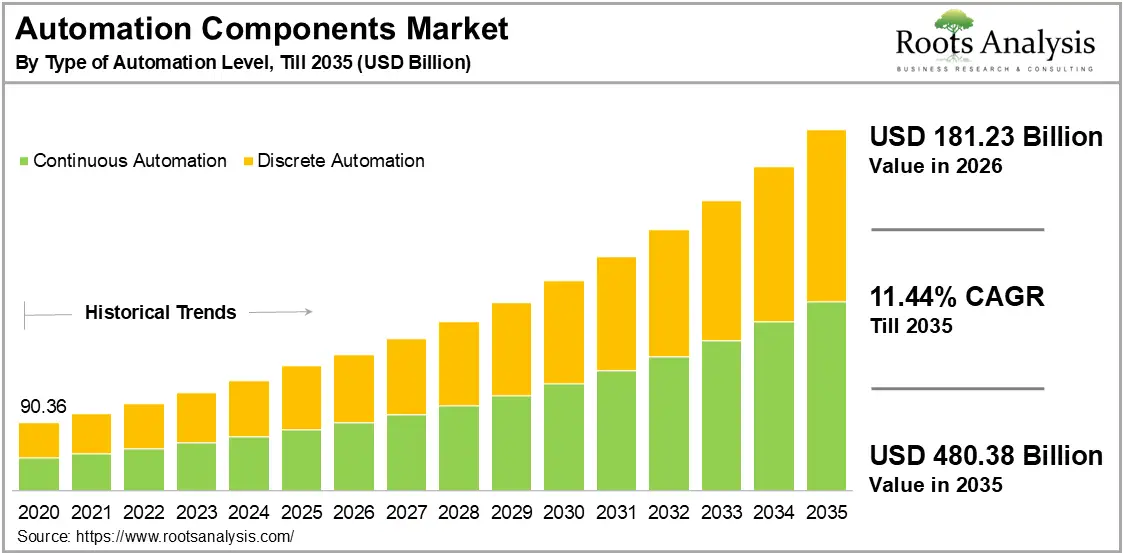
The global automation components market is estimated to grow from USD 181.23 billion in 2026 to reach USD 311.48 billion in 2030 and USD 480.38 billion by 2035, representing a 11.44% CAGR during the forecast period 2026 to 2035.
See What’s in the Full Report – Request Your Complimentary Insights!
Market Report: Key Takeaways
- An increasing demand for low-cost manufacturing is majorly driving the automation components industry.
- In terms of components, the motors sub-segment secures 23% of the overall revenue share, due to their capability of converting electrical energy to mechanical motions.
- Based on end user, the automotive sub-segment is currently having the highest market share (33%) due to the usage of robotics arms for precise assembling and wheel mounting for high-speed production lines.
- With respect to the regional landscape, Europe dominates the current market with a share of 35% driven by its advanced industrial base, strong emphasis on Industry 4.0, and commitment to sustainability.
Market Overview
With the emergence of technological advancements and the need for accurate and precise manufacturing, automation components are on a surge. Physical elements coupled with semiconductor fabrication techniques originate automation components. These systems have increased efficiency and productivity in comparison with traditional human workers.
The development of light detection and ranging (LDIR) and computer vision for identifying edges and shapes have brought digital transformation in manufacturing. These collaborative robots are easy to install and operation able, making them flexible for various industries application. It is worth highlighting that energy-efficient automation systems help in energy conservation. Further, enhanced supply chain resilience and efficient material handling automation have spurred the industry 4.0 components market growth. These also reduces wastage due to precise control forwardly boosting sustainable production practices. Notably, OEM has accelerated customized automation solutions that allow manufacture to modify the working of machines for enhanced quality production.
The global market trends in automation are expected to grow significantly over the forecast period due to the rapid growth of smart factory initiatives in emerging economies like China and India. The IoT-enabled automation allows easy connection and operation among various devices boosts cybersecurity in industrial automation. It is worth highlighting that AI-driven automation systems for predictive maintenance solutions.
Notably, these scalable automation technologies allow effortless addition of new machine, fueling additive manufacturing for automation. Consequently, rising partnership and investments for research and development will drive industrial automation solutions.
Recently, Mahindra Accelo selected Rockwell Automation for the digitalization of its manufacturing operations. Dilip Sawhney, Managing Director, Rockwell Automation India, expressed pride in this partnership and said, "This partnership underscores Rockwell’s commitment to fostering sustainable business practices through innovative technologies.”
Recent Industry Developments
-
In October 2025, OMRON launched automation center in Bengaluru (India) to strength India’s smart manufacturing future. This center will support the production of automation components to serve manufacturers in India.
-
In January 2025, Wekaba, a leading CNC machined automation components manufacturer, launched R25 million automotive manufacturing plant for designed components production.
-
In October 2024, B&R, an Austrian-based automation company, launched X20 drives for enhanced motion control.
-
In October 2024, Camunda, an orchestration software company, launched AI co-pilot for enhanced and quick manufacturing of automation components.
-
In September 2024, ABB, a leading automation company, launched innovative wireless home automation solutions in India to reduce carbon footprint.
Pay Only for What You Need – The Best Way to Optimize
Market Share Insights
Motors Sub-Segment is Set to Lead the Market Growth
The motors sub-segment is anticipated to dominate 23% of market share in 2025. Further, this segment is expected to witness a relatively faster automation components market growth rate by 2035. This can be attributed to their need to power various automation machines. In addition, the capability of electrical energy to mechanical motion conversion equips precise and controlled movement has spurred the growth of smart manufacturing technologies.
Linear Motion Sub-Segment to Play a Prominent Role in the Growth of the Industry
Currently, according to our analysis, the linear motion segment is augmenting the segment's growth. Prominent reason for this can be precise and efficient movement across a straight path such as conveyer belts. It is worth highlighting their wide applications in manufacturing, medical equipment and logistics.
On the other hand, the rotary motion segment is expected to grow with a relatively higher CAGR in the near future. This can be attributed to the need for enhance automation operation on rotational movements such as packing. Notably, their rapid application in automotive and robotics is majorly driving the market growth.
Distributed Control System (DCS) to Have the Largest Market Share
The distributed control system (DCS) segment is anticipated to dominate the segment with 27.98% of market share in 2025. This can be attributed to real-time monitoring for process efficiency and safety. In addition, effective data collection, storage and analysis for effortless operation has played a pivotal role in the dominance.
However, the supervisory control and data acquisition (SCADA) segment is expected to witness a relatively faster CAGR of 12.70%. This can be ascribed to the operation expenses through process control optimization and routine task automation. Moreover, predictions of possible threats for safety and machine integrity will continue to accelerate market growth.
Discrete Automation to Shape the Future of the Automation Components Sector
The automation components market is bifurcated into continuous automation and discrete automation. The discrete automation segment is anticipated to dominate the segment in 2025. This can be attributed to error reduction, faster delivery and improved workflow support. Further, this provides reduced costs, quality enhancement and improved overall equipment effectiveness (OEE).
However, the continuous automation segment is expected to witness a relatively faster CAGR. This can be described as automated deployment and testing that neglects the need for human interference and shortens time-to-market. In addition, easy collaboration with other machines for early bug detection is fueling market growth.
Market is Excelling by Automotive Sector’s High Contribution
According to our analysis, automotive is leading the segment with the major market share (33%). This can be attributed to the usage of robotics arms for precise assembling and wheel mounting for high-speed production lines. Moreover, the development of advanced sensor technologies and actuators for object detection and collision prevention have fostered market growth.
On the other hand, 3D printing is expected to grow with the relatively faster CAGR (14.34%) in the forecasted period. This can be due to the capability of removing already printed parts to neglect the usage of additional hardware.
Europe to Lead the Regional Landscape of the Market
Europe dominates the automation components market with a 35% share in 2024, driven by its advanced industrial base, strong emphasis on Industry 4.0, and commitment to sustainability. Key countries like Germany and the UK lead through substantial investments in AI-driven automation, IoT-enabled smart factories, and energy-efficient solutions.
These are supported by government initiatives such as Germany’s Industry 4.0 programs and the UK’s Made Smarter Program. Europe's focus on precision engineering, manufacturing innovation, and regulatory push for net-zero emissions catalyzes the adoption of automation components and the growth of the market.
However, Asia-Pacific is projected to grow with a relatively higher CAGR in the forecast period. Primary reasons for this growth include rapid industrialization in emerging economies such as South Korea, India, Taiwan, and China.
Want Information on Specific Region / Segment?
Market Dynamics
Key Drivers of Automation Components Market
An increasing demand for low-cost manufacturing is majorly driving the automation components industry. Further, it shortens time-to-market and accelerates robotics in manufacturing that forwardly has contributed to expansion of modular automation platforms. Moreover, high precision and accuracy coupled with no possible errors that help in production of quality products have spurred the growth of automation components trends. It is worth highlighting that machine learning for predictive maintenance will drive the market growth in the forecasted period.
Automation Components Market Competitive Landscape
The automation components market is characterized by intense competition, shaped by the presence of both large multinational corporations and smaller specialized players. Major companies dominate global market share through extensive portfolios and strategic investments, while smaller firms focus on niche applications and specialized solutions to remain competitive. Industry participants are actively pursuing innovation, forming strategic alliances, and launching advanced automation technologies to enhance their market position and global reach. Key players driving this competitive landscape include Siemens, ABB, and Rockwell Automation.
Challenges in Automation Components Market
Despite strong market growth projection, the automation components market faces numerous challenges in the automation components market. The most common challenge is that the system uses and generates the data in complex methods, making data hard to manage. In addition, automation components work on tailored software, development of the software may be time consuming and expensive. Notably, security and privacy issues and lack of trust hamper market growth.
Have Questions? Let’s Get Them Answered.
Market Segmentation
Automation Components Market: Scope of the Report
| Key Report Attributes | Details | |
| Historical Trend | Since 2020 | |
| Forecast Period | Till 2035 | |
| Market Size 2026 | $ 181.23 Billion | |
| Market Size 2035 | $ 480.38 Billion | |
| CAGR (Till 2035) | 11.44% | |
| Segments Covered |
|
|
| Key Players Profiled | ||
| PowerPoint Presentation (Complimentary) |
Available | |
| Customization Scope | 15% Free Customization | |
| Excel Data Packs (Complimentary) |
|
|
Market Segments
Based on the research, we have segmented the automation components market into type of component, type of motion, type of solution, type of automation level, end-user, geographical regions, and leading players.
Market Share by Type of Component
- Actuators
- Bearings
- Bushings
- Couplings
- Gears
- Motors
- Other Components
Market Share by Type of Motion
- Linear Motion
- Rotary Motion
Market Share by Type of Solution
- Distributed Control System (DCS)
- Functional Safety
- Manufacturing Execution System (MES)
- Plant Asset Management (PAM)
- Product Lifecycle Management (PLM)
- Programmable Logic Controller (PLC)
- Supervisory Control and Data Acquisition (SCADA)
Market Share by Type of Automation Level
- Continuous Automation
- Discrete Automation
Market Share by End User
- 3D Printing
- Automotive
- Chemical
- Consumer Electronics
- Food and Beverage
- Packaging
- Pharmaceuticals
- Semiconductors
- Other End-Users
Market Share by Geographical Regions
- North America
- US
- Canada
- Mexico
- Rest of North America
- Europe
- Austria
- Belgium
- Denmark
- France
- Germany
- Ireland
- Italy
- Netherlands
- Norway
- Russia
- Spain
- Sweden
- Switzerland
- UK
- Rest of Europe
- Asia-Pacific
- Australia
- China
- India
- Japan
- New-Zealand
- Singapore
- South Korea
- Rest of Asia-Pacific
- Latin America
- Brazil
- Chile
- Colombia
- Venezuela
- Rest of Latin America
- Middle East and Africa (MEA)
- Egypt
- Iran
- Iraq
- Israel
- Kuwait
- Saudi Arabia
- UAE
- Rest of MEA


