


 Download Free Sample
 Buy Now
Market Overview
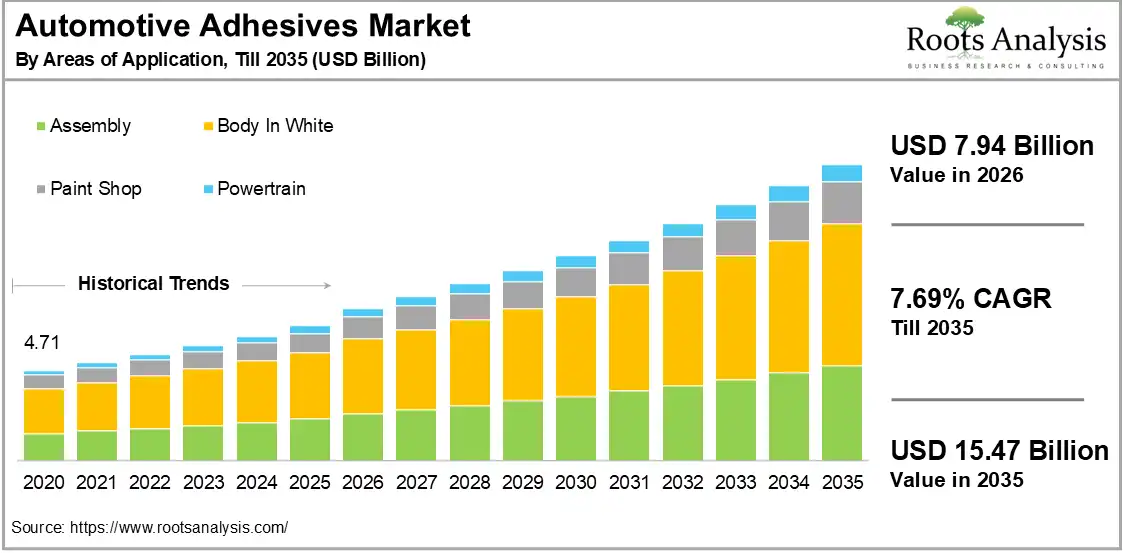
The global automotive adhesives market size is projected to reach USD 7.94 billion in 2026, USD 10.68 billion in 2030, and USD 15.47 billion by 2035, with 7.69% CAGR during the forecast period 2026 to 2035.
See What’s in the Full Report – Request Your Complimentary Insights!
Automotive adhesives are specialized bonding agents engineered to join a wide variety of materials, such as metals, plastics, composites, and glass within vehicle manufacturing and assembly processes. Unlike traditional mechanical fasteners or welding, these adhesives enable seamless integration of components, supporting the automotive industry’s drive for lighter, safer, and more efficient vehicles.
The evolution of automotive adhesives reflects broader shifts in automotive engineering. As manufacturers strive to reduce vehicle weight for improved fuel efficiency and lower emissions, adhesives have replaced or supplemented rivets and welds in many applications. According to Henkel’s automotive division, 'the right adhesive for the right application area takes many complex factors into account,' highlighting the need for tailored solutions that accommodate diverse substrates, curing methods, and performance requirements.
Recent advances in adhesive chemistry and application technology have opened new frontiers for innovation. The development of fast curing, bio-based, and smart adhesives is addressing industry demands for greater sustainability, manufacturing efficiency, and product longevity. As noted by industry experts, rigorous quality control and standardization ensure that adhesives meet stringent safety and durability standards, even under extreme conditions. With the automotive sector’s increasing reliance on multi-material construction and electrification, adhesives are poised to play an even more critical role in shaping the vehicles of tomorrow.
Automotive Adhesives Market Share Insights
Which Type of Resin Will Dominate the Automotive Adhesives Market?
Based on the automotive adhesives market analysis, the polyurethane (PU) segment is set to take the lead, holding a significant share of 35.21% of the market.
The dominance of this segment is largely due to its versatility, excellent adhesion to diverse substrates, high flexibility, and superior durability. The growing adoption of electric vehicles, which require advanced bonding solutions for battery assembly and thermal management, further strengthens PU’s leading position in the market.
However, it is worth highlighting that the epoxy market share is likely to witness the fastest CAGR (7%) during the forecasted period.
Which Type of Vehicle Will have the Fastest CAGR?
Based on the global automotive adhesives market forecast, the passenger vehicles segment is set to witness the fastest CAGR (6.7%) during the forecasted period. Additionally, this segment is also dominating the market with a share of 45%.
The growth is driven by high production volumes, increasing adoption of lightweight automotive adhesives, and the rapid growth of electric and hybrid passenger cars, which require advanced adhesive solutions for structural integrity, safety, and comfort.
Which Type of Technology Will Dominate the Automotive Adhesives Market?
According to our automotive adhesives market report, the reactive adhesives segment is set to have the highest market share of about 45% during the forecasted period.
The growth can be attributed to its versatility, strong bonding capabilities across diverse substrates (metals, plastics, composites, glass), and essential role in both traditional and electric vehicle manufacturing, especially for structural and battery assembly applications.
On the other hand, it is worth highlighting that the water-based adhesives segment is likely to witness the fastest CAGR (7.3%) during the forecast period.
Pay Only for What You Need – The Best Way to Optimize
How is the Body In White Segment Dominating Areas of Application?
In application, the BIW segment really stands out as the leading segment holding a market share of 54%. Additionally, this segment will also be the fastest growing one with a CAGR of 7.2%, during the forecasted period.
The critical role of adhesives in enabling weight reduction, improved crash performance, and integration of advanced materials makes BIW the primary application area for automotive adhesives. Further, the ongoing shift toward lightweighting, stricter emission standards, and the growing adoption of electric vehicles, where BIW construction is central to safety and efficiency are the key drivers accelerating growth in this segment.
Which Regions or Countries Offer the Highest Growth Potential for Automotive Adhesives?
According to our automotive adhesives regional analysis, the Asian automotive adhesives market exhibits dominance by capturing 49.86% of the overall current market share. This is mainly due to factors such as robust growth in automotive and general industries. Furthermore, the rise in electric vehicles and weight reduction materials in this area has also created a demand for advanced adhesives capable of bonding various substrates like aluminum & composites. In addition to this, government initiatives for environmental sustainability along with stringent emission regulations are also compelling the manufacturers to utilize innovative bonding solutions. This in turn is propelling the global automotive adhesives market growth.
Automotive Adhesives Market Key Insights
Automotive Adhesives Market Drivers and Trends
What are the Factors Driving Growth in the Automotive Adhesives Market?
- Lightweighting and Emissions Reduction: The push for lighter vehicles to improve fuel efficiency and meet stringent emissions standards is a primary driver. Adhesives replace heavier mechanical fasteners and welding, enabling the use of lightweight materials like aluminum and composites, thus reducing overall vehicle weight and CO2 emissions.
- Electric Vehicle (EV) Production: Surging EV sales globally are boosting demand for electric vehicle adhesives used in battery packs, thermal management, and lightweight body structures. Adhesives provide electrical insulation, thermal stability, and help in reducing vehicle weight to extend EV range.
- Technological Advancements: Continuous innovation in adhesive formulations, such as water based automotive adhesives, low-VOC, and high-performance structural adhesives-enhances bonding strength, durability, and environmental compliance, replacing traditional fastening methods.
- Stringent Emission Regulations: Regulatory pressure in Europe, North America, and Asia-Pacific is accelerating the adoption of adhesives that enable compliance with lower emission targets and sustainability goals.
- Growth in Emerging Markets: Rapid automotive production growth, especially in Asia-Pacific (notably China and India), is driving market expansion, with the region expected to account for a rising share of global demand.
- Enhanced Comfort and Safety: Adhesives improve NVH (noise, vibration, harshness) performance, crash resistance, and overall passenger comfort, supporting their broader adoption in vehicle design.
What is the Impact of Electric Vehicle Production on Automotive Adhesives Demand?
The surge in EV production is dramatically increasing demand for automotive adhesives, as EVs require advanced bonding solutions for battery assembly, lightweighting, and thermal management.
What is the Comparison of Structural Adhesives V/S Mechanical Fasteners in Vehicles?
Structural adhesives offer superior bonding for dissimilar and lightweight materials, distribute stress more evenly, enable sleeker designs, and reduce vehicle weight compared to traditional mechanical fasteners, which can add mass and create stress points.
What are the Advancements in Water-based and Low-VOC Automotive Adhesives?
Recent innovations in water-based and low-VOC adhesives are enabling automakers to meet stringent environmental regulations, reduce emissions during manufacturing, and maintain high-performance bonding for interior, trim, and structural applications.
What is the Role of Automotive Adhesives in Battery Thermal Management in EVs?
Specialized adhesives are now used in EV battery packs to provide thermal conductivity, electrical insulation, and vibration damping, ensuring battery safety, longevity, and efficient heat dissipation in high-performance electric vehicles.
What are the Future Automotive Adhesives Trends for Next Generation Vehicles?
Key trends include the rise of smart adhesives for sensor integration, bio-based and recyclable formulations, enhanced thermal and electrical properties for EVs, and digitalization of adhesive application processes for improved quality and efficiency.
What are the Key Strategies Used by Companies to Gain Automotive Adhesives Market Share?
Automotive adhesives companies are using smart strategies to stay ahead. Big players are focusing on automotive adhesives market opportunities in emerging economies, partnerships, acquisitions, joint ventures, and innovations to strengthen their position in the automotive adhesives competitive landscape while also investing in R&D to bring innovative and novel products to the market.
Your Business is Unique – Why Shouldn’t Your Report Be?
Automotive Adhesives Market Challenges
What are the Major Challenges Faced by Manufacturers in the Automotive Adhesives Market?
The automotive adhesives market, while growing, faces several challenges that can impede its expansion. Here are the major challenges affecting this market:
- Stringent Environmental Regulations: The need to comply with low-VOC and eco-friendly requirements increases R&D costs and complexity, especially for small and medium manufacturers.
- Raw Material Price Volatility: Fluctuations in the prices of chemicals and resins used in adhesives can impact profitability and supply chain stability.
- Technological Barriers: Developing adhesives that meet the demanding safety, durability, and performance requirements for new automotive applications, such as EV batteries and lightweight composites remains challenging.
- High Capital Investment: Upgrading manufacturing processes to accommodate new adhesive technologies and meet regulatory standards requires significant investment.
- Competition from Alternative Joining Methods: Mechanical fasteners, welding, and new hybrid joining techniques still compete with adhesives in certain applications, especially where cost or familiarity is a concern.
- Market Fragmentation: The presence of many global and regional players leads to intense competition, price pressure, and the need for continuous innovation.
Recent Developments in the Automotive Adhesives Market
- In November 2025, Covestro signed a strategic partnership with Nippon Paint to strengthen their collaboration in automotive and industrial coatings and adhesives.
- In February 2025, LG Chem and HL Mando Partner for the development of advanced adhesives for automotive electronics.
Automotive Adhesives Market: Report Attributes / Market Segmentations
| Key Report Attributes | Details | |
| Historical Trend | Since 2020 | |
| Forecast Period | Till 2035 | |
| Market Size 2026 | $ 7.94 Billion | |
| Market Size 2035 | $ 15.47 Billion | |
| CAGR till 2035 | 7.69% | |
| Resin |
|
|
| Type of Technology |
|
|
| Vehicle |
|
|
| Application |
|
|
| Enterprise |
|
|
| Geographical Regions |
|
|
| Leading Market Players | ||
| PowerPoint Presentation (Complimentary) | Available | |
| Customization Scope | 15% Free Customization | |
| Excel Data Packs (Complimentary) |
|
|
Want Information on Specific Region / Segment?


