
Lowest Price Guaranteed
Slides
248
Last Updated
July 2026
View Count
19220
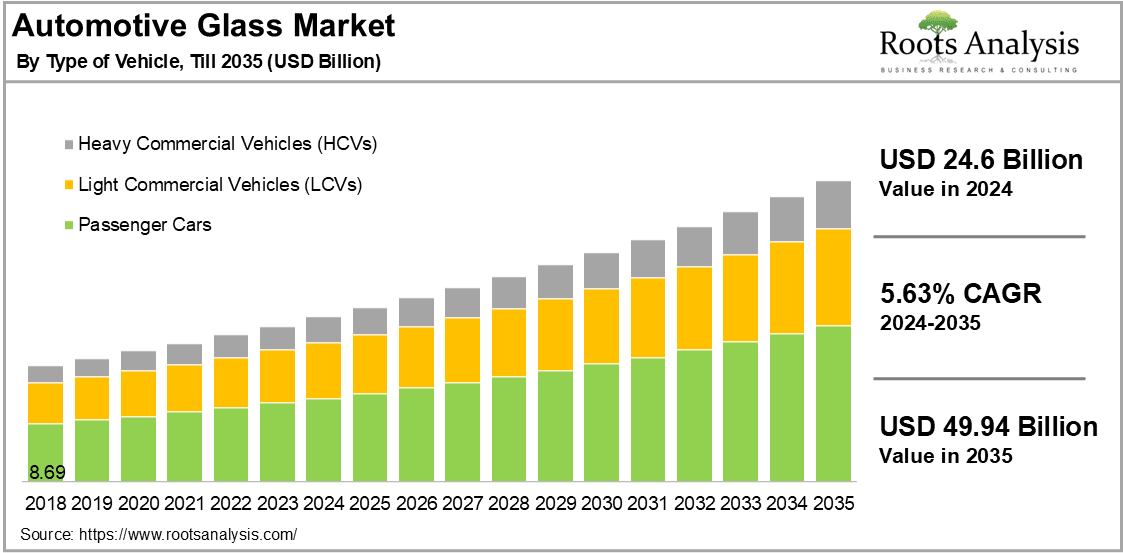
The automotive glass market size is projected to grow from USD 24.6 billion in 2024 to USD 49.94 billion by 2035, representing a CAGR of 5.63%, during the forecast period 2024-2035.
 |
To learn more about this report, request a free sample copy
The expansion of the automotive industry with increased production and sales of commercial vehicles, passenger vehicles, and electronic vehicles has generated new opportunities for the automotive glass market. Automotive glass is specially designed glass that is used in vehicles, such as cars, buses, and trucks to ensure safety, visibility, and comfort for occupants. The purpose of these glasses is to withstand various stresses and impacts encountered during vehicle operation, providing essential structural support and protection.
There are wide ranges of glasses in the market, including laminated glass and tempered glass which have numerous applications like windshields, sidelites side windows, backlites rear windows, rear quarter glass, and sunroofs. Of note, the windshield is a major application that has spiked the demand in the automotive glass industry. As it is typically made of laminated glass, which consists of two layers of glass with a plastic interlayer (usually polyvinyl butyral) in between. This construction prevents the glass from shattering into sharp pieces upon impact and enhances safety. Additionally, the integration of industrial automation has transformed automotive glass manufacturing.
Furthermore, with ongoing technological advancement in the automotive glass industry, including the integration of smart features and advanced driver assistance systems (ADAS), there is an increasing demand for smart glasses and gorilla glasses that offer improved safety and comfort to drivers and passengers and enhance comfort by reducing glare and heat. Also, it improves energy efficiency by minimizing reliance on air conditioning, and provides aesthetic and privacy benefits. Likewise, there is a rapid growth in smart glass options in sunroof and sunroof production, across different regions, upsurging the market growth. This trend aligns with evolving consumer preferences and the initiatives of automakers to improve vehicle features, thereby boosting demand for advanced automotive glass solutions.
Consequently, by leveraging these technological advancements, automotive glass manufacturers offer advanced products and services to enhance passenger comfort, improve energy efficiency and include advanced functionalities. Besides, they continuously invest in innovation and technologies to cater to changing customer requirements in the automotive glass industry. Considering these factors, the global market for automotive glass is projected to sprout out substantially during this forecast period. Additionally, due to increasing production of vehicles, rising demand for EVs, growing stringent regulatory compliances, surge in aftermarket demand for maintenance, and continuous technological advancements are other key drivers of automotive glass market.
The market report presents an in-depth analysis of the various manufacturers / service provides that are involved in offering automotive glass market, across different segments, as defined in the table below:
| Key Report Attributes | Details | |
| Historical Trend | 2018-2023 | |
| Base Year | 2023 | |
| Forecast Period | 2024-2035 | |
| Market Size Value in 2024 | $ 24.6 Billion | |
| Market Size Value by 2035 | $ 49.94 Billion | |
| Growth Rate | CAGR of 5.63% from 2024 to 2035 | |
Type of Products |
|
|
| Type of Technology |
|
|
| Type of Application |
|
|
| Type of Vehicle |
|
|
| Type of Distribution |
|
|
| Company Size |
|
|
| Geographical Regions |
|
|
| Leading Market Players |
|
|
| PowerPoint Presentation (Complimentary) |
Available | |
| Customization Scope | 15% Free Customization | |
| Excel Data Packs (Complimentary) |
|
|
The global automotive glass market is segmented into different types of products namely, laminated glass, tempered glass, and others. As per market research, laminated glass is anticipated to be a leading segment with the largest automotive glass market share. Laminated glass is a traditional glass protection technology that offers safety features, such as retaining its shape when shattered and reducing the risk of injury from flying glass shards. Further, it is extensively used for windshields as it is considered much safer than tempered glass for windscreens. In respect to this, there is an emerging trend of laminated glass in side windows which will likely spur the demand in the automotive glass industry.
Consequently, it is a preferred choice for automobile manufacturers who contribute significantly to the market share in the automotive glass market. Moreover, tempered glass is gaining traction in the modern automobile industry owing to its cost-effective and robust protection feature, which is expected to rise at a significant growth rate during this forecast period.
Based on the type of technology, the automotive glass industry is bifurcated into standard glass and smart glass. According to our prediction, smart glass dominates the automotive glass industry and is projected to gain the majority of the market share. The variety of smart glasses such as electrochromic, Polymer Dispersed Liquid Devices (PDLC), and Suspended Particle Devices (SPD), and their benefits are attributed to the segment growth.
Besides, ongoing technological advancements, growing preference for premium, luxurious vehicles, and advanced functionalities like dynamic tinting and glare reduction, enhanced comfort, and safety for drivers & passengers are poised to augment demand in the automotive industry. In addition, automobile manufacturing companies are widely adopting smart glass technology in their vehicles, lifting the market growth. Therefore, the smart glass segment is anticipated to witness a higher CAGR over this projection time frame.
This segment describes different types of applications of the automotive glass market which include windshield, sidelite (side windows, backlite (rear windows), rear quarter glass, and sunroof. Currently, windshield is capturing the highest market share and is dominating the automotive glass market. The windshield is a crucial auto part of any passenger vehicle that ensures the safety of the driver and passengers from debris and environmental elements and provides visibility for drivers. W
indshields are typically made of laminated glass, which is designed to prevent shattering upon impact. Additionally, modern windshields offer various other advantages, such as sound insulation, U.V. protection, a heads-up display (H.U.D.), and rain sensors. As a result, these factors contribute to windshield’s leading position. Furthermore, the side windows segment is estimated to experience a steady growth rate in the coming decade with growing concerns about vehicle protection and stringent safety standards.
This segment underscores the type of vehicles in the global market for automotive glass, such as passenger cars, light commercial vehicles, and heavy commercial vehicles. Based on the type of vehicle, the passenger car is the leading segment and capturing the highest market share. Due to the rise in the demand for electric vehicles, and light commercial vehicles, the passenger car segment will likely dominate the vehicle segment. The increasing awareness of emission control and environmental regulation is encouraging the production of EVs and hybrid vehicles, propelling the market growth.
Based on the type of distribution, the global market for automotive glass is split into OEM (original equipment manufacturer) and aftermarket. As per market research, the OEM segment leads the market with the majority of the market share. Pre-installed automotive glass in vehicles during the manufacturing process is a substantial factor in driving the growth of the OEM segment. The benefits of the OEM segment in durability, high quality, and perfect fit with the vehicle’s design make it a preference of customer’s choice. While the aftermarket segment is projected to grow at a steady CAGR due to the requirement for the replacement of glass and maintenance of vehicles.
The global automotive glass market is divided into different sizes of companies, such as small and medium-sized enterprises (SMEs) and large enterprises. Based on company size, the large multinational companies hold the largest market shares. The large distribution network, high capital investment for product innovation, and the advanced manufacturing technologies of large glass companies contribute to fostering the growth of the segment.
Besides this, their scalability to provide high quality products to meet the rising demand for OEM and aftermarket successfully aid them in retaining their leading position. Considering these factors, the large enterprises segment is projected to continue to drive the market at a faster growth rate over this forecast period.
This segment highlights the distribution of the automotive glass market across various geographical regions, such as North America, Europe, Asia Pacific, Latin America, Middle East and North America and rest of the world. In terms of revenue, Asia Pacific is a dominating region and captures the largest automotive glass market share. The driving factor of the region’s growth can be ascribed to its largest vehicle manufacturing industry in countries including China and Japan. Along with this, the expanding aftermarket sector with growing customer base in the region.
The “Automotive Glass Market, Till 2035: Distribution by Type of Product (Laminated Glass, Tempered Glass and Others), Technology (Standard Glass, Smart Glass), Application (Windshield, Sidelite (side windows, Backlite (rear windows), Rear Quarter Glass, and Sunroof), Vehicle (Passenger Cars, Light Commercial Vehicles, Heavy Commercial Vehicles), Distribution OEM (Original Equipment Manufacturer) and Aftermarket, Company Size (Small and Medium-sized Enterprises (SMEs) and Large Enterprises),) and Key Geographical Regions (North America, Europe, Asia, Latin America and Middle East and North Africa and Rest of the World): Industry Trends and Global Forecasts” report features an extensive study of the current market landscape, market size and future opportunity within the automotive glass market, during the given forecast period. The market report highlights the efforts of several stakeholders involved in this rapidly emerging segment of the service providers industry. Key takeaways of the automotive glass market report are briefly discussed below.
Ongoing technological advancement is one of the latest automotive glass market trends which has expanded the potential growth of the market. Further, with the emergence of smart glass technologies, such as electrochromic and photochromic glass, industry is witnessing rapid growth. These types of glasses are gaining traction in the market due to their advantages of changing their tint based on electric signals or light exposure, which helps in controlling the amount of sunlight entering the vehicle, enhancing comfort, and reducing glare. Apart from this, the trend of modern automotive glass is becoming popular due to its integrating heads-up-display technology that aids in estimating significant information like speed, navigation, and warnings directly onto the windshield. Consequently, leading automotive glass companies are embracing these advanced glass technologies to offer enhanced safety, comfort, and energy efficiency in vehicles which will likely generate lucrative opportunities for market players and expand the market outlook during the forecast period.
With several small and large automotive glass manufacturing companies, the market is experiencing intense competition and changing market dynamics. From large multinational companies to local automotive glass manufacturers, companies are striving to enhance their competitive edge. In terms of market share, large enterprises and multinational companies are dominating the market. While small automotive glass manufacturers are continuously improving their products to cater to niche markets or they are offering specialized products, glass solutions, and services. These industry players focus on adopting competitive strategies, such as introducing innovative products and technologies, partnerships, and collaboration with glass manufacturers, automotive suppliers, aftermarket suppliers, and others. For instance, car manufacturers are using advanced glass coatings to keep vehicle cabins cool, reducing the need for air conditioning as summer temperatures exceed 45°C. This aligns with the trend of larger SUVs and electric vehicles, which require more battery space and have larger glass surfaces, increasing thermal loads.
One of the major driving factors of the automotive glass market is the mounting production and sale of vehicles, particularly electric vehicles. This rise in production and sales directly influences the automotive glass market growth. Stringent safety regulations mandating the use of safety glass in vehicles, specifically, windshields, propel the demand for automotive glass. While compliance with safety standards encourages automakers to invest in high-quality glass products to ensure the safety of vehicle occupants. Apart from this, growing technological advancements, a spike in vehicle customization, and aftermarket demand are some other significant automotive glass market drivers that will likely foster the growth of the market during this forecast period.
With regard to regional insights, the Asia Pacific region is expected to grow at the fastest growth rate with the maximum market share and is likely to dominate the automotive glass industry. The rapidly expanding automotive manufacturing industry in developing countries, such as China, India, and Japan is substantially influencing market growth and driving the demand for automotive glass for OEM and aftermarket applications. Additionally, a large customer base, increasing disposable income, and ongoing technological advancement in the automotive glass industry with features like heads-up displays, embedded sensors, and self-tinting capabilities are attributed to elevating the automotive glass market growth in the region. Furthermore, the implementation of strict regulations for road safety by governments are accelerating the growth of the market. Coupled with this, growing partnerships and collaborations among local and global companies are stimulating market growth. For instance, in January 2024, Hegla and Glaston entered a new partnership targeting the Asia-Pacific region. This partnership extends across most of the Asia-Pacific region for architectural and automotive glass applications to bring the expertise, technology, and resources of both companies to serve customers more effectively and comprehensively.
Examples of key service providers involved in the automotive glass market industry (which have also been captured in this market report, arranged in alphabetical order) include AGC, Central Glass, Corning Incorporated, Fuyao Glass, Guardian Industries, Magna International, Nippon Sheet Glass, Pilkington Group, Saint Gobain, Taiwan Glass Industry, Vitro S.A.B. de C.V., Webasto Group, and Xinyi Glass Holdings. This market report includes an easily searchable Excel database of all the companies who have adopted the automotive glass market.
Automotive Glass Market Report Coverage
The market report presents an in-depth analysis, highlighting the capabilities of various companies engaged in this domain, across different segments. Amongst other elements, the market report includes:
At Roots Analysis, we genuinely care about your success and understand that your business requirements are unique. While our market research reports provide valuable insights, we recognize that they might not cover every aspect you need to make well-informed strategic decisions. To account for that, we offer 15% free report customization tailored to your specific needs. Whether you require additional quantitative analysis, qualitative insights, or any other information related to the supply chain analytics market, reach out us today at: support@rootsanalysis.com