


 Download Free Sample
 Buy Now
Autonomous Data Center Market Size
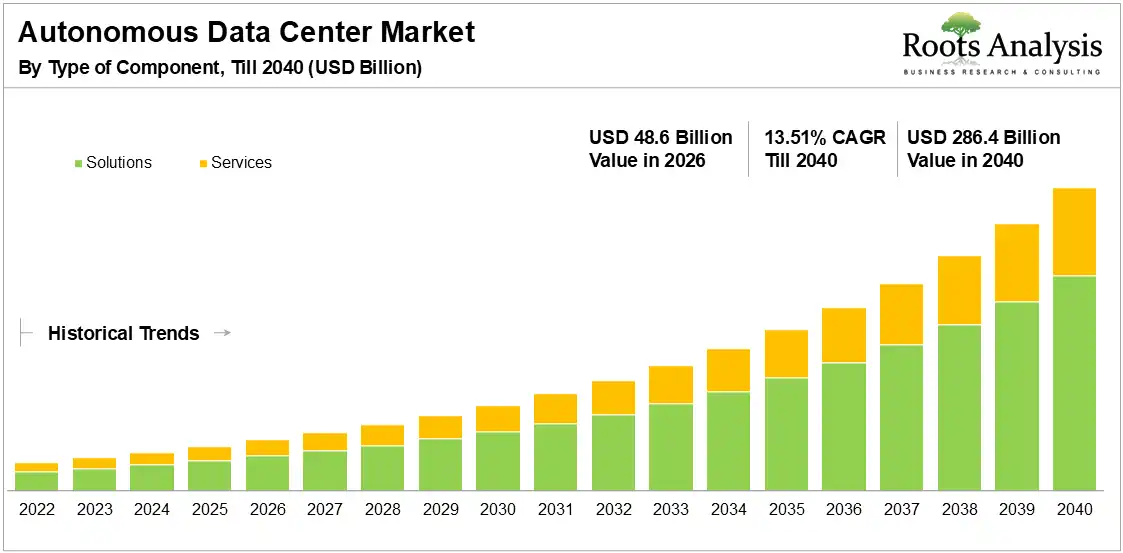
The global autonomous data center market reached USD 48.6 billion in 2026 and will grow to USD 286.4 billion by 2040, registering a CAGR of 13.51% over the forecast period 2026 to 2040, driven by accelerated AI-led infrastructure automation and hyperscale capacity expansion.
See What’s in the Full Report – Request Your Complimentary Insights!
Market Report: Key Takeaways
- Based on component, solutions captures 68.0% market share in 2026, in fact, solutions registers a 14.1% CAGR through 2040, driven by integrated AI orchestration demand.
- On the basis of deployment mode, on-premises captures 39.0% market share in 2026, whereas cloud-based registers a 16.1% CAGR through 2040, driven by hyperscale automation adoption.
- With respect to data center type, hyperscale data centers is both the dominant and fastest-growing category, holding 41.0% share in 2026 and expanding at 16.5% CAGR through 2040, driven by AI compute density requirements.
- Based on technology, AI and machine learning captures 23.0% market share in 2026, whereas digital twin technology registers a 17.2% CAGR through 2040, driven by simulation-based infrastructure optimization.
- Based on geography, North America captures 39.0% market share in 2026, whereas Asia-Pacific registers a 16.4% CAGR through 2040, driven by sovereign AI infrastructure investments.
Autonomous Data Center Market Outlook
Autonomous data center demand has shifted from isolated automation tools to integrated AI control stacks. Hyperscale operators now want predictive maintenance, workload orchestration, and energy optimization inside one operating layer. That change matters because compute density, thermal loads, and staffing constraints now shape design choices as much as server count. The market is no longer buying point software; it is buying autonomous operating capability.
Growth now comes from AI infrastructure spending, liquid cooling adoption, and the push toward lights-out operations. Energy efficiency has become a commercial requirement, not a branding claim, because power and cooling costs now cap cluster expansion. Schneider Electric's October 2025 AI data center reference designs with NVIDIA show how vendors are packaging deployment speed and operational control together. This market is also absorbing sustainability pressure through AI-based energy optimization and diversified power planning.
Through 2040, autonomous data centers will stay high-growth and increasingly software-defined. Digital twins, AIOps, and autonomous cooling will pull control decisions closer to real time, while hyperscale campuses will keep consolidating spending. Vertiv's January 2026 expansion of predictive infrastructure and liquid cooling capabilities reflects that direction. The outlook remains strong because artificial intelligence (AI) workloads keep raising both the value and the complexity of autonomous operations.
Autonomous Data Center Market Size Estimation Methodology
- As a starting point, the forecast begins with hyperscaler capex disclosures, AI cluster build announcements, and server shipment data. These inputs show how fast operators are adding autonomous infrastructure layers above physical data center assets. We then isolate spend tied to DCIM software, predictive cooling, AIOps, and workload orchestration rather than the full construction market. That separation keeps hardware replacement cycles from inflating software-led growth.
- Moving forward, we map those demand signals against colocation leasing rates, utility billing data, and power availability trends. Autonomous data center adoption rises fastest where electricity cost, thermal load, and utilization volatility pressure operators to automate. That step helps separate temporary capex spikes from structural shifts in operating models. It also reveals where energy economics support faster commercialization.
- Building on this, we benchmark deployment patterns across hyperscale, colocation, enterprise, and edge facilities. Hyperscale data centers lead because AI compute density, liquid cooling, and autonomous orchestration move together in large campuses. The segment shares from the research package anchor the model and prevent overstatement in smaller deployment pockets. They also preserve consistency across geography and end-user splits.
- Drawing upon these inputs, we test technology adoption using vendor release timing, partnership cadence, and product scope changes. Recent moves from Schneider Electric, Vertiv, Microsoft, Oracle, and Google help distinguish early commercialization from broader market diffusion. This keeps the forecast tied to observed adoption behavior rather than to generic AI enthusiasm. It also shows which vendors are turning announcements into repeatable demand.
- The projected value was then calibrated against construction cost indices, utility expansion constraints, and supply chain availability for cooling and power equipment. We also checked semiconductor fab output and trade flow data where equipment shortages could delay autonomous facility rollout. That calibration reduced the risk of double counting infrastructure upgrades already embedded in adjacent data center forecasts. The resulting range stays close to the source consensus.
- Finally, the model was reconciled with the published segment shares and the 2026 to 2040 growth path in the source package. We used the consensus research notes to avoid extreme long-term CAGR assumptions and to keep the Autonomous Data Center Market forecast inside a defensible range. The result reflects autonomous operational layers, not the entire global data center construction market. It remains consistent with the 48.6 billion dollar 2026 base and 13.51% CAGR.
Autonomous Data Center Market Share Insights
Market Share by Type of Component
According to our market forecast, solutions dominate the market by holding 68% of the overall revenue share in 2026. Solutions dominate because enterprises prioritize integrated orchestration, predictive analytics, and autonomous workload management capabilities. Hyperscale operators increasingly consolidate DCIM, AIOps, and digital twin functions into unified software stacks. In February 2025, Schneider Electric expanded its EcoStruxure autonomous data center platform capabilities for AI-intensive facilities.
Notably, solutions will continue to grow at a higher CAGR of 14.1% during the forecast period 2026-2040. Solutions will expand rapidly because operators seek real-time automation to reduce labor intensity and energy inefficiencies. AI-driven orchestration platforms increasingly support unmanned and lights-out infrastructure operations across hyperscale campuses. In March 2025, Vertiv launched new AI-ready infrastructure management software for autonomous operational optimization.
Market Share by Technology
On the basis of our projection, AI and machine learning lead the market with 23% of the global market share in 2026. AI and machine learning technologies lead because autonomous operations depend on continuous anomaly detection and infrastructure optimization. Operators increasingly deploy machine learning models for thermal balancing, workload placement, and predictive maintenance. In February 2025, Dell Technologies launched AI-driven autonomous operations capabilities for enterprise and hyperscale data centers.
Conversely, the digital twin technology segment is likely to grow at a CAGR of 17.2% during the forecast period through 2040. Digital twin technology will grow fastest because operators require simulation-driven infrastructure planning for AI cluster expansion. Virtual replicas improve energy efficiency, capacity planning accuracy, and autonomous incident response capabilities. In July 2025, Siemens expanded digital twin software integrations targeting AI data center infrastructure management.
Regional Analysis: North America Leads the Market and Asia-Pacific Growth at Higher CAGR
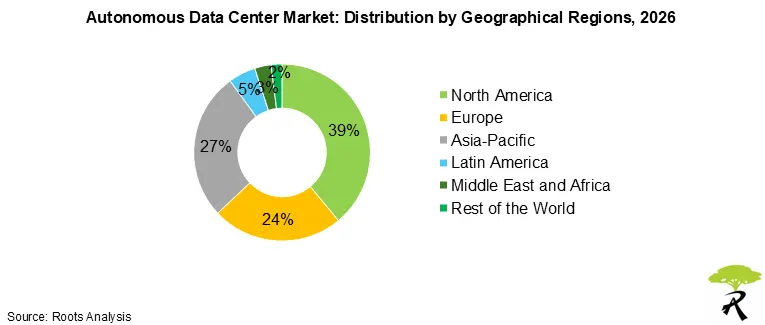
North America Accounted for 39.0% Market Share in 2026
The region leads because hyperscale cloud providers maintain the world’s deepest autonomous infrastructure ecosystems and capital resources. Strong semiconductor supply chains and advanced AI deployment maturity continue accelerating autonomous operations adoption across large-scale facilities. Regulatory support for AI infrastructure and renewable energy integration also strengthens long-term deployment economics. In May 2025, Microsoft announced expanded AI infrastructure investments supporting autonomous operational capabilities across multiple US campuses.
Asia-Pacific will Register a CAGR of 16.4% Through 2040
The region will expand rapidly because governments increasingly prioritize domestic AI compute infrastructure and digital sovereignty initiatives. Notably, these initiatives are government-led actions to ensure a nation's data, digital infrastructure, and AI technologies are stored and controlled entirely within its own borders. These policies protect national security, reduce dependence on foreign tech giants, and enforce strict local data privacy laws.
Further, Cloud adoption, 5G rollout, and manufacturing digitization continue driving strong demand for autonomous infrastructure management solutions. Large hyperscale operators are also accelerating regional campus expansion to support local AI workloads. In October 2025, Alibaba Cloud expanded autonomous AI data center operations supporting Southeast Asian enterprise demand. Moreover, in December 2025, Microsoft announced to invest USD 17.5 billion in India to drive AI diffusion at large scale.
Market Ecosystem Analysis
Autonomous Data Center Market Competitive Landscape
The autonomous data center market remains highly consolidated around hyperscale cloud operators, AI compute platform vendors, and intelligent infrastructure providers. The dominant competitive dynamic is hardware-software convergence, where vendors combine AI accelerators, orchestration software, networking fabrics, cooling systems, and DCIM platforms into unified autonomous infrastructure stacks.
The primary commercial force reshaping competition is the rapid scaling of AI workloads, which is increasing demand for autonomous power optimization, liquid cooling, AI-native networking, and self-managing infrastructure orchestration across hyperscale and enterprise environments.
Leading Autonomous Data Center Providers and Their Initiatives
The autonomous data center market is accelerating at a 13.51% CAGR, driven by enterprises demanding self-provisioning, self-healing, and self-securing infrastructure. Hyperscalers including AWS, Microsoft, Google, Meta, and Oracle are spending over USD 600 billion in capex in 2026 alone, building AI-native campuses at unprecedented scale. Google DeepMind leads on operational autonomy, with its AI directly controlling cooling across multiple data centers and delivering consistent energy savings of around 30%.
On the other hand, infrastructure suppliers are combining AI accelerators, autonomous networking, and high-density thermal management into tightly integrated AI-ready data center architectures.
- NVIDIA Corporation strengthened its position in AI-accelerated autonomous infrastructure during 2025 through integrated GPU, networking, and AI orchestration offerings targeting hyperscale deployments. The strategy increases ecosystem lock-in while accelerating autonomous infrastructure adoption for generative AI workloads.
- Vertiv Holdings expanded AI-ready power and liquid cooling infrastructure deployments during 2025 to support high-density GPU clusters. The company’s focus on autonomous thermal optimization directly addresses rising energy intensity from AI training workloads.
Top Startup Companies and Their Initiatives
The startup ecosystem of the autonomous data center market is consolidating fast around a new class called neoclouds. CoreWeave, the biggest of them, ended 2025 with 43 data centers and 850 megawatts of active power, posting USD 5.13 billion in revenue, up 2.7x from 2024. It has locked in an USD 87.8 billion revenue backlog anchored by a USD 22.4 billion OpenAI capacity deal and a USD 35.2 billion Meta commitment running through 2032. NVIDIA invested USD 2 billion into CoreWeave in January 2026 to expand their joint data center buildout.
Autonomous Data Center Market Trends
GPU Density Requirements Driving Liquid Cooling Buildout
AI clusters keep pushing rack density higher, and liquid cooling is becoming a commercial requirement rather than an optional upgrade. Vertiv’s acquisition of PurgeRite in November 2025 strengthens thermal management for AI data centers. Suppliers that own cooling integration will defend pricing power as thermal complexity rises.
Reference designs are now a competitive weapon because operators want faster deployment with fewer integration errors. Schneider Electric’s October 2025 NVIDIA co-developed designs and Vertiv's October 2025 800 VDC collaboration both point to standardized high-density architectures. That standardization favors vendors with credible engineering depth and compresses the gap between design and revenue.
Agentic Operations Turning Software into the Control Plane
Autonomous infrastructure management is shifting buying decisions toward software stacks that can coordinate power, cooling, and compute in real time. Schneider Electric highlighted agentic AI and autonomous infrastructure management in July 2025. That shift raises the value of integrated DCIM, AIOps, and digital twin tools. Predictive control is now the fast lane for adoption because operators want fewer manual interventions and better fault recovery. Vertiv’s January 2026 predictive infrastructure expansion and Dell's AI-driven autonomous operations launch in February 2025 show how software is moving upstream into infrastructure decisions. Vendors that combine analytics with execution will win the strongest renewal and upsell rates.
Your Business is Unique – Why Shouldn’t Your Report Be?
Market Access Considerations
High-Density Power and Cooling Integration
Autonomous data center vendors need credible power and cooling integration before they can win large contracts. Liquid cooling, 800 VDC power, and predictive thermal control create a technical entry gate that punishes weak engineering teams. Vertiv’s work with NVIDIA on 800 VDC infrastructure and its PurgeRite acquisition show how access depends on thermal competence and not just software claims. That raises the bar for commercialization and protects incumbents with installed service capability.
Hyperscale Reference Architecture Alignment
Procurement access increasingly depends on whether a vendor fits the reference architecture of a hyperscale buyer. Schneider Electric's NVIDIA co-developed designs and similar platform partnerships shorten sales cycles for approved suppliers, while outsiders face longer validation periods. This behavior matters because hyperscalers buy at scale, lock in standards early, and then reuse those templates across regions. Vendors that join these programs gain faster entry and better renewal leverage.
Capital Intensity and Partnership Depth
Autonomous operations require large upfront spending on software, cooling, power, and integration, so access favors companies with patient capital or strong channel partners. Reuters' reporting on record data center deal activity in December 2025 and NVIDIA’s May 2026 IREN investment show that money is concentrating around a small group of scaled players. Smaller entrants must enter through alliances or niche software hooks. That structure slows stand-alone commercialization but rewards specialized positioning.
Regional Buildout and Operational Localization
Market access also depends on where autonomous capacity is being built and who controls local infrastructure decisions. Asia-Pacific is growing fastest because governments and cloud operators push regional AI capacity, while North America still holds the deepest capital base. Alibaba Cloud's October 2025 Southeast Asia expansion shows how localized operations open new sales channels. Vendors that understand regional energy, procurement, and service models can scale faster and defend share better.
How Stakeholders Benefit from the Key Focus Areas of Our Autonomous Data Center Market Report
AI infrastructure spending is forcing operators to redesign power, cooling, and control at the same time. That makes the Autonomous Data Center Market commercially urgent for teams deciding where to invest, which partners to back, and which technologies to deploy first. This report helps narrow those choices by quantifying segment growth and showing where competitive access is tightening.
- Unmet Needs and Market Gaps in Autonomous Data Center Market: The report pinpoints where current solutions still fall short, especially in integrated orchestration, thermal control, and cross-layer visibility. Product teams and strategy leaders can use that gap view to decide which problems justify premium positioning. It helps them avoid features that sound advanced but do not remove deployment friction.
- Funding and Venture Investment Opportunities in Autonomous Data Center Market: The report identifies where capital is concentrating, especially around liquid cooling, predictive infrastructure, and hyperscale automation. Investors and corporate development teams can use that view to decide which subsegments deserve early backing and which are already crowded. It also helps them compare platform plays with specialist infrastructure bets.
- Technology Innovation and Adoption Trends: The report shows which technologies are gaining share, including AI and Machine Learning at 23.0% in 2026 and Digital Twin Technology at a 17.2% CAGR through 2040. Technology leaders can use that split to decide whether to invest in execution software, simulation layers, or autonomous cooling. It also clarifies which capabilities are becoming table stakes and which still differentiate vendors.
- Autonomous Data Center Competitive Landscape and Industry Analysis: The report maps Tier 1 leaders, Tier 2 specialists, and emerging vendors across infrastructure, networking, cooling, and automation. Business teams can use that structure to target competitors, set partnership priorities, and decide whether to sell through hyperscalers or enterprise channels. It gives a clear view of where scale and ecosystem access shape win rates.
- Mapping Strategic Partnerships and Ecosystem Synergies: The report highlights the partnerships that now define market access, including NVIDIA with IREN, Vertiv with NVIDIA, and Schneider Electric with NVIDIA. Operations leaders and alliance teams can use that pattern to identify which integrations reduce deployment friction and which relationships unlock buyer trust. It supports partner selection, co-development planning, and channel design.
- Autonomous Data Center CAGR and Growth Trends: The report quantifies the market path from USD 48.6 billion in 2026 to USD 286.4 billion in 2040, at a 13.51% CAGR. Finance teams and investors can use that to size opportunity pools and stress-test growth assumptions. It also shows where growth is strongest, including cloud service providers, hyperscale data centers, and Asia-Pacific.
Autonomous Data Center Market: Scope of the Report
| Key Report Attributes | Details | |
| Forecast Period | Till 2040 | |
| Market Size 2026 | USD 48.6 Billion | |
| Market Size 2040 | USD 286.4 Billion | |
| CAGR (Till 2040) | 13.51% | |
| Segments Covered |
|
|
| Geographical Regions Covered |
|
|
| Key Sections Covered |
|
|
Source: Roots Analysis
Market Segmentation
The autonomous data center market report presents an in-depth analysis, highlighting the capabilities of various stakeholders, based on different segments such, component, deployment model, data center type, application, technology type, end user industry, geographical regions, and leading players.
By Component
- Solutions
- Services
By Deployment Mode
- Cloud
- On-Premises
- Hybrid
By Data Center Type
- Hyperscale Data Centers
- Colocation Data Centers
- Enterprise Data Centers
- Edge Data Centers
By Technology Type
- AI and Machine Learning
- AIOps Platforms
- DCIM Software
- Digital Twin Technology
- Robotic Process Automation
- Predictive Analytics
- Autonomous Cooling Systems
- Intelligent Power Management
By Application
- Infrastructure Management
- Network Management
- Security Management
- Energy Optimization
- Workload Orchestration
- Predictive Maintenance
- Capacity Planning
By End User Industry
- Cloud Service Providers
- Telecom Operators
- BFSI
- Healthcare
- Government and Defense
- Manufacturing
- Retail and E-commerce
- Media and Entertainment
By Geographical Regions
- North America
- US
- Canada
- Mexico
- Rest of North America
- Europe
- Austria
- Belgium
- Denmark
- France
- Germany
- Ireland
- Italy
- Netherlands
- Norway
- Russia
- Spain
- Sweden
- Switzerland
- UK
- Rest of Europe
- Asia-Pacific
- Australia
- China
- India
- Japan
- New-Zealand
- Singapore
- South Korea
- Rest of Asia-Pacific
- Latin America
- Argentina
- Brazil
- Chile
- Colombia
- Venezuela
- Rest of Latin America
- Middle East and North Africa (MENA)
- Egypt
- Iran
- Iraq
- Israel
- Kuwait
- Saudi Arabia
- UAE
- Rest of MENA
- Rest of the World


