


 Download Free Sample
 Buy Now
Market Size
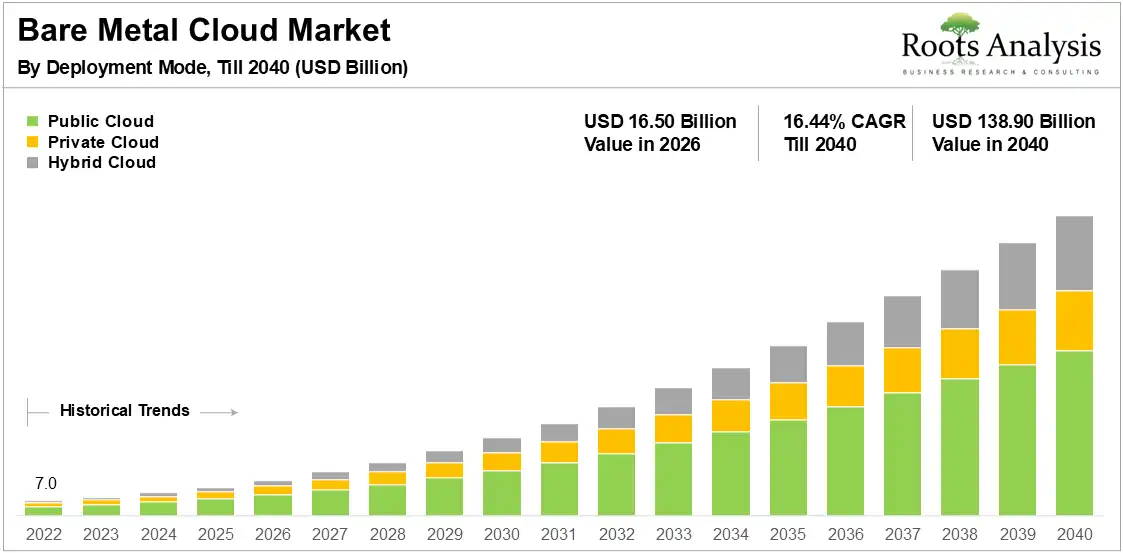
The global bare metal cloud market size is projected to grow from USD 16.50 billion in 2026 to USD 138.90 billion by 2040, representing a CAGR of 16.44% during the forecast period 2026 to 2040.
See What’s in the Full Report – Request Your Complimentary Insights!
Market Report: Key Takeaways
- In 2026, compute captures the leading share (35.0%) for AI workloads, while professional services segment is projected to grow at a rapid pace during the forecast period till 2040.
- In terms of deployment mode, public cloud dominates (60.0%) the 2026 global market, whereas hybrid cloud infrastructure growth is expected to gain significant momentum (at a 25.5% CAGR) by balancing scalability with data localization.
- Currently, AI / ML and high-performance computing capture the highest bare metal cloud market share by application and is also projected to grow at a faster CAGR through 2040.
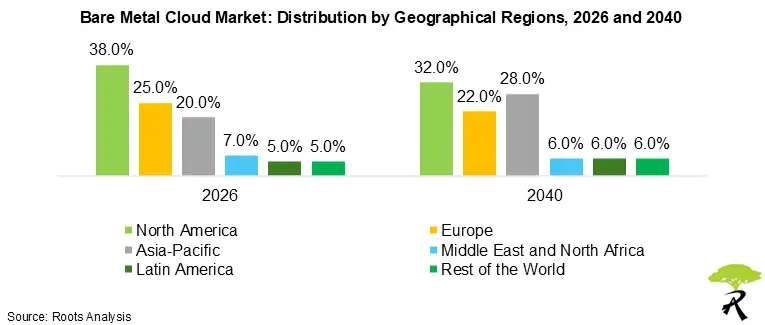
- In 2026, North America holds regional dominance (38.0%) via mature hyperscalers, on the other hand the Asia-Pacific region expands rapidly through aggressive sovereign infrastructure buildouts.
- Market mega-trends show rapid adoption of liquid-cooled data centers and AI-optimized hardware to ensure consistent, high-speed enterprise performance.
Market Overview
The bare metal cloud infrastructure is transitioning from niche high-performance computing to a foundational enterprise pillar. Organizations are rapidly adopting single-tenant infrastructure to completely bypass hypervisor overhead and achieve precise deterministic performance. This convergence of hardware-level control and cloud-native orchestration delivers the strict isolation required for mission-critical, data-intensive workloads.
Fueling this sustained adoption is the explosive enterprise demand for generative AI training and large-scale inference, which necessitate dedicated, GPU-optimized instances. To support these intensive localized compute requirements, operators are actively integrating compute express link (CXL) technology and advanced data processing units. This integration enables ultra-fast memory pooling and offloads network processing.
Consequently, deployment strategies are aggressively expanding beyond centralized data centers into edge computing environments and sovereign cloud architectures. Stringent regulatory mandates for data residency are heavily incentivizing these localized, non-virtualized hybrid deployments. Consequently, this structural evolution firmly establishes bare metal-as-a-service (BMaaS) as the primary engine for autonomous systems.
Pay Only for What You Need – The Best Way to Optimize
Bare Metal Cloud Market Size Estimation Methodology
- As a starting point, we established the market scope by identifying the core components of the bare metal cloud ecosystem, including essential hardware configurations across compute, storage, and networking, alongside specific service types tailored for major end-use industries.
- Then we examined adoption patterns and enterprise workload requirements, evaluating the strategic shift from multi-tenant environments to single-tenant dedicated servers for latency-sensitive applications, artificial intelligence, and high-performance computing (HPC), to understand baseline infrastructure lifecycles and standard hardware refresh cycles.
- Thereafter, we collected physical server provisioning volumes, average pricing per node, and prevailing billing models (such as hourly versus reserved instances) through primary research with key stakeholders, including cloud architects, IT infrastructure directors, and data center operators, and cross-validated these insights using secondary sources like vendor financial filings, whitepapers, and industry association metrics.
- Using these data and insights, we calculated the global bare metal cloud market size and projected the future market opportunity. This was achieved through a comprehensive hybrid modeling approach that combined bottom-up calculations of deployed bare metal instances with top-down assessments of total enterprise infrastructure-as-a-service (IaaS) expenditures.
- The overall opportunity associated with the global market was further distributed across distinct market segments, allocating demand by specific computing configurations (such as CPU versus GPU instances), organization sizes, and key geographic regions driven by localized data center investments, edge computing adoption, and regional data sovereignty regulations.
- Finally, in order to assess the sensitivity of our assumptions, we conducted a multivariate sensitivity and scenario (conservative, base, and optimistic) analysis of some of the most important parameters of our forecast methodology, evaluating the potential impact of macroeconomic IT budget shifts, semiconductor supply chain constraints, and fluctuating data center power costs.
Bare Metal Cloud Market Share Insights
Compute Captures the Largest Share within the 2026 Market by Component
- Compute infrastructure captures 35.0% share in 2026 and firmly dominates the bare metal market, acting as the foundational anchor for latency-sensitive, high-throughput applications. The immediate catalyst driving this segment is the massive scale-up of generative artificial intelligence training and strict sovereign data residency mandates across North America and Europe. These factors rigorously necessitate the elimination of hypervisor overhead, pushing regulated entities in finance and healthcare toward isolated, non-virtualized processing.
- This structural shift directly alters infrastructure capital allocation, forcing providers to pivot from generalized virtual utilities to highly specialized, GPU-dense compute nodes. This is evidenced by Oracle’s 2025/2026 deployment of massive bare-metal AI clusters utilizing NVIDIA Hopper and AMD MI300X GPUs, alongside IBM Cloud’s integration of Intel Gaudi 3 accelerators and SmartNIC hardware into their bare metal virtual private cloud (VPC) instances.
- Conversely, professional services emerged as the fastest-growing segment, having a CAGR of 28.5%. This rapid acceleration of bare metal cloud professional services market is fueled by rising enterprise demand for managed deployments and operational expertise. As adoption trends shift toward complex hybrid, edge, and AI-driven environments, organizations increasingly rely on service providers for orchestration, integration, and compliance support. This growth outlook reflects accelerating commercialization momentum and evolving competitive dynamics, where services act as a key enabler of scalability and faster time-to-market.
BFSI Commands Dominant Market Share While Healthcare Accelerates as the Fastest-Growing Segment
- According to the bare metal cloud industry analysis, the BFSI sector holds the largest share of 23.0%, driven by stringent data sovereignty mandates and the necessity for ultra-low latency in quantitative modeling. Financial institutions are aggressively migrating high-frequency trading and real-time fraud detection workloads away from shared virtualized environments. This structural shift is fundamentally catalyzed by the immediate requirement to eliminate hypervisor overhead, ensuring deterministic performance capable of executing millions of transactions with precise microsecond reliability.
- This dominance is structurally reinforced by strict regulatory compliance frameworks, such as PCI-DSS and regional banking mandates, which necessitate absolute physical server dedication. By utilizing single-tenant architecture, financial enterprises establish clean audit boundaries and secure, isolated hardware access. Consequently, this establishes a robust competitive moat, allowing organizations to leverage mature, high-performance computing ecosystems without undertaking extensive, capital-intensive retooling of their legacy mission-critical transaction infrastructure.
- On the other hand, healthcare emerges as the fastest-accelerating sub-segment, propelled by explosive compute-intensive demand in genomics sequencing, precision medicine, and AI-driven diagnostic imaging. These advanced workloads require massive parallel processing and direct, unimpeded GPU access that traditional virtualized limits simply cannot sustain. To capitalize on this, infrastructure operators are actively deploying high-density bare-metal clusters, specifically engineered to support the localized processing demands of cutting-edge clinical trials and advanced personalized treatments.
- This rapid adoption is strictly governed by rigid regulatory pushes for secure electronic Protected Health Information (ePHI) handling and HIPAA compliance. Bare metal architecture resolves this by enabling hardware-level confidential computing, securing patient data during complex algorithmic processing. For instance, OpenMetal’s integration of NVIDIA H100 GPU clusters and Intel TDX specifically optimizes AI-health computations, providing medical research institutions with the verified physical isolation necessary for safe, enterprise-scale commercialization.
Want Information on Specific Region / Segment?
North America to Hold Largest Market Share in 2026 Amid Rapid Growth in the Asia-Pacific Region
- Regional analysis of the bare metal cloud services industry indicates that the North America region dominates the global market with a 38.0% share in 2026. This is driven by its mature digital infrastructure, strong enterprise adoption in regulated sectors such as finance and healthcare, and highly developed data center ecosystems. Further, its dominance is reinforced by supply chain maturity, low-latency capabilities, and compliance-driven demand for dedicated hardware, supported by a well-established hyperscaler and provider landscape.
- Meanwhile, Asia-Pacific emerges as the fastest-growing segment, registering a CAGR of 26.0%, fueled by rapid digital transformation, government-backed AI initiatives, and expanding data center investments across key markets like China and India. Accelerated adoption trends in AI / ML workloads, sovereign cloud requirements, and hyperscale infrastructure buildouts are reshaping competitive dynamics, positioning the region for significant share gains and a strong long-term growth outlook.
Market Ecosystem Analysis
Bare Metal Cloud Market Competitive Landscape
The global bare metal cloud ecosystem features established hyperscalers like Amazon Web Services, IBM Cloud, Microsft Azure, Google Cloud and Oracle Cloud, alongside specialized infrastructure operators, such as OVHcloud and Equinix. Concurrently, agile innovators / startups, including Vultr, Cherry Servers, Nava, phoenixNAP, and Servers.com, aggressively disrupt the bare metal cloud competitive landscape by pioneering localized, AI-optimized single-tenant architectures that prioritize strict hardware control over massive-scale workloads.
- Amazon Web Services: Accelerating enterprise infrastructure modernization, AWS consistently expands its custom silicon offerings to deliver high-performance, single-tenant computing. Highlighting this advancement, in February 2026, AWS officially launched M8gn and M8gb bare metal instances powered by Graviton4 processors, strictly eliminating virtualization overhead for massive-scale operations.
- IBM Cloud: Enhancing high-throughput hybrid environments, IBM continuously upgrades its bare metal provisioning to support mission-critical enterprise workloads. Solidifying this strategy, in April 2025, the company integrated NVMe primary boot drives, guaranteeing deterministic, ultra-low latency infrastructure specifically engineered for demanding Windows-based server deployments.
- OVHcloud: Enhancing secure data sovereignty, OVHcloud continuously fortifies its localized single-tenant architectures against operational disruptions and data loss. Highlighting this capability, in January 2026, the provider partnered with Veeam to launch Backup Agent, deploying a managed, immutable backup solution engineered specifically for its Bare Metal Cloud enterprise customers.
- phoenixNAP: Accelerating automated enterprise deployment, phoenixNAP actively shifts capital allocation away from legacy virtualization toward API-driven single-tenant infrastructure. Executing this strategic pivot, in March 2026, the company entered a definitive agreement with RadiusDC, divesting colocation assets to exclusively scale its specialized, automated Bare Metal Cloud platform.
- Servers.com: Pioneering flexible commercialization models, Servers.com consistently engineers scalable ecosystems designed for strict hardware isolation environments. Validating this approach, in April 2026, the company expanded its scalable bare metal portfolio with hourly compute rentals, empowering fintech startups to manage massive traffic spikes seamlessly without virtualization drag.
Bare Metal Cloud Market Growth Drivers, Restraints, Challenges and Opportunities
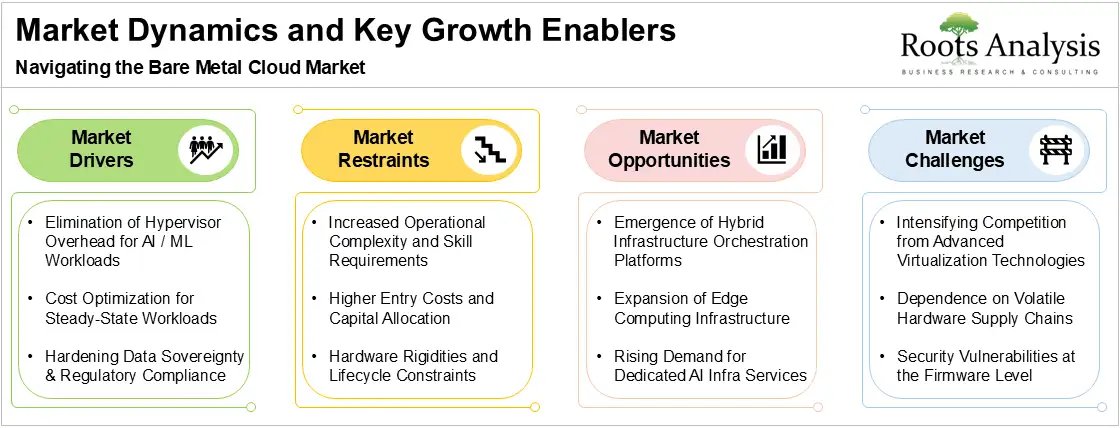
The bare metal cloud industry gains momentum from drivers that eliminate hypervisor overhead in AI / ML workloads, delivering direct hardware access for superior, latency-free performance. Enterprises increasingly leverage bare metal for cost optimization across steady-state data workloads to curb rising cloud expenditures, while regulatory data sovereignty and compliance mandates further reinforce the case for isolated, single-tenant infrastructure. Collectively, these dynamics establish bare metal cloud solutions as indispensable for compute-heavy scaling across regulated, high-throughput industries.
Nevertheless, adoption faces headwinds from operational restraints stemming from increased complexity, steep skill requirements, high entry costs, hardware rigidity, and lifecycle limitations that continue to weigh on broader market penetration. Meaningful opportunities are emerging through hybrid infrastructure orchestration platforms that blend bare metal agility with cloud flexibility, the rapid expansion of edge computing, and a surging enterprise appetite for dedicated AI infrastructure services. These gains, however, are accompanied by persistent challenges including intensifying competition from advanced virtualization technologies, unpredictable hardware supply chains, and firmware-level security vulnerabilities that demand sustained strategic attention from market participants.
Market Access Considerations
Capital Expenditure and Infrastructure Intensity
- Massive upfront capital requirements for hardware and data center real estate create formidable barriers to market entry. These costs limit the competitive landscape primarily to well-capitalized hyperscalers and established specialized hosting providers.
- Scaling operations require immense financial backing to manage long hardware depreciation cycles. Consequently, smaller entrants must target niche geographical segments or specific workloads to maintain commercial viability.
Data Sovereignty and Regulatory Compliance Mandates
- Stringent data localization laws and privacy regulations determine where bare metal cloud infrastructure must be physically deployed to gain market access. Providers must invest heavily in localizing data centers to meet the strict compliance needs of healthcare, finance, and government sectors.
- This regulatory environment fragments the global market and complicates commercialization. Success depends on securing regional security certifications and guaranteeing absolute tenant isolation for high-security enterprise contracts.
Ecosystem Integration and Orchestration Readiness
- Broad market access requires seamless integration of bare metal servers into hybrid cloud ecosystems and modern orchestration frameworks. Enterprises now demand cloud-like provisioning speeds and API-driven control, making a mature software layer essential for driving any mainstream adoption of raw hardware.
- Competitors who successfully bridge this gap through advanced automation, native Kubernetes support, and frictionless integrations with adjacent public cloud services capture significant market share by accelerating legacy infrastructure migrations.
Workload-Specific End User Procurement Behavior
- Driven by the strict processing demands of generative AI and high-frequency trading, enterprise procurement is rapidly shifting away from self-service cloud utilities. Organizations now mandate rigorous technical validation to ensure hypervisor bypass delivers measurable latency reductions. Consequently, infrastructure providers must execute highly consultative, architecture-specific BMaaS contracting to secure enterprise deployments.
- To win these capital-intensive contracts, vendors must establish a competitive moat built upon deep engineering expertise and transparent GPU-accelerated benchmarking. Providers secure deals only by mathematically proving that single-tenant performance yields a superior return on investment compared to standard virtualized alternatives, specifically lowering operational costs for massive, data-intensive compute workloads.
Get an Instant Quote in 10 Minutes. Lowest Price Guaranteed
How Stakeholders Benefit from the Key Focus Areas of Our Bare Metal Cloud Market Report
The bare metal cloud market has moved definitively beyond niche high-performance computing, entering a critical phase of enterprise-scale commercialization across generative AI, high-frequency trading, and edge deployments. Rapid hypervisor-bypass innovation and single-tenant architecture adoption are actively rewriting competitive dynamics. This market report equips infrastructure decision-makers with the verified intelligence necessary to optimize CapEx allocation, de-risk BMaaS commercialization roadmaps, and execute high-yield global expansion strategies, ultimately establishing a robust competitive moat in data-intensive environments.
- Unmet Needs and Market Gaps in Bare Metal Cloud Market: The report identifies critical deterministic latency, automated hardware provisioning, and GPU clustering efficiency gaps limiting broader adoption across autonomous systems, quantitative trading, and edge AI deployments. It highlights underserved hypervisor-bypass applications that create immediate commercialization opportunities. These insights help infrastructure strategy leaders prioritize high-impact deployment models, while engineering teams refine value propositions aligned with CapEx reduction. Investors gain visibility into white-space infrastructure opportunities with defensible differentiation.
- Funding / Capital Flow and Investment Landscape: This section analyzes venture concentration, strategic data center operator investments, and institutional capital backing hyperscale infrastructure deployments. By benchmarking funding momentum across specialized BMaaS startups and GPU-accelerated environments, corporate development teams can accurately gauge capital intensity and align M&A strategies with validated structural growth trajectories.
- Bare Metal Cloud Market Landscape and Competitive Dynamics: The study maps the complete infrastructure ecosystem, profiling legacy colocation giants alongside emerging, specialized BMaaS orchestration innovators. By evaluating hardware-level IP moats, commercialization progress, and localized data sovereignty dominance, executive teams can anticipate infrastructure consolidation, refine pricing structures, and accelerate high-value data center partnerships.
- Technology Innovations and Adoption Insights: The report evaluates advancements in compute express link, SmartNICs, liquid-cooled architectures, and data processing units integration driving precise hardware control. It assesses adoption trends across high-growth AI workloads and identifies hardware supply chain barriers to massive-scale deployment. Technology leaders can use this analysis to align capital expenditures with evolving hybrid-cloud frameworks. The insights also inform commercialization roadmaps for localized edge hardware entry.
- Partnership and Collaboration Trends: The analysis highlights strategic alliances between chip manufacturers, colocation operators, and cloud-native software vendors, detailing the collaborative models required to eliminate orchestration friction. Business development teams gain a clear framework for accelerating hardware validation, navigating data residency compliance, and ensuring silicon supply chain resilience.
- Market Segmentation and Geographic Coverage: The report provides detailed bare metal cloud market forecast segmentation by component, deployment models, applications, end use industries, and regional markets, along with bare metal cloud market growth outlooks. It identifies high-demand segments and emerging geographic hotspots driving adoption. These insights help stakeholders prioritize target markets and allocate resources effectively. This supports data-driven expansion strategies and optimized market penetration efforts.
Bare Metal Cloud Market: Scope of the Report
| Key Report Attributes | Details | |
| Forecast Period | Till 2040 | |
| Market Size 2026 | USD 16.50 Billion | |
| Market Size 2040 | USD 138.90 Billion | |
| CAGR (Till 2040) | 16.44% | |
| Segments Covered |
|
|
| Geographical Regions Covered |
|
|
| Key Sections Covered |
|
|
Market Segmentation
The global bare metal cloud market report presents an in-depth analysis, highlighting the capabilities of various stakeholders, based on different segments such as component, deployment mode, application, organization size, industry vertical, geographical regions, and key players.
Market Share by Component
- Compute
- Networking
- Professional Services
- Storage
Market Share by Deployment Mode
- Public Cloud
- Private Cloud
- Hybrid Cloud
Market Share by Application
- AI / ML & High-Performance Computing
- Containerization
- Data Analytics
- DevOps and Test & Development
- Gaming & Media
- General Purpose Infrastructure
Market Share by Organization Size
- Large Enterprises
- Small & Medium Enterprises (SMEs)
Market Share by Industry Vertical
- BFSI
- Energy & Utilities
- Government & Defense
- Healthcare
- IT & Telecom
- Manufacturing
- Media & Entertainment
- Retail & E-commerce
Market Share by Geographical Regions
- North America
- US
- Canada
- Mexico
- Rest of North America
- Europe
- Austria
- Belgium
- Denmark
- France
- Germany
- Ireland
- Italy
- Netherlands
- Norway
- Russia
- Spain
- Sweden
- Switzerland
- UK
- Rest of Europe
- Asia-Pacific
- Australia
- China
- India
- Japan
- New-Zealand
- Singapore
- South Korea
- Rest of Asia-Pacific
- Middle East and North Africa (MENA)
- Egypt
- Iran
- Iraq
- Israel
- Kuwait
- Saudi Arabia
- UAE
- Rest of MENA
- Latin America
- Brazil
- Chile
- Colombia
- Venezuela
- Rest of Latin America
- Rest of the World


