


 Download Free Sample
 Buy Now
Market Size
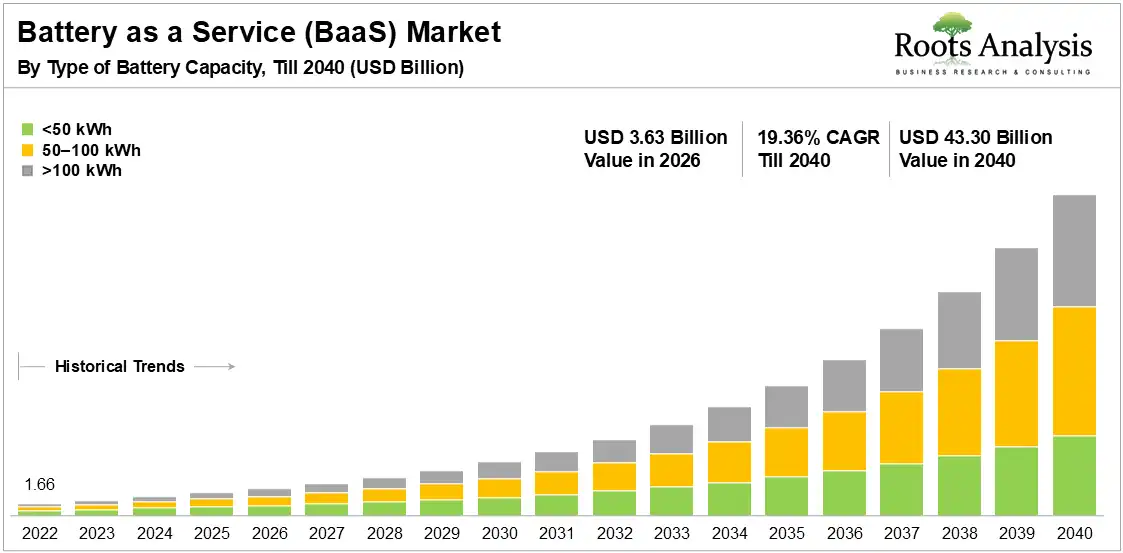
The global battery-as-a-service (BaaS) market is projected to reach USD 3.63 billion in 2026 and USD 43.30 billion by 2040, representing a CAGR of 19.36% during the forecast period 2026 to 2040.
See What’s in the Full Report – Request Your Complimentary Insights!
Market Overview
The Battery-as-a-Service (BaaS) market is defined by a business model that separates battery ownership from the end product, such as a vehicle or connected device. Under this structure, users obtain battery access through subscription or usage-based pricing that typically covers management, maintenance, battery analytics and monitoring services and replacement. By lowering upfront purchase requirements for electric vehicles and micromobility assets, BaaS reshapes market boundaries while relying on standardized swapping networks and advanced battery management systems to maximize performance and usable battery life in real-world conditions.
Adoption is primarily driven by the high cost of lithium-ion batteries, which materially increases total cost of ownership for individual users and commercial fleets. BaaS addresses this constraint by shifting battery costs from capital expenditure to predictable operating expense, improving financial planning and scalability. Core use cases span commercial logistics fleets, passenger electric vehicles, and dense urban micromobility markets including e-bikes and scooters.
Innovation in the BaaS market is centered on interoperability, with efforts to align battery formats and systems across manufacturers and vehicle platforms to enable network-scale deployment. At the same time, providers are linking swapping infrastructure with smart grid frameworks and vehicle-to-grid capabilities, positioning batteries as flexible energy assets. Looking ahead, strategic partnerships between established global players and emerging markets are prioritizing standardized swapping station deployment, signalling sustained infrastructure investment for extensive BaaS business model.
Market Report: Key Takeaways
- Leading Players: Top battery as a service market giants, such as Ample, NIO, CATL, Gogoro, and Tesla are undertaking initiatives to build proprietary networks while trying to define global standards. In December 2025, CATL successfully achieved its target of 1000 Choco swap stations and raised its end 2026 target from 2,500-3,000 stations, offering gateways for investments.
- Major Market Pulls: Corporate ESG mandates are creating a powerful "pull" for BaaS market players. Large logistics operators (Amazon, DHL, and Flipkart) are shifting their fleets to 100% electric. These operators cannot afford the downtime associated with traditional charging. Consequently, they are increasingly demanding "modular energy" contracts where they pay for "uptime" rather than owning the vehicles or batteries, which is significantly driving the adoption of high-capacity BaaS systems (>100 kWh).
- Software-Defined Battery (Mega Trend): The most significant breakthrough in 2025 is the arrival of the "smart battery" that communicates directly with the cloud. By utilizing AI to analyze millions of swap cycles, providers can now predict a cell failure weeks before it occurs. This allows for "preventative swapping," where a user is directed to a station to replace a battery that is still functional but showing early signs of internal stress. This minimizes on-road breakdowns and significantly increases the safety of the entire fleet.
- Data-Led Optimization Startups: A new class of "BaaS-enabling" startups, such as ArtificaX Technologies and Nicola Tech have developed AI-powered cloud platforms that are essential for the "BatteryCo" business model, as they allow for the accurate calculation of residual value, a key metric for any leasing entity. By utilizing IoT devices to provide real-time fault diagnosis, these startups enable providers to offer "guaranteed health" subscriptions, which mitigate consumer anxiety about receiving a "bad" battery at a swap station.
- Collaborative Market Penetration: Based on the global BaaS industry statistics and data, the partnership landscape was defined by "corridor-based" expansion and cross-sector integration. Recently, U Power and NV Gotion signed a Memorandum of Understanding (MoU) to co-develop battery modules and swap infrastructure in Thailand. This move is indicative of the "China-plus-one" strategy, where Chinese firms are exporting their mature BaaS models to burgeoning markets in Southeast Asia to circumvent trade tensions in the West.
Recent Industry Developments
- In December 2025, Solaris Bus announced to launch battery replacement services for older Urbino electric buses and add a zero-emission vehicle retrofit into its product portfolio.
- In October 2025, BattRE Electric Mobility signed a partnership with Battery Smart to introduce battery-as-a-service (BaaS) in Jaipur (India). This partnership enables fleet operator Beez Electric to deploy more than 1,000 BattRE e-scooters that are powered by Battery Smart’s swapping technology.
- In September 2025, Yuma Energy signed a strategic partnership with Hindustan Petroleum Corporation Limited (HPLC) to deploy AI-driven, smart battery swapping station across tier 2 towns and metro cities of India.
- In August 2025, The European Commission approved a new 50:50 joint venture between Bosh and Mitsubishi to offer battery-as-a-service solutions for electric vehicles.
Pay Only for What You Need – The Best Way to Optimize
Market Dynamics
Key Market Drivers
- Reduction of Upfront Capital Expenditure for EV Adoption: Battery-as-a-Service reshapes the EV purchase economics by separating the battery (the highest-cost component) from the vehicle’s initial price. This structural shift lowers entry barriers for both individual buyers and commercial fleets, accelerating adoption in price-sensitive segments where total cost of ownership directly influences procurement and replacement decisions.
- Mitigation of Battery Degradation Risk for Consumers: Concerns around long-term battery performance and replacement expense remain a major psychological and financial hurdle for EV battery leasing models and adoption rates. BaaS reallocates degradation and end-of-life risk from the user to the service provider, delivering greater certainty through subscription-based access that bundles maintenance, performance assurance, and lifecycle management.
- Enablement of Fleet Optimization and Operational Efficiency: For commercial fleets with high utilization rates, operational uptime is a critical performance metric. BaaS models that support battery swapping enable rapid energy replenishment, predictable operating costs, and more reliable scheduling compared to conventional charging, making the model particularly attractive for logistics, ride-hailing, and last-mile delivery operators.
Market Restraints
- Fragmentation of Battery Standards and Infrastructure Interoperability: The absence of uniform battery designs and communication standards across OEMs has resulted in a fragmented landscape. This lack of interoperability constrains the development of scalable, cross-brand swapping networks and limits BaaS adoption beyond closed or proprietary platforms.
- High Initial CapEx and Network Effect Challenges for Providers: Establishing a viable BaaS network demands significant upfront investment in physical infrastructure, real estate, and spare battery inventory. Achieving sufficient network density to unlock utilization and cost efficiencies is capital-intensive, creating substantial entry barriers and extending payback timelines.
- Consumer Reluctance to Subscription Models and Long-Term Value Perception: A portion of the market remains uncomfortable with subscription-based access to a core vehicle component. Concerns around cumulative costs, contract rigidity, and the absence of full asset ownership can dampen demand, particularly in regions with strong traditions of vehicle ownership.
Market Share Insights
Battery Leasing and Subscription Holds the Highest Share
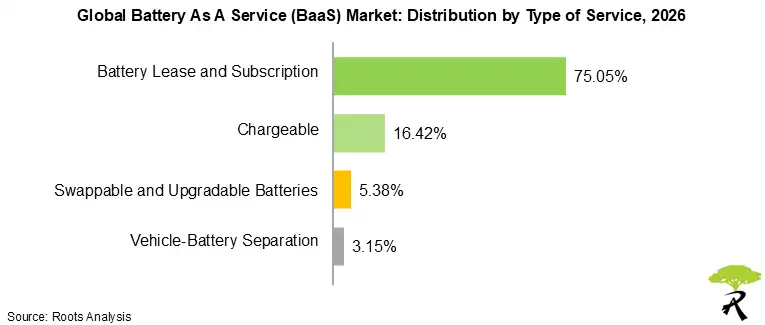
- Battery leasing and subscription remains the dominant service model, capturing 75.05% of market share in 2026. This service model offers predictable operating costs, centralized lifecycle management, and broad applicability across EV and stationary storage use cases without requiring specialized infrastructure. Moreover, this model aligns well with both fleet operators and individual consumers seeking flexibility and lower ownership risk.
- Based on the battery swapping market size and share analysis, it is anticipated that battery swapping segment is projected to be the fastest-growing service model, registering a CAGR of 28.0% through 2040. This is due to the fact that it directly addresses vehicle downtime challenges in high-utilization fleets. Rapid swap times and improving standardization, particularly in Asia are accelerating adoption, with large-scale swapping deployments and new AI-enabled swapping stations underscoring growing commercial viability.
Regional BaaS Adoption Rates Across APAC, Europe, North America
Asia-Pacific: The Dominant Epicenter
The Asia-Pacific region held an estimated 60.18% market share in 2026 and remains the primary driver of BaaS volume. China’s lead is cemented by the scale of its passenger vehicle swapping, with NIO operating over 3,400 stations and completing nearly 100 million swaps.
However, the real growth story in 2026 is Indian government's extension of the PM E-DRIVE scheme through March 2028 and infrastructure-first model of Asia-Pacific provides a stable horizon for BaaS investments.
North America: Navigating the “One Big Beautiful Bill ACT (OBBBA)”
The North American market, while growing at a projected CAGR of 26%, is in a state of flux due to the OBBBA. The removal of many IRA tax credits has forced a shift toward private-sector fleet management. Large-scale fleet operators in the US are moving toward "blended" fuel strategies, where BaaS is used for urban duty cycles while hybrid or hydrogen systems are used for long-haul routes.
Europe: The Battery Passport and Traceability
Europe is positioning itself as the global leader in "Circular BaaS." The EU Battery Regulation (Regulation 2023 / 1542), which became sole legal framework in August 2025, mandates that every battery placed on the market carry a digital “Battery Passport” by February 2027.
The passport will track the carbon footprint, recycled material content, and supply chain origin of every battery. This regulatory environment makes the BaaS model highly attractive to OEMs, as it ensures they retain control of the battery throughout its life, making the mandatory end-of-life recycling and second-life repurpose much easier to manage and report to regulators.
Have Questions? Let’s Get Them Answered.
Market Ecosystem Insights
Baas Market Competitive Landscape and Key Players Analysis
The global BaaS business model analysis and profitability forecast highlighted that the industry is immensely competitive, featuring the presence of diverse array of well-established industrial players and startup companies. It is worth mentioning that the next decade of the BaaS market will be defined by the convergence of software-defined power and advanced manufacturing.
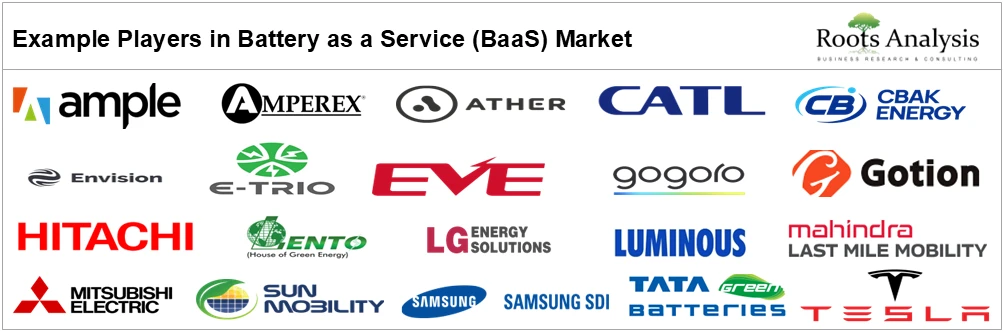
Market players, such as NIO, Tesla, CATL, Envision Group, Gotion High-Tech, and Gogoro are leveraging partnerships and collaborations as well as making investments to strengthen market positions. In late 2025, CATL is advancing its investment capped at RMB 2.5 billion in NIO Power to strengthen their partnership to co-develop new energy vehicle industry by building a battery swapping network for passenger vehicles across the full range of products.
BaaS Market Investment Opportunities and Partnership Trends
The Battery-as-a-service market is attracting investment due to its expanding role in energy ecosystem integration. By managing large-scale fleets of batteries, BaaS providers are positioned to support grid-level storage and vehicle-to-grid services. Idle batteries within swapping stations can contribute to demand response and ancillary grid operations, unlocking additional revenue streams beyond conventional subscription-based mobility models. This dual role enhances grid stability while improving utilization of existing infrastructure, making BaaS a strategic component of smart energy management systems and sustainable transportation networks.
In parallel, the growing sophistication of data analytics is transforming BaaS platforms into intelligent service ecosystems. Real-time monitoring of battery health, usage behavior, and charging performance enables predictive maintenance, efficiency optimization, and personalized service plans for fleet operators. Furthermore, end-of-life asset control allows providers to repurpose degraded battery packs for stationary energy storage, maximizing lifecycle value and minimizing waste. This holistic approach not only strengthens financial sustainability but also aligns with circular economy principles, reinforcing BaaS as both a mobility enabler and a critical contributor to the evolving renewable energy landscape.
Simultaneously, strengthening partnerships and technological collaboration are fostering the development of intelligent, data-driven BaaS ecosystems. Advanced analytics capabilities derived from real-time monitoring of battery health and usage patterns enable predictive maintenance, operational optimization, and customized service delivery for enterprise fleets. Moreover, strategic alliances in battery management systems (BMS) and lifecycle management are unlocking new value through second-life battery deployment for stationary energy storage. Such collaborations are attracting investors focused on scalable, circular, and sustainable models, reinforcing BaaS as a financially viable and environmentally aligned segment within the clean energy and smart mobility landscape. Some of the instances have been outlined below:
- Indian Funding Program: The Indian government has approved a second viability gap funding (VGF) scheme with financial support of around USD 631 million to support the development of an additional 30 GWh of Battery Energy Storage Systems (BESS) capacity.
- CATL Battery Swapping Breakthrough: Partnered with multiple automakers to co-develop 10 new EV models with swappable batteries, targeting replacement of one-third of China's gas stations
- Mahindra-Vidyut Partnership: Launched BaaS financing for ZEO 4W, Zor Grand, and Treo Plus commercial EVs in India.
Get an Instant Quote in 10 Minutes. Lowest Price Guaranteed
Battery as a Service Market: Scope of the Report
| Key Report Attributes | Details | |
| Historical Trend | Since 2022 | |
| Forecast Period | Till 2040 | |
| Market Size 2026 | $ 3.63 Billion | |
| Market Size 2040 | $ 43.30 Billion | |
| CAGR (Till 2040) | 19.36% | |
| Segments Covered |
|
|
Market Segmentation
Based on research, we have segmented the battery as a service (BaaS) market into type of service, type of battery, type of battery capacity, type of vehicle, battery ownership model, type of usage, application, end use industry, geographical regions, and key players.
Market Share by Type of Service
- Battery Leasing and Subscription
- Chargeable
- Swappable and Upgradable Batteries
- Vehicle-Battery Separation
Market Share by Type of Battery
- Lithium-Ion Batteries
- Solid-State Batteries
Market Share by Type of Battery Capacity
- <50 kWh
- 50–100 kWh
- >100 kWh
Market Share by Type of Vehicle
- Two Wheelers
- Three Wheelers
- Commercial Vehicles
- Passenger Vehicles
Market Share by Battery Ownership Model
- Pay-Per-Use Model
- Subscription Model
Market Share by Type of Usage
- Commercial
- Private
Market Share by Application
- Electric Vehicles (EVs)
- Energy Storage Systems (ESS)
- Material Handling Equipment
- E-Bikes and Scooters
Market Share by End Use Industry
- Automotive
- Commercial & Industrial
- Energy & Utilities
- Residential
- Telecommunications
- Others
Market Share by Geographical Regions
- North America
- US
- Canada
- Mexico
- Rest of North America
- Europe
- Austria
- Belgium
- Denmark
- France
- Germany
- Ireland
- Italy
- Netherlands
- Norway
- Russia
- Spain
- Sweden
- Switzerland
- UK
- Rest of Europe
- Asia-Pacific
- Australia
- China
- India
- Japan
- New-Zealand
- Singapore
- South Korea
- Rest of Asia-Pacific
- Latin America
- Brazil
- Chile
- Colombia
- Venezuela
- Rest of Latin America
- Middle East and Africa (MEA)
- Egypt
- Iran
- Iraq
- Israel
- Kuwait
- Saudi Arabia
- UAE
- Rest of MEA


