


 Download Free Sample
 Buy Now
Market Size
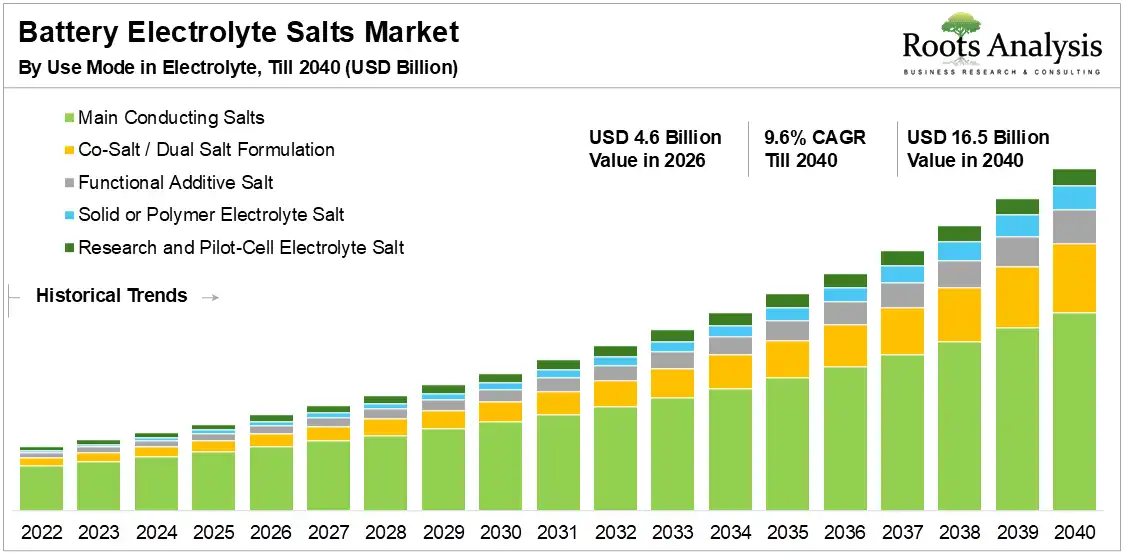
The global battery electrolyte salts market reached USD 4.6 billion in 2026 and is projected to grow to USD 16.5 billion by 2040, registering a CAGR of 9.6% over the forecast period 2026 to 2040, driven by EV and grid-storage battery manufacturing scale-up.
See What’s in the Full Report – Request Your Complimentary Insights!
Market Report: Key Takeaways
- Based on salt type, lithium hexafluorophosphate / LiPF6 captures 62% market share in 2026, whereas sodium hexafluorophosphate / NaPF6 registers a 15.1% CAGR through 2040, driven by sodium-ion commercialization.
- On the basis of battery chemistry, lithium-ion batteries capture 82.0% market share in 2026, whereas lithium-sulfur batteries register an 18.5% CAGR through 2040, driven by advanced-cell R&D migration.
- In terms of use mode in electrolyte, main conducting salt captures 70.0% market share in 2026, whereas solid or polymer electrolyte salt registers a 14.0% CAGR through 2040, driven by solid-state validation.
- With regards to application, electric vehicles capture 62% market share in 2026, whereas energy storage systems register a 12.6% CAGR through 2040, driven by grid-scale battery deployment.
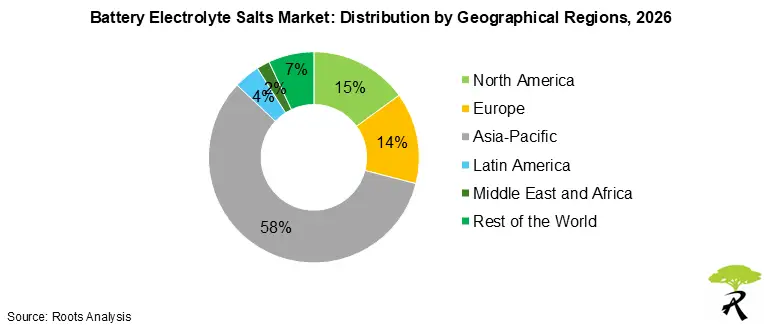
- Based on Geography, Asia-Pacific captures 58% market share in 2026, whereas Middle East and Africa registers a 12.8% CAGR through 2040, driven by low-base storage localization.
Battery Electrolyte Salts Market Outlook
Battery electrolyte salts have evolved from a formulation input into a strategically managed supply chain component, driven by the dual pressures of electrochemical advancement and procurement security. Lithium hexafluorophosphate (LiPF6) has anchored commercial electrolyte production since the first generation of lithium-ion batteries and retains majority market share today.
However, its dominance is narrowing as lithium bis(fluorosulfonyl)imide / LiFSI, sodium hexafluorophosphate (NaPF6), and next-generation conducting salts gain adoption across high-performance cell formats. The electrochemical demands of longer-range electric vehicles, fast-charging architectures, and emerging sodium-ion chemistries are actively pulling procurement toward diversified salt systems.
Supply chain origin has become equally consequential. In March 2026, antidumping and countervailing duty petitions against LiPF6 imports from China were filed before the U.S. International Trade Commission, citing alleged below-fair-value pricing and government subsidization. The petitioner withdrew in April 2026, and investigations were discontinued without Commerce Department initiation. The episode exposed the depth of the US dependence on Chinese LiPF6 supply and established trade origin as a commercially material procurement variable. Dongwha Electrolyte's long-term LiPF6 supply agreement with Xinya Zhongning, secured in May 2026, reflects the same concern, with electrolyte manufacturers moving to protect upstream salt availability ahead of potential future disruptions.
Capital deployment confirms that the structural shift is durable. Gujarat Fluorochemicals secured International Finance Corporation support in December 2025 for an integrated production program spanning LiPF6, electrolytes, additives, LFP cathode material, and binders. LiPF6 share is forecast to decline from 62% in 2026 to 48% by 2040 as LiFSI and NaPF6 absorb incremental demand from advanced cell programs. The outlook remains positive, with chemistry diversification reshaping supplier advantage.
Battery Electrolyte Salts Market Size Estimation Methodology
- As a starting point, the forecast verified 2026 and 2040 market values from the prior sizing step. The global market starts at USD 4.6 billion in 2026 and reaches USD 16.5 billion in 2040. The model then checked the implied 9.6% CAGR using the stated formula. This created the control total for the battery electrolyte salts market forecast.
- Moving forward, the model segmented demand by geography, salt type, battery chemistry, use mode, physical form, and application. It used materials production volumes, battery manufacturing scale, and electrolyte formulation demand as the most relevant input types. Asia-Pacific led with 58.0% share in 2026 because cell, electrolyte, and battery-material supply chains remain concentrated there. North America and Europe gained share through domestic battery supply-chain programs.
- Building on this, the salt-type forecast separated LiPF6, LiFSI, LiTFSI, LiBF4, LiPO2F2, lithium borate salts, NaPF6, and other salts. LiPF6 held 62.0% share in 2026 because commercial lithium-ion electrolyte production remains optimized around proven carbonate systems. LiFSI rose from 18.0% to 28.0% share by 2040. NaPF6 grew fastest at 15.1% CAGR as sodium-ion commercialization increased.
- Drawing upon these, the chemistry model connected electrolyte salt demand with lithium-ion, lithium-metal, lithium-sulfur, sodium-ion, solid-state, primary lithium, and capacitor applications. Lithium-ion batteries held 82.0% share in 2026 because existing factories and recipes favor mature chemistries. Sodium-ion and lithium-sulfur each reached 18.5% CAGR through 2040. Solid-state and polymer batteries grew at 14.0% CAGR as validation activity increased.
- The projected value was then allocated across use modes and commercial forms. Main conducting salts held 70.0% share in 2026 because bulk ionic carriers still drive electrolyte consumption. Co-salt and dual-salt formulations rose to 20.0% share by 2040. Ultra-high-purity salts grew at 14.3% CAGR as high-voltage, fast-charge, and solid-state cells tightened impurity limits.
- Finally, the forecast was cross-checked against company roles, recent developments, and regulatory signals. Inputs included supplier product portfolios, funding disclosures, trade investigation notices, and peer-reviewed electrolyte studies. This helped separate recurring commercial demand from research-grade or pilot-cell demand. The final forecast keeps electric vehicles as the largest application while identifying energy storage as the fastest-growing use case.
Battery Electrolyte Salts Market Share Insights
Market Share by Type of Battery Chemistry
- According to our market forecast, Lithium-ion batteries hold 82% of the overall revenue share in 2026. This highest share is supported by entrenched gigafactory infrastructure, long qualification cycles, and established LiPF6-based electrolyte recipes that cell manufacturers are reluctant to reformulate.
- Orbia Fluor & Energy Materials inaugurated its custom electrolyte production facility in Madison, Wisconsin in April 2025, backed by an USD 8.4 million U.S. Department of Defense contract secured to strengthen the domestic lithium-ion battery supply chain and scale up electrolyte formulations. The investment signals that lithium-ion salt demand is attracting national security-grade procurement commitments, not just commercial capital.
- Meanwhile, Sodium-ion batteries and lithium-sulfur batteries are emerging as the highest-growth chemistry segments, both growing at a CAGR of 18.5% through 2040. This growth is driven by sodium's natural abundance, lower raw material cost, and reduced exposure to lithium supply chain risk. Sodium-ion pulls ahead on scale and commercial readiness. China's sodium-ion market alone is projected to expand from 10 GWh in 2025 to 292 GWh by 2034, near 45% annual growth, with China expected to hold over 90% of global production by 2030.
- That expansion is now backed by commercial commitments: Sinopec and LG Chem formalized a joint development agreement in November 2025 to co-develop cathode and anode materials for sodium-ion batteries, targeting energy storage systems and low-speed EVs across China and global markets. Sodium's natural abundance, lower raw material cost, and reduced exposure to lithium supply chain risk underpin the segment's investment case.
Market Share by Application
- Based on our analysis, electric vehicles occupy the highest share (62%) in 2026. This dominance is largely because electric vehicles consume the highest electrolyte salt volumes per unit, making them the dominant application by a wide margin over portable electronics or industrial uses.
- CATL's April 2025 Super Tech Day introduced the Naxtra, the world's first mass-producible sodium-ion battery for passenger EVs, alongside a dual-power cross-chemistry pack architecture integrating multiple cell chemistries within a single vehicle platform.
- Multi-chemistry EV platforms create concurrent demand for both LiPF6-based and NaPF6-based electrolyte salts, broadening the salt requirement per vehicle unit beyond what single-chemistry procurement historically required.
- On the other hand, the energy storage systems segment is expected to show robust growth, anticipated to grow at a CAGR of 12.6% through 2040. Grid-scale and commercial storage deployments are diversifying electrolyte salt demand beyond LiPF6, as sodium-ion adoption in stationary storage accelerates.
- The Sinopec and LG Chem joint development agreement signed in November 2025 explicitly targets sodium-ion battery materials for energy storage systems across China and global markets. China's sodium-ion battery market alone is projected to expand from 10 GWh in 2025 to 292 GWh by 2034 at roughly 45% annually, with ESS deployments expected to drive NaPF6 salt demand at scale through the forecast period.
Want Information on Specific Region / Segment?
Regional Analysis: Asia-Pacific Holds the Largest Share
Dominant Region: Asia-Pacific, 58% Share in 2026
Asia-Pacific holds 58% of the global battery electrolyte salts market in 2026. This growth is underpinned by the concentration of gigafactory capacity, Chinese LiPF6 production scale, Korean advanced material suppliers, and Japanese specialty-chemical expertise operating across the full electrolyte value chain.
CATL's April 2025 Super Tech Day, at which it launched the Naxtra sodium-ion battery and the second-generation Shenxing Superfast Charging Battery, reinforced the region's position as the primary driver of next-generation electrolyte salt demand. Both products require distinct salt formulations, confirming that Asia-Pacific's dominance extends into emerging chemistry segments, not only established LiPF6 procurement.
Fastest-Growing Region: Middle East and Africa, 12.8% CAGR from 2026-2040
The Middle East and Africa region is projected to register a 12.8% CAGR from 2026 to 2040, the highest growth rate globally, expanding from a low absolute base as grid-scale storage deployment, industrial battery adoption, and localized clean-energy infrastructure programs gain traction.
Growth is driven by structural underpenetration rather than existing manufacturing scale, meaning absolute volumes will remain smaller than North America or Europe through the forecast horizon. The region's trajectory reflects a build-out phase rather than a share-shift dynamic, with salt demand rising in step with storage project commissioning and nascent domestic battery assembly activity.
Market Ecosystem Analysis
Battery Electrolyte Salts Market Competitive Landscape
The battery electrolyte salts ecosystem is consolidating around vertical integration, with fluorine feedstock owners, electrolyte formulators, and lithium-salt specialists moving closer together. The primary commercial force reshaping competition is localized supply security for LiPF6 and LiFSI, especially in North America, Europe, India, and China. Competitive advantage now depends on high-purity salt capacity, qualification speed, and proximity to EV and ESS cell plants.
Fluorine-Integrated Suppliers Localizing LiPF6 and Electrolyte Capacity
Fluorine-based incumbents are converting upstream chemistry control into regional battery-material supply positions.
- Orbia Fluor & Energy Materials inaugurated its Madison, Wisconsin custom electrolyte facility in April 2025. The facility supports small- and medium-batch electrolyte sourcing for U.S. battery developers, reducing dependence on imported formulation capacity. This strengthens Orbia’s downstream route beyond LiPF6 salt into customer-specific electrolyte qualification.
- Mitsubishi Chemical signed definitive agreements in December 2025 to transfer the US and the UK lithium-ion electrolyte manufacturing assets to Green Energy Origin. The move shifts Mitsubishi toward an upgraded business model in Europe and America, while GEO gains operating manufacturing assets. The transaction increases specialist-led electrolyte capacity in Western markets.
Asian Salt and Electrolyte Leaders Scaling LiFSI and Integrated Feedstock Control
Asian producers are protecting share through LiFSI capacity growth, integrated electrolyte raw materials, and global capital access.
- Nippon Shokubai announced in April 2026 that it would add 10,000 MT/Y of LiFSI capacity at Hunan Fluopont. The expansion raises the joint venture’s total LiFSI capacity from 2,400 MT/Y to 12,400 MT/Y by fiscal 2027. The investment targets EV and ESS demand, where LiFSI improves cycle life, fast charging, and low-temperature output.
- Hunan Fluopont gives Capchem, Nippon Shokubai, and Toyota Tsusho a shared LiFSI platform in China. The April 2026 expansion deepens Capchem’s vertical integration into lithium salts, not only formulated electrolytes. It also gives Nippon Shokubai stronger leverage in commercializing IONEL LiFSI beyond Japanese production.
Startup Companies Initiatives Within Battery Electrolyte Salts Industry
Startups are accelerating innovation in battery electrolyte salts, particularly around lithium and sodium chemistries. Several companies focus on developing fluorinated lithium salts like LiFSI to improve ionic conductivity and reduce electrolyte viscosity, supporting higher energy density and longer cycle life in next-generation cells.
Emerald Battery Labs, a Seattle-based startup working out of the University of Washington, raised close to USD 1.1 million in a pre-seed round to scale its sodium-ion battery technology, aiming to reduce dependence on lithium given its supply constraints and extraction challenges.
On the manufacturing side, Anthro Energy is developing a large-scale advanced electrolyte production facility in Louisville, Kentucky, with planned capacity of 25 GWh and roughly 12,000 metric tons of electrolyte output annually, using inputs free of Foreign Entity of Concern restrictions. This reflects a broader startup push toward domestic, supply-chain-secure electrolyte production in the US.
Battery Electrolyte Salts Market Trends
LiPF6 Supply Localization Reshaping Battery Electrolyte Salts Market Competition
LiPF6 remains the commercial anchor for lithium-ion battery electrolyte formulations. It holds 62% salt-type share in 2026 because qualified carbonate electrolyte systems still dominate cell production. Orbia’s April 2025 custom electrolyte facility supported LiPF6-linked domestic supply in the United States. Domestic formulation capacity gives qualified suppliers stronger customer access.
Trade scrutiny now makes LiPF6 sourcing strategy a board-level issue for electrolyte buyers. The US investigations on lithium hexafluorophosphate from China began in March 2026, then petitions were withdrawn in April 2026. This volatility rewards suppliers with diversified production footprints, reliable documentation, and long-term customer contracts.
NaPF6 and Sodium-Ion Commercialization Expanding Battery Electrolyte Salts Market Use Cases
Sodium-ion adoption creates a fast-growing demand lane for sodium hexafluorophosphate NaPF6. NaPF6 grows at 15.1% CAGR from 2026 to 2040, faster than LiPF6 and LiFSI. CATL launched Naxtra sodium-ion batteries in April 2025, supporting commercial movement beyond laboratory-stage sodium-ion platforms. Early NaPF6 suppliers can capture storage and mobility qualification slots.
Energy storage systems drive salt diversification because stationary batteries prioritize cost, safety, and supply-chain flexibility. ESS applications rise from 15.0% share in 2026 to 22.0% in 2040. Sinopec and LG Chem signed a November 2025 agreement covering sodium-ion battery materials for energy storage systems. This creates a clearer commercial path for non-lithium electrolyte salt systems.
Your Business is Unique – Why Shouldn’t Your Report Be?
Market Access Considerations
Battery-Grade Purity and Moisture-Controlled Manufacturing
Battery electrolyte salts require high-purity production, purification, packaging, and logistics because impurities affect cell safety and performance. This constrains access for suppliers without fluorinated salt manufacturing know-how or moisture-controlled handling. Ultra-high-purity salts grow at 14.3% CAGR through 2040, showing rising qualification pressure. Suppliers offering LiFSI, LiPF6, and specialty salts with consistent quality gain stronger positions in high-voltage and fast-charge programs.
Trade Exposure and Origin Documentation for LiPF6
LiPF6 market access increasingly depends on origin transparency, trade compliance, and procurement resilience. The US antidumping and countervailing duty investigations on lithium hexafluorophosphate from China began in March 2026. Even after petition withdrawal, buyers must plan for tariff risk and documentation requests. Suppliers with domestic or diversified supply can shorten buyer approval cycles and reduce landed-cost uncertainty.
Cell-Maker Qualification and Electrolyte Formulation Dependence
Electrolyte salts face long qualification cycles because salt chemistry affects cycle life, thermal behavior, impedance, and electrode compatibility. Main conducting salts hold 70.0% share in 2026, so any change creates material validation risk for cell manufacturers. Dual-salt systems add opportunity but increase testing complexity. Suppliers that provide formulation support, pilot-scale material, and consistent batch data can enter faster than vendors selling only catalog-grade salts.
Integrated Supply Platforms and Financing Credibility
Market access increasingly favors suppliers that connect salts with electrolytes, additives, binders, and cathode materials. Gujarat Fluorochemicals secured IFC-linked support for an integrated battery-materials facility covering LiPF6, electrolyte formulations, additives, LFP, and binders in December 2025. Integration lowers customer sourcing risk and supports larger offtake discussions. Financing credibility also helps new producers compete against established Asian suppliers.
How Stakeholders Benefit from the Key Focus Areas of Our Battery Electrolyte Salts Market Report
The market matters now because EVs, energy storage, and battery localization are increasing demand for qualified electrolyte salts. The report supports capacity planning, supplier selection, technology prioritization, and investment screening across LiPF6, LiFSI, NaPF6, and specialty salt systems.
- Unmet Needs and Market Gaps in Battery Electrolyte Salts Market: The report identifies gaps in domestic LiPF6 supply, LiFSI availability, NaPF6 commercialization, and ultra-high-purity salt production. Strategy teams can use these gaps to decide whether to prioritize domestic supply, specialty salts, or formulation services. Operations teams can assess where purity, logistics, and qualification limits create bottlenecks. These insights support supplier qualification, sourcing redundancy, and regional expansion decisions.
- Funding and Venture Investment Opportunities in Battery Electrolyte Salts Market: The report highlights investment signals around integrated battery-material platforms and domestic supply-chain buildout. Investors can compare salt categories by CAGR, including NaPF6 at 15.1% and LiFSI at 13.1% through 2040. The Gujarat Fluorochemicals example shows how financing can support LiPF6, electrolyte formulations, additives, LFP, and binders. This helps investors screen projects with stronger customer relevance and scale potential.
- Technology Innovation and Adoption Trends: The report tracks technology shifts from LiPF6-only formulations toward LiFSI-LiPF6 dual-salt systems, sodium-ion salts, and solid-state electrolyte salts. Technology leaders can use this view to align R&D spending with adoption timing. The analysis separates commercial lithium-ion demand from lithium-metal, lithium-sulfur, sodium-ion, and solid-state growth. This supports chemistry roadmaps, pilot-cell priorities, and supplier collaboration decisions.
- Battery Electrolyte Salts Market Competitive Landscape and Industry Analysis: The report maps producers, formulators, specialty suppliers, and emerging platforms across LiPF6, LiFSI, LiTFSI, NaPF6, and research-grade salts. Business development teams can identify where Tier 1 suppliers dominate and where specialists can win. The competitive view links company roles with salt type, commercial form, and application exposure. This supports partnership targeting, supplier benchmarking, and market-entry positioning.
- Mapping Strategic Partnerships and Ecosystem Synergies: The report explains how electrolyte producers, fluorochemical companies, battery-material platforms, and cell supply chains interact. Dongwha Electrolyte’s 2026 LiPF6 agreements show how long-term procurement stabilizes electrolyte production. Integrated platforms show synergy across salts, formulations, additives, binders, and cathode materials. This helps commercial teams select partners that reduce supply risk and improve customer qualification outcomes.
- Battery Electrolyte Salts Market CAGR and Growth Trends: The report provides a 2026 to 2040 forecast with annual market values, segment shares, and CAGR comparisons. Finance and planning teams can use the 9.6% market CAGR to test revenue assumptions. Segment-level growth shows where demand shifts, including ESS at 12.6% and sodium-ion batteries at 18.5%. This supports budgeting, capacity timing, and portfolio allocation decisions.
Battery Electrolyte Salts Market: Scope of the Report
| Key Report Attributes | Details | |
| Forecast Period | Till 2040 | |
| Market Size 2026 | USD 4.6 Billion | |
| Market Size 2040 | USD 16.5 Billion | |
| CAGR (Till 2040) | 9.6% | |
| Segments Covered |
|
|
| Geographical Regions Covered |
|
|
| Key Sections Covered |
|
|
Source: Roots Analysis
Market Segmentation
The Battery Electrolyte Salts market report presents an in-depth analysis, highlighting the capabilities of various stakeholders, based on different segments such as salt type, battery chemistry, use mode in electrolyte, physical / commercial form, application, geographical regions, and leading players.
By Salt Type
- Lithium hexafluorophosphate / LiPF6
- Lithium bis(fluorosulfonyl)imide / LiFSI
- Lithium bis(trifluoromethanesulfonyl)imide / LiTFSI
- Lithium tetrafluoroborate / LiBF4
- Lithium difluorophosphate / LiPO2F2
- Lithium borate salts, including LiBOB and LiODFB
- Sodium hexafluorophosphate / NaPF6
- Others
By Battery Chemistry
- Lithium-Ion Batteries
- Lithium-Metal Batteries
- Lithium-Sulfur Batteries
- Sodium-Ion Batteries
- Solid-State and Polymer Batteries
- Primary Lithium Batteries
- Supercapacitors and Hybrid Capacitors
By Use Mode in Electrolyte
- Main Conducting Salt
- Co-Salt / Dual-Salt Formulation
- Functional Additive Salt
- Solid Or Polymer Electrolyte Salt
- Research and Pilot-Cell Electrolyte Salt
By Physical / Commercial Form
- Crystalline Powder / Solid Salt
- Battery-Grade Electrolyte Solution
- Formulated Liquid Electrolyte
- Ultra-High-Purity Salt
- Research-Grade and Laboratory-Scale Salt
- Custom Blended Salt System
By Application
- Electric Vehicles
- Energy Storage Systems
- Consumer Electronics
- Power Tools and Light Electric Mobility
- Industrial Batteries
- Battery R&D and Pilot Manufacturing
By Geographical Regions
- North America
- US
- Canada
- Mexico
- Rest of North America
- Europe
- Austria
- Belgium
- Denmark
- France
- Germany
- Ireland
- Italy
- Netherlands
- Norway
- Russia
- Spain
- Sweden
- Switzerland
- UK
- Rest of Europe
- Asia-Pacific
- Australia
- China
- India
- Japan
- New Zealand
- Singapore
- South Korea
- Rest of Asia-Pacific
- Latin America
- Argentina
- Brazil
- Chile
- Colombia
- Venezuela
- Rest of Latin America
- Middle East and Africa (MEA)
- Egypt
- Iran
- Iraq
- Israel
- Kuwait
- Saudi Arabia
- UAE
- Rest of MEA
- Rest of the World


