


 Download Free Sample
 Buy Now
Market Size
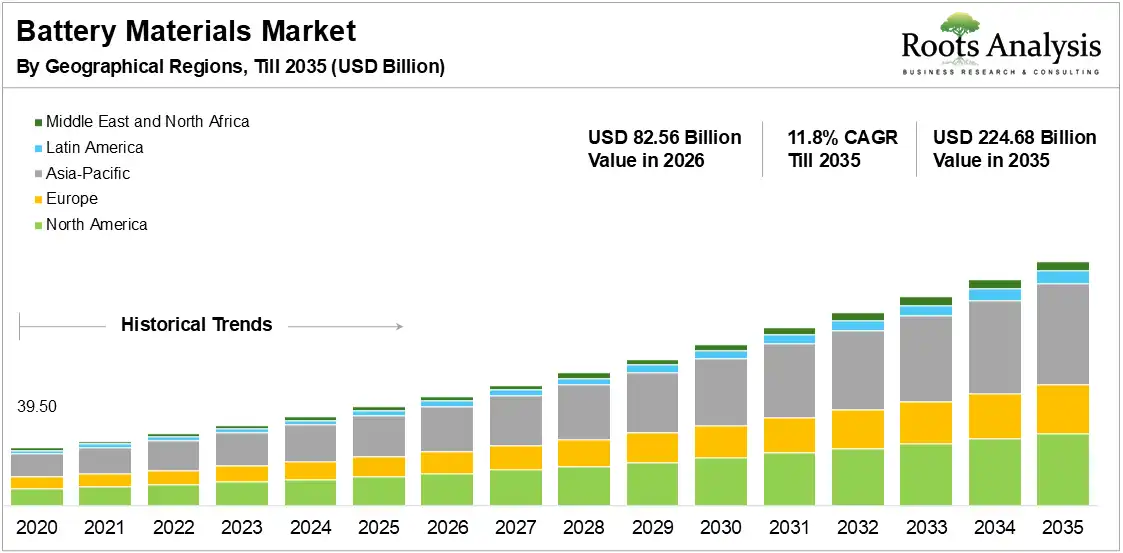
Battery materials market size is forecasted to reach USD 224.68 billion by 2035, growing at a 11.8% CAGR from USD 82.56 billion in 2026.
Would Like to Preview the Actual Report?
Market Report: Key Takeaways
- In terms of type of battery material, cathode holds the largest share (25%) of the market.
- Based on the type of battery, lithium-ion battery dominates the market by holding 57.95% of the overall revenue share.
- On the basis of application area, the automotive holds majority of the battery materials market share.
- With respect to geographical regions, Asia-Pacific currently occupies the largest share (41.26%) of the market.
Market Overview
A battery is a device that converts chemical energy into electrical energy using electrochemical cells. It consists of an anode, an electrolyte, and a cathode, which together establish the flow of electrons necessary to power a wide range of electrical devices, such as laptops, smartphones, and wearable devices. The growing shift toward renewable energy and electric vehicles are fueling the demand for batteries and its material across the globe.
Battery materials industry is a dynamically growing sector, offering enormous opportunities to market players for technological innovations. The primary focus of industrial players is to develop solid-state batteries, using innovative materials. This innovation is required to improve performance, facilitate faster charging, and achieve higher energy densities. In order to fulfil the demand, several market players are leveraging partnerships and collaborations.
For instance, in November 2025, Sinopec signed an agreement with LG Chem to conjointly develop solid-state battery materials. This agreement aims to escalate the commercialization of sodium-ion technology for low-speed electric vehicles and energy storage systems. Likewise, several battery materials market players are strengthening their product portfolio, which is likely to maintain a long term competitiveness in this industry.
Pay Only for What You Need – The Best Way to Optimize
Recent Developments
- In November 2025, Pure Battery Technologies invested USD 350 million in the Batang Industrial Park (Indonesia) to develop cathode materials for Indonesia’s growing battery industry.
- In October 2025, IBU - TEC and PowerCo signed a collaboration agreement, marking a pivotal moment in Europe’s battery manufacturing landscape. Under this agreement, both companies will focus on the production of lithium iron phosphate cathode material, a key milestone towards reducing Europe’s dependency on Asian suppliers.
- In July 2025, American Battery Technology Company received USD 1 million collaborative agreement with the U.S Department of Energy’s Argonne National Laboratory. This award have been granted to advance lithium hydroxide manufacturing technology of ABTC’s electrochemical processing system to reduce the chemical agents use in lithium production, which is a core component of batteries.
- In June 2025, Fastmarkets signed a collaboration with Intercontinental Exchange to launch a new suit of future contracts focused on battery raw materials. This partnership will aim to address the need for efficient price-risk management within the battery materials industry.
Market Dynamics
Key Market Drivers
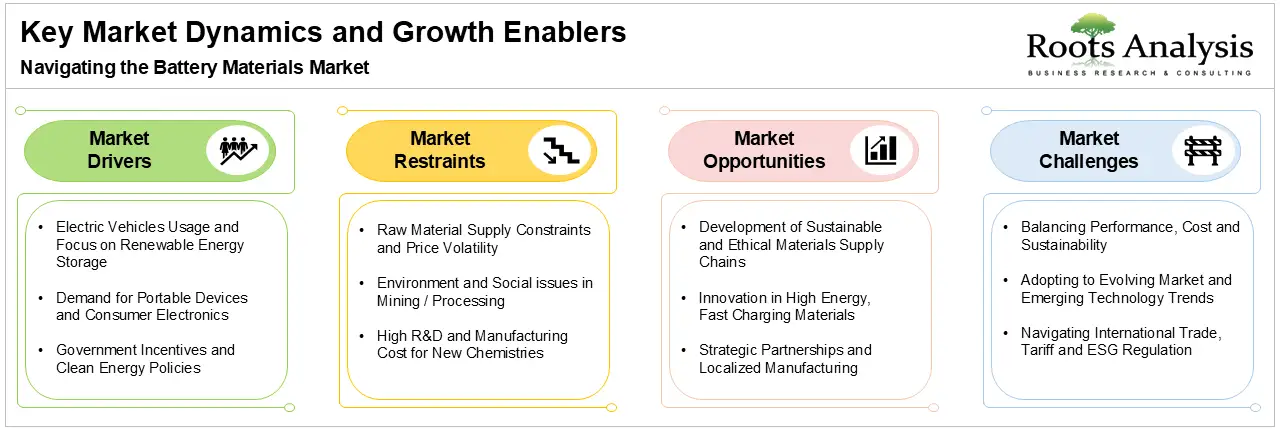
- Electric Vehicles Usage and Focus on Renewable Energy Storage: With government initiatives, such as zero tailpipe emissions, the global consumers are shifting to electric vehicles which run on batteries. This transit to electric vehicles has further fueled the demand for battery materials for lithium-ion and solid-state battery production with improved performance and efficiency, such as cobalt, nickel, lithium, graphite and anode / cathode.
- Demand for Portable Devices and Consumer Electronics: The global digitization has fueled the demand for consumer electronics and portable devices, such as laptops, smartphones, and IoT devices. These devices require lightweight, long-life batteries, which further drives the demand for sustainable battery materials.
- Government Incentives and Clean Energy Policies: The growing mandates of clean energy policies to reduce carbon emission, and decarbonization are stimulating the investments in energy efficient vehicles and advanced battery technology.
Market Challenges
- Balancing Performance, Sustainability and Cost: It is worth noting that the battery materials, such as nickel is crucial for achieving high performance and energy density. However, the use of highly volatile nickel and high quality cobalt to maintain safety and stability can significantly increase the overall cost of the batteries. Therefore, delivering performance while maintaining affordability, and safety can be challenging for the market players.
- Adapting to Evolving Market and Technology Trends: The market players are aiming to improve battery technology to enhance performance, safety and efficacy. The rapidly evolving battery technology requires a flexible supply chain to ensure the continuous provision of raw materials. However, the stringent regulatory framework and agility among material suppliers create challenges for the market players.
- Navigating International Trade, Tariff, and ESG Regulation: The cross border trade of raw materials for battery production is subjected to regulatory frameworks and government protocols. Therefore, the international trade, high tariff and operational complexity may create challenges for the battery materials market players.
Have Questions? Let’s Get Them Answered.
Market Segmentation
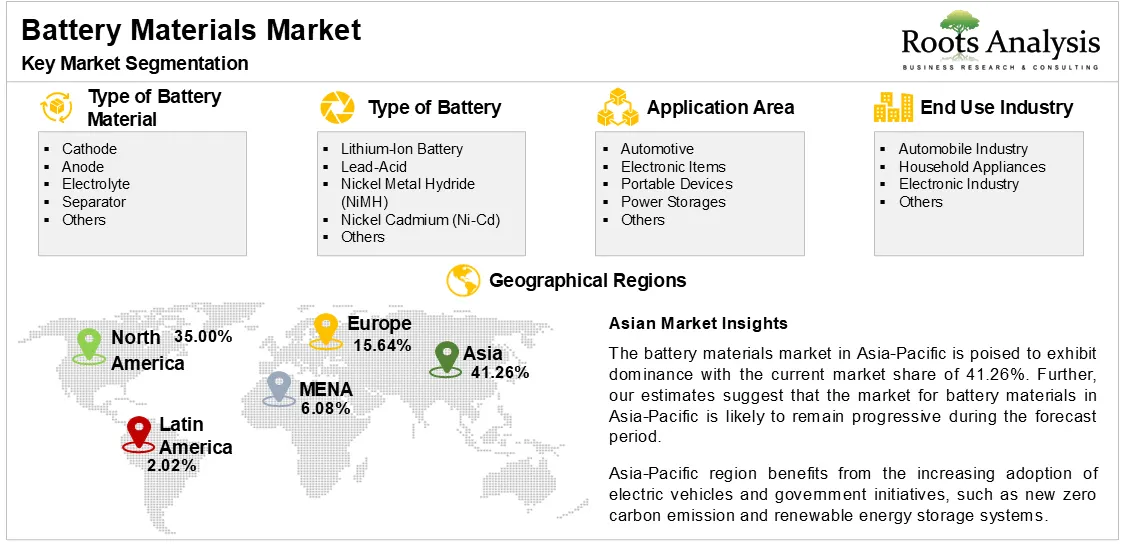
The battery materials market report presents an in-depth analysis of the various companies that are involved in offering rare earths for battery manufacturing, across different segments, as in the figure below:
Market Share Insights
Cathode Lead the Market
Our battery materials market forecast estimates that the cathode holds 25% of the overall revenue share. This growth stems from the fact that the cathode material is the raw source of lithium ions, which is crucial for making electronic vehicles batteries. Moreover, cathode based battery materials are highly used in the preparation of lead-acid batteries where the cathode is lead dioxide.
It is important to note here that the anode is likely to grow at a higher CAGR during the forecast period. This can be attributed to the increasing advancements in silicon-based and graphene battery materials to improve battery performance.
Lithium-Ion Battery Sub-Segment Drive the Market Growth
According to our battery materials market report, the lithium-ion battery sub-segment leads the market, accounting for 57.95% of the market share. This dominance is due to the increasing innovation of battery materials for lithium-ion and solid-state battery production. In addition, the lithium-ion batteries are widely adopted in electric vehicles to improve performance and efficiency.
It is worth noting that this sub-segment will continue to gain momentum at a higher CAGR of 8.70% during the forecast period. The rising government initiatives to install charging stations are driving the demands for electric vehicles (EVs), which further propel the demand for lithium iron phosphate materials to manufacture EVs batteries.
Get an Instant Quote in 10 Minutes. Lowest Price Guaranteed
Regional Insights: Asia-Pacific Dominates the Market Due to the Increasing Adoption of EVs
Our forecast estimated that the Asia-Pacific is leading the market by holding 41.26% share of the battery materials market growth. The region benefits from the ongoing innovations in battery materials for electric vehicle and energy storage applications. Notably, Asian countries, such as China, India, Japan, and South Korea are hub for the key players of critical minerals for battery production and raw materials for batteries, such as cobalt, lithium and nickel.
The continuous adoption of electronic gadgets, such as smartphones, wearable devices and other electrical appliances has further solidified the demand for battery materials in this region. Moreover, the government organizations in Asian countries are implementing strategic policies, such as Zero Emission Vehicle (ZEV) mandates which directly subsidies manufacturers to develop next-generation technologies in this region.
On the other hand, North America is likely to register the fastest CAGR during the forecast period. This lucrative growth is due to the increasing government support for renewable energy storage systems and heightened demand for portable electronic devices are fueling the demand for electrolyte materials for batteries in North American region.
Key Market Insights
Competitive Landscape of Key Players in the Battery Materials Industry
The advanced battery materials market is highly competitive, featuring the presence oof technology giants, industrial firms, and startups. Some of the key market players, such as Albemarle, Asahi Kasei, Arcadium Lithium, BASF, NEI, and Norilsk Nickel / Nornickel are undertaking initiatives, such as launching new platforms, strengthen partnerships, and collaborations to innovate new extraction technologies to extract raw materials and develop next generation batteries.
For instance, in December 2025, Trinseo the launch of its fourth-generation SBR binder platform which is specifically engineered to power the next generation electric vehicles and battery energy storage system application. This launch of new platform mark a key milestone for Trinseo to enhance its leadership in high-performance materials for the energy transition.
In addition, the leading players are also emphasizing research into battery recycling materials, solid-state batteries materials, and lithium-sulfur, which further catalyze the battery materials market growth. For instance, in December 2025, Dong Hou of Clemson University has shared his insights on the development of next generation batteries with ceramic-based materials. Currently, Dong Hou and his team is making electrolytes with new ceramic-based materials to ensure that advanced solid-state batteries will be safe, long-lasting and sustainable than currently available batteries. Overall, the market seems immensely competitive, which is likely to strengthen the market progress in the future.
Want Information on Specific Region / Segment?
Market Trends in Cathode and Anode Battery Material Innovations
The key innovations in cathode and anode battery materials involves the use of silicon-carbon composites and nanostructures silicon to replace the graphite anode portion. In addition, market players are widely focused on lithium metal anodes or solid-state electrolytes for the development of high energy density batteries.
- Silicon-Based Anodes: Market players are widely adopting silicon-carbon composites and nanostructured silicon, such as silicon oxide, to replace a portion of the graphite anode. This technology manages the massive volume expansion of silicon during battery charging and delivers high performance for high-tech Electric Vehicles.
- Lithium Metal Anodes: For the ultimate boost in energy density, the industry is focusing on lithium metal anodes. These are a core component for solid-state batteries and replace graphite entirely, but their commercialization is currently limited by the risk of dendrite formation and related safety issues.
- High-Nickel Chemistries: The trend is toward high-nickel cathodes, where the percentage of nickel is significantly increased to boost energy density. This shift reduces the relative amount of expensive cobalt needed.
What are the Latest Innovations and Technology Trends in Battery Materials?
Future innovations involve radical technological advancements, predominantly focusing on enhancing safety, energy density, and cost-efficiency of batteries for electric vehicles. Notably, the solid-state batteries are known as the next-generation technology because these batteries efficiently replace the flammable liquid organic electrolyte with solid electrolyte, such as sulfide-based compounds for high energy density. In addition, the focus will be on lithium-sulfur batteries, which significantly reduce weight and cost, making them ideal for electric vehicles and aviation industries.
How is Demand for Sustainability and Recycling Shaping the Battery Materials Market?
The market players are continually investing in green, traceable, and ethically-source raw materials for batteries. Furthermore, the industrial leaders are aiming for sustainable sourcing and recycling of critical battery materials to improve cost-efficiency. It is worth noting that the closed-loop recycling processes help producers to adhere with regulatory compliance, support brand value and customer trusts.
In addition, the market players are broadly emphasizing technological innovations, such as hydrometallurgy that helps to achieve high-purity recovery of cobalt, nickel, and lithium. The direct recycling through these technologies helps to preserve chemical structure of the cathode materials and reduce environmental burden by lowering the green house gases emission. The synergy of these regulatory demands and economic incentives is rapidly transforming battery waste management into a highly valuable, essential sector of the battery materials supply chain.
Expansion in Alternative Chemistries and Emerging Market Segments
Beyond consumer electronics and electric vehicles demand, the market players are aiming to unlock new applications of batteries in alternative chemistries, which further diversify the demand for battery materials. Moreover, increasing interest in chemistries like zinc-based and vanadium redox flow batteries are fueling the demand for long-duration stationary energy storage.
Furthermore, the alternative chemistries are opening new, high-growth market segments previously dominated by less efficient or older technologies.
- Grid Infrastructure: The need to balance intermittent solar and wind power is creating massive demand for energy storage solutions suitable for utility and microgrid installations.
- Commercial & Industrial (C&I): Batteries are being adopted for reducing electricity costs by drawing less from the grid during high-demand times and providing uninterruptible power supplies (UPS) for critical infrastructure like data centers and 5G telecom stations.
- Low-Speed Electric Mobility: Sodium ion batteries are finding a niche in applications that do not require high energy density, such as two/three-wheelers, forklifts, and low-range urban delivery vehicles.
These emerging trends are dynamically shaping the battery materials growth by driving the demand for more innovative and sustainable materials.

Battery Materials Market: Scope of the Report
| Key Report Attributes | Details | |
| Forecast Period | Till 2040 | |
| Market Size 2026 | $ 82.56 Billion | |
| Market Size 2035 | $ 224.68 Billion | |
| CAGR (Till 2035) | 11.8% | |
| Segments Covered |
|
|
Your Business is Unique – Why Shouldn’t Your Report Be?
Market Segments
Based on research, we have segmented the Battery Materials Market into type of material, type of battery, application area, end user, geographical regions, and key players.
By Type of Material
- Cathode
- Lithium Cobalt Oxide
- Lithium Manganese Oxide
- Lithium Iron Phosphate
- Lithium Nickel Manganese Cobalt
- Lithium Nickel Cobalt Aluminum Oxide
- Anode
- Natural & Artificial Graphite
- Lithium Titanate
- Silicon Compound
- Activated Carbon
- Electrolyte
- Separator
- Others
By Type of Battery
- Lithium-Ion
- Lead-Acid
- Nickel Metal Hydride (NiMH)
- Nickel Cadmium (Ni-Cd)
- Others
By Application Area
- Automotive
- Electric Vehicle
- Hybrid Vehicle
- Electronics Items
- Computer
- Portable Devices
- Tablets & Mobiles
- Others
- Power Storages
- Others
By End Use Industry
- Automobile Industry
- Electronics Industry
- Household Appliance
- Others


