Battery Raw Material Market by Type of Raw Material (Cobalt, Graphite, Lithium, Manganese, Nickel and Vanadium), Type of Source (Mines, Recycling and Refineries), End-User (Consumer Electronics, Electric Vehicles, Energy Storage Systems, Industrial Machinery and Medical Devices), Type of Enterprise, Geographical Regions, and Key Players - Trends and Forecasts 2026-2035
Market Size
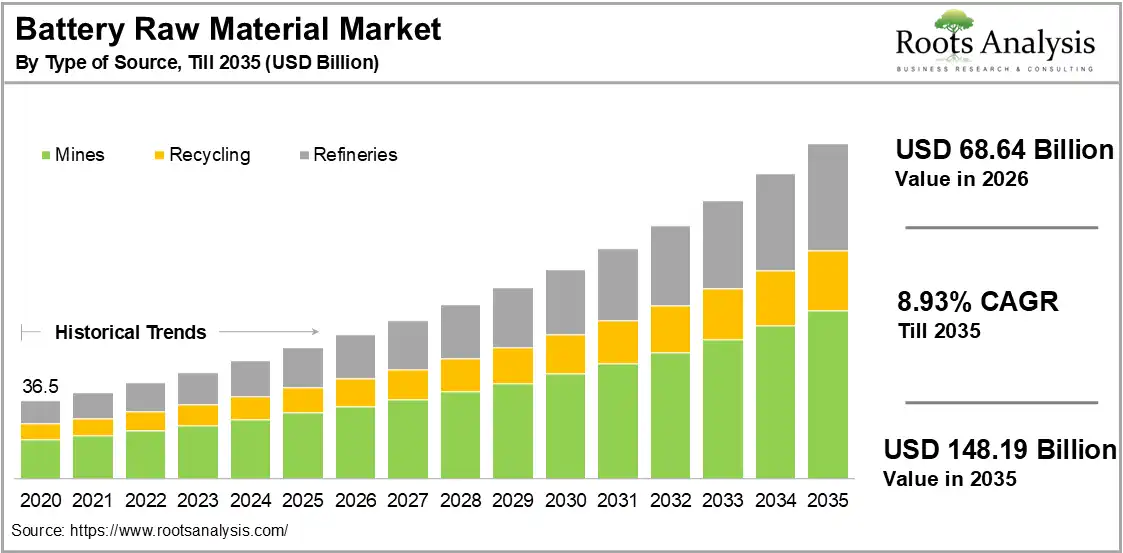
The global battery raw material market, valued at USD 61.79 billion in 2025, is projected to reach USD 68.64 billion in 2026 and USD 148.19 billion by 2035, with a CAGR of 8.93% during the forecast period 2026 to 2035.
Would Like to Preview the Actual Report?
Key Takeaways
- In terms of type of raw material, lithium secures the largest market share of the overall revenue of the global market.
- In terms of end-user, electric vehicles hold the largest share of battery raw material market.
- In terms of leading region, Asia-Pacific holds the largest share with 36.75% share of the market.
- Key market driver is the electric vehicle market growth for environment conservation which is increasing the battery raw material adoptions.
Market Overview
The rapid global transition to electric vehicles is creating a direct and growing demand for the underlying battery raw material supply chain. Firstly, natural critical minerals for batteries like lead, cobalt, nickel and graphite are extracted, and then undergo various battery production processes such as hydrometallurgical and pyrometallurgical methods, for manufacturing battery-grade chemicals.
What’s driving the growth of the battery raw material market is the increasing trends in electric mobility, as they offer sustainability along with cost-effectiveness. Not only this, but these battery materials are also highly used to store renewable energy storage solutions as they are effective in storage and can release that energy effortlessly when needed. Furthermore, the requirement of efficient batteries in smartphones, wearables and laptops are driving consumer electronics battery demand.
In reference to this, the advancements in battery technology like nuclear battery for improved capacity, charging speeds and reduced costs certainly have a lead role in growth. As the innovation in material science and lithium extraction methods are in the race, the acceleration is bound. Consequently, major organizations are partnering to establish an enhanced supply chain for battery materials.
For instance, in March 2025, Webasto and Cylib forged a sustainable partnership to recycle used batteries and secure critical raw materials. In reference to this, Marcel Bartling, Chief Technology Officer (CTO) at Webasto stated that “Collaborations like the one between Webasto and Cylib are in the interest of the entire European automotive industry, because they make the local raw material ecosystem more sustainable and resilient - ultimately benefiting everyone, right down to the end consumer.”
Recent Developments in Battery Raw Material Market
- In November 2025, Redwood Materials announced the recovery of critical raw materials at its Berkeley county site, wherein 20,000 tons of material (lithium, cobalt, nickel and copper) will be processed from lithium-ion batteries.
- In February 2025, Rock Tech Lithium, a Canadian-based lithium-ion battery materials manufacturer partnered with Arcore, a Swiss mining company to launch a subsidiary named NewCo to establish fully integrated supply chain for lithium in Europe.
- In October 2024, Sudeep Pharma, an Indian-based pharmaceutical company launched battery raw material company coined as Sudeep Advanced Materials focused on green iron phosphate for EV storage.
Your Business is Unique – Why Shouldn’t Your Report Be?
Market Share Insights
Lithium to Dominate the Battery Raw Material Domain
When it comes to the global battery raw material market, the lithium segment is set to take the lead, holding a significant market share. This market growth is largely a result of demand for lightweight materials that have high electrochemical potential. Additionally, high density power storage promises longer battery life in comparison with nickel and cobalt in batteries, it’s a given that lithium is bound to be excelling in this segment.
Refineries to Witness the Fastest Growth Rate
The refineries segment is expected to witness the fastest CAGR during the forecast period. This growth can be attributed to the ability of refineries to convert raw material into high purity chemicals that are crucial for battery manufacturing. This is a major reason behind industries heavily investing in establishing refineries. In addition to this, these offer recycling of used materials, making them a favorable choice for sustainable battery materials, further fueling battery recycling market growth.
Impact of Electric Vehicle Adoption on the Battery Raw Material Market Growth
The electric vehicle segment really stands out as the dominant end use industry. In fact, it’s also expected to grow with the highest battery raw materials market growth rate during the forecast period. Electric vehicles not only conserve the environment they also save money. As gasoline prices continue to sky-boost, consumers are swiftly shifting to electric vehicles. These vehicles require batteries that can store high energy for longer drives. Furthermore, as technology continues to evolve, for example ongoing study and R&D on improved efficiency and reduced raw materials have solidified the impact.
Asia-Pacific to Lead the Growth Trajectory of the Battery Raw Material Industry
According to our battery raw material market forecast, Asia-Pacific currently exhibits dominance with 36.75% of overall market share as well as is expected to witness the fastest CAGR. This is mainly because of the region’s high focus on electric vehicles, for instance South Korea’s Hyundai and Kia and India’s Mahindra and Tata are launching advanced electric cars and truck, creating a strong demand for electric vehicle battery materials market.
As the world gradually relies on technology such as wearable, smart phones and digital cameras, Asia-Pacific finds its way to lead the domain through technological advancements and innovations. This region is known as an emerging economy, this boosting growth demands faster industrialization and urbanization.
Want Information on Specific Region / Segment?
Market Dynamics
What are the Key Drivers for Demand in the Battery Raw Material Industry?
The electric vehicle market growth for environment conservation is playing a crucial role in driving the battery raw material adoptions. Various industries around the world are mandating batteries due to improved efficiency and cost-effectiveness in comparison with traditional mediums.
It is worth highlighting that much ongoing research in material science, innovations in energy storage systems and technological advancements are also a major factor in boosting growth. In fact, the demand for the domain is directly proportional to the demand for wearables and smartphones. As these devices also require efficient batteries, smartphone manufacturers are also investing in longer-life batteries.
What Strategies are Companies Using to Gain Battery Raw Material Market Share?
The battery raw material market is experiencing rapid expansion driven by surging demand for electric vehicles, grid-scale energy storage, and consumer electronics. Top battery raw material suppliers, such as BASF, Mitsubishi Chemical, and Targray Technology, have solidified their market positions through aggressive strategies including partnerships, acquisitions, and joint ventures, alongside heavy investment in R&D to launch advanced cathode and anode technologies.
These companies are prioritizing sustainable sourcing, recycling collaborations, and geographic expansion into automation-driven regions to capture additional market share while maintaining leadership in innovation and product quality.
Pay Only for What You Need – The Best Way to Optimize
What Are the Technical Challenges in Battery Raw Material Implementation?
The major challenges faced by manufacturers in securing supply chains for critical minerals are that these materials are highly toxic, as they possess high physical and mental health concerns. Workers and people who are exposed to these materials have shown major signs of slow thinking and learning difficulties. In the light of these side effects, they require proper implementation and manufacturing.
That forwardly requests skilled labor, and proper training may finite battery metal demand trends.
The list does not end, inadequate presence of charging infrastructures also limits user adaptation of batteries, as recharging difficulties seem to be resolved by traditional alternatives that do not involve batteries at all slows future trends in sustainable sourcing of battery materials.
Market Segmentation
Battery Raw Material Market: Scope of the Report
| Key Report Attributes | Details | |
| Historical Trend | Since 2020 | |
| Forecast Period | Till 2035 | |
| Market Size 2026 | $ 68.64 Billion | |
| Market Size 2035 | $ 148.19 Billion | |
| CAGR (Till 2035) | 8.93% | |
| Segments Covered |
|
|
| Key Players Profiled | ||
| PowerPoint Presentation (Complimentary) |
|
|
| Customization Scope |
|
|
| Excel Data Packs (Complimentary) |
|
|
Market Segments
Based on research, we have segmented the battery raw material market into type of raw material, type of source, type of end-user, type of enterprise, geographical regions, and key players.
By Type of Raw Material
- Cobalt
- Graphite
- Lithium
- Manganese
- Nickel
- Vanadium
By Type of Source
- Mines
- Recycling
- Refineries
By Type of End-User
- Consumer Electronics
- Electric Vehicles
- Energy Storage Systems
- Industrial Machinery
- Medical Devices
By Type of Enterprise
- Large Enterprises
- Small and Medium Enterprises
By Geographical Regions
- North America
- US
- Canada
- Mexico
- Rest of North America
- Europe
- Austria
- Belgium
- Denmark
- France
- Germany
- Ireland
- Italy
- Netherlands
- Norway
- Russia
- Spain
- Sweden
- Switzerland
- UK
- Rest of Europe
- Asia-Pacific
- Australia
- China
- India
- Japan
- New-Zealand
- Singapore
- South Korea
- Rest of Asia-Pacific
- Latin America
- Brazil
- Chile
- Colombia
- Venezuela
- Rest of Latin America
- Middle East and Africa (MEA)
- Egypt
- Iran
- Iraq
- Israel
- Kuwait
- Saudi Arabia
- UAE
- Rest of MEA


