


 Download Free Sample
 Buy Now
Market Size
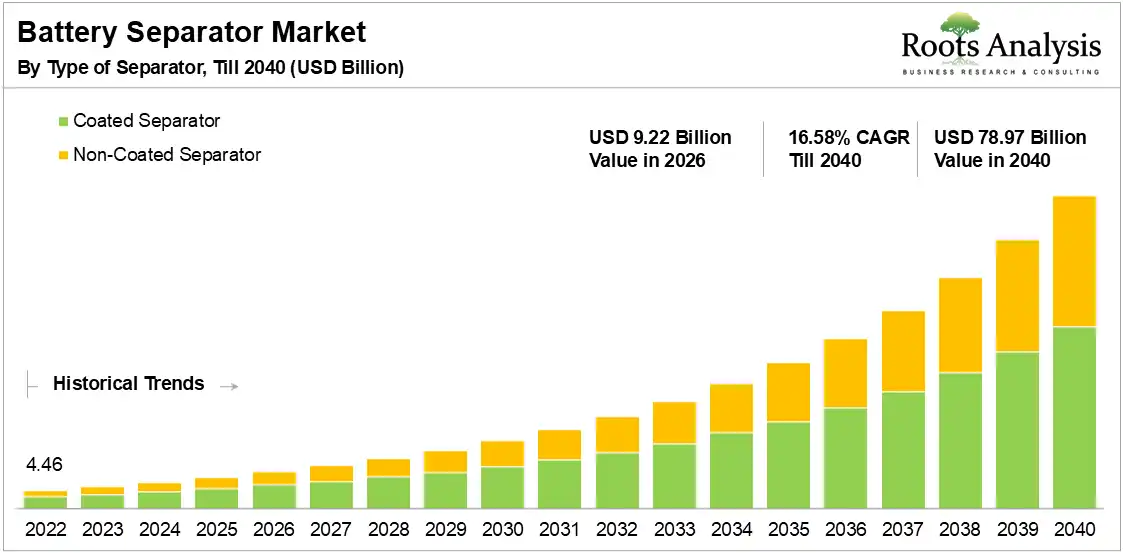
The global battery separator market, valued at USD 9.22 billion in 2026, is projected to reach USD 36.67 billion in 2035 and USD 78.97 billion by 2040, representing a CAGR of 16.58% during the forecast period 2026 to 2040.
See What’s in the Full Report - Request Your Complimentary Insights!
Market Report: Key Takeaways
- In terms of battery, lithium-ion battery dominates the market by holding 66.15% of the overall revenue share.
- Based on the type of separator, coated separator leads the market by securing 65.05% of the market share.
- With respect to type of material, polypropylene holds the largest share (nearly 50%) of the market.
- Based on the type of thickness, 10µM-20µM accounts for the maximum share (Nearly 70%) of the market share.
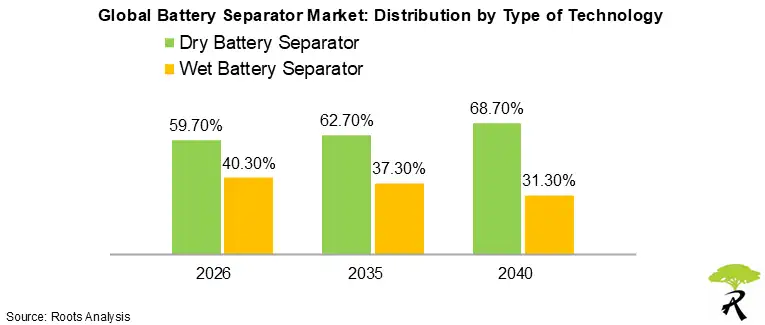
- On the basis of type of technology, dry battery separators hold the largest share (59.70%) of the market.
- On the basis of end use industry, automotive dominates by holding 49.65% of the market share.
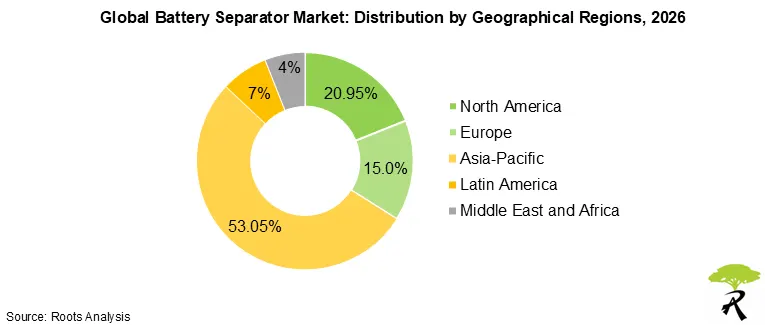
- According to regional analysis, Asia-Pacific leads the market with 53.05% of the market share.
Market Overview
Battery separator is a form of thin membrane which is implanted between a battery’s cathode and anode electrodes to prevent short circuits while allowing ions to pass through it. These battery separators play a crucial role in safety and performance of the batteries particularly in electronic devices, smartphones and electric vehicles. Moreover, these battery separators are designed to promptly shut down the appliance’s batteries during overheating and short circuit, thereby keeping appliances safe.
With an increasing shift towards electric automotive vehicles and renewable energy storage systems, the demand for these batteries has significantly increased. Additionally, the adoption of wearable technologies, tablets, smartphones, and digital devices that rely on batteries are driving the demand for high-voltage separators.
Owing to the ongoing demand, several market players are aiming to expand production capacity, innovate new battery separator technologies, and rising partnerships. For instance, in December 2025, Arkema signed a Memorandum of Understanding with Semcorp to escalate innovation in battery separator technology and support Semcorp in the international expansion. Likewise, several market players are leveraging partnerships and collaborations, which is expected to maintain long-term competitiveness in the battery separator market.
Have Questions? Let’s Get Them Answered.
Recent Development in Battery Separator Market
- In December 2025, Kingswood Capital Management announced the acquisition of Daramic (the leading manufacturer and supplier of lead battery separator).
- In November 2025, Asahi Kasei and its partners reassessed their lithium-ion battery separator businesses and planned to invest over USD 1 billion on a new wet-process separator plant in Canada.
- In June 2025, QuantumScape integrated a new battery separator production process for solid-state batteries to improve quality and process stability.
Market Share Insights
Lithium-Ion Battery Lead the Market
Based on the battery separator market forecast, lithium-ion battery accounts for the largest market share. This growth stems from the rising use of lithium-ion batteries in the automotive industry, specifically electric vehicles. In addition, the rising partnerships for the production of lithium-ion batteries has further accelerated the lithium-ion battery separator market for electric vehicles and energy storage.
For instance, in February 2025, SK IT Technology entered into a partnership with Gotion to expand the battery separator supply in North America and Europe. This partnership aims to strengthen collaboration on supplying EV battery separator that are used in electric vehicles and energy storage systems batteries.
On the other hand, lead-acid batteries are likely to grow at a higher CAGR during the forecast period. This dynamic growth stems from the growing adoption of lead-acid batteries in the automotive industry. Moreover, commercial vehicles and heavy vehicles rely on lead-acid batteries for ignition systems, lighting, and starting, which further underscore the demand for lead-acid separator.
Automotive Dominates the Market While Consumer Electronics Will Grow at Higher CAGR
According to our analysis, automotive accounts for the largest battery separator market share. The increasing concern of air pollution and climate change have bolstered the demand for environmental-friendly and sustainable batteries. This growing shift towards sustainable and environmentally friendly batteries have boosted the demand for high-performance battery separator materials to maximize battery efficiency.
It is worth noting that consumer electronics show robust growth during the forecast period at a higher CAGR. Several factors, such as increasing technological innovations to improve electronic devices with enhanced capabilities, are driving the demand for nonwoven battery separators for advanced rechargeable batteries.
Regional Analysis: Asia-Pacific to Hold the Largest Share of the Battery Separator Industry
Based on the battery separator market report, Asia-Pacific leads the market with a share of xx%. Several factors, such as robust adoption of electric vehicles, electronic devices, renewable energy storage systems in Asian countries, such as Japan, China, and India are the key reasons for the highest share. Furthermore, the rapid industrialization, and increasing spending on technological innovations in electronic devices, and increasing lithium-ion batteries applications within automotive sectors has further fueled the battery separator market demand in Asia-Pacific gigafactories.
In North America, the market for battery separators is likely to grow at a higher CAGR during the forecast period. This unprecedented growth is driven by the rising adoption of electric vehicles, consumer electronics, and focus on zero carbon emission policies are likely to fuel the battery separators market growth in this region.
Want Information on Specific Region / Segment?
Market Dynamics
Key Market Drivers
- Increasing Demand in Automotive Industry: The increasing expansion of the automotive industry including advanced automotive vehicles and electric vehicles are driving the demand for battery separators. Notably, electric vehicles require lithium-ion (Li-ion) battery packs. Each lithium-ion battery cell inside the pack uses a battery separator. This increasing usage of battery separators in lithium-ion batteries directly increases the demand for battery separators.
- Growing Adoption of Electronic Products: The growing urbanization in the developing countries has escalated the adoption of consumer electronic products including smartphones, laptops, smart home electronic appliances, and fitness gadgets. These consumer electronics rely on batteries which further require battery separators for maximum performance and long life. Therefore, with rising adoption of consumer electronics, there will be a surge in the demand for innovative battery separators.
- Growth in Energy Storage Systems (ESS): The global shift towards renewable energy sources has created an unprecedented demand for large scale battery storage systems, which further boosted the battery separator demand. Furthermore, the increasing adoption of residential battery storage and commercial storage systems has also increased the non-automotive demand for separators.
Key Market Challenges
- Disruption in Supply Chain: The global battery separator industry is witnessing disruption in the supply chain. Factors such as raw material price volatility (polypropylene and polyethylene purity) which impact final cost of these separators and geological concentration of raw materials in few countries creates supply chain vulnerability.
- Safety and Thermal Stability: One of the significant challenges for market players is maintaining safety and thermal stability of battery separators. It is worth noting that standard polyolefin material-based separators melt at relatively low temperatures which create difficulty in preventing thermal runaway in high-energy density electric vehicle batteries. Therefore, the market players are required to research advanced solutions such as ceramic-coated separators to provide high thermal shutdown point and mechanical integrity.
- Compatibility with Next-Generation Chemistries: Next-generation battery technologies, such as solid-state batteries, and lithium-metal batteries demand advanced battery separators with properties, such as high mechanical strength, thermal stability, and performance to achieve stability against polysulfides. However, the complexity of manufacturing advanced battery separators may create challenges for the market players because traditional porous polymer film is either chemically incompatible or mechanically insufficient for these new cell designs.
Pay Only for What You Need – The Best Way to Optimize
Key Market Insights
Competitive Landscape of Battery Separator Industry
The battery separator market is witnessing the presence of well-established and emerging entrants. Some of the notable examples of the market players include Asahi Kasei, Bernard Dumas, Sinoma Lithium Film, SK Innovation, and Toray Battery Separator Film. These market players are at the forefront of technological innovations and research & development activities to develop advanced separators.
Besides separator innovation, governments are investing heavily for the expansion of battery separators manufacturing facilities. For instance, in July 2025, Malaysian Investment Development Authority (MIDA) officially launched MYR 3.2 billion INV New Material Technology Sdn. BHd’s. cutting-edge lithium-ion battery separator facility. The MIDA further said that this newly launched facility holds the capacity to produce 1.3 billion square meters of wet-processed and coated lithium-ion separators, which are an essential component of EV batteries. These innovations and facility expansion are creating competitive environment for the market players.
What Technological Innovations are Emerging in Separator Design and Coatings?
- Ceramic-Coated Separator: Market players are widely emphasizing innovations to go beyond traditional polyolefin membranes to advance the composite and structural designs. One of the significant innovations includes ceramic-coated separators which will be made with inorganic ceramic nanoparticles coated onto polyolefin and polymer membranes. This polyolefin battery separator enhances thermal stability and reduces thermal shrinkage to prevent internal short circuits and thermal runaway at high temperatures.
- Innovation in Sustainable and Recyclable Separator Materials: Market players and research institutes focus on research and development into bio-based polymers, lower-energy manufacturing processes, and easier-to-separate structures. These innovations are aiming to meet with demand for electric vehicle manufacturers who are primarily focusing on lifecycle sustainability.
- Growth in Nonwoven, Paper, and Solid-State Separator Technologies: The market players are greatly emphasizing nonwoven fabric and solid-state separators to replace conventional porous film separators in some applications. The key benefits of nonwoven fabric separators includes high porosity and superior electrolyte wettability which further improves overall cell performance.
Strategic Partnerships Across the Battery Value Chain
The polypropylene battery separator market players and battery separator producers are undertaking initiatives, such as partnerships and collaborations. These partnerships are typically between cell makers, electric vehicles manufacturers and renewable project developers to optimize battery chemistries and applications.
For instance, in July 2025, Asahi Kasei signed a strategic partnership with Toyota Tsusho for the supply of automotive lithium-ion battery separators in North America.
Battery Separator Market: Scope of the Report
| Key Report Attributes | Details | |
| Historical Trend | Since 2022 | |
| Forecast Period | Till 2040 | |
| Market Size 2026 | $ 9.22 Billion | |
| Market Size 2040 | $ 78.97 Billion | |
| CAGR (Till 2040) | 16.58% | |
| Segments Covered |
|
|
| Key Players Profiled |
|
|
| PowerPoint Presentation (Complimentary) |
|
|
| Customization Scope |
|
|
| Excel Data Packs (Complimentary) |
|
|
Get an Instant Quote in 10 Minutes. Lowest Price Guaranteed
Market Segments
Based on research, we have segmented the battery separator market into type of battery, type of separator, type of thickness, type of technology, application area, end use industry, geographical regions, and key players.
By Type of Battery
- Lithium-Ion (Li-Ion)
- Lead Acid
- Nickel-Cadmium
- Nickel Metal
- Others
By Type of Separator
- Coated Separator
- Non-Coated Separator
By Type of Material
- Ceramic
- Nylon
- Polyethylene (PE)
- Polypropylene (PP)
- Others
By Type of Thickness
- 5µM-10µM
- 10µM-20µM
By Type of Technology
- Dry Battery Separator
- Wet Battery Separator
By Application Area
- Consumer Electronics
- Electric Vehicles
- Industrial Applications
- Renewable Energy Storage
By End Use Industry
- Automotive
- Consumer Electronics
- Industrial
- Others
By Geographical Regions
- North America
- US
- Canada
- Mexico
- Rest of North America
- Europe
- Austria
- Belgium
- Denmark
- France
- Germany
- Ireland
- Italy
- Netherlands
- Norway
- Russia
- Spain
- Sweden
- Switzerland
- UK
- Rest of Europe
- Asia-Pacific
- Australia
- China
- India
- Japan
- New-Zealand
- Singapore
- South Korea
- Rest of Asia-Pacific
- Latin America
- Brazil
- Chile
- Colombia
- Venezuela
- Rest of Latin America
- Middle East and Africa (MEA)
- Egypt
- Iran
- Iraq
- Israel
- Kuwait
- Saudi Arabia
- UAE
- Rest of MEA


