
Lowest Price Guaranteed
Slides
214
Last Updated
August 2026
View Count
10989
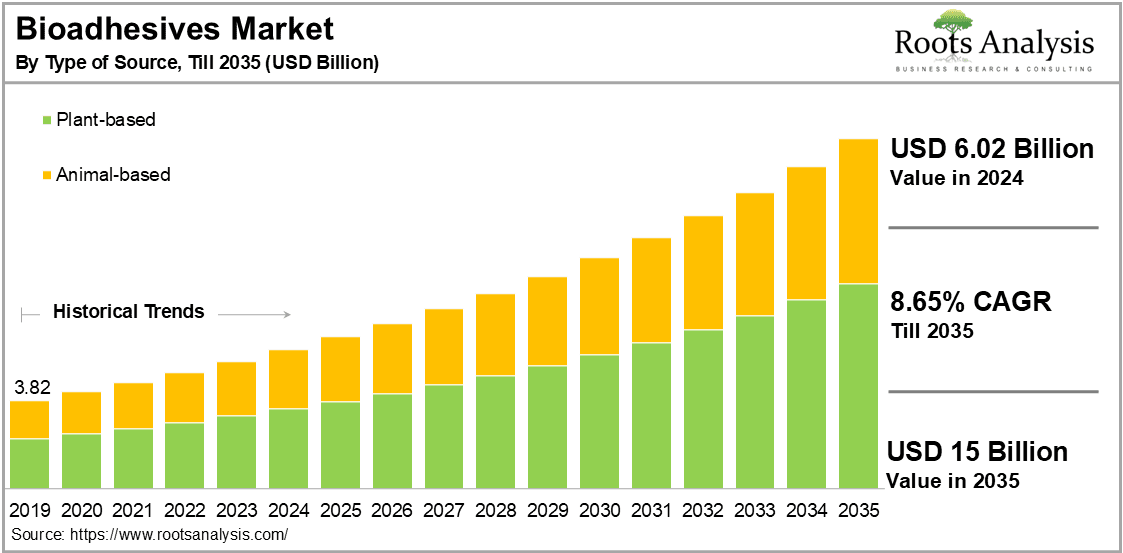
According to the global bioadhesives market size forecast, the market is projected to grow from USD 6.02 billion in 2024 to USD 15 billion by 2035, representing a CAGR of 8.65%, during the forecast period 2024-2035.
 |
To learn more about this report, request a free sample copy
The new research study consists of bioadhesives trends 2025 analysis, detailed global bioadhesives growth forecast analysis, and providing actionable strategic recommendations.
Bioadhesives are adhesives derived from renewable biological sources, including plants and animals. They utilize biological intermediates like starch, cellulose, and gelatin in their production. The applications of bioadhesives are expanding, particularly in flexible packaging, specialty packaging, printed sheet lamination, and cigarette filters. As consumer demand for environmentally friendly products rises, manufacturers are increasingly focused on developing bio-based alternatives. This shift toward sustainable packaging, coupled with a growing awareness of bioadhesives in the packaging sector, is expected to drive market growth.
The bioadhesive market has seen substantial growth recently and is projected to continue this trend. Their appeal as sustainable adhesive technologies in comparison to the synthetic adhesives stems from their biodegradable properties and lower environmental impact. A significant factor fueling the global bioadhesive market is the rising demand for eco-friendly adhesive products across various sectors, such as packaging, construction, healthcare, and automotive. As consumers become more aware of their environmental impact, there is a notable shift towards bio-based materials, including adhesives.
The bioadhesives market report presents an in-depth analysis of the various companies that are involved in offering bioadhesives solutions, across different segments, as defined in the table below:
| Key Report Attributes | Details | |
| Historical Trend | Since 2019 | |
| Forecast Period | 2024-2035 | |
| Market Size Value in 2024 | $ 6.02 Billion | |
| Market Size Value by 2035 | $ 15 Billion | |
| CAGR (Till 2035) | 8.65% | |
| Type of Source |
|
|
| Areas of Application |
|
|
| Type of End Users |
|
|
| Company Size |
|
|
| Geographical Regions |
|
|
| Leading Market Players | ||
| PowerPoint Presentation (Complimentary) |
Available | |
| Customization Scope | 15% Free Customization | |
| Excel Data Packs (Complimentary) |
|
|
Based on the types of sources, the global biodegradable adhesives market is split into animal-based and plant-based. According to the bioadhesives industry outlook, the plant-based adhesives segment growth is expected to be the maximum, capturing a market share of 70.34% by 2035. This can be attributed to their wide usage as they are petrochemical-free and contain very low formaldehyde emissions. The increasing focus on sustainable solutions and the growing requirement for eco-friendly adhesives have also increased the plant-based segment’s market growth. On the other hand, the animal-based segment is expected to witness rapid growth at a significant CAGR of 9.78% during the forecasted period. This growth can be attributed to its limited usage as compared to the plant-adhesive segment. These adhesives are used in certain areas, such as wound care and tissue engineering, in the healthcare sector.
Based on the areas of application, the global bioadhesives market is split into boxes and cartons, cigarettes & filters, cosmetics, foil laminates, flooring, labels & envelopes, wood works and others. According to our bioadhesives market forecast for these categories, the boxes and cartons segment growth is expected to be the maximum, capturing a market share of 30.34% by 2035. This can be attributed to the increasing demand for sustainable packaging solutions. On the other hand, the cigarettes & filters segment is expected to witness rapid growth at a significant CAGR of 13.45% during the forecasted period. According to our market analysis this growth can be attributed to the rising trend towards using bio-based materials in tobacco products to meet regulatory impact on bioadhesives and consumer preferences for sustainable options.
The global bioadhesives market is segmented into various types of end users, such as construction, healthcare, paper & packaging, personal care & cosmetics and wood industry. According to our global bioadhesives market analysis, the paper & packaging segment will augment the segment's growth with the largest market share of over 55.56% by the next decade. The market growth can be attributed to the wide usage of bioadhesives in applications like specialty packaging, bags, cartons, filters, flexible packaging, disposables, envelopes, foil laminates, labels cigarettes, and laminating printed sheets. On the other hand, the construction segment is set to witness the fastest CAGR of around 10.78% during the forecasted period. This growth is owed to the wide usage of bioadhesives in manufacturing wood composites such as particleboard and fiberboard as well as wood products such as furniture, doors and windows.
The global bioadhesives market is fragmented into multiple types of enterprise namely large and small and medium enterprise. Currently, the large enterprise segment is anticipated to dominate the segment with 67.34% of the bioadhesives market share. However, small and medium enterprise segments are expected to witness a relatively higher (12.26%) bioadhesives market growth rate until 2035. This is ascribable to their agility, innovation, focus on niche markets, and ability to adapt to changing customer preferences and market conditions.
This segment highlights the distribution of bioadhesives market share by region, such as North America, Europe, Asia, Latin America, Middle East and North Africa, and the rest of the world. According to our regional analysis of bioadhesives markets, Europe currently exhibits dominance with 37.69% of the overall market share. This growth is owed to the extensive application of bioadhesives in construction, particularly in residential and institutional projects, highlighting their importance in the region. Countries like Germany are at the forefront, leveraging their expertise in producing natural rubber- and starch-based adhesives, which are favored for their environmental benefits and effectiveness in creating durable bonds.
The “Bioadhesives Market, Till-2035: Industry Trends and Global Forecasts” report features an extensive study of the current market landscape, market size and future opportunity within the bioadhesives market, during the given forecast period. The market report highlights the efforts of several stakeholders involved in this rapidly emerging segment of the service providers industry. Key takeaways of the bioadhesives market report are briefly discussed below.
According to bioadhesives industry trends, the market is expected to be driven by rising demand for environmentally friendly products and stringent government regulations promoting the use of bio-based materials. As consumers become more aware of the harmful effects of synthetic adhesives, there is a notable shift towards bioadhesives made from natural polymeric materials like proteins and carbohydrates, which are biocompatible and less harmful to the environment. Regulatory bodies such as the US Environmental Protection Agency (EPA) and the Food and Drug Administration (FDA) are encouraging the adoption of bio-based adhesives, further propelling market growth. Significant investments in research and development further highlight the focus on innovation in this sector. Additionally, the growing medical applications of bioadhesives in drug delivery systems, driven by an increase in chronic diseases and a preference for safer materials, is contributing to the market's expansion. Overall, these factors collectively position bioadhesives as a sustainable alternative to traditional synthetic options, fostering growth across various industries.
With the presence of several small and large bioadhesives companies, the market is experiencing intense competition and changing bioadhesives market dynamics. From large multinational companies to local bioadhesives players, companies are striving to enhance their competitive edge. In terms of market share, large enterprises and multinational companies are dominating the market. With the help of advancements in bioadhesives solutions, small bioadhesives market players are continuously improving their products to cater to niche markets, or they are offering specialized bioadhesives solutions. These industry players are focusing on adopting competitive strategies, such as developing innovative bioadhesives solution techniques, forming strategic alliances and partnerships to expand their portfolios and global footprint, investing in recent developments and new feature launches to enhance their products offerings.
Despite the strong market growth projection, there are several challenges in the bioadhesives market. The most common challenge is their higher costs compared to synthetic adhesives, which can deter adoption in price-sensitive industries. This cost disparity limits the widespread use of bioadhesives, as many sectors prioritize affordability. Additionally, sourcing and processing raw materials for bioadhesives can be difficult due to their limited availability, leading to inconsistencies in quality and performance. Variations in raw material composition further complicates the production process, posing additional constraints to market growth. Together, these factors hinder the competitive edge of bioadhesives against more established synthetic alternatives.
With respect to regional bioadhesives industry insights, Europe is likely to dominate the market for the forecasted period. The dominance of this region is majorly due to stringent government regulations that favor the use of bio-based materials over synthetic alternatives, alongside rapid advancements in technology related to bioadhesives.
Examples of major players in the global bioadhesives industry (which have also been captured in this market report, arranged in alphabetical order) include 3M, Adhesives Research, Adhbio, Arkema, Ashland Global Holdings, Beardow Adams, Bioadhesive Alliance, Camurus, Columbia, CryoLife, DuPont de Nemours, EcoSynthetix, Ellsworth, Everis, Henkel AG, Jowat, Meyer-Haake, Medtronic, Paramelt BV, S. Adhesives, Tate & Lyle, The Lubrizol, VYGON, and Wacker Chemie.
At Roots Analysis, we genuinely care about your success and understand that your business requirements are unique. While our bioadhesives research reports provide valuable insights, we recognize that they might not cover every aspect you need to make well-informed strategic decisions. To account for that, we offer 15% free report customization tailored to your specific needs. Whether you require additional quantitative analysis, qualitative insights, or any other information related to the bioadhesives market, reach out us today at: support@rootsanalysis.com