Body Area Network Market
Body Area Network Market Till 2035: Distribution by Type of Device (Implantable, Smart Bands, Smart Earphones, Smartwatches and Wearable Devices), by Type of Technology (Bluetooth Low Energy (BLE), Wi-Fi, Zigbee and Other Technologies), by Type of Component (Processors, Memory Modules, Displays, Sensors, Electromechanicals and Communication & Interface Components), by Area of Application (Medical and Fitness, Military, Security, Sports and Other Applications), by Type of Enterprise (Large Enterprises, Small and Medium Enterprises (SMEs)), and Key Geographical Regions (North America, Europe, Asia, Latin America, and Middle East and North Africa and Rest of the World) Industry Trends and Global Forecasts.
-
Lowest Price Guaranteed
-
Slides
211 -
Last Updated
August 2026 -
View Count
10901 -
Body Area Network Market Overview
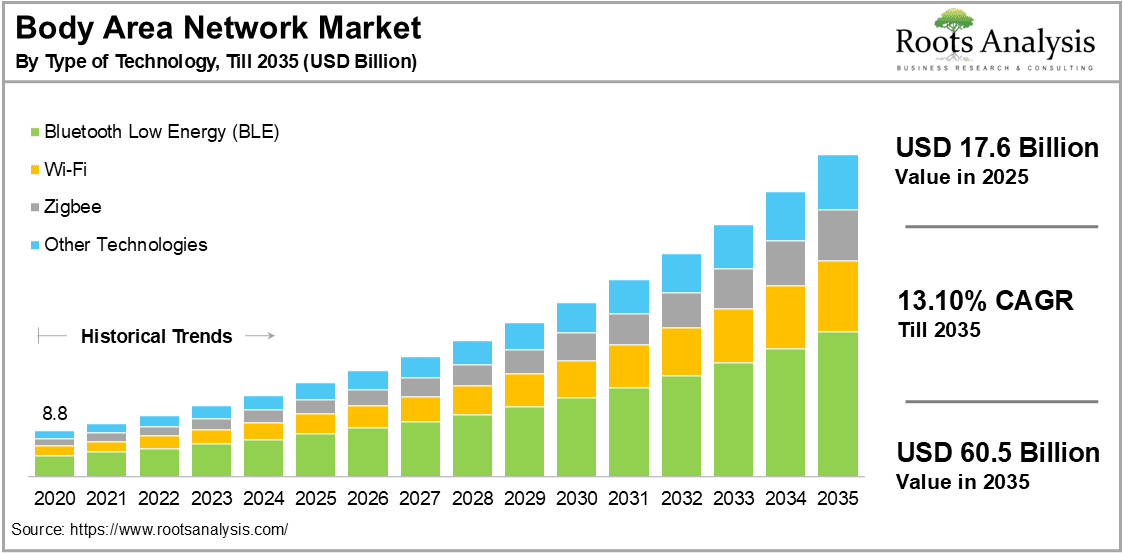
The global body area network market, valued at USD 15.4 billion in 2024, is projected to reach USD 17.6 billion in 2025 and USD 60.5 billion by 2035, representing a CAGR of 13.10% during the forecast period.
 |
The new research study consists of global body area network market analysis, mega trends, patent analysis, porter five forces, SWOT analysis, value chain analysis and other strategic frameworks.
According to the World Health Organization 31% of adults and 80% adolescents do not meet the recommended levels of physical activity. According to the same organizations inactivity can cause cardiovascular diseases, cancer and type-2 diabetes. The rising question is how to track the amount of activity? The body area network helps with this monitoring.
What’s driving the growth of the body area network technology market is the demand for chronic disease monitoring devices that can accurately analyze the human body and activities. The other major factor of this is that these Bluetooth-enabled health devices can be connected to smartphones. Forwardly easing tracking as smartphone screen is bigger and users favor such screens more.
In reference to this, the rising BAN industry trends are boosted by technological advancements such as ZigBee and Wi-Fi connectivity in BANs, for lower power consumption and extended range. It is worth highlighting that these fitness and sports tracking systems are favored for their accurate and real-time results.
Body Area Network Markets Share Insights
The body area network market report presents an in-depth analysis of the various companies that are involved in offering body area network services, across different segments, as defined in the table below:
Body Area Network Market: Report Attributes / Market Segmentations
| Key Report Attributes | Details | |
| Historical Trend | Since 2020 | |
| Forecast Period | Till 2035 | |
| Current Market Size | $ 17.6 Billion | |
| Market Size 2035 | $ 60.5 Billion | |
| CAGR till 2035 | 13.10% | |
| Type of Device |
|
|
| Type of Technology |
|
|
| Type of Component |
|
|
| Area of Application |
|
|
| Type of Enterprise |
|
|
| Geographical Regions |
|
|
| Leading Market Players | ||
| PowerPoint Presentation (Complimentary) |
Available | |
| Customization Scope | 15% Free Customization | |
| Excel Data Packs (Complimentary) |
|
|
Body Area Network Market Segmentation
Which Type of Device Will Dominate the Body Area Network Market?
When it comes to the global body area network market, the smartwatches segment is set to take the lead, holding a significant market share of over 30.21% of the market. This market growth is largely a result of benefits of using body area networks for real-time health monitoring and remote patient care.
In addition to this, these watches are efficient in activity tracking and sleep patterns. As interoperability of these systems enhances, like smartphone connection, it’s a given that smartwatches are bound to be excelling in wearable devices market.
Which Type of Technology will Witness the Fastest Growth Rate?
When it comes to the body area network industry analysis, the Wi-Fi segment is expected to grow the fastest with a projected CAGR of 14.61% during the forecast period. Here’s why: the rising demand for exceptionally faster network speed is majorly driving the domain growth. For instance, the development of Wi-Fi 7 offers 5 Gbps.
It has become a favorable choice of users as it provides improved security like WPA2 and WPA3, these security barriers keep health and personal data safe and confidential.
How is the Sensors Segment Dominating Types of Components?
When we look at the components of body area network market, it’s segmented into processors, memory modules, displays, sensors, electromechanicals and communication & interface components. Among these, the sensors segment really stands out as the dominant player. In fact, it’s expected to increase the market share of body area network by 15.77% during the forecast period.
Here’s how; these sensors are used to monitor physiological data like heart rates, body temperature and blood pressure in real-time. Furthermore, as the market for wearable devices continues to grow, thanks to sensors futuristic functions, such as early disease detection and prevention will continue to flourish the demand for biosensors in healthcare, solidifying their position as the leading segment.
What are the Applications of Body Area Networks?
When we look at the applications of body area network market, it is segmented into medical and fitness, military, security, sports and other applications. Among these, the medical and fitness segment really stands out as the dominant application area. In fact, it’s expected to grow with a body area network market growth rate of 14.55% during the forecast period.
Here’s how; after the pandemic the awareness of health and wellbeing has boosted. This is the major factor of the swift growth. These preventive healthcare technologies allow users to track their movements and activities.
Medical institutes are also benefitting from such technology as they are reliable in collecting data and transmission. Adding to this, AI and IoT integration in healthcare systems promises a proactive, efficient and patient-centric care are boosting healthcare body area networks.
Why is North America Leading the Body Area Network Market?
According to our body area network market by region analysis, the North America body area network market currently exhibits dominance with 49.86% of the overall market share. This is mainly because of the region’s high focus on physical wellbeing, that requires real-time body monitoring and personalized routine, that is accurately catered by BAN network.
North America is rapidly adopting the latest networks say it to be 5G or Wi-Fi, not only do these fast networks help in fast data sharing but also its wide coverage plays a crucial role in medical institutes to keep track of patients in in remote cases.
As we talk about growth, the prominent players are also in frontliner when it comes to accelerating expansion. For reference, Apple and Fitbit have gained global recognition.
Body Area Network Market Key Insights
The “Body Area Network Market, Till-2035: Industry Trends and Global Forecasts” report features an extensive study of the current market landscape, market size, how to evaluate the growth of the body area network market and future opportunity within the body area network market forecast period. The market report highlights the efforts of several stakeholders involved in this rapidly emerging segment of the service providers industry. Key takeaways of the market report are briefly discussed below.
Market Drivers and Trends
What are the key drivers for demand in the body area network industry?
The demand for body area network is basically because of the high elderly population and health issues, real-time monitoring becomes crucial for such cases. Various hospitals around the world are mandating body area network for remote patient monitoring and telemedicine. These benefits patients too, as the need for frequent hospital visits saves time and expenses.
It is worth highlighting that the high trend in smartwatches and smartphones is also emerging as a major factor of growth. Adding to the list, cost-effectiveness, AI integration and IoT are nurturing the growth.
What Strategies are Companies Using to Gain Body Area Network Market Share?
Body area network suppliers are using smart strategies to stay ahead. Big players are focusing on partnerships, acquisitions, joint ventures, and innovations to strengthen their position while also investing in R&D to bring innovative and novel products to the market. Launching new technologies and expanding into regions where industry automation is growing are key moves helping them capture more market share.
What Are the Technical Challenges in Body Area Network Implementation?
The major challenges faced by manufacturers in ensuring data security for BAN devices are limited power sources, as majority of chronic disease monitoring devices work on small or irreplaceable batteries. These inefficient batteries may also downgrade performance, as power is crucial for such devices to operate.
Signal propagation and communication add further complexities. For example, signal attenuation and interference make it challenging to have reliable communication with such devices. The human body may also work as a signal blocker.
In reference to challenges, privacy concerns, for instance, this network is prone to cyberattacks, such attacks may cause data breach. As user’s confidential data leaks the trust vanishes, limiting the expansion of the domain.
Who Are the Key Players in the Body Area Network Market?
Examples of leading body area network manufacturers (which have also been captured in this market report, arranged in alphabetical order) include Apple, Asus, Fitbit, Fossil, Garmin, Huawei, LG Electronics, Samsung, Sony and Xiaomi.
What is the Body Area Network in healthcare?
They are used for activity tracking, personalized treatment and even hospitals use this technology to keep track of patient’s health and improvements.
What are the advantages of BAN?
Body area networks have various advantages such as:
- Continuous and unobtrusive health monitoring
- Easy remote monitoring of patients
- Real-time tracking and results
- Improved quality of health and life
- Early disease detection and prevention
What are Examples of Wireless Body Area Network?
Most popular examples of wireless body area network are:
- Smartwatches
- Pacemakers
- Remote monitoring
- Biosensors
Glossary of Body Area Network Market
- Pacemakers: A small sized, battery-operated device implanted under the skin to regulate slow or irregular beating heart.
- Remote Monitoring: It refers to a technology that allows hospitals and heath institute to keep track of patients from a distance, saving costs and prioritizing patient’s health.
- Wi-Fi 7: It refers to the latest version of Wi-Fi that offers significant faster speed, reduced latency and improved network capacity.
- Biosensors: It is an analytical device that detects and measures biological or chemical reactions in the body.
Body Area Network Market Report Coverage
The market report presents an in-depth analysis, highlighting the capabilities of various companies engaged in this domain, across different segments. Amongst other elements, the market report includes:
- A preface providing an introduction to the full report, body area network market, 2020-2024 (Historical Trends) and 2025-2035 (Forecasted Estimates).
- An outline of the systematic research methodology adopted to conduct the study on the body area network market, providing insights on the various assumptions, methodologies, and quality control measures employed to ensure the accuracy and reliability of our findings.
- An overview of economic factors that impact the overall body area network market, including historical trends, currency fluctuation, foreign exchange impact, recession, and inflation measurement.
- An executive summary of the insights captured during our research. It offers a high-level view of the current state of the body area network market and its likely evolution in the mid-long term.
- A detailed assessment of the body area network market landscape, based on several relevant parameters, including year of experience, company size, location of headquarters, and ownership structure.
- Elaborate profiles of prominent players engaged in the body area network market, featuring information on their year of establishment, location of headquarters, company size, company mission, company footprint, management team, contact details, financial information, operating business segments, body area network market portfolio, moat analysis, recent developments, and an informed future of body area network systems.
- A qualitative assessment of the various megatrends ongoing in the body area network market, including rapid health awareness, demand for digital health solutions and rising research and development in technology.
- An analysis highlighting the key unmet needs across body area network market industry, featuring market research on body area network industry insights generated from real-time data on unmet needs as identified from social media posts, recent publications, industry blogs and the views of key opinion leaders expressed on online platforms.
- An in-depth analysis of various patents that have been filed / granted related to body area network market and its components, based on various parameters, such as type of patent, patent publication year, patent age and leading players
- A detailed analysis of recent developments in the body area network market domain, based on relevant parameters such as year of initiative, type of initiative (partnerships and collaborations, expansions, funding and product launches), geographical distribution and most active players (in terms of number of recent developments).
- Key winning strategies framework that helps in analyzing the level of competition within an industry, by tracing the key market activities including partnership, funding, expansion of leading players
- A qualitative analysis, highlighting the five competitive forces prevalent in body area network market industry, including threats for new entrants, bargaining power of suppliers, bargaining power of customers, threats of substitution and rivalry among existing competitors.
- A discussion on affiliated global body area network market trends, key drivers and challenges, under a SWOT framework, which are likely to impact the industry’s evolution, along with a Harvey ball analysis, highlighting the relative effect of each SWOT parameter on the overall body area network market.
- A value chain analysis featuring a discussion on various stakeholders involved in the development of the body area network market, from suppliers to end-users.
- A detailed estimate of the current market size and the potential growth future of body area network market initiatives over the next decade. Based on multiple parameters we have provided an informed estimate on the market evolution during the forecast period 2025-2035. The report also features the likely distribution of the current and forecasted opportunity within the body area network market. Further, in order to account for future uncertainties and to add robustness to our model, we have provided three forecast scenarios, namely conservative, base, and optimistic scenarios, representing different tracks of the industry’s growth.
- Detailed projections of the current and future market across various type of device such as implantable, smart bands, smart earphones, smartwatches and wearable devices.
- Detailed projections of the current and future market across various types of technology such as bluetooth low energy (BLE), wi-fi, zigbee and other technologies.
- Detailed projections of the current and future market across various type of component, such as processors, memory modules, displays, sensors, electromechanicals and communication & interface components.
- Detailed projections of the current and future market across various area of application, such as medical and fitness, military, security, sports and other applications.
- Detailed projections of the current and future market across various types of enterprises such as large enterprises and small and medium enterprises.
- Detailed projections of the current and future body area network market across various geographical regions, such as North America (US, Canada, Mexico and other North American countries), Europe (Austria, Belgium, Denmark, France, Germany, Ireland, Italy, Netherlands, Norway, Russia, Spain, Sweden, Switzerland, UK and other European countries), Asia (China, India, Japan, Singapore, South Korea and other Asian countries), Middle East and North Africa (Egypt, Iran, Iraq, Israel, Kuwait, Saudi Arabia, UAE and other MENA countries), Latin America (Brazil, Chile, Colombia, Venezuela and other Latin American countries) and rest of the world (Australia, New Zealand and other countries).
Author: Ronit Sharma and Shivam Tiwari
Customization Opportunities
At Roots Analysis, we genuinely care about your success and understand that your business requirements are unique. While our body area network market research reports provide valuable insights, we recognize that they might not cover every aspect you need to make well-informed strategic decisions. To account for that, we offer 15% free report customization tailored to your specific needs. Whether you require additional quantitative analysis, qualitative insights, or any other information related to the body area network market, reach out us today at: support@rootsanalysis.com