Bubble Generator Market
Bubble Generator Market Till 2025: Distribution by Type of Bubbles (Fine, Micro, Nano), by Type of Technology (Diffused Air Systems, Electrolytic Generators, Mechanical Aerators, Ultrasonic Generators), by Type of End-user (Agriculture & Aquaculture, Chemicals, Food & Beverage, Mining & Mineral Processing, Power Generation, Water & Wastewater Treatment), by Company Size (Large Enterprises, Small and Medium Enterprises (SMEs)), and Key Geographical Regions (North America, Europe, Asia, Latin America, and Middle East and North Africa and Rest of the World) Industry Trends and Global Forecasts.
-
Lowest Price Guaranteed
-
Slides
194 -
Last Updated
January 2025 -
View Count
11087 -
Bubble Generator Market Overview
According to the global bubble generator market size forecast, the market is projected to grow from USD 1.31 billion in 2025 to USD 2.55 billion by 2035, representing a CAGR of 6.85%, during the forecast period 2025-2035.
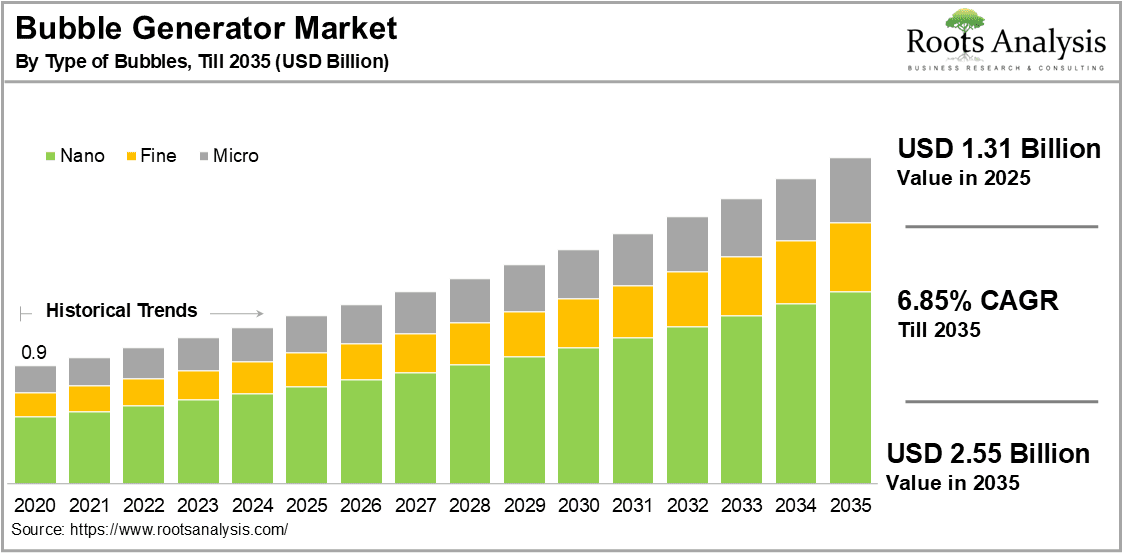 |
To learn more about this report, request a free sample copy
The new research study consists of bubble generator trends 2025 analysis, detailed growth forecast, and providing actionable strategic recommendations.
The bubble generator market encompasses equipment designed to create bubbles for a wide range of applications, including industrial processes, environmental management, and entertainment. These generators can produce various sizes of bubbles, from macro to nano, each serving distinct purposes such as enhancing gas solubility in liquids or improving water quality. This versatility makes bubble generators valuable in sectors like wastewater treatment, aquaculture, and food processing.
The market has witnessed significant growth in recent years, primarily driven by the increasing demand for bubble generators in water treatment solutions amid global water scarcity concerns. Additionally, the rising trend towards sustainable practices in agriculture and aquaculture has further propelled the adoption of bubble generators, as they play a crucial role in aeration and nutrient delivery. Advancements in bubble generator technology, particularly in the development of nano-bubble generators, have also contributed to this growth by offering enhanced performance and environmental benefits across diverse sectors.
Bubble Generator Market Share Insights
The bubble generator market report presents an in-depth analysis of the various companies that are involved in offering bubble generator solutions, across different segments, as defined in the table below:
Bubble Generator Market: Report Attributes / Market Segmentations
| Key Report Attributes | Details | |
| Historical Trend | Since 2020 | |
| Forecast Period | 2025-2035 | |
| Market Size Value in 2025 | $ 1.31 Billion | |
| Market Size Value by 2035 | $ 2.55 Billion | |
| CAGR (Till 2035) | 6.85% | |
| Type of Bubbles |
|
|
| Type of Technology |
|
|
| Type of End-Users |
|
|
| Company Size |
|
|
| Geographical Regions |
|
|
| Leading Market Players |
|
|
| PowerPoint Presentation (Complimentary) |
Available | |
| Customization Scope | 15% Free Customization | |
| Excel Data Packs (Complimentary) |
|
|
Bubble Generator Market Segmentation
Market Share by Type of Bubbles
Based on the types of bubbles, the global bubble generator market is split into fine, micro and nano. According to the bubble generator market forecast, the nano segment growth is expected to be the maximum, capturing a market share of 68.34% by 2035. This can be attributed to the unique properties of nano bubbles including high surface area-to-volume ratio, neutral buoyancy, and the ability to create high oxygen dissolution levels. Owing to these properties and enhanced cleaning abilities as well as energy efficiency, these bubbles are crucial for advanced applications, including semiconductor cleaning, medical sterilization and precision agriculture.
Furthermore, it is worth highlighting that the nano size segment is expected to witness the fastest CAGR of around 7.89% during the forecasted period. This growth can be attributed to their ability to provide greater solid and gas solubility due to their size, i.e. smaller than 100 micrometers. Along with this, fine bubbles have lower bubble rise velocity in liquids, making them more suitable for water treatments in different fields including applications of bubble generators in agriculture and aquaculture, industrial water and wastewater treatments and others.
Market Share by Type of Technology
Based on the types of technology, the global bubble generator market is split into diffused air systems, electrolytic generators, mechanical aerators, and ultrasonic generators. Among these categories, the ultrasonic generators segment share is expected to be the maximum, capturing a market share of 54.34% by 2035. This can be attributed to their ability to generate micro and nano-sized bubbles. Ultrasonic generators produce bubbles using high-frequency sound waves. Their ability to generate micro and nano-sized bubbles is pivotal in medical imaging, drug delivery, and industrial cleaning applications. Ultrasonic technology is witnessing growing demand due to its capacity for targeted applications and minimal environmental impact.
Market Share by Type of End-Users
The global bubble generator market is segmented into various types of end-users, such as agriculture & aquaculture, chemicals, food & beverage, mining & mineral processing, power generation, water & wastewater treatment. According to our global bubble generator industry analysis, the agriculture & aquaculture segment will augment the segment's growth with the largest market share of over 36.56% by the next decade. The market growth can be attributed to its increasing application of efficient technologies that allows for increased productivity and efficiency.
For the fish, in aquaculture, micro and nanobubble generators have a major application in enhancing water quality by increasing the level of oxygen that is good for fish health and growth and minimizes the rate of diseases. Similarly, in agriculture these generators enhance the quality of water and nutrients supplied to the root zone and dramatically enhance the production and vigor of the crop.
Market Share by Company Size
The global bubble generator market is fragmented into multiple types of enterprise namely large and small and medium enterprise. Currently, the large enterprise segment is anticipated to dominate the segment with 73.87% of the bubble generator market share. However, small and medium enterprise segments are expected to witness a relatively higher (10.28%) global bubble generator market growth rate until 2035. This is ascribable to their agility, innovation, focus on niche markets, and ability to adapt to changing customer preferences and market conditions.
Market Share by Geographical Regions
This segment highlights the distribution of market share of bubble generators by region, such as North America, Europe, Asia, Latin America, Middle East and North Africa, and the rest of the world. According to our regional analysis of bubble generator markets, Asia currently exhibits dominance with 37.69% of the overall market share. This growth is owed to the continuous investments and advancements in end-user sectors. Demand in this region for bubble generators is significantly driven by their use in agriculture & aquaculture sectors.
Bubble Generator Market Key Insights
The “Bubble Generator Market, Till-2035: Industry Trends and Global Forecasts” report features an extensive study of the current market landscape, market size and future opportunity within the bubble generator market, during the given forecast period. The market report highlights the efforts of several stakeholders involved in this rapidly emerging segment of the service providers industry. Key takeaways of the bubble generator market report are briefly discussed below.
Bubble Generator Market Drivers
According to bubble generator industry trends, the market is expected to be driven by the increasing demand for efficient water treatment solutions, spurred by global water scarcity issues and the need for sustainable practices in various industries, particularly agriculture and aquaculture. The rising awareness of environmental concerns has led to a shift towards eco-friendly technologies, which bubble generators provide through their ability to enhance aeration and improve water quality.
Additionally, advancements in technology, such as the development of nano-bubble generators, are gaining traction due to their effectiveness in dissolving gases and nutrients, further boosting their adoption in sectors like food and beverage processing. Moreover, ongoing infrastructure development in emerging markets presents significant opportunities for manufacturers to expand their reach.
Competitive Landscape of Bubble Generator Market
With the presence of several small and large bubble generator companies, the competitive landscape of the bubble generator market is experiencing intense competition and changing bubble generator market dynamics. From large multinational companies to local bubble generator players, companies are striving to enhance their competitive edge. In terms of market share, large enterprises and multinational companies are dominating the market. With the help of advancements in bubble generator solutions, small bubble generator market players are continuously improving their products to cater to niche markets, or they are offering specialized bubble generator solutions.
These industry players are focusing on adopting competitive strategies, such as developing innovative bubble generator solution techniques, forming strategic alliances and partnerships to expand their portfolios and global footprint, investing in recent developments and new feature launches to enhance their products offerings. For instance, in March 2024, the Moleaer launched Trinity Nanobubble Generator to revolutionize agriculture. In reference to this, Niels Schillinger, Business Development Manager at Moleaer stated that they were thrilled to introduce the Trinity Nanobubble Generator to the agricultural community. With its advanced technology and proven benefits, Trinity comes as a game changer for growers looking to improve sustainability and productivity in their operations.
Bubble Generator Market Challenges
Despite the strong market growth projection, there are several challenges and market dynamics affecting bubble generator adoption. The most common challenges in bubble generation technology are the high initial investment required for advanced bubble generation technologies, which can deter potential buyers, especially in developing regions where budgets are constrained. Additionally, the maintenance and operational costs associated with these systems can be significant, leading to concerns about long-term profitability for users.
There is also a need for specialized knowledge and training to operate and maintain bubble generators effectively, which can limit adoption in some sectors. Furthermore, competition from alternative technologies and methods for aeration and innovations in gas dissolution methods poses a threat to market expansion. Lastly, regulatory hurdles and varying standards across different regions may complicate market entry and compliance for manufacturers, impacting their ability to scale operations effectively.
Regional Analysis: Asia is Expected to Dominate the Market with the Largest Bubble Generator Market Share
With respect to regional bubble generator industry insights, Asia is likely to dominate the market for the forecasted period. The dominance of this region is majorly driven by China, Japan, and India, as these countries are rapidly adopting bubble generator in newer applications. Along with this, the rapid industrialization in this region is also expected to drive the bubble generators market in the upcoming years.
Leading Bubble Generator Companies
Examples leading companies in the bubble generator market (which have also been captured in this market report, arranged in alphabetical order) include Acniti, Agrona, All-Pumps, AquaB Nanobubble Innovations, Canadian Pond, Energenius Technologies, Fine Bubble Technologies, Gasion Airtec, KAESER KOMPRESSOREN, Kasco Marine, Kinboshi, Moleaer, NanobOx, NanoKriti, nice Neotech Medical Systems, Nikuni, NITTA, OxiGenesis, OxyDoser, Ozone India, Pacific Water, PENTAIR PLC, Pure Water Enterprises, Qingdao Ozonier Purification Equipment, Rapid Water Technologies, Shandong Sundon Technology, Shanghai Edon Mechanical & Electrical Equipment, Shanghai Mutao Environmental Technology, Solari Water, SSI Aeration, Sulzer, taisei kogyo, TOFLE, Trident Bubble Technologies, Velim Ecological Solutions, VIETNAM MANAGEMENT & DEVELOPMENT, Xylem.
Recent Developments in Bubble Generator Market
- In September 2024, Innovative nanobubble aquaponics pilot at De Grendel School pioneered sustainable agriculture advancements.
- In June 2024, Moleaer and Griffin partnered to enhance efficiency and sustainability in greenhouse operations.
- In April 2024, the Water bubble generator for Houdini transformed simulation with innovative features and upgrades.
Bubble Generator Market Report Coverage
The market report presents an in-depth analysis, highlighting the capabilities of various companies engaged in this domain, across different segments. Amongst other elements, the market report includes:
- A preface providing an introduction to the full report, bubble generator market, 2020-2024 (Historical Trends) and till-2035 (Forecasted Estimates).
- An outline of the systematic research methodology adopted to conduct the study on the bubble generator market, providing insights on the various assumptions, methodologies, and quality control measures employed to ensure the accuracy and reliability of our findings.
- An overview of economic factors that impact the overall bubble generator market, including historical trends, currency fluctuation, foreign exchange impact, recession, and inflation measurement.
- An executive summary of the insights captured during our research. It offers a high-level view of the current state of the bubble generator market and its likely evolution in the mid-long term.
- A detailed assessment of the bubble generator market landscape, based on several relevant parameters, including year of experience, company size, location of headquarters, and ownership structure.
- Elaborate profiles of prominent players engaged in the bubble generator market, featuring information on their year of establishment, location of headquarters, company size, company mission, company footprint, management team, contact details, financial information, operating business segments, bubble generator portfolio, moat analysis, recent developments, and an informed future outlook.
- A qualitative assessment of the various megatrends ongoing in the integration with sustainable water treatment, agriculture & aquaculture applications and technological advancements.
- An analysis highlighting the key unmet needs across bubble generator industry, featuring bubble generator market research insights generated from real-time data on unmet needs as identified from social media posts, recent publications, industry blogs and the views of key opinion leaders expressed on online platforms.
- An in-depth analysis of various patents that have been filed / granted related to bubble generator and its components, based on various parameters, such as type of patent, patent publication year, patent age and leading players
- A detailed analysis of recent developments in the bubble generator domain, based on relevant parameters such as year of initiative, type of initiative (partnerships and collaborations, expansions, funding and product launches), geographical distribution and most active players (in terms of number of recent developments).
- Key winning strategies framework that helps in analyzing the level of competition within an industry, by tracing the key market activities including partnership, funding, expansion of leading players
- A qualitative analysis, highlighting the five competitive forces prevalent in bubble generator industry, including threats for new entrants, bargaining power of suppliers, bargaining power of customers, threats of substitution and rivalry among existing competitors.
- A discussion on affiliated global bubble generator market trends, key drivers and challenges, under a SWOT framework, which are likely to impact the industry’s evolution, along with a Harvey ball analysis, highlighting the relative effect of each SWOT parameter on the overall bubble generator market.
- A value chain analysis featuring a discussion on various stakeholders involved in the development of the bubble generator market, from suppliers to end-users.
- A detailed estimate of the current market size and the future growth potential of the bubble generator market over the next decade. Based on multiple parameters we have provided an informed estimate on the market evolution during the forecast period 2025-2035. The report also features the likely distribution of the current and forecasted opportunity within the bubble generator market. Further, in order to account for future uncertainties and to add robustness to our model, we have provided three forecast scenarios, namely conservative, base, and optimistic scenarios, representing different tracks of the industry’s growth.
- Detailed projections of the current and future market across various types of bubbles such as fine, micro and nano.
- Detailed projections of the current and future market across various types of technology such as diffused air systems, electrolytic generators, mechanical aerators, and ultrasonic generators.
- Detailed projections of the current and future market across various types of end-users such as agriculture & aquaculture, chemicals, food & beverage, mining & mineral processing, power generation, water & wastewater treatment.
- Detailed projections of the current and future bubble generator market across various geographical regions, such as North America (US, Canada, Mexico and other North American countries), Europe (Austria, Belgium, Denmark, France, Germany, Ireland, Italy, Netherlands, Norway, Russia, Spain, Sweden, Switzerland, UK and other European countries), Asia (China, India, Japan, Singapore, South Korea and other Asian countries), Middle East and North Africa (Egypt, Iran, Iraq, Israel, Kuwait, Saudi Arabia, UAE and other MENA countries), Latin America (Brazil, Chile, Colombia, Venezuela and other Latin American countries) and rest of the world (Australia, New Zealand and other countries).
Author: Ronit Sharma and Anmol Bali
customization opportunities
At Roots Analysis, we genuinely care about your success and understand that your business requirements are unique. While our bubble generator research reports provide valuable insights, we recognize that they might not cover every aspect you need to make well-informed strategic decisions. To account for that, we offer 15% free report customization tailored to your specific needs. Whether you require additional quantitative analysis, qualitative insights, or any other information related to the bubble generator market, reach out us today at: support@rootsanalysis.com