


 Download Free Sample
 Buy Now
Market Outlook
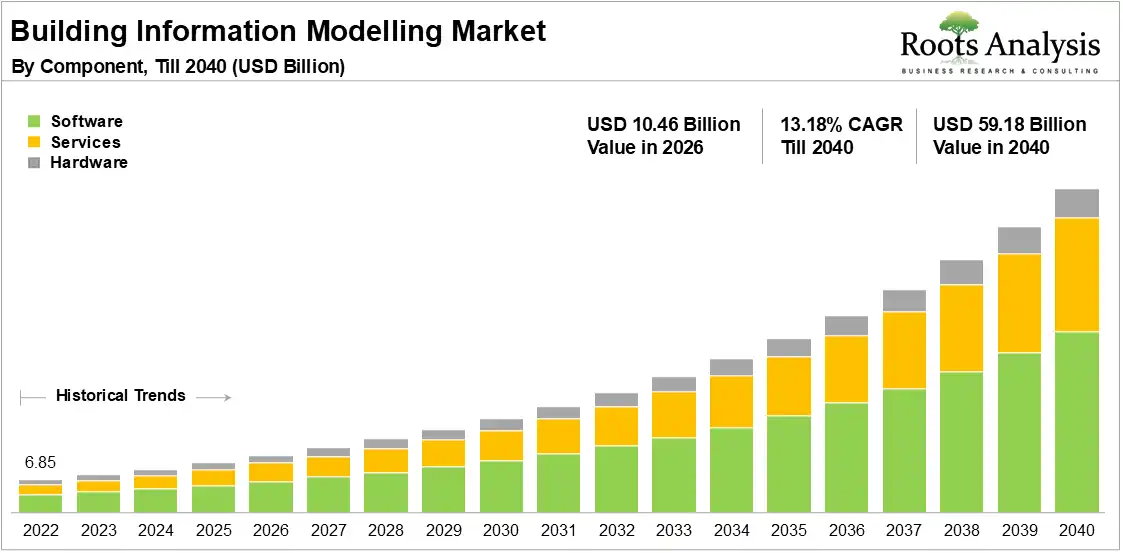
The building information modelling market, valued at USD 8.55 billion in 2025, is projected to reach USD 10.46 billion in 2026 and USD 59.18 billion by 2040, representing a 13.18% CAGR during the forecast period 2026 to 2040.
See What’s in the Full Report – Request Your Complimentary Insights!
Building information modelling (BIM) encompasses digital representations of physical and functional characteristics of buildings and infrastructure. It includes software tools, hardware integrations, and consulting services that enable collaborative design, construction, and management processes. Value is created through enhanced data sharing across project lifecycles, to integrate project delivery models, from initial planning to ongoing operations, primarily in architecture, engineering, construction, and real estate sectors.
The market gains traction due to rising demands for cost efficiency, reduced errors, and streamlined collaboration in complex projects. Key drivers include the need for integrated workflows amid labor shortages and supply chain pressures, with major applications in residential, commercial, and public infrastructure developments. End-use industries such as transportation and energy benefit from BIM’s ability to simulate scenarios and optimize resources. In recent years, Autodesk has been continuously updating its cloud-based BIM 360 platform, evolving it into the broader Autodesk Construction Cloud (ACC), which integrates familiar BIM 360 features like Document Management (Docs) and Design Collaboration with new tools for field management, takeoff, and AI-driven risk analysis, creating a unified environment for project teams to manage data and workflows from design to operations.
Innovations like artificial intelligence AI-driven clash detection and cloud-native platforms are reshaping the industry, emphasizing interoperability and lifecycle sustainability. Regulatory pushes for digital twins in public tenders further accelerate adoption, enhancing energy efficiency and waste reduction. For instance, upcoming EU mandates will require BIM for major infrastructure by 2026. Overall, the market continues to evolve, supporting strategic advancements in project portfolio management and asset management.
Key Takeaways
- Leading Players Competitive Footprint: Dominant players like ACCA Software, Asite, Autodesk, AVEVA, Bentley, Covet, Dassault Systemes, Hexagon, Nemetschek Group, Procore and Trimble hold strong market positions with extensive geographic presence in various regions.
- Startup Ecosystem and Innovation Hotspots: Early-stage companies are focusing on catering to the increasing demand for 4D scheduling and 5D cost estimation. Companies are making advancements in areas, such as AI-powered construction and scheduling, cloud security for automated building engineering.
- Regional Penetration and Adoption Trend: Rapid urbanization, rising number of infrastructure projects, and expanding applications across various end-use sectors is leading the regional growth of information modelling in Asia-Pacific. Notably, China and India hold dominating position in Asia-Pacific due to government mandates and sustainable practices; further, these countries are expected to witness the highest compounded annual growth rate (CAGR) during the forecast period.
- Opportunities and Unmet Market Needs: Building information modelling market analysis report suggests that innovative software in this market lead digital transformation, alongside expansion in emerging sectors like AI integration, cloud migration services, and advanced features like clash detection and real time collaboration.
- Funding and Investment Momentum: The building information modelling industry sees steady investment from venture capitalists, private equity firms, and government grants, largely directed towards sustainable product innovation.
Recent Industry Developments
- June 2025: GM to invest $4 Billion into US manufacturing plants to increase the production for electric vehicles. This has created job opportunities and meet the demand for customers choice to innovate the brand range of designs in vehicles that can gain public attention and bring growth.
- January 2025: BCF and BIM has undergone collaboration to understand the challenges in management; this will essentially improve coordination and communication among stakeholders involved in the project team.
Pay Only for What You Need – The Best Way to Optimize
Market Dynamics
Key Market Drivers
- Rising Demand for Efficient Construction: The increasing demand for construction and more complex post-pandemic growth of cloud-based BIM in commercial real estate projects. As BIM platforms allow teams to design, build, and manage other operations faster with fewer mistakes.
- Government Mandates Speeding Adoption: Global BIM industry forecast 2026-2040 states that countries like UK and US require BIM for public projects, pushing firms to use it to win contracts and stay compliant. Government supporting these initiatives for adoption and driving need for building information.
- Boom in Smart Building Tech: BIM market surges as scan-to-BIM, reality capture, IoT, and AI integration enables energy-efficient connected structures, cutting operational costs 20-30% through cloud adoption and sustainability mandates.
Market Restraints
- High Upfront Software Costs: Implementing BIM 6D tools for Net-Zero Building Compliance requires investments for software licenses, and hardware upgrades that can cost small firms $50,000 high upfront. Cost benefit analysis shows lifecycle savings through energy modelling and facility management for the slowing adoption among SMEs.
- Data Security Concerns: The government mandates impact on BIM market growth as storing detailed building plans in the cloud raises cyber risks, especially for sensitive and commercial projects.
- Limited Skilled Talent Pool: There are limited building information modelling experts available, making it hard for companies to hire and scale up quickly.
Impact of AI and Machine Learning on BIM Software Market Evolution
AI and machine learning are revolutionizing the building information modelling software market by automating workflows, enhancing predictive capabilities, and enabling smarter decision-making across project lifecycles. AI enables automation of repetitive tasks like clash detection and risk mitigation software, quantity takeoffs and reducing manual effort through cutting rework costs by real time error identification.
In machine learning, historical data is analyzed and IoT inputs are optimized to use resources and reduce risk boosting productive design and construction phases. ML driven analytics stimulate outcomes, support generative design and create digital twin for AR/VR visualization improving accuracy with sustainability mandates.
Market Share Insights
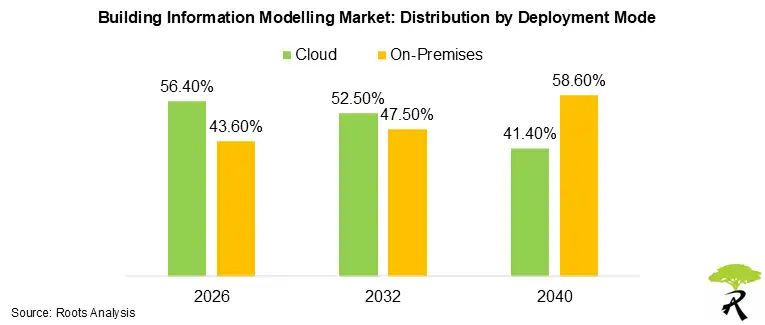
Market Share by Deployment Mode: On-Premises Hold the Largest Market Share
- On-premises deployment commands the largest BIM market share at 60.20% in 2025, driven by its unmatched security in sensitive environments favored by large enterprises and defense contractors. Superior data control ensures regulatory compliance while extensive customization and high performance integrate seamlessly with established AEC workflows, even in low-connectivity regions.
- Rising BIM lifecycle demands across pre-construction, construction, and operations, coupled with environmental regulations and multidisciplinary coordination needs, fuel sustained growth through proven ROI in cost control and efficiency.
Market Share by Geographical Regions: Asia-Pacific to Dominate the Industry Through 2040
- The regional analysis suggests that Asia-Pacific holds the largest building information modelling market share of 39% and is also expected to witness the fastest CAGR. This is due to its rapid urbanization and expanding production base in countries, such as China and India with rapidly growing bases of data exchange for facility management.
- n Asia-Pacific region, countries such as Japan and Singapore mandate BIM for public projects like smart cities and transport network accelerating adoptions via sustainable manufacturing, which necessitate the need for digital construction push.
- Various sectors (commercial, infrastructure and residential) benefit by integrating BIM with AI and cloud to sustain goals, further indicating Asia-Pacific’s dominance in the building information modelling market.
Want Information on Specific Region / Segment?
Market Ecosystem Insights
Leading Players Competitive Footprint
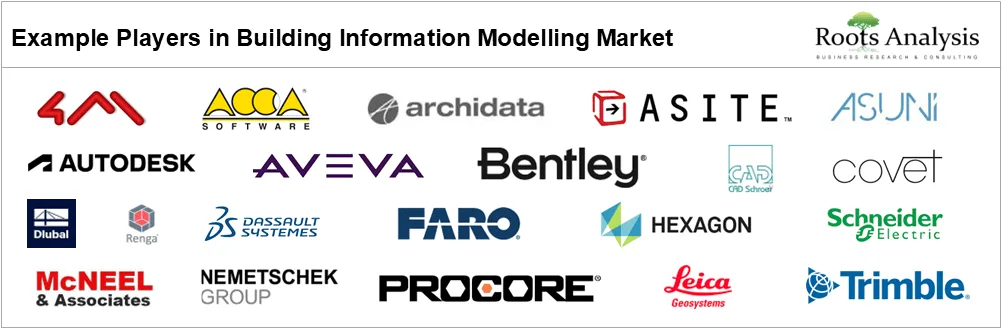
Leading players in the building information modelling domain include industry giants such as ACCA Software, Asite, Autodesk, AVEVA, Bentley, Covet, Dassault Systemes, Hexagon, Nemetschek Group, Procore and Trimble which hold strong market positions through their extensive product portfolios and global reach in various regions.
Collaborations and expansions remain key growth strategies, with players like “Autodesk and Adani Group announced strategic partnership to deploy construction cloud, and BIM advisory services across infrastructure projects”.
Startup Activity and Innovation Hotspots
The startup activity within the building information modelling domain is rapidly evolving with early-stage companies pioneering disruptive applications, primarily focused on sustainable building information modelling. Innovators are launching functionalized AI powered construction scheduling platforms, focusing on real time source monitoring, and monitoring team coordination.
Wolken Vision recently launched one-click AI point cloud processing in their Scan2BIM toolkit for automated building reverse engineering. Most of the innovations and new launches have taken place in European region as (Switzerland and Finland) due to growing urbanization and need for BIM Market Forecast for Smart City Infrastructure Projects in APAC.
Besides the above ongoing advancements, startups are also leveraging AI automation for practicing customization in building information modelling for specialty applications and enhancing production efficiency. In Asia-Pacific, an AI-powered business planning platform, is expanding rapidly driven by innovation in AI and dynamic modelling. Meanwhile, in Europe, regions like Germany and Austria see strong adoption of AI-driven solutions in planning and modelling designs for building information.
Funding and Investment Momentum
The building information modelling market has seen robust funding and investment momentum. Investment flows primarily come from venture capitalists, private equity firms, and government grants which not only focus on channelizing enhanced AI software, cloud platforms and startups addressing projected towards market expansion.
These funds cater to the expanding demand for technological convergence, sustainable mandates and infrastructure booms. Key investors include companies, such as Bentley Systems and Cesium, which invest heavily in 3D geospatial integration in digital twins.
In addition, government initiatives and grants predominantly support sustainability-focused innovations by companies in Asia Pacific and Europe to reduce environmental footprints and comply with stricter regulations. For instance, ESG-focused on BIM for green certifications drives $800M in green bonds and impact funds, emphasizing lifecycle carbon tracking.
Have Questions? Let’s Get Them Answered.
Building Information Modelling Market: Scope of the Report
| Key Report Attributes | Details | |
| Historical Trend | Since 2022 | |
| Forecast Period | Till 2040 | |
| Market Size 2026 | $ 10.46 Billion | |
| Market Size 2040 | $ 59.18 Billion | |
| CAGR (Till 2040) | 13.18% | |
| Segments Covered |
|
|
Market Segmentation
Based on research, we have segmented the building information modelling market into component, deployment mode, project lifecycle, type of building and infrastructure vertical, application, end user, geographical regions, and key players.
Market Share by Component
- Hardware
- Services
- Software
Market Share by Deployment Mode
- Cloud
- On-Premises
Market Share by Project Lifecycle
- Construction
- Operation and Maintenance
- Pre-construction
Market Share by Type of Building and Infrastructure Vertical
- Buildings
- Commercial
- Industrial
- Residential
- Civil Infrastructure
- Other Verticals
Market Share by Application
- Asset Management
- Building System Analysis & Maintenance Scheduling
- Construction & Design
- Planning & Modelling
Market Share by End User
- Academic Institutes
- AEC Professionals
- Government
Market Share by Geographical Regions
- North America
- US
- Canada
- Mexico
- Rest of North America
- Europe
- Austria
- Belgium
- Denmark
- France
- Germany
- Ireland
- Italy
- Netherlands
- Norway
- Russia
- Spain
- Sweden
- Switzerland
- UK
- Rest of Europe
- Asia-Pacific
- Australia
- China
- India
- Japan
- New Zealand
- Singapore
- South Korea
- Rest of Asia-Pacific
- Latin America
- Brazil
- Chile
- Colombia
- Venezuela
- Rest of Latin America
- Middle East and Africa (MEA)
- Egypt
- Iran
- Iraq
- Israel
- Kuwait
- Saudi Arabia
- UAE
- Rest of MEA


