


 Download Free Sample
 Buy Now
Carbon Footprint Management Market Size Overview
The global carbon footprint management market, valued at USD 15 billion in 2026, is expected to reach USD 26 billion in 2030 and USD 56 billion by 2035, representing a higher CAGR of 15.54% during the forecast period.

See What’s in the Full Report – Request Your Complimentary Insights!
A carbon footprint measures the total greenhouse gas emissions produced by an organization, activity, or product, expressed as carbon dioxide equivalent (CO2e). It is released into the atmosphere either directly or indirectly through various activities, processes, or products. These emissions originate from diverse sources, including energy consumption, manufacturing processes, transportation networks, and waste management strategies.
Carbon footprint management involves measuring, reducing, and compensating carbon emissions to reduce their environmental impact. It is a structured approach that engages all stakeholders, particularly businesses, in mitigating climate change. This approach encompasses different strategies, including assessing companies' carbon footprint, reducing emissions at the source, and supporting carbon offsetting initiatives.
Carbon footprint management has gained significant traction in recent years to become an essential part of environmental sustainability efforts. As a result, government bodies across the world are adopting climate change mitigation strategies to meet the net zero goals.
From an economic perspective, businesses are also adopting strong carbon management practices, owing to the associated benefits, such as cost savings through enhanced energy efficiency and waste reduction. Overall, these factors are collectively projected to drive the market growth significantly during this forecast period.
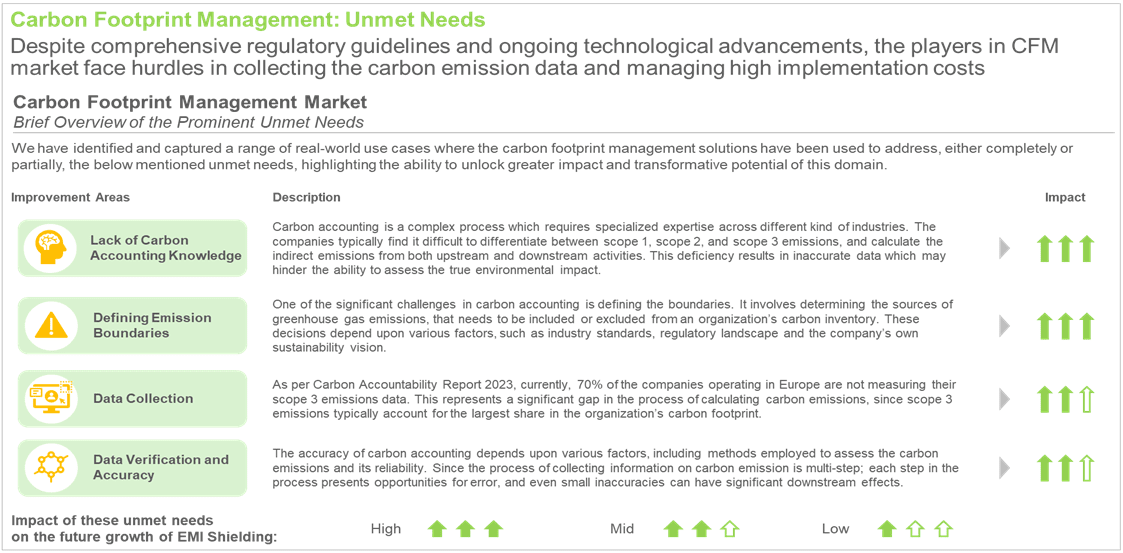
In efforts to mitigate the existing unmet needs and to further fuel the carbon offset market growth, companies are actively developing advanced carbon footprint reduction solutions and carbon reporting tools that provide real-time emission tracking, predictive analytics, and automated reporting. These efforts empower businesses across diverse industries to accurately monitor and effectively reduce their environmental impact.
Carbon Footprint Management Market: Report Attributes
| Key Report Attribute | Details | |
| Historical Trend | Since 2022 | |
| Forecast Period | Till 2035 | |
| Market Size 2026 | $ 15 Billion | |
| Market Size 2035 | $ 56 Billion | |
| CAGR (Till 2035) | 15.23% | |
The market analysis also features the likely distribution of the current and forecasted opportunity within the carbon footprint management industry across various segments, such as type of offering, deployment mode, type of enterprise, end-use industry and geographical regions.
We have created three global carbon footprint management market forecast scenarios, namely conservative, base and optimistic, to account for future uncertainties in key parameters and enhance the robustness of our model. These scenarios represent different tracks of the industry's evolution.
Get an Instant Quote in 10 Minutes. Lowest Price Guaranteed
Recent Developments in Global Carbon Footprint Management Market
Several recent developments in the field of carbon footprint management have occurred, and we outline some of these below. These developments, even if they arose after our market report’s release, support the overall global carbon footprint management market trends detailed in our analysis.
- January 2026: Mondra launched Base Year Recalculation, an AI-powered capability for measuring and validating carbon footprint reductions driven by product and supply chain changes.
- January 2026: TruCarbon officially launched TruCount, a digital carbon accounting platform designed to help companies measure, verify, and manage greenhouse gas emissions across Scopes 1, 2, and 3.
- January 2026: ICC and Carbon Measures announced the first cohort of experts for their Technical Expert Panel on Carbon Accounting to define the principles and scope of a ledger-based carbon emissions accounting system.
Carbon Footprint Management Market Segmentation Insights
The market research report presents an in-depth analysis of the various carbon footprint management software / service providers, across different segments, as defined in the table below:
Carbon Footprint Management Market: Market Segmentations
| Market Segmentations | Details | |
| Type of Offering |
|
|
| Deployment Mode |
|
|
| Type of Enterprise |
|
|
| End Use Industry |
|
|
| Geographical Regions |
|
|
| Market in North America |
|
|
| Market in Europe |
|
|
| Market in Asia-Pacific |
|
|
| Market in Middle East and Africa |
|
|
| Market in Latin America |
|
|
Driven by the rising environmental awareness, stringent regulations and the increasing adoption of carbon management solutions by organizations across various sectors, the global market for carbon footprint management is likely to witness remarkable growth in the coming years.
Have Questions? Let’s Get Them Answered
Carbon Footprint Management Market Share Insights
Market Share by Type of Offering: Software Sub-Segment Holds the Largest Share
- This segment explores the types of offerings, such as software and services, across the global carbon footprint management market. In 2026, software (~60%) sub-segment dominates the market.
- According to our projections, the service sub-segment is likely to grow at a relatively higher pace (CAGR of 15.7%) during the forecast period. The soaring need for consulting training and implementation support can be attributed to this segment's growth.
Market Share by Deployment Mode: Cloud-based Deployment Mode Holds the Largest Share
- In this segment, we examine the global carbon footprint management market by deployment mode, such as cloud-based and on-premises. According to our projections, in 2026, the cloud-based sub-segment (~75%) dominates the market. Moreover, the cloud-based segment is expected to grow at a higher CAGR during the forecast period.
- The rise in the adoption of cloud-based carbon footprint management software and services is a key factor in this growth. These solutions provide secure and cost-effective carbon emissions tracking software and tools. In addition, their flexibility, scalability, and ease of deployment contribute to the market development.
Market Share by Type of Enterprise: Large Companies Hold the Largest Share
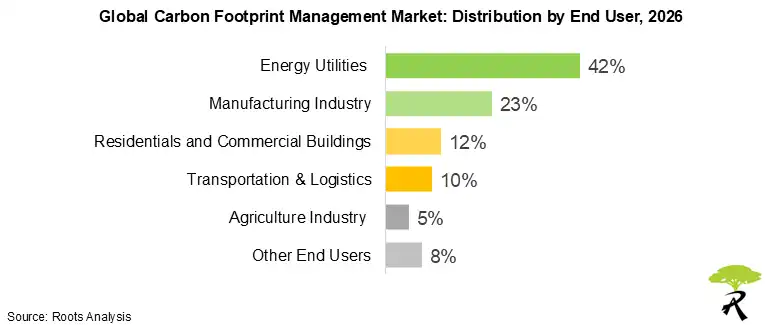
- In this segment, we have segregated the global carbon footprint management market into small companies, mid-sized companies and large companies. In 2026, the large companies sub-segment dominates the market with >70% share.
- According to our projections, the small companies’ sub-segment is likely to grow at a higher CAGR during the forecast period. This growth can be attributed to rising regulatory pressures and demand for sustainable supply chains. These factors make it easier and more beneficial for small firms to adopt emissions tracking and reduction strategies.
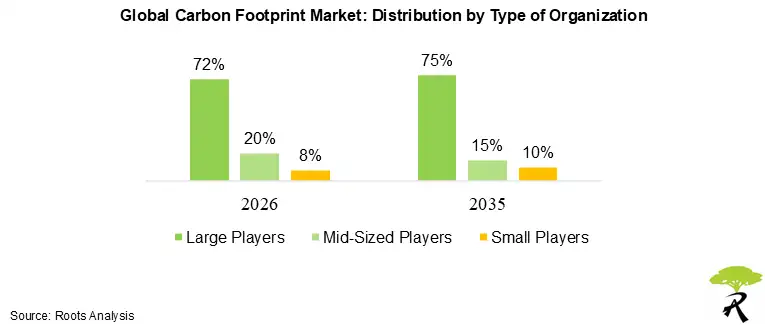
Market Share by End Use Industry: Energy Utilities is the Most Prominent End Use Industry
- There are various sub-segments of the global carbon footprint management market based on end use industry, which include energy utilities, manufacturing industry, residential and commercial buildings, transportation and logistics, agriculture industry and other industries. According to our projections, in 2026, energy utilities sub-segment holds the highest market share (41%).
- It is important to highlight that transportation and logistics sub-segment will continue to grow at a higher CAGR during the forecast period, due to growing electrification and adoption of advanced technologies, such as IoT and AI-enabled software (to improve operational efficiency) across different end use industries.
Market Share by Geographical Regions: Regional Analysis of Global Carbon footprint Management Market
- This segment highlights the distribution of global carbon footprint management market across various geographies, such as North America, Europe, Asia-Pacific, Latin America, and Middle East and Africa. According to our projections, Europe is likely to capture the majority (~40%) of the market share in 2026, and this trend is unlikely to change in the future.
- It is worth highlighting that the market in North America is likely to grow at a relatively high CAGR, during the forecast period. This can be attributed to the presence of prominent companies and their strong partnership with companies to support sustainability goals reinforce the region’s dominance in the global marketplace.
Want Information on Specific Region/Segment?
Carbon Footprint Management Market: Report Deliverables
| Report Deliverables | Details | |
| Excel Data Packs (Complimentary) |
|
|
| Carbon Footprint Management Companies Profiled | (Full list of companies captured is available in the report) | |
| PowerPoint Presentation (Complimentary) | Available | |
| Customization Scope | 15% Free Customization | |
Carbon Footprint Management Industry Market Key Takeaways
Competitive Landscape and Key Players in Carbon Footprint Management Market
The current market landscape features the presence of several small and large carbon footprint management companies. These companies have the required expertise to provide carbon footprint management solutions and services, across different geographical regions.
It is worth noting that more than 45% of the companies offer cloud-based carbon footprint management solutions while 4% of the companies offer on-premises services; examples of companies offering cloud-based carbon footprint management solutions include (in alphabetical order) AiDASH, Carbon Footprint, Cority, Diligent and Envirosoft.
The small carbon footprint management players are continuously improving their offerings to cater to niche markets and fulfill the untapped market opportunities across various business sectors. Notable examples of small players include (in alphabetical order) Carbon Analytics, Carbon Footprint, Carbon Upcycling Technologies, Envirosoft, ESP and Green Sutra.
Market Size Analysis: What is the Opportunity for Carbon Footprint Management?
The global carbon footprint market size is likely to be worth USD 15 billion in 2026 and will reach USD 56 billion by 2035. In terms of the type of end-use industry, energy utilities segment captures the highest market share.
The growing focus on AI integration for carbon tracking as well as demand for carbon accounting services are the significant carbon footprint management trends that are expected to significantly drive the growth of this market.
Current Market Valuations for Carbon Footprint Management in Key Regions
Europe to Lead the Market with the Largest Carbon Footprint Management Market Share
Europe is likely to dominate the global carbon footprint management market in 2035, capturing more than 40% of the overall revenue share. This growth is due to the rapid industrialization and urbanization in the region that has surged the carbon emission in the region.
As a result, the European Union has implemented stringent environment policies, such as reducing greenhouse gas emissions by 55% till 2030 and achieving net-zero emissions by 2050. Further, they have also launched emission trading systems to cover about 40% of the EU greenhouse gas emissions, obliging companies to hold permits for every ton of CO2 emitted. All of this drives widespread deployment and high market share of carbon footprint management solutions in this region.
North America: An Emerging Growth Spot
The market in North America is likely to grow at a relatively high CAGR (15.6%), till 2035. This is a result of the fact that the North American government has imposed several stringent regulatory compliance checks for emissions, such as the Affordable Clean Energy (ACE) Rule in the US.
This incentivizes companies to invest in carbon management solutions to ensure compliance, thereby, leading companies to seek solutions to reduce their environmental impact, driving the market growth. Also, the rising trend of corporate commitment to net zero targets has fueled the demand for sustainability consulting and advanced reporting solutions.
Rising Patent Activity Related to Carbon Footprint Management
In the past few years, nearly 430 patents have been filed / granted, demonstrating substantial efforts of researchers in this domain. Notably, the majority of the patents in this domain include patent applications (93%), followed by granted patents. Further, majority (38%) of the patents have been filed by players in North America. Interestingly, both industry and non-industry players are equally active in patent filing in this domain.
What are the Key Drivers of Carbon Footprint Management Industry Market?
One of the major key drivers propelling global carbon footprint management market growth is the rising government initiatives to reduce carbon emissions. These include the carbon credit trading scheme (CCTS), designed to reduce greenhouse gas (GHG) emissions by pricing carbon.
The increasing emphasis on net-zero commitments across several industries has also spiked the demand for innovative technology in carbon footprint tracking to meet internal goals and external pressure from investors. Further, the rising importance of environmental, social, and governance (ESG) criteria is remarkably contributing to market development as investors are prioritizing companies with strong environmental performance.

In essence, companies are increasingly adopting environmental impact assessment tools and solutions to meet ESG reporting standards, supporting market progress. Moreover, soaring consumer demand for sustainable practices, demand for energy consumption across industries, and technological advancements in renewable energy, carbon tracking and reporting are expected to enlarge the market outlook in the upcoming years.
Your Business is Unique-Why Shouldn’t Your Report Be?


