


 Download Free Sample
 Buy Now
Market Size
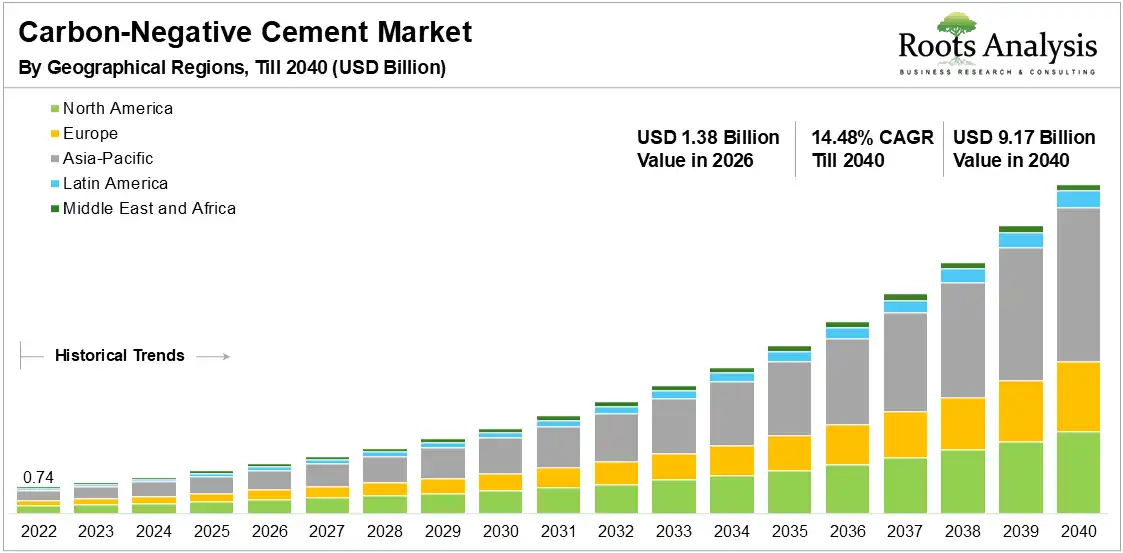
The global carbon-negative cement market is projected to reach USD 1.38 billion in 2026 and USD 9.17 billion by 2040, representing a CAGR of 14.48% during the forecast period 2026 to 2040.
See What’s in the Full Report – Request Your Complimentary Insights!
Market Overview
The global construction industry is undergoing a fundamental shift as its reliance on carbon-heavy advanced materials meets the urgency of 2030 and 2050 net-zero mandates. Driven by intensifying regulations on embodied carbon, the sector is moving toward a more sustainable future. At the center of this recalibration is the cement industry, which historically accounts for approximately 7% to 8% of total global CO2 emissions. Consequently, the emergence of the carbon-negative cement market represents a critical paradigm shift; a transition toward advanced materials designed to function as active carbon sinks rather than atmospheric carbon sources.
Beyond traditional low-carbon methods, this evolution includes advanced technologies such as mineral carbonation and alternative binders like industrial byproducts or magnesium-based materials. These high-performance materials are increasingly prioritized in infrastructure and commercial projects where reducing embodied carbon is a primary requirement. This demand is further supported by real estate developers and Fortune 500 enterprises aligning with green building standards and corporate sustainability goals.
Market growth is fueled by rising public and private investment in green infrastructure and a move toward performance-based procurement. Current innovation focuses on scaling mineral carbonation and non-clinker binders to reduce energy intensity and lower the cost of early-stage technologies. Further, the industry's trajectory is defined by strategic partnerships between tech innovators and established producers to integrate these solutions into existing supply chains. With several large-scale demonstration projects nearing full commercialization, the carbon-negative cement market is positioned for steady, long-term growth.
Market Report: Key Takeaways
- Leading Players in the Carbon-Negative Cement Industry: Leading companies, such as Heidelberg Materials, Forterra, and Partanna are increasingly undertaking strategic initiatives and investing heavily in the market. For instance, Pegasus Capital Advisors is planning to invest up to $20 million in climate tech company Partanna to advance CO2-negative building materials and coastal protection solutions.
- Corporate ESG Investment Capital Mobilization: Climate innovation funds (such as Microsoft CIF, Breakthrough Energy Ventures, and Energy Transition Fund) collectively deploy approximately USD 10-15 billion annually into climate technology, with about 8-12% (USD 800 million to USD 1.8 billion) allocated to cement decarbonization initiatives. Unlike traditional Venture Capital (VC), strategic investments provide off-take agreements and market validation, reducing demand risk for startups.
- Fundings and Investments Rollouts: Market players are investing heavily in this market. For instance, in June 2025, Carbon Upcycling Technologies secured USD 18 million in a funding round led by Builders Vision to support its carbon capture and utilization project at Ash Grove Mississauga cement plant and with Titan Group at two facilities.
- Construction Firms are Leading the Industry: Construction accounts for the highest share (38%) of the market. The growing consumption of cement and rising adoption of green cement in commercial and residential construction are the key drivers for the market growth of this segment.
Recent Industry Developments
- December 2025: Vattenfall signed a commercial agreement with Cemvision for the supply of near-zero-carbon cement to be used in energy infrastructure projects across Europe. Moreover, Cemvision is also raising investment for full-scale plants in Northern Europe with 500,000 metric ton annual capacity and its first industrial-scale production plant is scheduled to begin in 2028.
- November 2025: Ecocem Material Science Advisory Council announced the establishment of Materials Science Advisory Council. It comprises of eleven of the world's foremost materials scientists to support development and adoption of low-carbon cement solutions globally. Moreover, Ecocem has also made an investment of over €70 million in research and development activities to meet the goal of global cement decarbonization by 2040.
- September 2025: Microsoft invested in Fortera (a green cement manufacturer) through its Climate Innovation Fund (CIF), securing rights to procure Fortera's ReAct low-carbon cement and environmental attribute certificates.
Get an Instant Quote in 10 Minutes. Lowest Price Guaranteed
Market Dynamics
Key Market Drivers
- Stricter EU CBAM Tariffs on High-Carbon Imports: The EU's Carbon Border Adjustment Mechanism, effective from 2026, imposes escalating charges on cement with embedded emissions above benchmarks. The impact of government regulations on low-carbon cement adoption rate and high tariffs on high-carbon imports are pressuring importers and giving carbon-negative variants a cost edge in Europe.
- Supply Chain Bottleneck Arbitrage: Supply of supplementary cementitious materials declining 5-8% CAGR in developed markets due to the retiring of coal-fired power plants. This supply chain bottleneck creates value for alternative binders and carbon capture utilization (CCU) in construction sector. Companies controlling fly ash supply (power utilities, steelmakers in partnership models) or offering SCM replacements (geopolymer, calcined clay) gain competitive moats
- Corporate Net-Zero Pledges in Construction Supply Chains: Major builders and developers are prioritizing embodied carbon reductions and CO2 mineralization in concrete production to meet 2030 net-zero targets. These initiatives for net-zero pledges are driving demand for carbon-negative cement in large infrastructure projects, as seen with sold-out low-carbon capacity from producers like Heidelberg Materials.
- Biogenic Sequestration Tech Scaling via R&D Investments: By leveraging biological mineralization and industrial upcycling, firms like Biomason and Blue Planet have transitioned from lab-scale prototypes to commercial pilots in 2025-2026, proving that cement can evolve from a primary carbon emitter into a permanent carbon sink.
- Expansion of Blended Cements with Low-Clinker Content: US imports of low-clinker blends rose to 60% by 2025. This initiative is signaling a value chain shift toward carbon-negative options as producers integrate carbon utilization to meet regulatory benchmarks.
Market Restraints
- 20-30% Premium Over Traditional Portland Cement Pricing: Higher costs from innovative binders like geopolymers limit uptake in price-sensitive markets, specifically where builders prioritize budgets over sustainability despite long-term savings potential.
- Nascent Supply Chain for Biogenic and Waste Feedstocks: Reliance on inconsistent industrial waste and natural materials creates scalability hurdles, as current production lags behind the 4.2 billion tons annual global cement demand.
- Fragmented Market with No Dominant Scale Players: Emerging firms like CarbonBuilt compete without the production muscle of incumbents, slowing industrial-scale rollout amid traditional cement’s USD 475 billion dominance.
Market Share Insights
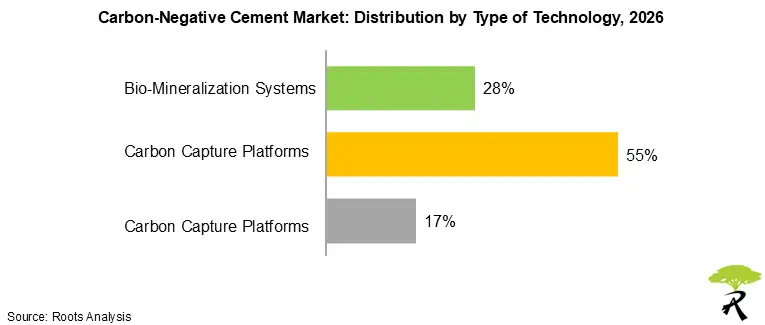
Market Share by Type of Technology: Carbon Capture Platforms Hold the Largest Share
Based on the global carbon-negative cement market report, carbon capture platforms dominate the market in 2026, with an estimated 55.0% share. The dominance is validated by the Intergovernmental Panel on Climate Change (IPCC) which explicitly states that CCS will be essential for eliminating process emissions from clinker production until very low emission alternative binders are fully commercialized.
While carbon capture platforms are securing highest share, bio-mineralization is assessed as the fastest growing segment, with an estimated 15.0% CAGR to 2040. This lucrative growth is due to the fact that biomineralization technology enables permanent storage of CO2 in aggregates and can be deployed at various scales using CO2 from cement plants, steel mills, power stations, and even direct air capture.
Global Market Share Analysis of Carbon-Negative Cement Manufacturers by Region
According to the carbon neutral cement market share analysis, Asia-Pacific region currently dominates the global market, commanding a 38.20% market share driven by rapid urbanization and a strategic shift toward low-carbon alternatives. Notably, China and India are the primary growth engines, with China capitalizing on smart city initiatives and "Belt and Road" infrastructure, while India addresses critical housing shortages through sustainable development.
Despite strong investor interest in these large-scale projects, regional price sensitivity has directed market focus toward cost-effective technologies like LC³ (Limestone Calcined Clay Cement) and energy efficiency measures. Consequently, industry leaders such as CNBM and JSW Cement are actively integrating alternative fuels and Supplementary Cementitious Materials (SCMs) to align with national carbon peak mandates.
Want Information on Specific Region / Segment?
Market Ecosystem Insights
Competitive Landscape of Top Companies and Startups in Carbon-Negative Cement Industry
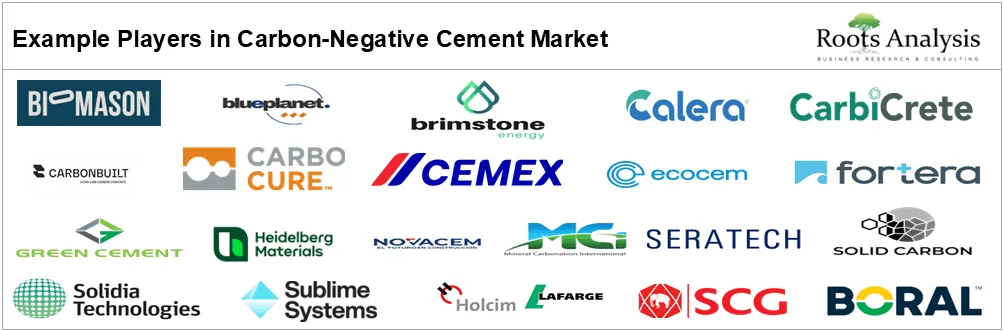
The global carbon-negative concrete market research report indicates that the market is highly consolidated with the presence of tech-giants and startup companies. Notably, the technology leaders, such as Brimstone Energy and Sublime Systems are strategically raising funds and investments, to strengthen their market position.
Recently, Brimstone Energy secured USD 189 million grant by the US Department of Energy's Industrial Demonstrations Program to establish a green cement plant with a capacity of 80,000 tone / yr of green cement and 20,000 tone / yr of smelter-grade alumina. These investments and initiatives are likely to maintain long-term competitiveness for the market players.
Startup Initiatives and Broad Company Strategies
The strategic focus of the carbon-negative market is split between "Digitalization of the Kiln" and "Chemical Disruption of the Binder."
- Queens Carbon: Utilizing a novel thermal process to produce SCMs at much lower temperatures, potentially reducing clinker energy requirements by 50%.
- CarbonBuilt: Implementing a modular reactor strategy that allows existing concrete masonry producers to utilize industrial CO2 emissions for curing, turning their products into carbon sinks.
- Broad Corporate Strategies: These giants are moving toward "Vertical Integration." By acquiring ready-mix and aggregate companies, they control the entire value chain, allowing them to mandate the use of their own carbon-negative binders in their end-products.
Demand Forecast for Sustainable Cement in European Construction Projects 2025-2030
The demand for sustainable cement is structurally driven by the "Fit for 55" package, which legally mandates a 55% net reduction in greenhouse gas emissions by 2030. This transition is enforced by the carbon border adjustment mechanism (CBAM), which entered its definitive phase on January 1, 2026. As of this date, importers must strictly function as "authorized CBAM declarants" and purchase certificates to cover embedded emissions, effectively monetizing the carbon cost of traditional clinkers and creating a direct financial imperative for low-carbon alternatives.
On the demand side, the clean industrial deal prioritizes the creation of lead markets for low-carbon products. This strategy leverages public procurement (which accounts for approximately 16% of EU GDP) to drive adoption through mandatory sustainability criteria. Simultaneously, the "renovation wave" strategy targets the renovation of 35 million buildings by 2030, addressing a building stock where 35% is over 50 years old and largely energy inefficient. These synchronized regulatory levers ensure that carbon-negative cement transitions from a niche product to a compliance necessity for European infrastructure.
Unlock Deeper Insights – Schedule Your Personalized Workshop Today!/p>
Carbon-Negative Cementing Market: Scope of the Report
| Key Report Attributes | Details | |
| Historical Trend | Since 2022 | |
| Forecast Period | Till 2040 | |
| Market Size 2026 | $ 1.38 Billion | |
| Market Size 2040 | $ 9.17 Billion | |
| CAGR (Till 2040) | 14.48% | |
| Segments Covered |
|
|
Market Segmentation
Based on the research, we have segmented the caron-negative cementing market forecast into type of raw material, type of product, type of technology, application, distribution channel, end user, geographical regions, and key players.
Market Share by Type of Raw Material
- Natural Raw Materials
- Industrial Waste Raw Materials
Market Share by Type of Product
- Bio-Based Cements
- CO2-Mineralized Concrete
- Calcium Sulfoaluminate (CSA) Cement
- Carbon Capture, Utilization, and Storage (CCUS) Enhanced Cement
- Geopolymers
- Magnesium Oxide Cement
- Zero-Clinker / Electrochemical Cement
Market Share by Type of Technology
- Bio-Mineralization Systems
- Carbon Capture Platforms
- Hybrid Carbon Sequestration Systems
Market Share by Application
- Construction
- Commercial
- Residential
- Infrastructure
- Bridges & Tunnels
- Roads & Highways
Market Share by Distribution Channel
- Direct Sales
- Distributors
- Online Channels
Market Share by End User
- Construction Firms
- Cement Producers
- Government Agencies
- Precast Manufacturers
- Real Estate Developers
Market Share by Geographical Regions
- North America
- US
- Canada
- Mexico
- Rest of North America
- Europe
- Austria
- Belgium
- Denmark
- France
- Germany
- Ireland
- Italy
- Netherlands
- Norway
- Russia
- Spain
- Sweden
- Switzerland
- UK
- Rest of Europe
- Asia-Pacific
- Australia
- China
- India
- Japan
- New Zealand
- Singapore
- South Korea
- Rest of Asia-Pacific
- Latin America
- Brazil
- Chile
- Colombia
- Venezuela
- Rest of Latin America
- Middle East and Africa (MEA)
- Egypt
- Iran
- Iraq
- Israel
- Kuwait
- Saudi Arabia
- UAE
- Rest of MEA


