
Lowest Price Guaranteed
Slides
174
Last Updated
August 2026
View Count
12201
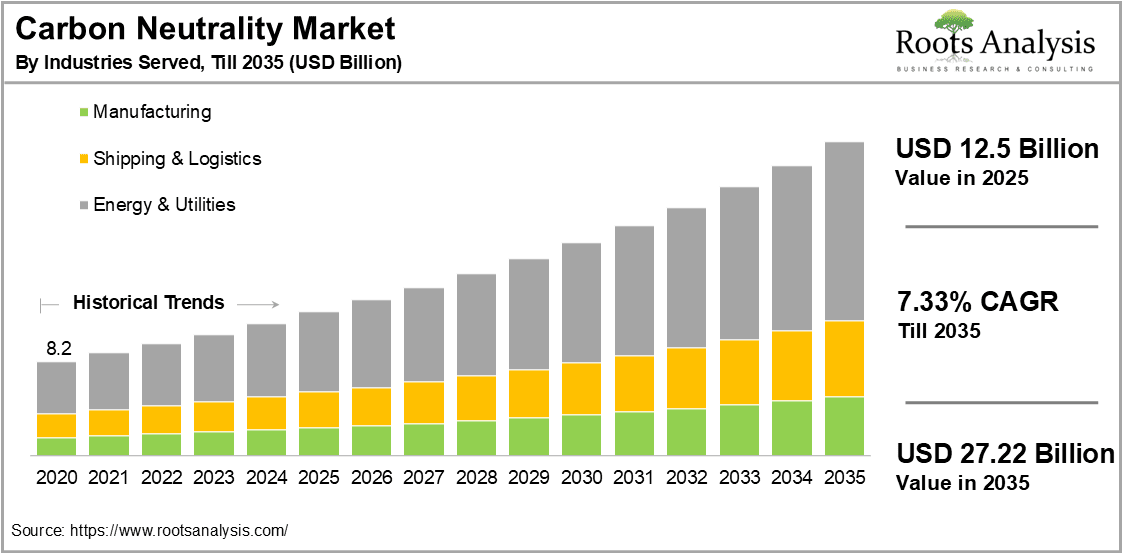
The carbon neutrality market size is projected to grow from USD 12.5 billion in 2025 to USD 27.22 billion by 2035, representing a CAGR of 7.33%, during the forecast period till 2035.
 |
To learn more about this report, request a free sample copy
The new research study consists of carbon neutrality industry analysis, detailed market forecast analysis and providing actionable strategic recommendations.
Carbon neutrality is defined as the state where the amount of carbon dioxide emitted into the atmosphere is equal to the amount removed, resulting in a zero-carbon, through carbon footprint reduction strategies. Notably, advantages of carbon neutrality include it not only mitigates the adverse effects of climate change but also leads to reduced environmental pollution, improved public health, economic growth through green jobs, enhanced food security, and preservation of biodiversity.
The global carbon neutrality market is expected to grow with a steady growth over the forecast period due to the growing demand in emerging economies like China and India. Additionally, some of the carbon neutrality product innovations and advancements include carbon capture and storage (CCS) and direct air capture are at the forefront of this movement, enabling industries to mitigate emissions. Notably, companies like Microsoft have committed substantial investment in carbon neutrality funds to accelerate the development of these technologies, highlighting a trend towards corporate sustainability goals in achieving carbon neutrality.
Recently, in July 2024, Molten Industries led a partnership with United States Steel and CPFD Software aimed at developing carbon-neutral steel production. The collaboration focused on innovative technologies to reduce carbon emissions in the steel manufacturing process. While informing about the partnership Peter Blaser, Vice President of Operations of CPFD Software mentioned-This project reflects a significant energy transition occurring across various industrial sectors, and we are delighted that our technology and expertise are playing a role in the decarbonization of steel production in the United States.
The carbon neutrality market research report presents an in-depth analysis of the various companies that are involved in offering carbon neutrality, across different segments, as defined in the table below:
| Key Report Attributes | Details | |
| Historical Trend | Since 2020 | |
| Forecast Period | Till 2035 | |
| Current Market Size | $ 12.5 Billion | |
| Market Size Value by 2035 | $ 27.22 Billion | |
| CAGR (Till 2035) | 7.33% | |
| Type of Activity |
|
|
| Type of Component |
|
|
| Industries Served |
|
|
| Type of Distribution Channel |
|
|
| Geographical Regions |
|
|
| Leading Market Players |
|
|
| PowerPoint Presentation (Complimentary) |
Available | |
| Customization Scope | 15% Free Customization | |
| Excel Data Packs (Complimentary) |
|
|
Based on the type of activity, the global carbon neutrality market is split into emissions reduction and renewable energy use. According to our analysis the naphthenic segment will augment the segment's growth with over 60% of carbon neutrality market share during this carbon neutrality market forecast period. This can be attributed to its comprehensive approach to addressing greenhouse gas emissions across various sectors, particularly in energy-intensive industries.
However, the renewable energy use segment is expected to grow with a relatively higher (8.34%) CAGR in the near future. This can be ascribed to their significant cost reductions, increased global energy demand, and heightened energy security concerns.
On the basis of the type of component, the carbon neutrality market is bifurcated into services and solutions. The services segment is anticipated to dominate the segment with more than 65% of carbon neutrality market size in 2025. Further, this segment is expected to witness a relatively faster carbon neutrality market growth rate of (8.47%) until 2035. This can be ascribed to the increasing complexity of carbon management and the growing demand for expert guidance among organizations striving to achieve sustainability goals.
On the basis of the industries served, the carbon neutrality market is bifurcated into manufacturing, shipping & logistics and energy & utilities. The energy & utilities segment is anticipated to dominate the segment with more than 45% of carbon neutrality market size in 2025. Further, this segment is expected to witness a relatively faster carbon neutrality market growth rate of (8.27%) until 2035. This can be attributed to its pivotal role in forming strategies for reducing greenhouse gas emissions, as it is one of the largest contributors to carbon output.
On the basis of the type of enterprise, the carbon neutrality market is bifurcated into large enterprise and small and medium enterprise. The large enterprise segment is anticipated to dominate the segment with more than 65% of carbon neutrality market size in 2025. Further, this segment is expected to witness a relatively faster carbon neutrality market growth rate of (8.52%) until 2035. This can be attributed to their significant financial resources, which enable them to invest in advanced technologies and carbon neutrality initiatives.
This segment highlights the distribution of the carbon neutrality market across various geographical regions such as North America, Europe, Asia, Latin America, Middle East, North Africa, and the rest of the world. According to our carbon neutrality market analysis, North America exhibits dominance in the market with over 42.5% of the Carbon Neutrality market share in the global marketplace. However, Asia is projected to grow with a relatively higher CAGR in the forecasted period. Primary reasons for this rapid growth driven by several factors, including strong governmental commitments from major economies like China, Japan, and South Korea to achieve net-zero emissions.
The “Carbon Neutrality Market, Till-2035: Industry Trends and Global Forecasts” report features an extensive study of the current market landscape, market size and future opportunity within carbon neutrality market, during the given forecast period. The market report highlights the efforts of several stakeholders involved in this rapidly emerging segment of the service providers industry. Key takeaways of the global carbon neutrality market report are briefly discussed below.
Transition to renewable energy sources, promotion of sustainable transportation, and corporate emissions strategies is majorly driving the carbon neutrality industry. Regulatory frameworks and policies support these efforts, while technological innovations like carbon capture and storage enhance emissions reduction. Further, forest conservation and afforestation play a crucial role in increasing carbon sink. Notably, the economic opportunities presented by a low-carbon economy, along with public awareness and engagement on climate issues, further contribute to this goal.
With the presence of several small and large carbon neutrality companies, the market is experiencing intense competition and changing dynamics. From large multinational companies to carbon neutrality manufacturers players, companies are striving to enhance their competitive edge. In terms of market share, large enterprises and multinational companies are dominating the market. While small carbon neutrality players are continuously improving their products to cater to niche markets, or they are offering specialized services. These industry players are focusing on adopting competitive strategies, such as developing innovative solution techniques, forming strategic alliances and partnerships to expand their portfolios and global footprint, investing in recent developments and new feature launches to enhance their carbon neutrality offerings.
Despite the market growth projection, the carbon neutrality market faces numerous challenges. The most common challenges include the establishment of realistic carbon targets, financial constraints particularly for small and medium enterprises, and difficulties in managing supply chain emissions. Additionally, issues of data transparency and integrity undermine the credibility of carbon credits trading, while concerns about greenwashing erode public trust in carbon offset market trends.
North America currently holds a substantial share of approximately 42.5% in the carbon neutrality market opportunities. This dominance can be attributed to a combination of strong government initiatives and policies aimed at reducing emissions, significant consumer demand for renewable energy for carbon neutrality. Further, technological advancements in carbon capture and renewable energy further enhance the feasibility of sustainable business practices. Notably, heightened public awareness and support for climate action influence both policy and corporate strategies, and are a few of the major governing reasons for growth in this region.
Examples of key player involved in the carbon neutrality market (which have also been captured in this market report, arranged in alphabetical order) include Carbon Footprint, Climate Impact, ClimeCo, EcoAct, ENGIE, ESG Enterprise, Green Mountain Energy, SAP, Schneider Electric, and Terrapass. This market report includes an easily searchable excel database of all the companies who have adopted the carbon neutrality market.
The market report presents an in-depth analysis, highlighting the capabilities of various companies engaged in this domain, across different segments. Amongst other elements, the market report includes:
At Roots Analysis, we genuinely care about your success and understand that your business requirements are unique. While our market research reports provide valuable insights, we recognize that they might not cover every aspect you need to make well-informed strategic decisions. To account for that, we offer 15% free report customization tailored to your specific needs. Whether you require additional quantitative analysis, qualitative insights, or any other information related to the carbon neutrality market, reach out us today at: support@rootsanalysis.com