
Lowest Price Guaranteed
Slides
203
Last Updated
May 2025
View Count
15457
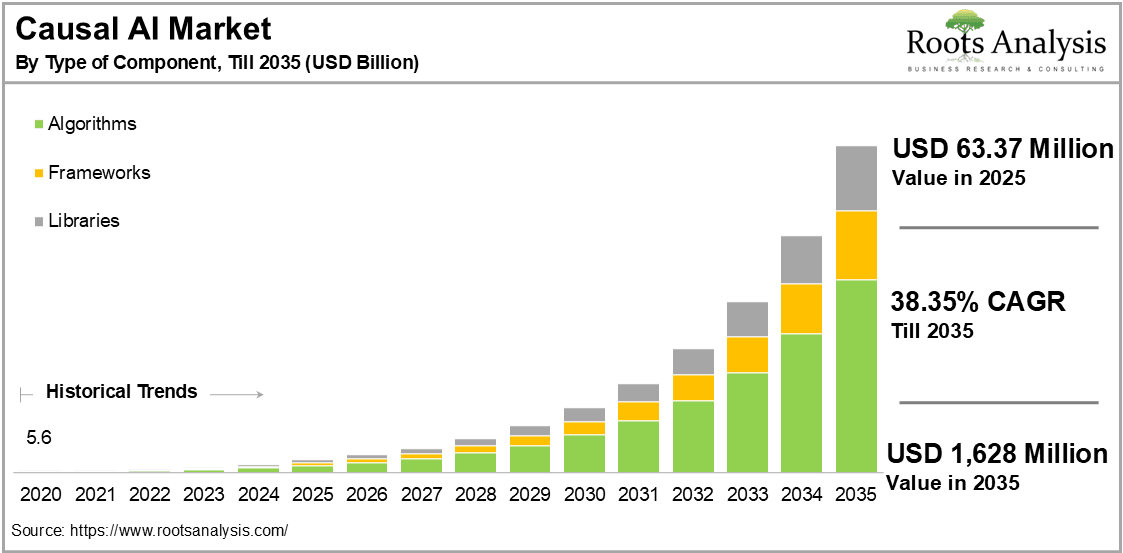
The causal AI market size is projected to grow from USD 63.37 million in 2025 to USD 1,628.43 million by 2035, representing a CAGR of 38.35%, during the forecast period till 2035.
 |
To learn more about this report, request a free sample copy
The new research study consists of causal AI market analysis, detailed causal AI market analysis, mega trends, patent analysis, porter five forces, SWOT analysis, value chain analysis and other strategic frameworks.
Causal AI represents a groundbreaking advancement in artificial intelligence and machine learning, concentrating on the identification and utilization of cause-and-effect relationships within data. Unlike traditional AI models, which primarily rely on correlation-based methods to identify patterns and make predictions, causal AI addresses scenarios where understanding the underlying causal mechanisms is essential. By integrating principles from causal inference-a statistical and philosophical discipline focused on deducing causal relationships from data-causal AI enhances the analytical capabilities of AI systems.
The market for causal AI is experiencing substantial growth due to several driving factors. The rise of virtual assistants and chatbots that can engage in natural language interactions has spurred demand for causal AI applications. Additionally, the decreasing costs associated with hardware, cloud computing, and storage have made AI technology more accessible to a wider range of individuals and organizations. This affordability has facilitated the creation and implementation of causal AI solutions, bringing these technologies closer to everyday users and promoting innovation in the market. Personalization is a key aspect of causal AI applications, leveraging user data to deliver tailored experiences.
The causal AI market report presents an in-depth analysis of the various companies that are involved in offering causal AI solutions, across different segments, as defined in the table below:
| Key Report Attributes | Details | |
| Historical Trend | Since 2020-2024 | |
| Forecast Period | 2025-2035 | |
| Market Size Value in 2025 | $ 63.37 Million | |
| Market Size Value by 2035 | $ 1,628.43 Million | |
| CAGR (Till 2035) | 38.35% | |
| Type of Offering |
|
|
| Type of Deployment Mode |
|
|
| Type of Services |
|
|
| Type of Analytics |
|
|
| Type of Technology |
|
|
| Type of Component |
|
|
| Areas of Application |
|
|
| Type of Functionality |
|
|
| Type of Industry Vertical |
|
|
| Company Size |
|
|
| Geographical Regions |
|
|
| Leading Market Players |
|
|
| PowerPoint Presentation (Complimentary) |
Available | |
| Customization Scope | 15% Free Customization | |
| Excel Data Packs (Complimentary) |
|
|
Based on the type of offering, the market is split into services and software. Among these categories, the services segment growth is expected to dominate the market with a share of 78.8%. This growth is attributed to the increasing need for consulting, integration, and ongoing support as organizations seek to implement causal AI solutions effectively. On the other hand, the software segment is expected to witness rapid growth at a significant CAGR of 39.23% during the forecasted period. This growth is attributed to their adaptability across various industries and their ability to provide organizations with insights into cause-and-effect relationships, which are critical for informed decision making.
The global causal AI market is segmented into various types of deployment factors, such as cloud, hybrid and on-premises. According to our causal AI industry analysis, the cloud segment will augment the segment's growth with the largest market share of over 64.56% as well as the fastest CAGR of around 38.7% by the next decade. The market growth can be attributed to the advantages offered by cloud platforms, such as scalability, accessibility, and lower upfront costs compared to on-premises solutions.
The increasing adoption of cloud technologies and the growing need for advanced analytics capabilities across various industries is also propelling the market growth. Additionally, cloud-based deployments also allow organizations to easily adjust resources based on demand, which further proves to be beneficial for applications requiring significant computational power.
The market is segmented into various types of services such as consulting, deployment & integration, support & maintenance, and training. According to our causal AI market forecast, the consulting segment will augment the segment's growth with the largest market share of over 55.68% by the next decade. The market growth can be attributed to the crucial role consulting plays in providing expert guidance to organizations for implementing and leveraging causal AI technologies.
Consulting services help businesses understand how to utilize causal AI for improved decision-making and operational efficiency. Furthermore, the support & maintenance segment is expected to witness a growth in CAGR of 40.98% during the forecasted period. This growth is attributed to the rising need for ongoing support and training as organizations adopt causal AI solutions and require assistance in optimizing their use and ensuring successful integration into existing systems.
The market is segmented into various types of analytics, such as descriptive analytics, predictive analytics, and prescriptive analytics. According to our causal AI statistics, the predictive analytics segment will augment the market's growth with a market share of 65.8% during the forecasted period. This growth can be owed to its wide usage by organizations to forecast outcomes based on historical data and trends, making it an essential tool for decision-making processes across various industries.
Furthermore, the prescriptive analytics segment is expected to witness the fastest CAGR of around 39.64% during the forecasted period. This growth can be attributed to the ability of prescriptive analytics to not only predict outcomes but also recommend actions to achieve desired results. This is increasingly valuable for businesses aiming to optimize their operations and strategies.
The market is segmented into various types of technology, such as computer vision, deep learning, machine learning, and natural language processing. According to our causal AI analysis, the machine learning segment will augment the market's growth with a market share of 67.65% during the forecasted period. This growth can be owed to their ability to form the foundation for many causal AI applications, enabling systems to learn from data and identify cause-and-effect relationships effectively.
Furthermore, the natural language processing (NLP) segment is expected to witness the fastest CAGR of around 40.88% during the forecasted period. This growth can be attributed to the increasing demand for AI systems that can understand and interpret human language, allowing for more sophisticated interactions and insights derived from textual data.
The market is segmented into various types of components, such as algorithms, frameworks, libraries. According to our causal AI analysis, the algorithms segment will augment the market's growth with a market share of 67.65% during the forecasted period. This segment is gaining traction as algorithms form the core of causal AI models, enabling the identification and analysis of cause-and-effect relationships within data. Furthermore, the frameworks segment is expected to witness the fastest CAGR of around 40.8% during the forecasted period. This growth can be attributed to the increasing demand for robust frameworks that facilitate the development and deployment of causal AI applications, allowing organizations to implement these technologies more efficiently and effectively.
The market is segmented into various areas of application, such as customer experience management, fraud detection, healthcare diagnostics, marketing optimization, predictive maintenance, risk management, and supply chain optimization. According to our causal AI analysis, the healthcare diagnostics segment will augment the market's growth with a market share of 37.65% during the forecasted period. This growth can be owed to the increasing demand for advanced analytics in healthcare to improve patient outcomes and operational efficiencies.
Furthermore, the fraud detection segment is expected to witness the fastest CAGR of around 39.84% during the forecasted period. This growth can be attributed to the increasing demand for enhanced security measures in financial services and other sectors as organizations seek to leverage causal AI to identify and mitigate fraudulent activities effectively. This has increased the demand for causal AI in healthcare and finance.
The market is segmented into various types of functionalities, such as causal discovery, causal inference, and counterfactual analysis. According to our causal AI analysis, the causal inference segment will augment the market's growth with a market share of 67.65% as well as the fastest CAGR of around 41.86% during the forecasted period. This segment is critical as it allows organizations to derive meaningful insights regarding cause-and-effect relationships from data, which is, in return, essential for informed decision-making across various industries.
Furthermore, the increasing recognition of its importance in enhancing decision-making processes, particularly in fields like marketing, healthcare, and operations is also playing a significant role in propelling market growth.
The market is segmented into various types of industry verticals, such as BFSI, financial services, healthcare, manufacturing, retail, transportation & logistics. According to our causal AI analysis, the healthcare segment will augment the market's growth with a market share of 37.65% during the forecasted period. This growth can be owed to its ability to identify causal relationships between genetic, environmental, & lifestyle factors as well as specific diseases while providing valuable insights into complex biological systems, disease mechanisms, & treatment effectiveness.
Furthermore, the manufacturing segment is expected to witness the fastest CAGR of around 41.88% during the forecasted period. This growth can be attributed to the increasing adoption of causal AI in predictive maintenance, quality control and supply chain optimization.
The market is fragmented into multiple types of enterprise namely large and small and medium enterprise. Currently, the large enterprise segment is anticipated to dominate the segment with 74.34% of the market share. However, small and medium enterprise segments are expected to witness a relatively higher (40.78%) growth rate until 2035. This is ascribable to their agility, innovation, focus on niche markets, and ability to adapt to changing customer preferences and market conditions.
This segment highlights the regional analysis of the causal AI market, such as North America, Europe, Asia, Latin America, Middle East and North Africa, and the rest of the world. According to our regional analysis, North America currently exhibits dominance with 37.69% of overall market share. The North America growth is driven by the presence of major tech giants, academic institutions, & research organizations, which are actively involved in advancing the field of causal AI and conduct cutting-edge research in AI algorithms, causal inference, and related areas.
The “Causal AI Market, Till-2035: Industry Trends and Global Forecasts” report features an extensive study of the current market landscape, market size and future opportunity within the causal AI market forecast period. The market report highlights the efforts of several stakeholders involved in this rapidly emerging segment of the service providers industry. Key takeaways of the causal AI market report are briefly discussed below.
The global causal AI market growth is expected to be driven by the rising demand for transparency and explainability in AI systems. Organizations are seeking solutions that not only provide insights but also clarify the underlying cause-and-effect relationships behind those insights, which traditional machine learning models often fail to deliver. Additionally, the rise of personalized marketing is fueling market expansion, as businesses leverage causal insights to develop tailored customer engagement strategies that enhance user experience and satisfaction. The growing complexity of business operations further necessitates advanced analytical tools capable of managing intricate data environments, leading to a heightened interest in causal AI technologies.
Moreover, as companies pursue digital transformation initiatives, the integration of causal AI into various operational processes is becoming essential for improving decision-making and operational efficiency. Overall, these market drivers underscore the critical role of causal AI in helping organizations navigate an increasingly data-driven landscape while meeting regulatory requirements and customer expectations.
With the presence of several small and large companies, the market is experiencing intense competition and changing market dynamics. From large multinational companies to local players, companies are striving to enhance their competitive edge. In terms of market share, large enterprises and multinational companies are dominating the market. The key players are using strategies such as partnerships, acquisitions, ventures, innovations, novel product launches, R&D and geographical expansions in an attempt to solidify their position in the industry. Additionally, the increasing emphasis on sustainability is driving companies to invest in biodegradable materials and technologies, further intensifying the competitive landscape.
For instance, in September 2023, Logility acquired Garvis to enhance its supply chain planning with AI-driven demand forecasting. In reference to this, Allan Dow, president of Logility stated that with an AI driven approach at their core, Garvis has revolutionized the way companies forecast demand in every dynamic market. Bringing them into Logility’s portfolio will accelerate their shared vision to break the boundaries of traditional myopic supply chain planning solutions.
Despite the strong market growth projection, there are several challenges in implementing causal AI models. One major issue is data quality. Causal AI requires high-quality, comprehensive datasets that accurately capture both correlations and contextual information necessary for establishing causal relationships. However, in many real-world scenarios, such data is often incomplete, biased, or difficult to obtain, which can lead to flawed causal inferences. Additionally, the complexity of causal relationships poses another challenge. Identifying and isolating true causal factors among numerous interconnected variables demands sophisticated algorithms and a deep understanding of causal inference, making it less accessible to many practitioners compared to traditional correlation-based methods.
With respect to regional industry insights, North America is likely to dominate the market for the forecasted period. The dominance of this region is majorly influenced by technological advancements in causal AI technology, diverse industries, and supportive infrastructure. The region’s well-established infrastructure, including advanced cloud computing and data centers, supports the implementation and scalability of causal AI applications. The region's well-established infrastructure, including advanced cloud computing and data centers, supports the implementation and scalability of causal AI applications.
Examples of leading companies in the causal AI market(which have also been captured in this market report, arranged in alphabetical order) include Aible, Aitia, Actable AI, Alibaba, Amazon Web Services, Amelia.ai, Beyond Limits, Biotx.ai, Blue Prism, Causa, CausaAI, CausaLens, Causaly, Causely, Causality Link, Cognizant, CognitiveScale, Data Poem, DataRobot, Dataiku, Databricks, Descartes Labs, Dynatrace, Element AI, Ernst & Young, Facebook, Geminos, Glencoe Software, Howso, H2O.ai, IBM, Impact Genome, Incrmntl, Intel, Lifesight, Logility, Microsoft, Modzy, Nebula, NVIDIA, OpenAI, Oracle, Parabole.AI, Pinterest, PwC, RapidMiner, Restackio, Salesforce, SAP SE, Scalnyx, Seldon Technologies, Shopify, Slack, Snowflake, Symphony Ayasdi AI, Taskade, ThoughtSpot, TikTok, Twitter, Uber, Unlearn.AI, VELDT, WeChat, Wipro.
The market report presents an in-depth analysis, highlighting the capabilities of various companies engaged in this domain, across different segments. Amongst other elements, the market report includes:
At Roots Analysis, we genuinely care about your success and understand that your business requirements are unique. While our causal AI market research reports provide valuable insights, we recognize that they might not cover every aspect you need to make well-informed strategic decisions. To account for that, we offer 15% free report customization tailored to your specific needs. Whether you require additional quantitative analysis, qualitative insights, or any other information related to the causal AI market, reach out us today at: support@rootsanalysis.com