Cognitive Radio Market
Cognitive Radio Market, Till 2035: Distribution by Type of Component (Hardware, Software and Service) Type of Application (Cognitive Routing, Location Tracking, Spectrum Allocation, Spectrum analysis, and Spectrum Sensing), Type of Vertical (Government, Telecommunication, Transportation, and Others), and Geographical Regions (North America, Europe, Asia, Latin America, and Middle East and North Africa and Rest of the World): Industry Trends and Global Forecast
-
Lowest Price Guaranteed
-
Slides
169 -
Last Updated
February 2025 -
View Count
10931 -
Cognitive Radio Market Overview
The cognitive radio market size is projected to grow from USD 8.89 billion in 2025 to USD 41.74 billion by 2035, representing a CAGR of 16.72% during the forecast period till 2035.
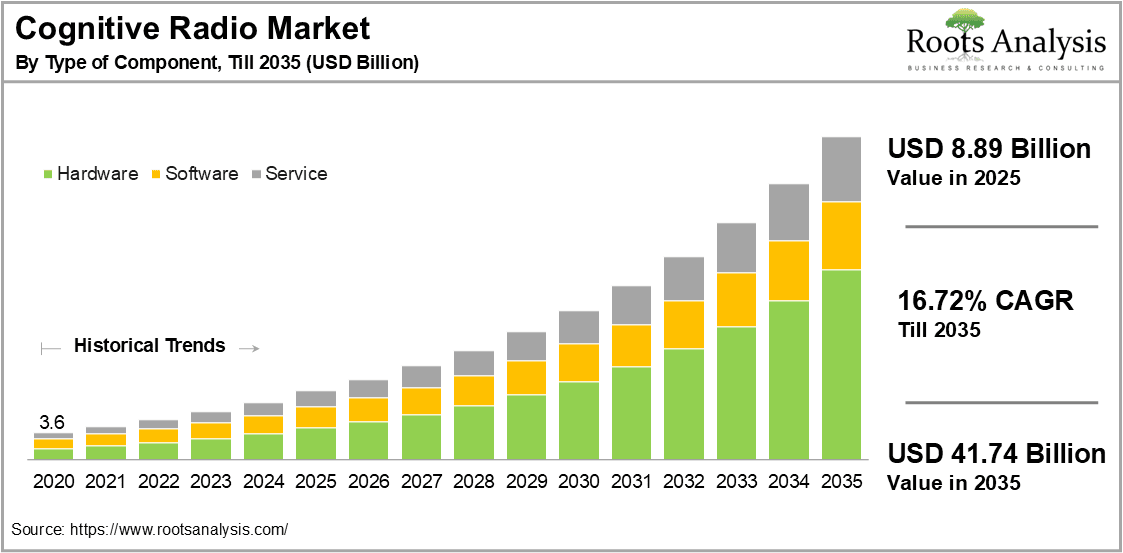 |
To learn more about this report, request a free sample copy
The new research study consists of cognitive radio market and trends analysis, detailed market forecast analysis, and provide actionable strategic recommendations.
The rising scarcity of radio spectrum resources is creating new possibilities for cognitive radio technology. Cognitive radio refers to a software-defined radio (SDR) system that can adapt to its environment by identifying available communication channels in a wireless spectrum and adjusting its transmission or reception parameters. The main feature of seamless transition across different frequencies to utilize unused frequencies for optimum performance inflates the demand for SDR technology. Its dynamic spectrum access, spectrum sensing, and interference management features uplift the adoption of cognitive radio systems. As an effect, the cognitive radio market is anticipated to rise exponentially driven by propelling demand for efficient spectrum utilization across industries.
This is due to the fact that industries including telecommunications, government & defense, and the internet of things (IoT) require high spectrum efficiency and better communication quality cost-effectively. Also, the growth of the IoT and its impact on cognitive radio has raised the market potential with the rising number of connected devices and high demand for low-latency communications. Furthermore, the expanding machine learning applications in cognitive networks for dynamic spectrum management and improved decision-making capabilities indicate a future trend in wireless communication technologies which will likely augment the market potential. By acknowledging these factors, several companies are collectively investing in R&D for technological advancement.
For example, in June 2024, Rohde & Schwarz became a member of the newly formed AI-RAN Alliance for contributing its testing and measurement expertise to help integrate AI into wireless communications. The goal of this partnership was to boost radio access network (RAM) performance and mobile networks. By sharing this news, the chief technology officer of the company, Andreas Pauly stated that this partnership is vital to explore the full potential of 6G technology components like AI-native air interface. Overall, these factors are projected to flourish the market growth during this forecast period.
Cognitive Radio Market Share Insights
The cognitive radio market report presents an in-depth analysis of the various companies that are involved in offering cognitive radio, across different segments, as defined in the table below:
Cognitive Radio Market: Report Attributes / Market Segmentations
| Key Report Attributes | Details | |
| Historical Trend | Since 2020 | |
| Forecast Period | Till 2035 | |
| Current Market Size | $ 8.89 Billion | |
| Market Size Value by 2035 | $ 41.74 Billion | |
| CAGR (Till 2035) | 16.72% | |
| Type of Component |
|
|
| Type of Application |
|
|
| Type of Vertical |
|
|
| Geographical Regions |
|
|
| Leading Market Players | ||
| PowerPoint Presentation (Complimentary) | Available | |
| Customization Scope | 15% Free Customization | |
| Excel Data Packs (Complimentary) |
|
|
Cognitive Radio Market Segmentation
Market Share by Type of Component
Based on the type of component, the market is split into hardware, software, and services. According to our analysis, the hardware segment is projected to hold the maximum (~41%) of the market share till 2035. Hardware involves transmitters, receivers, and radio frequency components that are core infrastructure and necessary for building the physical infrastructure for the systems. Thus, the growth of IoT and 5G networks will likely continue to fuel the demand for hardware to support dynamic spectrum access.
However, software-defined radio (SDR) technology is exciting the market demand owing to being a fundamental element of the cognitive radio system. This technology enables radios to be reconfigured through software to adapt and protocols. This flexibility allows spectrum access and boosts the integration of new technologies. As a result, the software segment is anticipated to rise to the fastest CAGR of (19.02%) throughout this forecast period.
Market Share by Type of Application
This segment of the cognitive radio market is distributed into multiple applications such as cognitive routing, location tracking, spectrum allocation, spectrum analysis, and spectrum sensing. As per market research, the spectrum sensing segment is poised to capture the highest (~42%) of the cognitive radio market share by 2035. Spectrum sensing is the main function that enables cognitive radios to detect unused or underutilized frequency bands which is fundamental to other applications, thereby, dominating the segment.
Further, the wide range of applications and regulatory requirements also fortify the segment's growth. On the other hand, the spectrum allocation segment is likely to grow at a higher CAGR of (18.58%) over this projection timeframe. The key factor of this growth can be attributed to its importance in optimizing spectrum usage which it ensures that frequencies are used effectively across multiple users and services to enhance network performance.
Market Share by Type of Verticals
Based on the type of verticals, the market is fragmented into government, telecommunication, transportation, and others. According to our cognitive radio industry analysis, the telecommunication sector is projected to occupy the largest (~44%) of the market share by 2035. Telecommunication is a primary user of cognitive radios due to its importance in improving spectrum efficiency and reducing interference in densely populated areas. Thus, after the rapid rollout of the 5G network, the demand for cognitive radio has spiked, thereby, advancing the market.
While, the government segment is estimated to register a faster (17.63%) CAGR throughout this forecast period. The key factor of this growth can be accredited to the heightened need for secure communication. The benefits of dynamic spectrum management and interference management which ensure secure and reliable communication foster the market expansion.
Market Share by Geographical Regions
This segment highlights the distribution of the cognitive radio market across various geographical regions, such as North America, Europe, Asia, Latin America, the Middle East and North Africa, and the rest of the world. With regard to regional analysis of cognitive radio markets, North America is expected to lead the market for cognitive radio with the highest (~46%) of the market share till 2035. Additionally, Asia is growing at the fastest pace and is likely to witness a noteworthy (19.04%) CAGR over this forecast period.
This rapid growth can be ascribed to the growing deployment of 5G network which has promoted the demand for cognitive radio driven by its vital role in optimizing spectrum efficiency for advanced networks. Besides, a rise in the investment in the defense sector especially in countries like China and India which are substantially enlarging their defense budget, is anticipated to propel the market potential. These nations are heavily investing in secure and adaptive communication technologies similar to cognitive radios, thereby, elevating the market scope in the region.
Cognitive Radio Market Key Insights
The “Cognitive Radio Market, Till-2035: Industry Trends and Global Forecasts” report features an extensive study of the current market landscape, market size and future opportunities within the cognitive radio market, during the given forecast period. The market report highlights the efforts of several stakeholders involved in this rapidly emerging segment of the service providers industry. Key takeaways of the cognitive radio market report are briefly discussed below.
Key Drivers of the Cognitive Radio Market
The market is predicted to witness exponential growth driven by various key drivers however, bourgeoning demand for efficient spectrum utilization is the notable key driver, boosting the global cognitive radio market growth. Lately, the excellent growth of wireless communication technologies and limited spectrum availability have pushed the demand for cognitive radio solutions as they allow dynamic spectrum access and efficient use of existing resources. In addition to this, the increasing applications of cognitive radio in defense sector is also attributed to the substantial growth of the market because of its secure, reliable and dynamic communication capabilities that are essential for military operations and emergency services. Moreover, the expansion of IoT and smart cities and ongoing innovation in wireless technologies is further anticipated to amplify the market outlook in the forthcoming years.
Cognitive Radio Market Competitive Landscape
Several global and regional key players are enhancing the market competition with their secure communication system, seamless integration with emerging technologies, and continuous development in spectrum efficiency. Leading companies in the cognitive radio market such as Rohde & Schwarz, Shared Spectrum, Wipro, and others capture the largest share and dominate the market. These industry players are employing various competitive strategies such as high capital investment in R&D and strategic partnerships with government bodies and telecommunication companies to address regulatory challenges and expand global reach. In addition to this, they are increasingly focusing on 5G integration with cognitive radio to cater to diverse applications across industries.
Market Challenges in Cognitive Radio Market
Despite the positive growth, the market can be confined owing to some technological challenges in cognitive radio deployment. Illustratively, there can be a difficulty in detecting and identifying unused spectrum accurately in real-time, particularly, in environments with high interference which can lead to complexity in spectrum sensing. Along with this, ensuring seamless communication between devices using different standards and protocols remains a barrier that can impact the adoption of cognitive radio solutions. Consequently, addressing these challenges becomes crucial for companies to drive market progress.
Regional Analysis: North America is Expected to Lead the Market with the Largest Cognitive Radio Market Share
With regard to regional insight, North America is anticipated to dominate the market during this forecast period due to greater demand for cognitive radio across the military and defense sectors. In North America, the US has a robust defense budget that significantly invests in cognitive radio technology for secure and dynamic communication, reinforcing the market position. Also, its highly developed telecommunication infrastructure that supports highly cutting-edge technology like software-defined radios and 5G has amplified the demand for cognitive radios in telecommunications in the region. Additionally, established companies such as BAE System, Raytheon, and Shared Spectrum headquartered in North America, are distinctly contributing to the market development with their innovation in spectrum sensing technologies which is likely to boost the region’s dominance in the upcoming decade.
Leading Cognitive Radio Solution Providers
Examples of key players involved in the market for cognitive radio (which have also been captured in this market report, arranged in alphabetical order) include BAE Systems (England), DataSoft (US), EpiSys Science (US), Ettus Research (US), Kyynel (Finland), Nutaq (Canada), Raytheon (US), Rohde & Schwarz (Germany), RTX (Denmark), Shared Spectrum (USA), Spectrum Signal Processing (Canada), Thales (Paris, France), Vecima Networks (Canada), Wipro (India), and xG Technology (US). This market report includes an easily searchable excel database of all the companies who have adopted the cognitive radio market.
Recent Developments in Cognitive Radio Market
- In June 2024, The Military College of Telecommunication Engineering (MCTE) and the Society for Applied Microwave Electronics Engineering & Research (SAMEER) signed MOU to collaborate on next-generation wireless technology for the Indian Army. This partnership aimed to establish a joint R&D and incubation center, focusing on developing deployable solutions in 5G, 6G, and SDR, and cognitive radios.
- In June 2024 EDGE formed a partnership with Thales to explore the co-development of Software Defined Rdio technologies in the UAE. Through this collaboration, both companies aim to innovate secure communication solutions for the defense and telecommunication sectors.
- In March 2023, BrainChip Holding announced that Intellisense Systems selected its technology to enhance cognitive communication on size, weight, and power-constrained platforms like spacecraft and robotics for commercial and government markets.
Cognitive Radio Market Report Coverage
The market report presents an in-depth analysis, highlighting the capabilities of various companies engaged in this domain, across different segments. Amongst other elements, the market report includes:
- A preface providing an introduction to the full report cognitive radio market, 2020-2024 (Historical Trends) and till-2035 (Forecasted Estimates).
- An outline of the systematic research methodology adopted to conduct the study on the cognitive radio market providing insights on the various assumptions, methodologies, and quality control measures employed to ensure the accuracy and reliability of our findings.
- An overview of economic factors that impact the overall cognitive radio market including historical trends, currency fluctuation, foreign exchange impact, recession, and inflation measurement.
- An executive summary of the insights captured during our research. It offers a high-level view on the current state of the cognitive radio market and their likely evolution in the mid-long term.
- A detailed assessment of the cognitive radio market landscape, based on several relevant parameters, including year of experience, company size, location of headquarters, and ownership structure.
- Elaborate profiles of prominent players engaged in the cognitive radio market, featuring information on their year of establishment, location of headquarters, company size, company mission, company footprint, management team, contact details, financial information, operating business segments, cognitive radio market portfolio, moat analysis, recent developments, and an informed future outlook.
- A qualitative assessment of the various megatrends ongoing in the cognitive radio industry, including rising integration with advanced technologies and expansion of government and defense applications.
- An analysis highlighting the key unmet needs across the cognitive radio market, featuring insights generated from real-time data on unmet needs as identified from social media posts, recent publications, industry blogs and the views of key opinion leaders expressed on online platforms.
- An in-depth analysis of various patents that have been filed / granted related to the cognitive radio market and its components, based on various parameters, such as type of patent, patent publication year, patent age and leading players.
- A detailed analysis of recent developments in the cognitive radio market domain, based on relevant parameters such as year of initiative, type of initiative (partnerships and collaborations, expansions, funding and product launches), geographical distribution and most active players (in terms of number of recent developments).
- Key winning strategies framework that helps in analyzing the level of competition within an industry, by tracing the key market activities including partnership, funding, expansion of leading players
- A qualitative analysis, highlighting the five competitive forces prevalent in cognitive radio market, including threats for new entrants, bargaining power of suppliers, bargaining power of customers, threats of substitution and rivalry among existing competitors.
- A discussion on affiliated global Cognitive Radio Market trends, key drivers and challenges, under a SWOT framework, which are likely to impact the industry’s evolution, along with a Harvey ball analysis, highlighting the relative effect of each SWOT parameter on the overall cognitive radio market.
- A value chain analysis featuring a discussion on various stakeholders involved in the development of the cognitive radio market, from suppliers to end-users.
- A detailed estimate of the current market size and the future growth potential of the cognitive radio market over the next decade. Based on multiple parameters we have provided an informed estimate on the market evolution during the forecast period 2025-2035. The report also features the likely distribution of the current and forecasted opportunity within the cognitive radio market. Further, in order to account for future uncertainties and to add robustness to our model, we have provided three forecast scenarios, namely conservative, base, and optimistic scenarios, representing different tracks of the industry’s growth.
- Detailed projections of the current and future market across various types of components such as hardware, software and service.
- Detailed projections of the current and future market across various types of applications such as cognitive routing, location tracking, spectrum allocation, spectrum analysis, and spectrum sensing.
- Detailed projections of the current and future market across various types of verticals such as government, telecommunication, transportation, and others.
- Detailed projections of the current and future Cognitive Radio Market across various geographical regions, such as North America (US, Canada, Mexico and other North American countries), Europe (Austria, Belgium, Denmark, France, Germany, Ireland, Italy, Netherlands, Norway, Russia, Spain, Sweden, Switzerland, UK and other European countries), Asia (China, India, Japan, Singapore, South Korea and other Asian countries), Middle East and North Africa (Egypt, Iran, Iraq, Israel, Kuwait, Saudi Arabia, UAE and other MENA countries), Latin America (Brazil, Chile, Colombia, Venezuela and other Latin American countries) and rest of the world (Australia, New Zealand and other countries).
Author: Ronit Sharma and Neha Kashyap
Customization Opportunities
At Roots Analysis, we genuinely care about your success and understand that your business requirements are unique. While our market research reports provide valuable insights, we recognize that they might not cover every aspect you need to make well-informed strategic decisions. To account for that, we offer 15% free report customization tailored to your specific needs. Whether you require additional quantitative analysis, qualitative insights, or any other information related to the cognitive radio market, reach out us today at: support@rootsanalysis.com