
Lowest Price Guaranteed
Slides
197
Last Updated
June 2025
View Count
12451
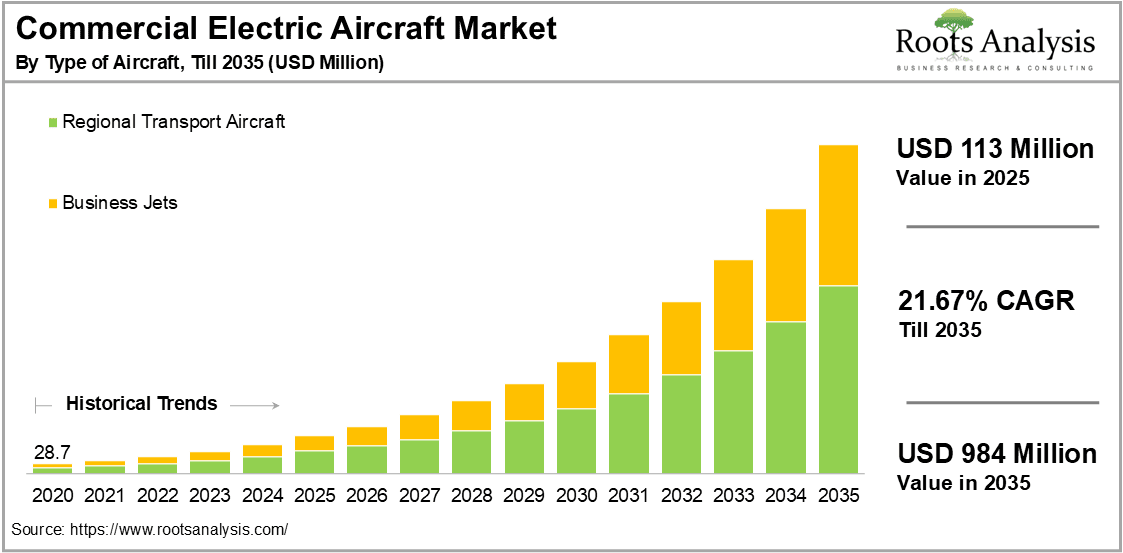
The commercial electric aircraft market, valued at USD 86 million in 2024, is projected to grow to USD 113 million in 2025 and USD 984 million by 2035, representing a CAGR of 21.67% during the forecast period.
 |
The new research study consists of commercial electric aircraft industry analysis, detailed market forecast analysis, and providing actionable strategic recommendations.
Traditional aircraft are considered to be a major factor in climate change, noise pollution and worsening air quality. To overcome these threats commercial electric aircraft are on a surge. Integration of batteries rather than traditional fuel tanks have originated commercial electric aircraft. These planes have zero-emission and minimize noise.
The advancements in battery technology, such as the development of lithium-ion batteries that provide high energy density despite being smaller in size and lightweight. These long-life batteries promise enhanced and longer air trips. It is worth highlighting that recharging such aircraft is easy and less time consuming in comparison to traditional aircrafts. Commercial electric planes are being favored by their no active maintenance that forwardly minimizes respective expenditure. Further, these aircraft have significant rise in efficiency, in relation to traditional aircraft they provide 90% more efficiency. Moreover, the rise in hybrid commercial electric aircraft has expanded the aviation industry, as they allow shifting between gasoline-powered to battery-powered planes swiftly.
The global commercial electric aircraft market size is expected to grow significantly over the forecast period due to the rising demand for sustainable airway transportation. In addition, a rise in the favored regulation will play a pivotal role in market growth of E-aircraft market. Rising trends of air taxis and regional transport aircraft due to their time saving and budget friendly approach are framing the future of electric aviation technology. Further, adoption of short takeoff and landing (STOL) and vertical takeoff and landing (VTOL) to minimize runway crashes and enhanced safety will contribute to the expansion of the domain. Moreover, easy availability of electrical aircraft components is driving the attention to the electric airline industry. Consequently, rapid investments in commercial electric aircraft infrastructure and charging methods will continue to fuel the market growth.
Recently, Hunter Cuthbertson III, President at SAI Flight, mentioned commercial electric aircraft not only allows us to expand range of on-demand transportation options but also aligns with commitment to advancing sustainable practices in the aviation sector.
The global commercial electric aircraft market research report presents an in-depth analysis of the various companies that are involved in offering commercial electric aircraft, across different segments, as defined in the table below:
| Key Report Attributes | Details | |
| Historical Trend | Since 2020 | |
| Forecast Period | Till 2035 | |
| Current Market Size | $ 113 Million | |
| Market Size Value by 2035 | $ 984 Million | |
| CAGR (Till 2035) | 21.67% | |
| Type of Aircraft |
|
|
| Type of Flying Range |
|
|
| Type of Power |
|
|
| Type of Propulsion |
|
|
| Type of Technology |
|
|
| Area of Application |
|
|
| Geographical Regions |
|
|
| Leading Market Players |
|
|
| PowerPoint Presentation (Complimentary) |
Available | |
| Customization Scope | 15% Free Customization | |
| Excel Data Packs (Complimentary) |
|
|
On the basis of the type of aircraft, the commercial electric aircraft market is bifurcated into business jets and regional transport aircraft. The regional transport aircraft segment is anticipated to dominate the segment with more than 60% market share of commercial electric aircraft in 2025. This can be attributed to zero-emission and low carbon footprint. In addition, these flights are coming out as a fast medium of transport and their cost-effectiveness makes them highly popular, forwardly boosting electric airplanes market.
On the other hand, the business jets segment is expected to witness a relatively faster (21.94%) commercial electric aircraft market growth rate by 2035. This can be due to their cost saving approach that allows organizations to save 90% of fuel costs and 50% maintenance.
Based on the type of flying range, the global commercial electric aircraft market is split into up to 200 km, 200-500 km and more than 500Km. Currently, according to our analysis, the 200-500 km is augmenting the segment's growth with over 45% of the market share. This can be ascribed to dedicated battery that allows effortless short to medium air trips. In addition, faster transportation in budget approach has played a pivotal role in the electric aircraft industry.
However, more than 500 km segment is expected to grow with a relatively higher (22.13%) CAGR in the near future. This can be attributed to ongoing research and development for long range commercial electric aircraft.
On the basis of the type of power, the commercial electric aircraft market is bifurcated into 100-500 kw and more than 500kw. The more than 500kw segment is expected to dominate the segment with more than 55% of market share in 2025. Further, this segment is expected to grow with a relatively higher CAGR of 22.49%. This can be attributed to the rising advancements to power electric aircraft for heavy tasks and more passenger capacity.
Based on the type of propulsion, the global commercial electric aircraft market report is segmented into battery electric (BEV), hybrid electric (HEV) and hydrogen fuel cell. According to our analysis, hybrid electric (HEV) is leading the segment with the major market share (50%). This can be attributed to reduced emissions and extended range. In addition, these aircraft require any dedicated new infrastructure making them easily implemented. Notably, used batteries can be charged in-flight making them highly favorable and enhance aircraft performance.
On the other hand, the hydrogen fuel cell segment is expected to grow with the relatively faster (22.66%) CAGR in the forecasted period. This can be ascribed to higher energy density in comparison of traditional. Notably, hydrogen fuel cells can be easily charged in a few minutes.
Based on the type of technology, the global commercial electric aircraft market report is segmented into conventional takeoff and landing (CTOL), short takeoff and landing (STOL) and vertical takeoff and landing (VTOL). According to our analysis, short takeoff and landing (STOL) lead the segment with the major market share (55%). This can be due to rising demand for short and fast trips, by minimizing takeoff and landing, such requirements are met. Further, this allows access to remote areas where long runways are not available.
However, vertical takeoff and landing (VTOL) are expected to grow with a relatively higher CAGR of 21.94% in the forecasted period. This can be due to rising focus on minimizing runway crashes. In addition, these aircraft are used in aerial photography, mapping and medical evacuations.
Based on the area of application, the global commercial electric aircraft market report is segmented into air taxi, cargo and logistics and military and defense. According to our analysis, air taxi leads the segment with the major market share (55%). This can be due to demand for faster and more efficient commutes to relieve traffic congestion. In addition, these allow point-to-point travelling, eliminating the need for multiple transfers.
However, military and defense are expected to grow with a relatively high CAGR of 22.48%. This can be due to their applications in reconnaissance, transportation and logistics. In addition, these help in access of remote areas forwardly strengthening defense.
This segment highlights the distribution of the commercial electric aircraft market across various geographical regions such as North America, Europe, Asia, Latin America, Middle East, North Africa, and the rest of the world. According to our commercial electric aircraft industry analysis, North America exhibits dominance in the market with over 40% of the commercial electric propulsion aircraft market share in the global marketplace. This can be attributed to benefitting government regulations to minimize environmental impact of traditional aircraft. In addition, the presence of prominent players such as Archer Aviation, Overair and Jobi Aviation have strengthened the market.
However, Asia is projected to grow with a relatively higher CAGR (22.69%) in the forecast period. Primary reasons for this growth include rising investments in research and development in emerging economies such as China, India and Japan will play a crucial role in the expansion of the market.
The “Commercial Electric Aircraft Market, Till-2035: Industry Trends and Global Forecasts “report features an extensive study of the current market landscape, market size and future opportunity within commercial electric aircraft market, during the given forecast period. The market report highlights the efforts of several stakeholders involved in this rapidly emerging segment of the service providers industry. Key takeaways of the global commercial electric aircraft market report are briefly discussed below.
An increasing demand for zero-emission aviation is majorly driving the commercial electric aircraft industry. Further, supportive regulations for commercial electric aircraft have played a pivotal role in the growth of the market. Moreover, technological advancements and the development of lightweight and high-performance batteries are the major driving factors. It is worth highlighting that STOL and VTOL adoption to minimize runway crashes will continue to drive growth. Consequently, trends in urban air mobility will strengthen the future of the market.
With the presence of several small and large commercial electric aircraft manufacturing companies, the competitive landscape of the commercial electric aircraft industry is experiencing intense competition and changing market dynamics. From large manufacturing multinational companies to local commercial electric aircraft manufacturers, companies are striving to enhance their competitive edge.
In terms of market share, large enterprises and multinational companies are dominating the market. While small commercial electric aircraft manufacturers are continuously improving their products to cater to niche markets by analyzing consumer preferences, or they are offering specialized services. These industry players are focusing on adopting competitive strategies, such as developing innovative solution techniques, forming strategic alliances and partnerships to expand their portfolios and global footprint, investing in recent developments and new feature launches to enhance their commercial electric aircraft manufacturing offerings.
Despite strong market growth projection, numerous market challenges for commercial electric aircraft have risen. The most common challenge is significant range reduction in comparison to traditional aircraft. Further, the need to tailor aircraft design for enhanced electric air travel sabotage the growth. Additionally, extremely high costs hamper market growth, while its requirement for dedicated infrastructure add further complexity.
North America currently holds a substantial share of approximately 40% in the commercial electric aircraft market opportunities. This dominance can be attributed to several factors, including supportive government regulations for commercial electric aircraft as they have zero-emission of greenhouse gases. Further, the presence of prominent players such as Archer Aviation, Overair and Jobi Aviation is expanding the market through innovation and rapid advancements. In addition, North America has a big budget for military that allows the adoption of latest technologies in regional defense. Notably, the rising demand for short and medium-haul air transportation for faster travel has played a pivotal role in the dominance. It is worth highlighting that rising partnerships and investments in advancements of the services will continue to aid the expansion.
Examples of key player involved in the commercial electric aircraft market (which have also been captured in this market report, arranged in alphabetical order) include Archer Aviation, Electric Aviation, Embraer, Eviation, Heart Aerospace, Joby Aviation, Leonardo, Lilium, magniX, Overair, SCYLAX, Supernal, Thales, Vertical Aerospace, Wisk Aero and Wright Electric. This market report includes an easily searchable excel database of all the companies who have adopted the commercial electric aircraft market.
The market report presents an in-depth analysis, highlighting the capabilities of various companies engaged in this domain, across different segments. Amongst other elements, the market report includes:
At Roots Analysis, we genuinely care about your success and understand that your business requirements are unique. While our market research reports provide valuable insights, we recognize that they might not cover every aspect you need to make well-informed strategic decisions. To account for that, we offer 15% free report customization tailored to your specific needs. Whether you require additional quantitative analysis, qualitative insights, or any other information related to the commercial electric aircraft market, reach out us today at: support@rootsanalysis.com