


 Download Free Sample
 Buy Now
Market Size
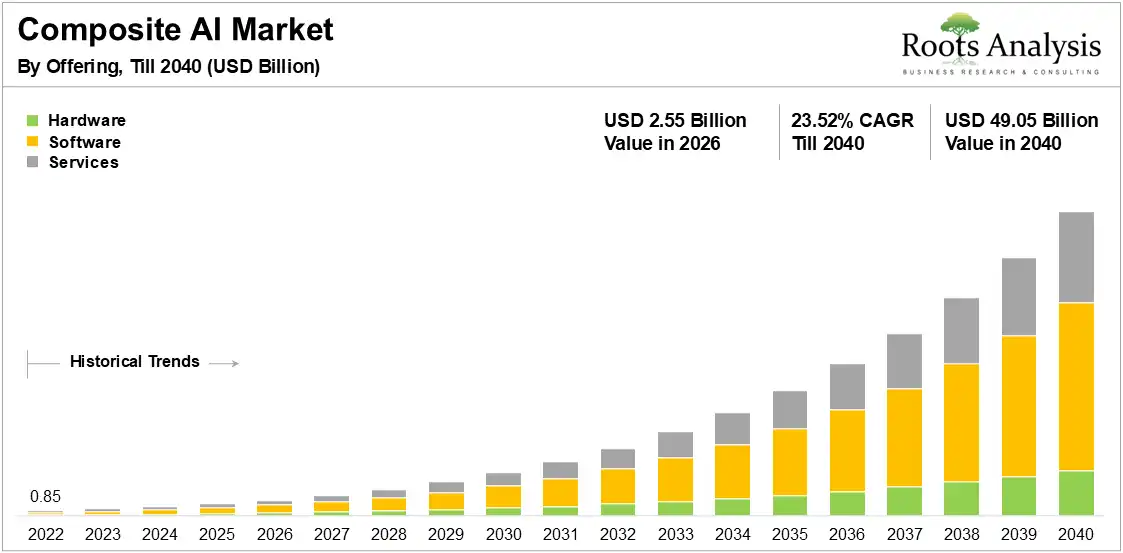
The global composite AI market size is projected to grow from USD 2.55 billion in 2026 to USD 49.05 billion by 2040, representing a CAGR of 23.52% during the forecast period 2026 to 2040.
See What’s in the Full Report – Request Your Complimentary Insights!
Market Report: Key Takeaways
- Based on offering, software dominates the market, capturing a 50.0% share in 2026, and is also projected to grow at a leading 24.3% CAGR through 2040 anchoring foundational enterprise algorithmic frameworks.
- In 2026, machine learning and data mining technique holds the largest share in the industry (35.0%), whereas knowledge graphs technique is poised to experience higher growth (26.5% CAGR) till 2040 mapping deterministic entity relationships for verifiable reasoning.
- As per the composite AI market share by applications, customer service maintains dominance (with 22.0% market share) in 2026, while simultaneously projecting faster growth at a leading 25.0% CAGR till 2040 automating hyper-personalized client engagement workflows.
- Global composite AI market forecast by deployment mode reveals that cloud architecture dominates the industry in 2026. Conversely, on-premises environments will experience an accelerated CAGR through 2040 securing localized computational governance and proprietary data sovereignty.
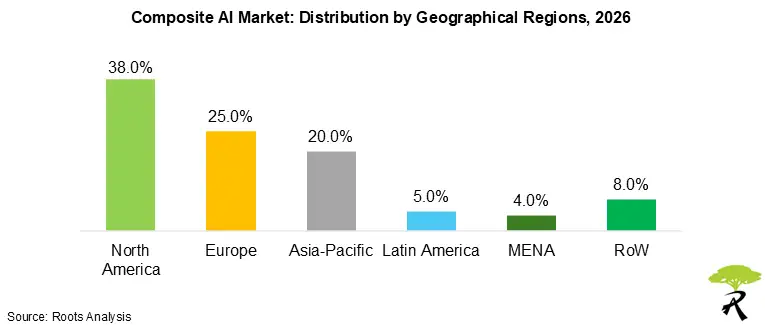
- Regionally, North America holds the largest share (38.0%) in 2026, while MENA showcases faster growth at a 26.1% CAGR till 2040 accelerating Greenfield sovereign AI infrastructure investments.
- In terms of market by vertical, BFSI secures the maximum share (18.5%) in 2026. Conversely, the composite AI market size in healthcare and life sciences sector is projected to experience rapid growth at a CAGR of 25.8% through 2040, propelling multi-modal precision diagnostics and clinical operational efficiencies.
Composite AI Market Outlook
The composite AI ecosystem aggressively transitions from isolated machine learning toward integrated, multi-technique architectures prioritizing deterministic reasoning. Enterprise deployments discard opaque statistical models, favoring modular frameworks fusing generative capabilities with symbolic logic. Synthesizing diverse methodologies directly secures interpretable intelligence for complex decision workflows demanding rigid rule-based consistency.
Aggressive transparency mandates under the EU AI Act directly propel the integration of explainable, multi-modal systems. Sovereign algorithmic compliance continuously accelerates hybrid deployments across industrial automation. In January 2025, Siemens embedded neuro-symbolic frameworks into digital twin platforms, enhancing manufacturing precision through verifiable logic dictated by strict data sovereignty requirements.
Accelerated market momentum thrives on the convergence of edge computing and autonomous operational workflows. Future innovations prioritize systems aligning specialized algorithmic techniques against distinct tasks. A 2026 precision oncology pilot synthesized genomic sequencing with clinical guidelines, delivering real-time treatment adjustments. This trajectory establishes composite frameworks as foundational enterprise intelligence.
Pay Only for What You Need – The Best Way to Optimize
Composite AI Market Size Estimation Methodology
- As a starting point, we categorized the composite AI ecosystem by its core functional integration of multiple artificial intelligence techniques, such as generative AI, symbolic reasoning, graph neural networks, and agentic workflows, designed to enhance complex decision-making and operational efficiency. We structured this analysis across key offerings, deployment models, and high-impact industry verticals like healthcare, financial services, and manufacturing.
- Next, we examined enterprise demand patterns and technology adoption cycles, evaluating the critical shift from monolithic AI models to sophisticated composite architectures. By mapping historical technology S-curves from previous paradigm shifts, such as deep learning and large language models (LLMs), alongside the growing enterprise mandate for explainable AI (XAI) and reduced computational costs, we established a robust baseline for adoption trajectories.
- Following this analysis, we gathered critical supply-side and demand-side metrics, including annual recurring revenue (ARR), consumption-based cloud pricing trends, and project-based service fees through primary research with Chief Technology Officers (CTOs), AI researchers, and enterprise procurement leads. We rigorously cross-validated these qualitative insights against secondary data, profiling the revenue streams and competitive positioning of pure-play AI vendors, hyperscalers, and specialized system integrators.
- Leveraging these triangulated data points, we calculated the global composite AI market size and projected the long-term commercial opportunity. This was achieved through a comprehensive hybrid methodology that combined a bottom-up aggregation of vendor revenues with a top-down assessment of the total addressable market (TAM) for advanced analytics, factoring in proprietary growth algorithms driven by hardware advancements, the proliferation of agentic AI applications, and decreasing data orchestration costs.
- The aggregate projected market value was then systematically distributed across distinct market segments, allocating revenue by offering, deployment mode, and specific industry verticals. Geographic distribution was meticulously mapped by evaluating regional R&D investment levels, localized digital infrastructure maturity, and the presence of stringent regulatory frameworks (such as the EU AI Act) that inherently favor the transparency and explainability delivered by composite AI systems.
- Finally, in order to assess the sensitivity of our assumptions, we conducted a multivariate sensitivity and scenario analysis (base, optimistic, and conservative) on some of the most important parameters of our forecast methodology, evaluating the potential market impacts of acute tech talent shortages, shifts in global semiconductor availability, and the risk of localized AI investment winters.
Composite AI Market Share Insights
Market Share by Techniques: Machine Learning and Data Mining Dominates the Industry while Knowledge Graphs to Grow Rapidly
- Machine learning and data mining holds a dominant 35.0% market share in 2026. This market growth trajectory is propelled by foundational requirements to execute predictive analytics across massive enterprise datasets. Decades of ecosystem maturity establish an irreplaceable infrastructure advantage, reducing computing costs through commoditized hardware.
- Furthermore, probabilistic outputs strongly satisfy stringent regulatory auditability mandates within finance and healthcare. For instance, Snowflake launched its Cortex AI platform in early 2026, seamlessly operationalizing unified governance and highly scalable enterprise machine learning workloads.
- Knowledge graphs represent the fastest growing sector, projecting a commanding 26.5% CAGR through 2040. This is driven by surging global demand for transparent, contextual reasoning across highly complex enterprise ecosystems.
- Aggressive regulatory pushes for explainable systems directly mandate deterministic architectures capable of resolving persistent semantic limitations. Advanced graph integrations unlock entirely new commercial applications in decision support. For instance, Neo4j launched its fully managed Aura Agent platform in April 2026, seamlessly orchestrating verifiable knowledge representations for scalable artificial intelligence workflows.
Which Applications Drive Demand in Composite AI Market?
- Customer service dominates composite AI applications, commanding a 22.0% market share in 2026, and is also projected to experience the rapid pace of growth till 2040. This market growth trajectory is propelled by aggressive regulatory mandates demanding highly efficient consumer operations. Scaling massive interaction volumes establishes an irreplaceable market barrier through immediate operational cost reductions.
- Furthermore, mature cloud architectures execute seamless natural language integration without requiring heavy internal infrastructure replacements. For instance, Zendesk deployed advanced agentic reasoning capabilities across its platform in April 2026, directly accelerating autonomous resolution scalability for major global enterprise software clients.
Want Information on Specific Region / Segment?
Composite AI Regional Market Outlook
North America Composite AI Market Captures the Largest Share in 2026
- North America dominates the industry, commanding a 38.0% share in 2026. This market growth is propelled by aggressive federal mandates prioritizing resilient infrastructure investments. Unparalleled hyperscale cloud capabilities establish a formidable ecosystem barrier by supplying advanced accelerator hardware essential for seamless multimodal AI scaling.
- Furthermore, concentrated technical research talent drives immediate commercialization outcomes. For instance, Microsoft announced major datacenter expansions in Wyoming during April 2026, directly scaling advanced regional infrastructure to handle exponential enterprise computing demands.
Composite AI Market Growth Rate in Asia-Pacific Region
- Asia Pacific represents the fastest growing regional sector, projecting a massive 25.4% CAGR through 2040. This is driven by explosive sovereign infrastructure funding alongside aggressive manufacturing digitization across emerging markets.
- Affordable computing access establishes deep structural barriers by rapidly converting localized startup initiatives into broad commercial ecosystems. For instance, Equinix launched an open artificial intelligence testing environment across Hong Kong in April 2026, seamlessly orchestrating localized testing capabilities to accelerate massive enterprise deployment frameworks across the entire economic region.
Composite AI Market Size in Healthcare and Life Sciences
- Projecting a massive 25.8% growth trajectory through 2040 the healthcare and life sciences sector aggressively scale intelligent diagnostic frameworks to satisfy surging demands for personalized precision medicine.
- Strict regulatory approvals now heavily favor algorithms capable of fusing complex multimodal clinical datasets. This dynamic establishes formidable commercial barriers converting isolated localized data into scalable enterprise intelligence. Merck directly capitalized on this compounding momentum finalizing a major commercial agreement with the Mayo Clinic during March 2026 to systematically orchestrate discovery pipelines.
Market Ecosystem Analysis
Composite AI Market Competitive Landscape
The composite AI ecosystem aggressively consolidates as industry pioneers fuse generative architectures with deterministic frameworks. Strategic acquisitions and massive infrastructure investments directly secure advanced operational capabilities. This fiercely competitive environment continuously accelerates hyper-personalized enterprise deployments, propelling sovereign algorithmic integration and bridging systemic gaps in mission-critical decision intelligence.
Established Top-Tier Ecosystem Players Scaling Hyperscale Composite AI Infrastructure
- Leading hyperscalers systematically consolidate global market dominance by leveraging strategic integrations and robust neuro-symbolic processing capabilities to aggressively optimize complex enterprise workloads. In October 2025, IBM strategically partnered with Anthropic to integrate Claude into its software portfolio, directly securing standardized frameworks for enterprise AI agents.
- Concurrently, Amazon Web Services launched Trainium3 hardware in December 2025 alongside autonomous operational agents, propelling large-scale retrieval-augmented generation (RAG) architecture. Furthermore, SAP aggressively advanced its software suite in March 2026 by acquiring Reltio. This targeted acquisition continuously accelerates the unification of multi-source enterprise data, definitively cementing data readiness for complex agentic AI applications.
Startup Innovation and Investments Accelerating Autonomous Composite AI Deployments
- Agile industry innovators continuously accelerate localized edge deployment capabilities, resolving critical algorithmic transparency bottlenecks while securely delivering disruption-proof cognitive computing frameworks. In January 2026, webAI secured a massive funding round led by Time Ventures, achieving a USD 2.5 billion valuation to aggressively scale its distributed, edge-native sovereign AI platform.
- Simultaneously, Kognitos fundamentally transformed business process automation by launching a neuro-symbolic platform in June 2025, synthesizing symbolic logic with machine learning to ensure deterministic intelligence. Furthermore, Liquid AI directly propelled non-transformer deployments by releasing the LEAP developer platform in July 2025, optimizing foundational models for localized mobile devices.
Composite AI Market Trends
Multi-Technique Algorithmic Architecture Innovations
- Enterprise deployments increasingly leverage neural-symbolic computing to resolve highly complex operational bottlenecks. Fusing deep learning and rule-based systems directly secures deterministic logic capabilities, enabling global organizations to scale autonomous workflows while ensuring rigid compliance across strictly regulated global healthcare environments.
- Synthesizing knowledge graphs and machine learning fundamentally transforms enterprise data architecture. This integration propels advanced semantic reasoning frameworks, bridging unstructured data lakes with relational context. Consequently, businesses achieve superior predictive accuracy, driving accelerated commercial outcomes and mitigating systemic operational risks.
Integrated AI Ecosystem Governance
- Deploying robust artificial intelligence orchestration platforms centralize algorithmic oversight across fragmented corporate infrastructures. These unified architectures continuously accelerate the adoption of decision intelligence systems, equipping executive stakeholders with verifiable, real-time commercial insights that ruthlessly optimize resource allocation and enterprise profitability margins.
- Mandating explainable AI (XAI) in composite systems ensures strict regulatory compliance alongside unparalleled algorithmic transparency. Executing causal AI integration directly amplifies the measurable impact of composite AI on supply chain optimization market value, definitively securing resilient disruption-proof global logistics networks.
Your Business is Unique – Why Shouldn’t Your Report Be?
Market Access Considerations
Composite AI Market Entry Prerequisite: Interoperability and Modular Standardization Constraints
Transitioning toward multi-technique intelligence demands rigorous interoperability across disparate frameworks. Single-vendor lock-in inflates integration costs, creating a high commercial threshold for new entrants. Establishing open modular architecture accelerates seamless API communication. Consequently, successful market penetration relies entirely on verifiable open-source compatibility rather than isolated proprietary algorithm dominance.
Commercial Viability in Composite AI Industry: Compute Economics and ROI Justification Barriers
High inference costs from concurrent algorithmic processing present a formidable economic barrier for mid-market expansion. However, fusing lightweight logic with heavy foundational models slashes operational inference expenses by up to 70%. Securing initial enterprise deployments therefore reveals that vendors must implement outcome-driven pricing structures demonstrating immediate, verifiable ROI.
Composite AI Market Expansion: Ecosystem Maturity and Integration Talent Prerequisites
Accelerated commercialization continuously stalls against a severe industry-wide engineering skills deficit. Orchestrating multi-modal workflows demands advanced system-level integration capabilities that internal corporate teams currently lack. To successfully penetrate new sectors, software vendors must cultivate robust channel partnerships, effectively bridging operational skill gaps to scale mission-critical enterprise deployments.
How Stakeholders Benefit from the Key Focus Areas of Our Composite AI Industry Report
The composite AI Market is gaining momentum as organizations increasingly combine multiple AI techniques to solve complex business problems and unlock higher-value outcomes. This report equips stakeholders with actionable insights to make informed strategic, investment, and technology decisions, while supporting commercialization and market expansion efforts. It provides a clear view of where value is emerging and how to capture it effectively.
- Unmet Needs and Market Gaps in Composite AI Market: The report identifies critical gaps between current AI capabilities and evolving enterprise requirements, highlighting areas where demand remains underserved. These insights help stakeholders pinpoint high-impact opportunities for innovation and differentiation. Strategy leaders can align product development with unmet demand, while investors can target segments with strong upside potential. This clarity supports faster commercialization and reduces the risk of misaligned investments.
- Funding and Venture Investment Opportunities in Composite AI Industry: A detailed analysis of investment activity, funding patterns, and capital allocation trends reveals where financial momentum is being built. Stakeholders gain visibility into high-growth segments attracting venture capital and strategic investments. This enables investors to assess risk-return profiles more effectively and helps companies align with capital flows. The insights also guide resource prioritization and long-term growth planning.
- Technology Innovation and Adoption Trends: An in-depth view of evolving technologies, integration models, and composite AI market growth drivers’ adoption highlights how this space is transforming enterprise workflows. Stakeholders can track which innovations are gaining traction and how they translate into real-world applications. This supports product leaders in prioritizing development roadmaps and accelerates adoption strategies. It also helps organizations stay ahead of disruption and capitalize on emerging trends.
- Composite AI Market Competitive Landscape and Industry Analysis: The report maps key players, emerging innovators, and competitive positioning across the ecosystem. It provides a clear understanding of market share dynamics, strategic moves, and differentiation strategies. Businesses can benchmark their capabilities and refine competitive positioning, while stakeholders identify potential acquisition or partnership targets. This enhances decision-making around market entry and expansion strategies.
- Mapping Strategic Partnerships and Ecosystem Synergies: The report examines strategic alliances, ecosystem collaborations, and co-innovation initiatives shaping the market. It identifies how partnerships are driving scalability, accelerating deployment, and expanding capabilities. Stakeholders can uncover opportunities to strengthen their ecosystem presence and access new markets. These insights enable more effective collaboration strategies and faster go-to-market execution.
- Composite AI Market Forecast and Geographic Expansion Opportunities: Comprehensive segmentation analysis provides clarity on demand patterns across industries, applications, and regions. Further, the report highlights cross-sectional composite AI regional market analysis, featuring high-growth geographies and segments with the strongest commercialization potential. Stakeholders can use these insights to prioritize target markets and tailor strategies to local dynamics. This supports efficient resource allocation and enhances global expansion planning.
Have Questions? Let’s Get Them Answered.
Composite AI Market: Scope of the Report
| Key Report Attributes | Details | |
| Forecast Period | Till 2040 | |
| Market Size 2026 | USD 2.55 Billion | |
| Market Size 2040 | USD 49.05 Billion | |
| CAGR (Till 2040) | 23.52% | |
| Segments Covered |
|
|
| Geographical Regions Covered |
|
|
| Key Sections Covered |
|
|
Composite AI Market Segmentation
The global composite AI industry report presents an in-depth analysis, highlighting the capabilities of various stakeholders, based on different segments such as offering, technique, application, deployment mode, vertical, geographical regions, and key players.
Market Share by Offering
- Hardware
- Memory Units
- Networks
- Processors
- Other Hardware
- Software
- AI Development Platforms and Tools
- AI Middleware
- Machine Learning Frameworks
- Other Software
- Services
- Support and Maintenance
- System Integration and Implementation
- Training and Consulting
Market Share by Techniques
- Computer Vision
- Knowledge Graphs
- Machine Learning and Data Mining
- Natural Language Processing (NLP)
- Symbolic AI / Rule-based AI
- Others
Market Share by Application
- Customer Service
- Fraud Detection
- Predictive Maintenance
- Product Design and Development
- Risk Management
- Security and Surveillance
- Others
Market Share by Deployment Mode
- Cloud
- On-Premises
Market Share by Vertical
- BFSI
- Energy and Utilities
- Government and Defense
- Healthcare and Life Sciences
- Manufacturing
- Media and Entertainment
- Retail and e-Commerce
- Telecommunications
- Transportation and Logistics
- Others
Market Share by Geographical Regions
- North America
- US
- Canada
- Mexico
- Rest of North America
- Europe
- Austria
- Belgium
- Denmark
- France
- Germany
- Ireland
- Italy
- Netherlands
- Norway
- Russia
- Spain
- Sweden
- Switzerland
- UK
- Rest of Europe
- Asia-Pacific
- Australia
- China
- India
- Japan
- New-Zealand
- Singapore
- South Korea
- Rest of Asia-Pacific
- Latin America
- Argentina
- Brazil
- Chile
- Colombia
- Venezuela
- Rest of Latin America
- Middle East and North Africa (MENA)
- Egypt
- Iran
- Iraq
- Israel
- Kuwait
- Saudi Arabia
- UAE
- Rest of MENA
- Rest of the World


