


 Download Free Sample
 Buy Now
Market Size
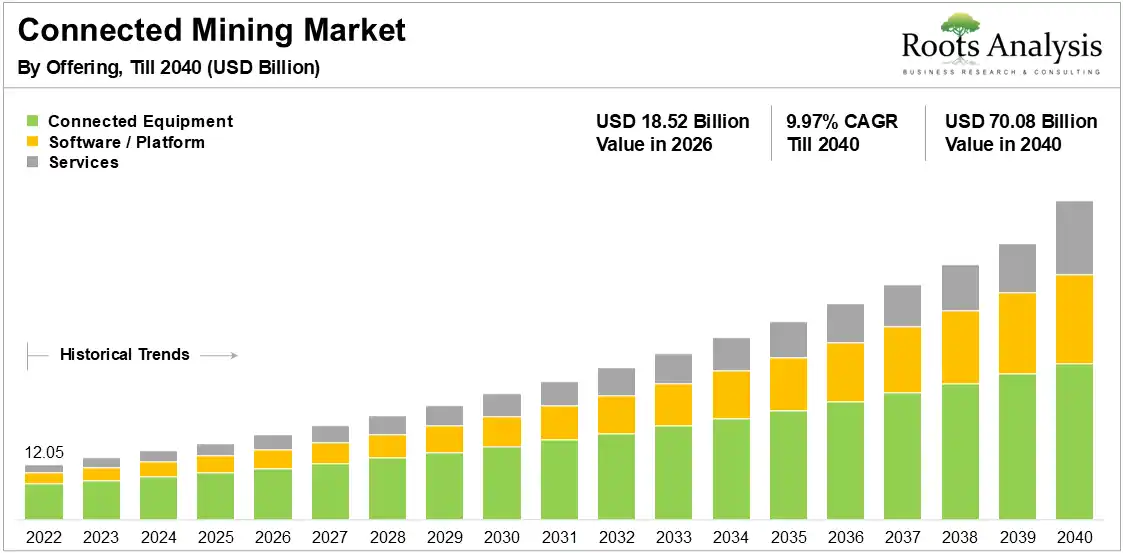
The connected mining market size is projected to grow from USD 18.52 billion in 2026 to USD 70.08 billion by 2040, representing a CAGR of 9.97% during the forecast period 2026 to 2040.
See What’s in the Full Report – Request Your Complimentary Insights!
Market Report: Key Takeaways
- In terms of offerings, connected equipment holds 63.8% in 2026 via hardware retrofits, while services project an 11.5% CAGR through 2040 as predictive analytics mature.
- Based on types of mining, surface extraction dominates at 81.5% in 2026, whereas underground operations expand faster at an 11.2% CAGR till 2040, driven by strict safety mandates.
- Within applications, processing & refining captures 52.5% in 2026 for yield optimization, though transportation & logistics exhibit a steeper 11.0% CAGR till 2040, fueled by autonomous fleet integrations.
- Amongst deployments, on-premises sub-segment holds the largest share of 52.1% in 2026, ensuring data security; meanwhile, cloud platforms display a faster 10.5% CAGR till 2040, enabled by robust 5G rollouts.
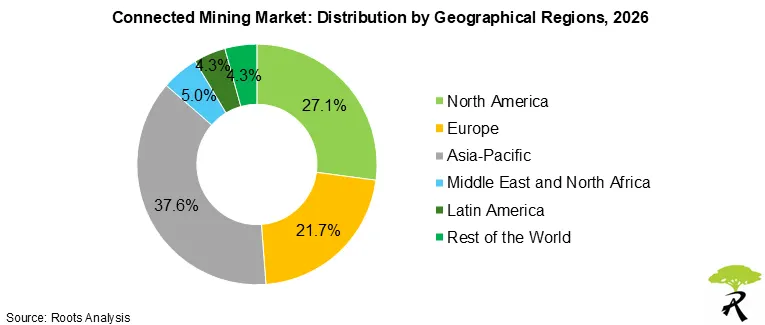
- Regionally, Asia-Pacific leads the 2026 market (37.6%) and future growth (11.5% CAGR till 2040), fundamentally driven by global macro mega-trends in battery mineral extraction for electrification.
Connected Mining Market Overview
The connected mining market is undergoing a fundamental structural shift, moving beyond fragmented technological deployments toward fully integrated digital ecosystems. Industry dynamics are now defined by the convergence of industrial IoT, 5G connectivity, and cloud analytics, replacing historically manual processes with real-time data flows that link site machinery to centralized control. Declining ore grades are accelerating this transition, compelling hardware vendors to reposition themselves as software-defined service providers. These market trends signal a sector reconfiguring its operational foundation, not merely upgrading its tools.
Stringent environmental regulations and decarbonization mandates are among the most consequential growth drivers reshaping investment priorities. Predictive maintenance and automated fleet management represent the highest-yield opportunity areas, further energized by rapid advances in adjacent telecommunications. Operators are deploying emissions-tracking systems in direct response to sustainability obligations. These adoption trends are already visible in practice, Nevada Gold Mines and Komatsu's July 2025 rollout of the connected FrontRunner Autonomous Haulage System demonstrates how fleet telemetry is simultaneously improving site safety and reducing carbon impact.
The market's growth outlook points firmly toward AI-driven, holistic mine design, replacing retrofit approaches with Day 0 infrastructure planning that embeds data systems before extraction begins. This forward shift reflects a broader industry consolidation trend; for instance, Caterpillar's October 2025 acquisition of RPMGlobal underscores the strategic pivot toward software-centric mine planning. As zero-entry protocols mature, the sector is positioned for sustained acceleration, transforming resource extraction into a highly automated, data-centric enterprise.
Pay Only for What You Need – The Best Way to Optimize
Connected Mining Market Size Estimation Methodology
- As a starting point, we established the market scope by identifying the core components of the connected mining ecosystem, including automation equipment, industrial IoT platforms, fleet management systems, and integration services, while systematically mapping distinct capital expenditure patterns and technology requirements across both surface and underground mining environments.
- Then we examined the demand dynamics and historical technology adoption cycles within the sector, evaluating mine operator strategies for digital transformation, driven by the need for enhanced worker safety, predictive maintenance, and operational yield improvements amid declining ore grades, to understand the transition rate from legacy, siloed equipment to fully integrated, data-driven mining ecosystems.
- Thereafter, we collected segment-wise hardware shipment volumes, software licensing metrics, and prevailing average selling price (ASP) trends through primary research with key industry stakeholders, including mining operations managers, technology vendors, and automation integrators. These inputs were cross-validated against supply-side data and secondary sources, such as vendor financial disclosures, global mining capital expenditure trends, and publications from industry associations.
- Using these data and insights, we calculated the global connected mining market size and projected the future market opportunity. This was achieved through a robust hybrid forecasting framework that triangulated bottom-up vendor revenue aggregations with top-down overall mining digital technology spend, factoring in critical growth multipliers like industrial 5G infrastructure rollouts, evolving safety regulations, and shifting global commodity demands.
- The overall opportunity associated with the global market was further distributed across distinct market segments, allocating demand by technological component, deployment environment, and key geographic regions driven by localized mining activity levels, technological readiness indices, and specific regional regulatory mandates.
- Finally, in order to assess the sensitivity of our assumptions, we conducted a multivariate sensitivity and scenario analysis (base, optimistic, and conservative) on some of the most important parameters of our forecast methodology, evaluating the potential impact of market uncertainties such as commodity price volatility, supply chain disruptions, and geopolitical resource shifts to establish a robust and defensible forecast range.
Connected Mining Market Share Insights
Market Share by Offering
- Connected equipment leads the connected mining market with a 63.8% share in 2026, driven by the capital-intensive deployment of IoT-enabled autonomous haul trucks, excavators, and drilling rigs that directly underpin productivity and worker safety across large-scale mining operations.
- Regulatory mandates for emissions tracking and ESG compliance, combined with electrification programs across Asia Pacific and North America, are reinforcing this equipment-centric build-out, with OEMs like Caterpillar and Komatsu actively scaling autonomous haulage systems in open-pit mines.
- Conversely, software / platform emerges as the fastest-growing sub-segment, projected to expand at an 11.0% CAGR through 2040, as operators shift toward cloud-hosted, AI-driven optimization platforms that consolidate asset tracking, energy management, and safety data. Platforms like AspenTech's Connected Mines solution exemplify this adoption trend, enabling scalable analytics without replacing core infrastructure; further signaling a structural shift toward recurring, software-driven revenue as green-field mines are increasingly designed as born-digital operations.
Connected Mining Market Size by Application
- Processing & refining holds the largest market share in the connected mining market, accounting for 52.5% in 2026, driven by its pivotal role in converting raw ore into high-value metals where connected technologies deliver immediate cost reductions across energy, reagents, and waste management. Mature plant infrastructure enables seamless IoT and AI integration, while stringent environmental regulations accelerate adoption of precise emissions monitoring systems. Established vendor ecosystems for mill optimization software further lower deployment barriers, reinforcing its dominant competitive position.
- Transportation & logistics emerges as the fastest-growing sub-segment, projected to expand at an 11.0% CAGR through 2040, fueled by rapid scaling of autonomous haulage systems and battery-electric trucks. BHP and Rio Tinto’s 2025 deployment of Caterpillar's first battery-electric haul trucks at Jimblebar mine signals accelerating electrification momentum. Digital logistics platforms enabling end-to-end mine-to-port tracking, combined with surging critical mineral demand, are reshaping adoption trends and redefining competitive dynamics across global mining operations.
Want Information on Specific Region / Segment?
Connected Mining Market by Geographical Regions
Asia-Pacific, The Digital-First Mining Hub, to Dominate the Market
- Asia-Pacific currently controls the largest and fastest-growing segment of the connected mining ecosystem, capturing a commanding 37.6% share in 2026. This trajectory is projected to reach 45.0% by 2040 at an 11.5% CAGR, and is driven by a massive, structural surge in demand for critical transition minerals required for electric vehicle batteries and renewable grids.
- To meet this macroeconomic pull, regional operators are breaking ground on new extraction sites across Australia, China, and India. Instead of retrofitting old machinery, these companies are deploying AI and IoT solutions from day one. Backed by strict government modernization mandates and a rapidly strengthening local manufacturing base, these early technological pilots are successfully graduating into full-scale, highly profitable commercial operations.
North America to Capture 2nd Largest Share in 2026
- North America holds the second largest share (27.1%) of the 2026 global market. The region commands the most mature digital infrastructure in the sector, and its strategy revolves around extracting maximum value from existing, heavily regulated sites. Capital flows aggressively into enterprise digital twins, predictive analytics, and private 5G networks to connect older machinery.
- For North American operators, the primary competitive moat lies in system integration; successfully overlaying modern IoT architectures onto legacy supply chains yields immediate, massive cost savings. Equipment vendors are directly supporting this retrofit strategy by releasing advanced analytics platforms, such as Hitachi Construction Machinery’s April 2025 launch of its real-time digital monitoring ecosystem, designed to track asset health and prevent costly downtime.
Market Ecosystem Analysis
Connected Mining Market Competitive Landscape
The connected mining ecosystem is rapidly consolidating around two distinct competitive vectors. Legacy equipment manufacturers are acquiring software capabilities to defend established infrastructure footprints, while agile technology startups pioneer highly specialized, AI-native solutions to disrupt niche segments like genomic extraction and GPS-denied subsurface mapping.
Top Enterprises and Their Recent Updates
Tier-1 equipment and network vendors are fiercely fortifying competitive moats by aggressively expanding interoperability and mining automation capabilities. A primary catalyst is the integration of heavy machinery with agnostic telemetry systems. For example, in March 2026, Epiroc launched a next-generation charging solution explicitly engineered for OEM-agnostic underground mining electrification, resolving critical infrastructure bottlenecks for mixed-fleet operations.
Simultaneously, legacy OEMs are proving the commercial scalability of autonomous haulage systems. Caterpillar recently documented a major operational milestone, with its autonomous Cat 777 fleet successfully hauling over one million tons at a Virginia quarry, demonstrating unparalleled operational continuity. Network providers are equally pivotal; 2026 intelligence confirms Nokia successfully deployed private LTE using the 700 MHz band at Salinas Gold in Brazil. This deployment anchors the essential mission-critical connectivity required to support highly automated, data-intensive industrial mining environments globally, raising the barriers to entry for unintegrated market technology participants.
Startup Activity and Innovation Landscape
The startup ecosystem is bypassing heavy hardware entirely, focusing strictly on resolving highly specific data extraction and mineral recovery inefficiencies. This agility creates immediate, low-capex integration opportunities for major miners. A standout early 2026 catalyst is Endolith, which won the Best Startup at the Global Mining Technology Awards for deploying engineered microbial intelligence platforms. This precision biology integrates seamlessly into existing heap-leach operations, drastically improving critical mineral recovery without massive infrastructure retrofits.
In the spatial intelligence domain, Exyn Technologies successfully deployed its Nexys modular reality capture ecosystem. This platform delivers critical 3D mapping and Simultaneous Localization and Mapping autonomy specifically built for complex, GPS-denied subterranean environments. Similarly, 2026 data from firms like Plotlogic highlights real-time material characterization scanners that provide quantitative, decision-ready ore chemistry data in under fifteen minutes. These hyper-focused innovations structurally transform how raw subterranean data translates into immediate yield optimization and enhanced commercial returns.
Connected Mining Market Trends & Emerging Opportunities
Autonomous Edge Capabilities & Proactive Risk Mitigation
The rapid integration of autonomous haulage systems (AHS) establishes a definitive operational moat for modern extraction sites. By embedding edge computing in remote mining operations, companies eliminate critical latency, enabling high-tonnage driverless fleets to navigate hazardous terrains with continuous, millisecond-level precision.
This localized processing architecture serves as the foundation for broader Mining 4.0 technological adoption. Recent 2025 deployments in Western Australia demonstrate that migrating AI decision-making directly onto heavy machinery guarantees uninterrupted productivity, actively slashing site downtime while aggressively compressing long-term capital expenditure.
Telemetry Optimization & Environmental Awareness
Beyond fleet navigation, the sector is aggressively pivoting toward predictive maintenance for mining equipment. Through continuous telemetry and vibration analysis, integrated sensors dynamically forecast mechanical failures before they disrupt operations. Equipment vendors now leverage these advanced digital twins to optimize strict maintenance schedules.
This proactive monitoring inherently reinforces smart safety and security systems in mining. Deep learning networks now automate personal protective equipment compliance and hazardous zone geofencing. Further, these sophisticated environmental awareness tools effectively prevent severe accidents and streamline rigid regulatory audits.
Your Business is Unique – Why Shouldn’t Your Report Be?
Market Access Considerations
Infrastructure Readiness and Remote Connectivity
Reliable communication infrastructure, such as private 5G networks and LEO satellite connectivity, is the foundational prerequisite for deploying connected mining technologies. Because most mining operations are located in harsh, remote environments with limited existing telecom networks, inadequate connectivity acts as a primary structural barrier to market entry and adoption. Vendors that can partner with telecom operators to offer bundled, low-latency connectivity solutions significantly accelerate their commercialization efforts by guaranteeing continuous uptime. Consequently, the market structure heavily favors large-scale technology integrators over standalone software providers, as mining operators demand end-to-end solutions capable of supporting mission-critical autonomous systems.
Capital Intensity and ROI Justification
The transition to connected mining involves substantial upfront capital expenditure to retrofit legacy machinery with IoT sensors, edge computing hardware, and automated control systems. This high-cost structure inherently delays rapid adoption, forcing technology providers to clearly demonstrate rapid return on investment through improved yield, reduced downtime, or lower fuel consumption to secure procurement approvals. As a result, commercialization often relies on phased implementations or hardware-as-a-service (HaaS) pricing models to lower the initial financial barrier for cyclical, capex-sensitive mining firms. This dynamic restricts competitive participation primarily to well-capitalized vendors capable of absorbing extended sales cycles and funding initial pilot projects.
Cybersecurity and Critical Infrastructure Regulation
As mining operations become increasingly digitized and autonomous, they evolve into prime targets for cyberattacks, subjecting them to stringent national security and data sovereignty regulations. This regulatory environment dictates that technology providers must achieve rigorous, market-specific cybersecurity certifications before their systems can be commercially deployed within a mine's operational technology (OT) network. Navigating these compliance requirements lengthens market entry timelines and elevates the baseline cost of product development, particularly for cross-border technology deployments. Vendors with native, enterprise-grade OT security architectures gain a distinct competitive advantage, creating a high barrier to entry that prevents smaller, generic IoT startups from effectively penetrating the market.
Workforce Transformation and Labor Dynamics
The deployment of connected mining solutions directly disrupts traditional operational workflows, requiring a fundamental shift from manual labor to highly skilled data analysis and remote system management. This workforce transformation often encounters localized resistance from labor unions concerned about job displacement, which can significantly stall procurement decisions and delay widespread technology adoption at the site level. To commercialize effectively, vendors must bundle their technological offerings with comprehensive change-management and upskilling programs to secure buy-in from both corporate management and site workers. This socio-economic barrier shapes the competitive landscape by rewarding technology partners who act as holistic operational consultants, effectively locking out vendors who treat deployment purely as an IT installation.
How Stakeholders Benefit from the Key Focus Areas of Our Connected Mining Market Report
The connected mining sector is undergoing rapid digital restructuring, driven by volatile commodity pricing, stringent environmental mandates, and the urgent need for operational expenditure reduction. This intelligence equips decision-makers to confidently navigate high-capital infrastructure investments, evaluate fleet automation opportunities, and align corporate strategies with true commercial momentum.
- Unmet Needs and Market Gaps in Connected Mining Industry: The report highlights severe interoperability bottlenecks between legacy extraction fleets and modern cloud architectures. Product leaders receive a precise roadmap of underserved pain points, particularly in subterranean network reliability and unified data visualization, guiding highly targeted, high-return digital investments.
- Technology Innovation and Adoption Trends: This section Analyzes the commercialization velocity of edge-offloaded robotics, private 5G networks, and AI-driven predictive maintenance. Technology officers can distinguish between experimental concepts and proven enterprise-grade solutions, ensuring capital is deployed toward innovations demonstrating measurable supply chain optimization and uptime.
- Connected Mining Market Landscape and Competitive Dynamics: The report evaluates the shifting power dynamics between traditional heavy equipment manufacturers and agile industrial technology providers. Strategy teams gain critical context to benchmark corporate positioning, anticipate OEM consolidation, and assess where proprietary software ecosystems create defensible operational moats.
- Funding and Investment Landscape in Connected Mining: The report tracks heavy capital flows into industrial IoT startups, strategic mining technology acquisitions, and private equity maneuvers. Financial stakeholders leverage this intelligence to benchmark valuation trends, track early-stage automation funding, and identify scalable platforms capturing verified institutional backing.
- Partnership and Collaboration Trends in Connected Mining Sector: The report analyzes the key alliances forming between telecom providers, system integrators, and major excavation firms to deploy autonomous networks. Business development units can identify lucrative go-to-market channels and structure joint ventures that systematically eliminate large-scale implementation friction.
- Connected Mining Market Demand Segmentation and Geographic Coverage: Segments operational demand across surface, underground, and processing applications while contrasting mature North American retrofit cycles with explosive Asia-Pacific greenfield developments. Expansion leaders gain granular geographic intelligence to sequence market entry based on digital readiness and infrastructure maturity.
Have Questions? Let’s Get Them Answered.
Connected Mining Market: Scope of the Report
| Key Report Attributes | Details | |
| Forecast Period | Till 2040 | |
| Market Size 2026 | USD 18.52 Billion | |
| Market Size 2040 | USD 70.08 Billion | |
| CAGR (Till 2040) | 9.97% | |
| Segments Covered |
|
|
| Geographical Regions Covered |
|
|
| Key Sections Covered |
|
|
Market Segmentation
The connected mining market report presents an in-depth analysis, highlighting the capabilities of various stakeholders, based on different segments such as offering, type of mining, application, deployment mode, geographical regions, and key players.
Market Share by Offering
- Connected Equipment
- Software / Platform
- Asset Tracking and Monitoring Software
- Automation and Control Software
- Data Analytics and Visualization Software
- Fleet Management Software
- Mine Operations Management Platform
- Predictive Maintenance Software
- Safety and Environment Monitoring Software
- Services
Market Share by Type of Mining
- Surface Mining
- Underground Mining
Market Share by Application
- Exploration
- Processing & Refining
- Transportation & Logistics
Market Share by Deployment Mode
- Cloud-based
- On-premises
- Hybrid
Market Share by Geographical Regions
- North America
- US
- Canada
- Mexico
- Rest of North America
- Europe
- Austria
- Belgium
- Denmark
- France
- Germany
- Ireland
- Italy
- Netherlands
- Norway
- Russia
- Spain
- Sweden
- Switzerland
- UK
- Rest of Europe
- Asia-Pacific
- Australia
- China
- India
- Japan
- New-Zealand
- Singapore
- South Korea
- Rest of Asia-Pacific
- Latin America
- Argentina
- Brazil
- Chile
- Colombia
- Venezuela
- Rest of Latin America
- Middle East and North Africa (MENA)
- Egypt
- Iran
- Iraq
- Israel
- Kuwait
- Saudi Arabia
- UAE
- Rest of MENA
- Rest of the World


