


 Download Free Sample
 Buy Now
Market Outlook
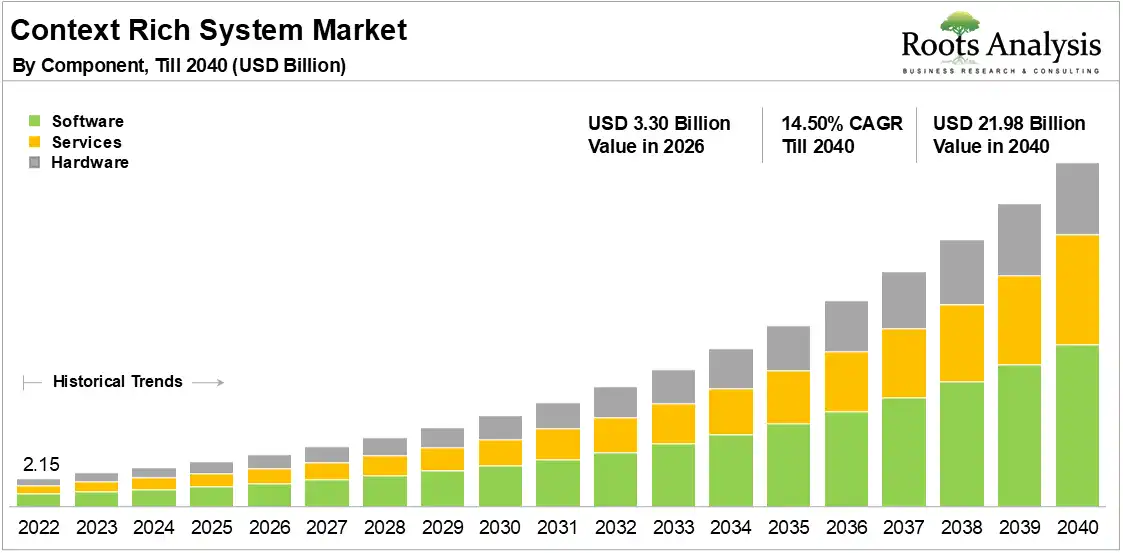
The global context rich system market report, valued at USD 3.30 Billion in 2026, is forecasted to reach USD 21.98 Billion by 2040, with 14.50% compounded annual growth rate (CAGR) during the forecast period 2026 to 2040.
See What’s in the Full Report – Request Your Complimentary Insights!
The context rich system (CRS) market refers to solutions that interpret real-time environmental signals to deliver personalized, adaptive responses for users or automated systems. The scope spans sensing hardware, data fusion layers, and artificial intelligence (AI) / machine learning (ML) engines that combine inputs such as location, time, activity, and surrounding conditions to infer intent and act proactively. Market value focuses on elevating user experience, boosting operational efficiency, enabling predictive automation across connected, and multi-industry environments.
Context rich system market growth drivers are led by the rapid scaling of IoT deployments and growing demand for personalized digital experiences. Adoption is strongest across consumer electronics, healthcare remote monitoring, and industrial automation where context-aware systems enable predictive maintenance and operational intelligence. The market is increasingly shifting from reactive execution to proactive, analytics-driven assistance, supporting real-time risk assessment, improved asset reliability, and streamlined enterprise operations.
Innovation trends point toward greater use of edge computing and multimodal data fusion, allowing faster decisions at the point of interaction. The market is moving toward ambient intelligence models in which devices learn user habits and execute actions seamlessly. This direction is reinforced as major platform providers invest in combining generative AI with contextual data, supporting a positive industry outlook anchored in scalable, and proactive automation for complex environments.
Key Takeaways
- Leading Players Competitive Footprint: Top key players like Amazon, ARM, Augmedics, Bosch, Contextflow, Everactive, Google, Hitachi, Huawei, IBM, Intel, Kognition, Microsoft, NVIDIA, NXP, Oracle, Palantir Technologies, Qualcomm, Samsung, and SAP hold strong market positions with extensive geographic presence in various regions.
- Startup Ecosystem and Innovation Hotspots: Early-stage companies are focusing on addressing surging demand for hyper-personalized experiences through AI-driven contextual analytics, edge computing integration, and targeted pilots in high growth sectors (like healthcare and retail). Companies are making advancements in this space. For instance, Everactive released new self-powered sensor solutions for industrial IoT applications, enabling continuous contextual data collection in locations previously unreachable due to battery limitations.
- Regional Penetration and Adoption Trend: Rapid industrialization, rising infrastructure investments, and expanding smart city projects drive context rich system (CRS) adoption in Europe. Notably, pilot scale deployments in the Netherlands and France are accelerating regional growth. Demand stems from EU subsidies and AI/IoT R&D initiatives supporting hyper-personalized applications.
- Cloud holds Highest Market Segment: In deployment mode, cloud holds the maximum market share of 65% in 2026. The market has been expanding, supported by ongoing migration to cloud-native analytics, remote accessibility requirements, and the economics of pay-as-you-go models.
- Opportunities in the CRS market are unlocking new growth through vertical integration in precision medicine and healthcare, where contextual intelligence enables personalized care and improved outcomes. Expanding use of digital twins is creating value by supporting dynamic simulation, optimization, and real-time decision-making across complex environments. At the same time, growing adoption in Industrial IoT and predictive maintenance is driving demand for proactive, context-aware operational systems.
- Funding and Investment Momentum: The CRS industry sees growing investment momentum with capital increasingly directed toward AI-driven context analytics, edge and IoT integration, and scalable platform development. Funding from venture capital, private equity, and government-backed digital innovation programs is supporting pilot deployments, enterprise-scale implementations, and cross-industry adoption, particularly in healthcare, industrial automation, and smart infrastructure.
Recent Industry Developments
- March 2025: Meta announced the reintroduction of the "Friends" tab to enhance user engagement by prioritizing content from users' friends over algorithmically suggested posts. This move aims to foster more meaningful social interactions, aligning with Facebook's foundational mission.
- March 2025: Google introduced its updated AI model Gemini 2.5, which reportedly surpasses other leading models on various benchmarks. This model aims to enhance Google's AI capabilities, particularly in providing more context-awareness and reasoning functionalities, positioning the company competitively in the AI landscape.
- March 2025: The US food and drug administration (FDA) issued new guidance detailing a framework for regulating AI/ML-based software as a medical device (SaMD), addressing the need for contextual awareness and adaptability in healthcare technology.
- May 2024: Percepto announced securing $3 million in funding to accelerate the development of its AI platform for industrial safety solutions enhancing real-time contextual awareness for autonomous operations.
Pay Only for What You Need – The Best Way to Optimize
Market Dynamics
Key Market Drivers
- Proliferation of IoT Devices and Ubiquitous Sensing: The rapid expansion of connected sensors and IoT-enabled devices across consumer, industrial, and infrastructure environments is generating continuous streams of real-time contextual data. Inputs such as location signals, environmental parameters, and behavioural indicators form the foundation for context rich systems, enabling applications to evolve from reactive responses to proactive, situation-aware decision-making.
- Advancements in Edge Computing and AI Inference: Context rich system industry trends indicate a clear shift toward edge computing architectures and purpose-built AI inference hardware, enabling contextual processing closer to the data source. This transition reduces latency, minimizes reliance on centralized cloud infrastructure, and enhances data privacy, making real-time contextual intelligence viable for latency-sensitive and mission-critical applications.
- Growing Demand for Hyper-Personalized User Experiences: Across consumer and enterprise environments, demand is rising for services that adapt in real time to individual context. Context-rich systems enable a shift from static segmentation to personalized engagement, driving higher retention, more relevant interactions, and greater operational agility.
- Convergence of Technologies for Immersive Environments: Context-Aware computing market research highlights the convergence of context rich systems with digital twins, augmented reality (AR), and conversational interfaces as a key enabler of more immersive and intuitive digital environments. Contextual intelligence provides the situational awareness necessary to accurately align digital overlays with physical realities and to support natural, multimodal human–machine interactions.
Market Restraints
- Complex Interoperability and Ecosystem Fragmentation: The absence of consistent standards across sensors, data formats, and platforms creates fragmentation within the CRS ecosystem. Integrating heterogeneous data sources often demands custom development and complex integration layers, limiting scalability and increasing both deployment timelines and total cost of ownership.
- High Cost of Implementation and Infrastructure Investment: IoT contextual data processing requires significant upfront investment in sensing hardware, edge computing infrastructure, data fusion platforms, and advanced model development. These capital expenditures, along with ongoing operational costs, create high entry barriers particularly for organizations with limited budgets or constrained technical capabilities.
- Data Privacy Concerns and Regulatory Hurdles: Context rich systems process highly sensitive personal and behavioral data, making them directly subject to strict data protection and privacy regulations. Compliance obligations limit data utilization, increase governance complexity, and elevate implementation costs, while inadequate transparency in data practices can undermine user trust.
- Challenges in Data Quality and Contextual Ambiguity: Predictive analytics for contextual systems is challenged by real-world sensor data that is often inconsistent, incomplete, or conflicting. Integrating multiple data streams into accurate and reliable context models remains technically complex, and persistent data quality issues can reduce system performance and erode user confidence.
Market Share Insights
Market Share by System Type: Indoor Context Rich System Holds the Largest Market Share
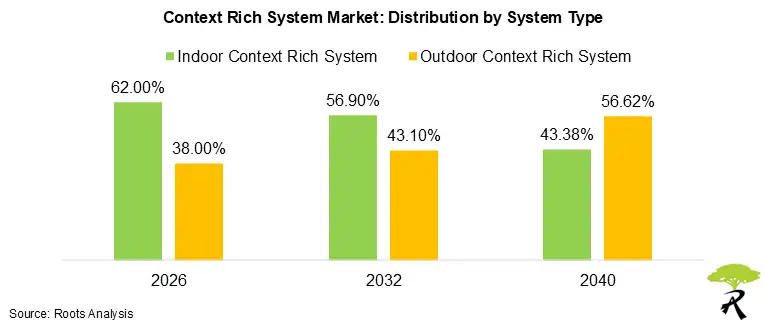
- According to our context rich system market analysis, Indoor context rich system holds the largest market share of 62% in 2026. Growth is driven by dense deployments in controlled environments such as (retail stores, hospitals, offices, and financial institutions) where accuracy and reliability of contextual data are critical.
- There is a growing industrial demand driven by evolution of smart manufacturing, labor shortages, and the need for hyper-efficient supply chains.
- Context rich system market forecasts indicate growing demand for AI-driven, context-aware solutions, with indoor CRS playing a critical role in enabling the real-time visibility required for mass customization. The rapid expansion of e-commerce has further accelerated adoption, rendering manual warehouse management increasingly obsolete.
- Installed indoor systems form the current foundation of the market, while a rapidly expanding outdoor opportunity is emerging, driven by infrastructure modernization initiatives and accelerating urban digitalization efforts among key industry players. For example, Microsoft introduced new capabilities for Azure digital twins, including 3D visualization and enhanced data integration to enable more comprehensive context rich simulations for industrial and building environments.
Market Share by Geographical Regions: North America to Dominate the Industry While Asia-Pacific Growing Rapidly through 2040
- The regional context rich system market forecast for North America suggests that it holds the largest market share of 38% while Asia-Pacific is also expected to witness the fastest CAGR.
- North America’s dominance is due to its early enterprise adoption, strong presence of technology leaders, and sustained investment in AI and context driven platforms across industries.
- Context rich system market overview and outlook indicates that Asia-Pacific is the fastest-growing region, projected to expand at a CAGR of 9.20%, driven by rapid digital infrastructure development, increasing smartphone penetration, and strong government leading smart city and digital transformation initiatives. This positive outlook is further supported by clear deployment momentum across major economies, positioning the region ahead of Europe, Latin America and the rest of the world in terms of long-term growth potential.
Want Information on Specific Region / Segment?
Market Ecosystem Insights
Leading Players Competitive Footprint
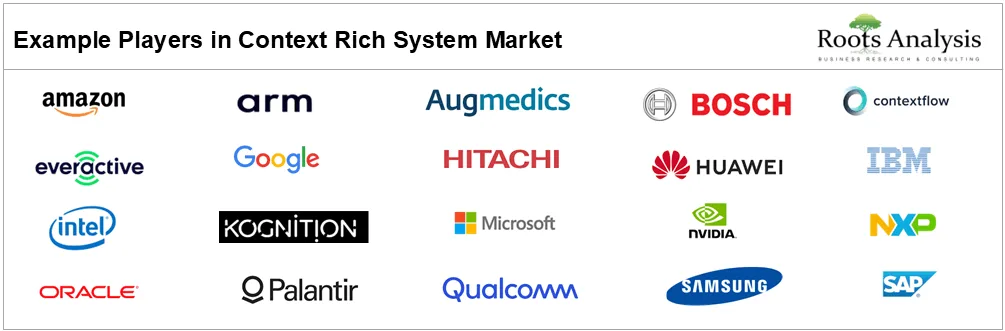
Competitive landscape of context rich system key players include Amazon, ARM, Augmedics, Bosch, ContextFlow, Everactive, Google, Hitachi, Huawei, IBM, Intel, Kognition, Microsoft, NVIDIA, NXP, Oracle, Palantir Technologies, Qualcomm, Samsung, SAP which hold strong market positions through their extensive product portfolios and global reach.
Collaborations, commercial developments and expansions remain key growth strategies, with players accelerating innovation, market penetration, and scalability. For instance, Microsoft announced new Copilot features for Microsoft 365 and Teams, integrating real-time context from user interactions and meeting content to provide adaptive, personalized assistance during work activities.
Similarly, NVIDIA introduced advancements in its Omniverse platform, leveraging contextual data and AI to build industrial digital twins that accurately simulate complex environments for optimization. This expansion is intended to primarily accelerate the commercial scalability of the technology and its integration into multi-purpose resource platforms.
Startup Activity and Innovation Hotspots
The startup activity within the context rich system competitive landscape analysis is rapidly evolving with early-stage companies pioneering disruptive applications, primarily focused on agentic AI architecture and the orchestration of context aware digital twins. Current innovative efforts emphasize the development of hybrid industrial context platforms capable of combining real-time operational telemetry with predictive reliability and performance models.
Recent launches in context rich system are focusing on market-ready products supported by strategic partnerships, standardized components, and pilot projects that showcase operational benefits in real-world environments. For instance, Sensei secured funding for its AI-powered retail platform, which utilizes computer vision and sensor fusion to provide real-time contextual data on store operations, inventory, and customer behavior to improve efficiency and reduce loss.
Additionally, there are other startups such as those providing technological advancements and innovations as the Kognition announced new features for its AI-based physical security platform focusing on integrating various sensor data sources (video, access control, and IoT) to create “contextual security digital twins” for enterprise customers.
Funding and Investment Momentum
The context rich system market has shifted from experimental venture capital to structural, large-scale institutional investment from utility giants, and sovereign wealth funds.
Funding initiatives are increasingly shifting beyond early-stage validation toward enabling industrial scale deployment of context-rich systems as critical enablers of efficiency and resilience across infrastructure-intensive applications. Public funding, including support from the European Commission, is being directed toward projects that advance core CRS technologies such as intelligent sensing architecture, adaptive system designs, and advanced material platforms to improve system performance, reliability, and real-time contextual optimization.
In addition, government initiatives and grants predominantly support sustainability-focused innovations by companies. For instance, Augmedics raised USD 8 million in funding to support the expansion of its product commercialization efforts across the US market. Similarly, Siemens acquired Senseye to strengthen Siemens industrial IoT portfolio by integrating advanced contextual data analytics capabilities into the MindSphere platform.
Your Business is Unique – Why Shouldn’t Your Report Be?
Context Rich System Market: Scope of the Report
| Key Report Attributes | Details | |
| Historical Trend | Since 2022 | |
| Forecast Period | Till 2040 | |
| Market Size 2026 | $ 3.30 Billion | |
| Market Size 2040 | $ 21.98 Billion | |
| CAGR (Till 2040) | 14.50% | |
| Segments Covered |
|
|
Market Segmentation
Based on the research, we have segmented the context rich system market into component, deployment mode, system type, application, geographical regions, and key players.
Market Share by Component
- Hardware
- Services
- Software
Market Share by Deployment Mode
- Cloud
- On-premise
Market Share by System Type
- Indoor Context Rich System
- Outdoor Context Rich System
Market Share by Application
- BFSI
- Healthcare
- Logistics
- Retail
- Telecommunication
Market Share by Geographical Regions
- North America
- US
- Canada
- Mexico
- Rest of North America
- Europe
- Austria
- Belgium
- Denmark
- France
- Germany
- Ireland
- Italy
- Netherlands
- Norway
- Russia
- Spain
- Sweden
- Switzerland
- UK
- Rest of Europe
- Asia-Pacific
- Australia
- China
- India
- Japan
- New-Zealand
- Singapore
- South Korea
- Rest of Asia-Pacific
- Latin America
- Brazil
- Chile
- Colombia
- Venezuela
- Rest of Latin America
- Middle East and Africa (MEA)
- Egypt
- Iran
- Iraq
- Israel
- Kuwait
- Saudi Arabia
- UAE
- Rest of MEA


