


 Download Free Sample
 Buy Now
Market Size
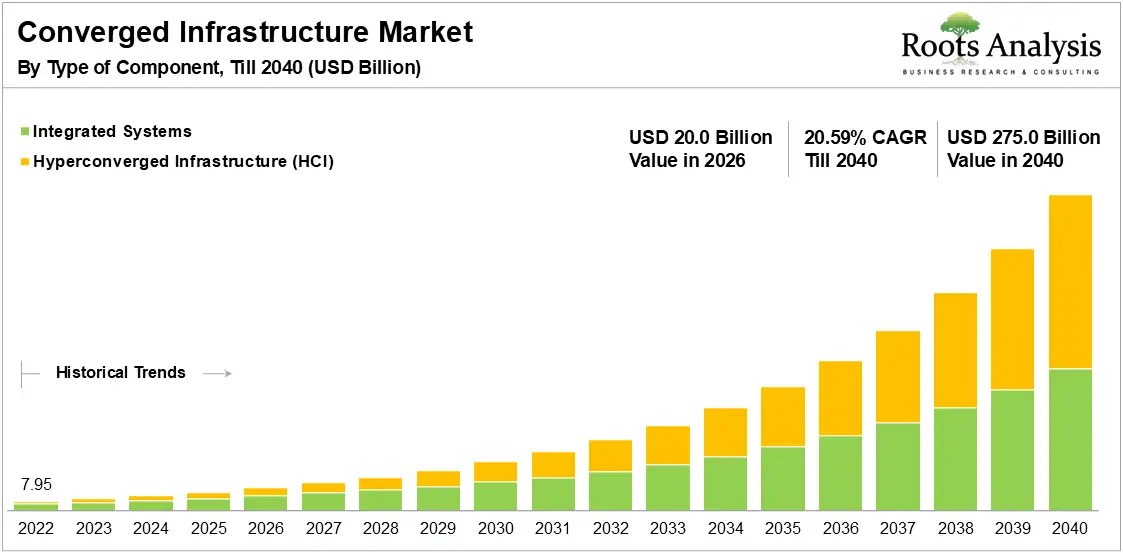
The global converged infrastructure market is projected to reach USD 20.0 billion in 2026 and USD 275.0 billion by 2040, representing a CAGR of 20.59% during the forecast period 2026 to 2040.
See What’s in the Full Report - Request Your Complimentary Insights!
Market Report: Key Takeaways
- Leading Players Competitive Footprint: The converged infrastructure (CI) competitive landscape features companies, such as Dell Technologies, Microsoft, Cisco Systems, HPE, and Broadcom, that are emphasizing technological innovations and strengthening partnerships to expand global presence.
- Innovation Hotspots: The critical technology inflection points reshaping converged infrastructure industry are AI-Ops integration, NVMe / TCP storage architecture, CXL memory pooling, GPU-accelerated CI nodes for generative AI workloads, and edge-optimized CI deployments.
- Regional Penetration Trends: The global converged infrastructure market exhibits distinct regional growth profiles, shaped by varying levels of digital maturity, government investment, enterprise IT spending, and regulatory frameworks. North America leads in absolute market share, while Asia-Pacific commands the highest CAGR, a divergence that creates differentiated investment and deployment opportunities for market participants.
- Market Growth Across End User Industries: IT and telecom sector holds the largest converged infrastructure market share. The global 5G subscriber base surpassing 2 billion connections by 2026 (GSMA) has compelled telecom operators to deploy dense CI node clusters at network edge locations to support ultra-low-latency application delivery.
Market Overview
The converged infrastructure market is undergoing a decisive transition as market trends shift from hardware-centric consolidation toward software-defined architectures. Industry dynamics increasingly favor flexible environments that support hybrid operations rather than tightly integrated legacy stacks. Enterprises are accelerating adoption trends that enable unified management across private data centers and public clouds, reflecting a broader modernization agenda. As traditional vendors face pressure from hyperconverged solutions emphasizing scalability and integration, organizations prioritize operational simplicity and improved resource efficiency to support ongoing digital transformation initiatives.
Maret growth drivers center on expanding hybrid cloud strategies and rising demand for distributed computing capabilities across multiple industries. Meanwhile, opportunities continue to expand as infrastructure requirements evolve to handle advanced workloads, including generative AI training and inference at decentralized locations. A recent example from 2026 highlights retailers deploying hyperconverged systems in stores to enable real-time inventory analytics, illustrating how ecosystem collaboration is shaping infrastructure investment priorities and influencing broader industry dynamics.
The growth outlook of converged infrastructure industry points toward deeper automation and architectural flexibility as converged systems shift toward composable infrastructure models. Future market trends emphasize disaggregated compute and storage resources that allow dynamic scaling aligned with workload needs. Artificial intelligence–driven operations are expected to strengthen infrastructure management through automated provisioning and optimization. Forward-looking product developments in 2026 demonstrate platforms introducing AI-based self-optimization capabilities, signalling a transition toward highly automated, software-defined environments that redefine long-term infrastructure strategy.
Pay Only for What You Need – The Best Way to Optimize
Market Size Estimation Methodology
- As a starting point, we identified core components of the converged infrastructure market, including compute, storage, and networking, along with key form factors such as integrated systems and reference architectures.
- We then assessed IT spending, infrastructure modernization cycles, and adoption trends to gauge market appetite, and adoption trends across major industries.
- Thereafter, the technology adoption lifecycle was evaluated to understand early adoption, mainstream deployment stages, and potential maturity levels, while also examining competition between traditional infrastructure, converged solutions, and alternative platforms.
- Based on the information collected in previous steps, we calculated the global converged infrastructure market using a hybrid modeling approach (combining both bottom-up for adoption rates and top-down for CAPEX validation) and projected its future growth till 2040.
- The overall market opportunity was distributed across different segments, such as type of component, type of deployment model, application, enterprise size, end user industry, geographical regions, and key players.
- Finally, in order to assess the sensitivity of our assumptions, we conducted a multivariate sensitivity analysis on some of the most important parameters of our forecast methodology.
Converged Infrastructure Market Share Insights
Market Share by Application: Cloud Enablement Dominates the Market
Based on our converged infrastructure market analysis, cloud enablement leads the application landscape with a 26.0% market share in 2026 and simultaneously represents the fastest-growing segment, expanding at a 23.6% CAGR through 2040, reflecting a structural shift in infrastructure priorities. Its dominance stems from strong enterprise adoption of hybrid and multi-cloud architectures, where converged infrastructure simplifies deployment, improves workload mobility, and ensures regulatory compliance and data sovereignty.
Organizations increasingly invest in unified compute, storage and networking environments to support cloud-native applications while reducing operational complexity and provisioning time. In addition, strategic partnerships between enterprise software providers and major cloud platforms are strengthening commercialization pathways and driving large-scale modernization initiatives. These adoption trends position cloud enablement as both the primary market share leader and the key engine shaping long-term growth outlook and competitive dynamics.
Market Share by Geographical Regions: North America Leads the Market
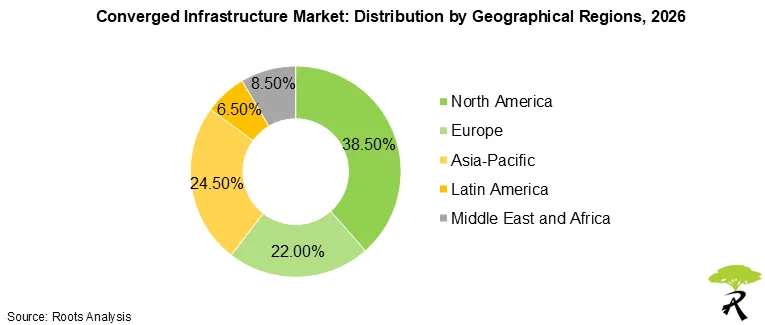
North America holds the largest share of the converged infrastructure market at 38.50% in 2026, underpinned by mature enterprise IT ecosystems, high hyperscaler concentration, and deeply integrated technology supply chains that accelerate large-scale deployment. Sustained capital investment and continuous cloud and AI infrastructure refresh cycles, reinforced by large-scale AI infrastructure investment commitments from entities such as Stargate LLC, further consolidate the region's installed-base advantage despite moderating near-term growth rates.
Asia Pacific represents the fastest-growing regional segment, expanding at a CAGR of 22.9%, driven by rapid digitalization, government-backed digital economy initiatives, and accelerating AI infrastructure adoption across both emerging and developed markets. Notably, the market is seeing a fundamental shift in capital flow, evidenced by the high-profile entry of KKR and Singtel into the ST Telemedia Global Data Centres ecosystem. For firms looking to capture new market share, the priority has shifted from North American retention to APAC expansion, specifically targeting regions benefiting from government-led digital economy mandates.
Want Information on Specific Region / Segment?
Market Ecosystem Insights
Top 10 Market Leaders Shaping the Future of Converged Infrastructure Industry
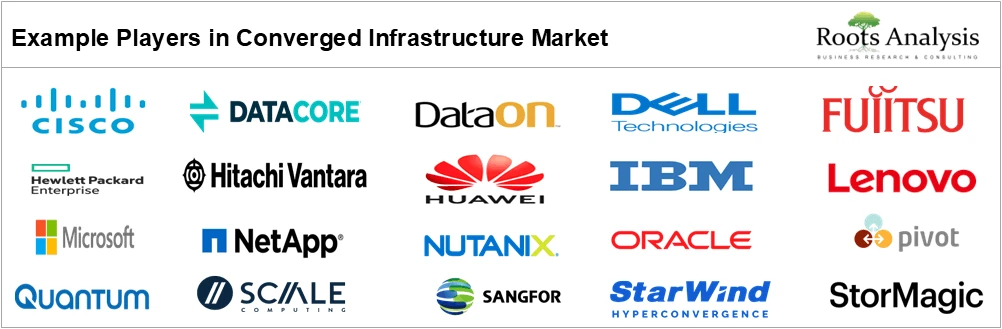
As per the global hyperconverged infrastructure market study, the 2026 market is characterized by a high degree of concentration, with the top 10 players, such as Dell Technologies, Oracle, Microsoft, IBM, Google Cloud, AWS, Cisco Systems, HPE, Broadcom, and Nutanix. These companies control the vast majority of enterprise revenue through deep integration and proprietary orchestration stacks.
The key focus of these companies is on technological innovation and global expansion. For instance, in February 2026, Dell Technologies launched Dell Private Cloud with Nutanix AHV support on PowerFlex, enabling independent scaling of compute and storage for modern, high-performance, and resilient workloads.
Top 5 Startups Driving Innovation in Converged Infrastructure Market
The converged infrastructure startup landscape is a hotbed of disruptive specialization, with venture capital flowing into companies that address the specific physical and operational limits of current-generation systems. Examples of the top five startup companies are Neurophos, Arcfra, SmartX, Scale Computing, and Upscale AI.
In 2026, the primary focus for startup companies is to overcome the power wall of silicon-based chips. For instance, Neurophos secured USD 110 million in Series A funding in early 2026 to scale its optical computing technology. By using light instead of electricity for matrix multiplication, Neurophos aims to integrate these photonic processors into converged nodes, potentially reducing AI power consumption by 90%. Similarly, Groq continues to attract investment for its language processing units, which offer deterministic performance for converged AI inference workloads.
Market Access Considerations
Ecosystem Maturity and Hybrid Integration Readiness
Market access in the converged infrastructure market depends on how effectively solutions integrate with existing IT environments and hybrid cloud architectures. Adoption slows when implementations create operational silos or lack robust connectors to public cloud platforms, limiting flexibility, data portability, and compliance alignment within the broader enterprise ecosystem.
Commercial success requires unified management across on-premises infrastructure, data center modernization solutions, and hyperscaler platforms. Vendors that lack mature integration capabilities face significant commercialization challenges, as enterprises increasingly favor providers with established partner ecosystems and adherence to open standardization frameworks that support scalable hybrid operations.
Total Cost of Ownership (TCO) Justification and Pricing Dynamics
Market access is strongly influenced by pricing dynamics and the ability to prove long-term total cost of ownership advantages over traditional infrastructure and public cloud alternatives. High upfront investment often challenges adoption drivers, particularly for organizations operating under cloud-first strategies and strict budget controls.
Successful commercialization depends on shifting toward value-based pricing focused on operational efficiency, utilization gains, and faster deployment outcomes. Vendors that introduce flexible, consumption-aligned pricing models reduce entry barriers and better align converged infrastructure economics with evolving enterprise purchasing expectations.
Procurement Behavior and Vendor Lock-in Perceptions
Enterprise procurement behavior significantly shapes market access, as buyers prioritize vendor reliability and implementation risk reduction. Converged infrastructure is often viewed as a long-term commitment, raising concerns around vendor lock-in, integration flexibility, and future scalability within the competitive landscape.
New entrants face commercialization challenges because organizations favor established vendors with proven deployment success and strong post-sales support. High switching costs reinforce incumbent advantages, while trusted relationships and existing infrastructure standards continue to influence adoption decisions and expansion opportunities.
Regulatory Compliance and Data Sovereignty Requirements
Market access in regulated sectors depends on strict alignment with data sovereignty, privacy, and security obligations. Organizations require converged infrastructure solutions that deliver encryption, access governance, and auditability capabilities to operate within demanding regulatory environments and industry compliance frameworks.
These requirements increase development and certification costs, shaping commercialization strategies and limiting competitive participation. Vendors with demonstrated vertical expertise gain advantage, as compliance readiness becomes both a market entry barrier and a differentiator driving adoption in high-value regulated industries.
Your Business is Unique – Why Shouldn’t Your Report Be?
How Stakeholders Benefit from the Key Focus Areas of Our Converged Infrastructure Market Research Report
The converged infrastructure market is gaining strategic importance as organizations accelerate digital transformation, hybrid cloud adoption, and IT modernization initiatives. Our report equips decision-makers with actionable market intelligence that strengthens strategic planning, investment prioritization, and technology adoption decisions.
- Unmet Needs and Market Gaps in Converged Infrastructure Market: The converged infrastructure market report identifies critical gaps between enterprise infrastructure requirements and existing converged infrastructure solutions, highlighting areas where performance, scalability, integration, or cost optimization remain insufficient. These insights help stakeholders recognize underserved customer segments and emerging demand pockets. Organizations can align product development and go-to-market strategies with real market needs, reducing innovation risk while improving commercialization outcomes.
- Funding and Investment Landscape in Converged Infrastructure Market: The study analyzes investment activity, funding patterns, and capital allocation trends shaping market growth and innovation. It enables stakeholders to identify high-growth segments attracting investor attention and evaluate risk-adjusted opportunities across deployment models and enterprise verticals. Financial decision-makers benefit from clearer visibility into growth outlook, helping guide portfolio diversification and long-term investment strategies.
- Player Landscape and Competitive Dynamics in Converged Infrastructure Market: Comprehensive evaluation of leading vendors, emerging challengers, and strategic positioning provides a clear understanding of the competitive landscape. Stakeholders gain insight into differentiation strategies, market consolidation trends, and competitive strengths influencing adoption drivers. These findings support informed decisions related to market entry, competitive benchmarking, and strategic positioning.
- Technology Innovation and Adoption Trends in Converged Infrastructure Market: The report examines evolving technology architectures, automation capabilities, software-defined integration, and cloud-aligned infrastructure developments driving adoption. Stakeholders understand how innovation cycles are reshaping enterprise infrastructure priorities and influencing purchasing decisions. This insight helps technology leaders align product roadmaps with future demand while enabling faster and more effective technology adoption.
- Partnerships and Collaboration Trends in Converged Infrastructure Industry: Analysis of ecosystem partnerships, vendor alliances, and solution integration strategies highlights how collaboration accelerates market penetration and solution scalability. Stakeholders can identify potential collaboration models that enhance value delivery and expand customer reach. These insights support business development initiatives and help organizations build resilient partner ecosystems that strengthen competitive advantage.
- Market Segmentation and Geographic Coverage in Converged Infrastructure Market: Detailed segmentation and regional analysis reveal demand variations across industries, organization sizes, deployment environments, and global markets. Stakeholders gain clarity on where adoption momentum is strongest and which regions present the most attractive expansion opportunities. This enables more precise resource allocation, targeted market entry strategies, and improved forecasting aligned with regional growth dynamics.
Converged Infrastructure Market: Scope of the Report
| Key Report Attributes | Details | |
| Historical Trend | Since 2022 | |
| Forecast Period | Till 2040 | |
| Market Size 2026 | $ 20.0 Billion | |
| Market Size 2040 | $ 275.0 Billion | |
| CAGR (Till 2040) | 20.59% | |
| Segments Covered |
|
|
| Geographical Regions Covered |
|
|
| Key Sections Covered |
|
|
Market Segmentation
Based on research, we have segmented the converged infrastructure market into type of component, deployment model, application, enterprise size, end use industry, geographical regions, and key players.
Market Share by Type of Component
- Integrated Systems
- Hyperconverged Infrastructure (HCI)
Market Share by Deployment Model
- On-Premises
- Hybrid Cloud
Market Share by Application
- Server Virtualization
- Virtual Desktop Infrastructure (VDI)
- Data Protection and Disaster Recovery
- Cloud Enablement
- Enterprise Resource Planning (ERP) and Customer Relationship Management (CRM)
Market Share by Enterprise Size
- Small and Medium-sized Enterprises (SMEs)
- Large Enterprises
Market Share by End Use Industry
- IT and Telecom
- Banking
- Financial Services and Insurance (BFSI)
- Healthcare
- Government and Public Sector
- Manufacturing
Market Share by Geographical Regions
- North America
- US
- Canada
- Mexico
- Rest of North America
- Europe
- Austria
- Belgium
- Denmark
- France
- Germany
- Ireland
- Italy
- Netherlands
- Norway
- Russia
- Spain
- Sweden
- Switzerland
- UK
- Rest of Europe
- Asia-Pacific
- Australia
- China
- India
- Japan
- New Zealand
- Singapore
- South Korea
- Rest of Asia-Pacific
- Latin America
- Brazil
- Chile
- Colombia
- Venezuela
- Rest of Latin America
- Middle East and Africa (MEA)
- Egypt
- Iran
- Iraq
- Israel
- Kuwait
- Saudi Arabia
- UAE
- Rest of MEA


