
Lowest Price Guaranteed
Slides
216
Last Updated
November 2025
View Count
17168
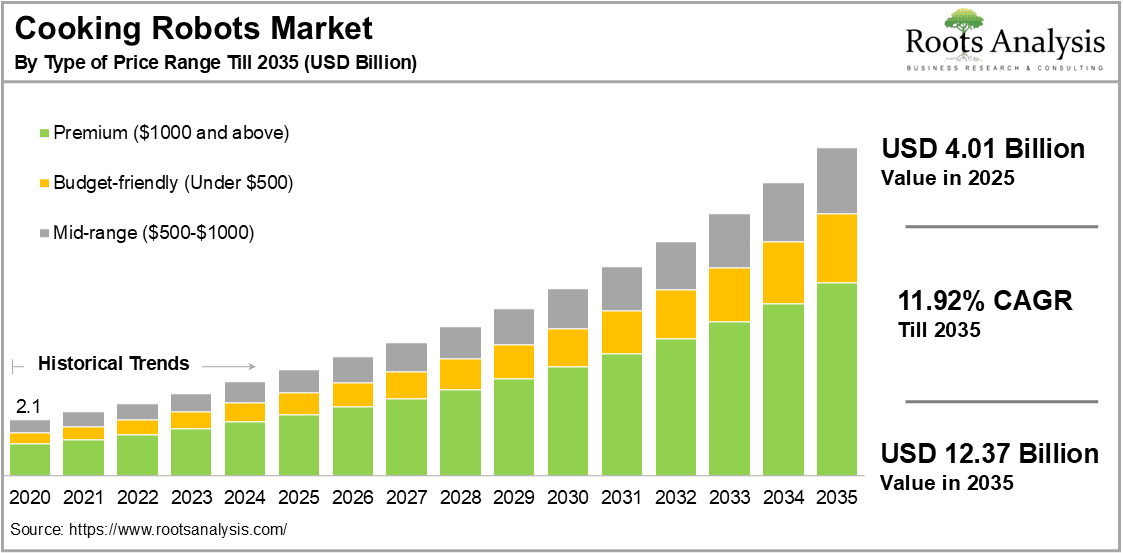
The cooking robot market size is projected to grow from USD 4.01 billion in 2025 to USD 12.37 billion by 2035, representing a CAGR of 11.92%, during the forecast period till 2035.
 |
The new research study consists of cooking robot industry analysis, detailed cooking robot market analysis, mega trends, patent analysis, porter five forces, SWOT analysis, value chain analysis and other strategic frameworks.
A cooking robot is an automated device crafted to assist or execute cooking tasks with high precision and efficiency. These robots leverage advanced technologies to guarantee consistent and high-quality meal preparation. They find applications in both residential and commercial environments, offering advantages such as enhanced productivity, lower labor costs, and improved food safety.
The global cooking robot market is witnessing a surge in demand for convenience, driven by the increasing popularity of smart kitchen robots. Consumers are looking for solutions that simplify meal preparation and save time. Key factors propelling the market include rising disposable incomes in emerging economies and the growing availability of affordable cooking robots. Additionally, technological advancements such as voice control, recipe integration, and mobile connectivity are significantly enhancing the user experience.
Opportunities for growth are present in the expanding smart home industry and the integration of cooking robots with other kitchen devices. Furthermore, a heightened focus on health is fueling demand for cooking robots that provide healthier cooking methods like air frying and steaming. Recent trends include the emergence of multifunctional cooking robots capable of performing various cooking techniques, allowing users to accomplish multiple tasks with a single appliance. Subscription-based services offering exclusive recipes and cooking tutorials are also gaining traction, providing convenience and inspiration for consumers.
The cooking robot market report presents an in-depth analysis of the various companies that are involved in offering such solutions, across different segments, as defined in the table below:
| Key Report Attributes | Details | |
| Historical Trend | Since 2020-2024 | |
| Forecast Period | 2025-2035 | |
| Market Size Value in 2025 | $ 4.01 Billion | |
| Market Size Value by 2035 | $ 12.37 Billion | |
| CAGR (Till 2035) | 11.92% | |
| Type of Robots |
|
|
| Type of Price Range |
|
|
| Type of Features |
|
|
| Areas of Application |
|
|
| Type of End-Users |
|
|
| Type of Enterprise |
|
|
| Geographical Regions |
|
|
| Leading Market Players |
|
|
| PowerPoint Presentation (Complimentary) |
|
|
| Customization Scope |
|
|
| Excel Data Packs (Complimentary) |
|
|
Based on the types of robots, the market is split into 6-axis, cartesian, cobots, cylindrical, delta, multifunctional cooking robots, SCARA, single-function cooking robots. Among these categories, the multifunctional cooking robots segment growth is expected to dominate the market with a share of 35.8%. This growth is attributed to their versatility and ability to combine various cooking techniques into a single appliance. These robots cater to a wide range of culinary tasks such as chopping, mixing, steaming, and frying, which appeals to both residential users looking for convenience and commercial establishments aiming for efficiency.
On the other hand, the cobots segment is expected to witness rapid growth at a significant CAGR of 12.23% during the forecasted period. Cobots are designed to work alongside human chefs, enhancing productivity while maintaining high standards of food safety and hygiene.
The global cooking robot market is segmented into various types of price ranges, such as budget-friendly (under $500), mid-range ($500-$1,000), and premium ($1,000 and above). According to our cooking robot industry analysis, the premium ($1,000 and above) segment will augment the segment's growth with the largest market share of over 64.56% by the next decade. This dominance is largely due to consumers seeking high-quality, multifunctional cooking robots that offer advanced features such as smart connectivity, AI in cooking robots, and enhanced cooking capabilities. As consumers increasingly prioritize convenience and quality in their culinary experiences, the demand for premium cooking robots is expected to continue growing, reflecting a trend toward investing in sophisticated kitchen technology.
On the other hand, it is worth highlighting that the budget-friendly (under $500) segment is expected to witness the fastest CAGR of around 12.87% during the forecasted period. This growth is driven by the rising disposable incomes in emerging markets and a growing interest in home cooking among consumers looking for affordable solutions. As more people seek to enhance their cooking skills without significant financial investment, budget-friendly cooking robots are becoming increasingly popular.
The market is segmented into various types of features such as automated cooking, guided recipes, meal planning, voice control, and wireless connectivity. According to our cooking robots market size forecast, the automated cooking segment will augment the segment's growth with the largest market share of over 57.6% by the next decade. This dominance can be attributed to the growing consumer preference for convenience and efficiency in meal preparation. Automated cooking solutions allow users to prepare meals with minimal manual intervention, appealing to busy households and commercial kitchens alike. As consumers increasingly seek solutions that simplify cooking processes, the demand for robots that can autonomously handle cooking tasks continues to rise.
Furthermore, the voice control segment is expected to witness a growth of CAGR of 14.85% during the forecasted period. The integration of voice control technology enhances user interaction with cooking robots, making them more accessible and user-friendly. This feature allows users to operate their cooking robots hands-free, which is particularly beneficial in busy kitchen environments. As smart home technology becomes more prevalent, the demand for voice-controlled cooking robots is anticipated to grow rapidly.
The market is segmented into various cooking robot applications, such as beverage making, burger & sandwich making, cocktail & coffee, fast food preparation, meat processing, multi-cuisine making, pizza making, salad making and others. According to our analysis, the fast-food preparation segment is expected to dominate by a market share of 35.8% during the forecasted period. This segment is favored due to the high demand for efficiency and consistency in fast food chains, where cooking robots can effectively follow set recipes and streamline operations. The ability of these robots to handle repetitive tasks in a high-volume environment makes them particularly valuable in commercial settings, contributing to their leading position in the market.
Furthermore, the multi-cuisine making segment is expected to witness the fastest CAGR of around 13.62% during the forecasted period. This growth can be attributed to the increasing consumer interest in diverse culinary experiences and the desire for convenience in preparing various international dishes. Multi-cuisine cooking robots that can adapt to different cuisines allow users to explore a wide range of flavors and cooking techniques, making them highly appealing in both residential and commercial kitchens.
The market is segmented into various types of end-users, such as commercial and residential. According to our global cooking robot analysis, the commercial segment will augment the market's growth with a market share of 85.6% during the forecasted period. The commercial sector has seen significant adoption of commercial cooking robots due to their ability to automate repetitive tasks, reduce labor costs, and maintain high standards of food safety and quality. As a result, the commercial segment is expected to continue leading the market as food establishments increasingly invest in robotic solutions to enhance operational efficiency.
Furthermore, the residential segment is expected to witness the fastest CAGR of around 12.8% during the forecasted period. This growth is driven by an increasing interest in home cooking and the convenience offered by residential cooking robots that simplify meal preparation for busy households. As more consumers seek innovative kitchen solutions that save time and effort, the residential market for cooking robots is becoming more attractive.
The market is fragmented into multiple types of enterprises, namely large and small and medium enterprises. Currently, the large enterprise segment is expected to dominate the segment with 83.34% of the market share. However, small and medium enterprise segments are expected to witness a relatively higher (17.78%) growth rate until 2035. This is ascribable to their agility, innovation, focus on niche markets, and ability to adapt to changing customer preferences and market conditions.
This segment highlights the distribution of cooking robot market share by regions, such as North America, Europe, Asia, Latin America, Middle East and North Africa, and the rest of the world. According to our regional analysis, North America currently exhibits dominance with 37.69% of overall market share. The dominance of this region can be attributed to the high adoption of advanced technologies and the presence of major market players. Moreover, the presence of supporting infrastructure and government policies along with deeper penetration of the fast-food industry in the regional market aids higher growth of cooking robots in North America.
The “Cooking Robot Market, Till-2035: Industry Trends and Global Forecasts” report features an extensive study of the current market landscape, market size and future opportunity within the cooking robot market forecast period. The market report highlights the efforts of several stakeholders involved in this rapidly emerging segment of the service providers industry. Key takeaways of the cooking robot market report are briefly discussed below.
The cooking robot market is driven by several key factors that contribute to its rapid growth and popularity. One of the primary drivers is the growing cooking automation trends in food preparation, as both residential and commercial users seek solutions that enhance efficiency and reduce labor costs. Additionally, increasing concerns about food safety and hygiene are prompting food service operators to adopt robotic solutions that minimize human contact during meal preparation. The rise in disposable incomes, particularly in emerging economies, is also contributing to market growth by making advanced cooking robots more accessible to a wider audience.
Furthermore, the integration of technological innovations such as artificial intelligence, voice control, and mobile connectivity is enhancing user experiences and functionality, making cooking robots more appealing. Lastly, the expansion of the smart home market is facilitating the adoption of cooking robots, as consumers increasingly look for devices that can seamlessly integrate into their connected home environments.
With the presence of several small and large companies, the market is experiencing intense competition and changing market dynamics. From large multinational companies to local players, companies are striving to enhance their competitive edge. In terms of market share, large enterprises and multinational companies are dominating the market. The key players are using strategies such as partnerships, acquisitions, ventures, innovations, novel product launches, R&D and geographical expansions in an attempt to solidify their position in the industry. Additionally, the increasing emphasis on sustainability is driving companies to invest in cooking robots further intensifying the competitive landscape.
Despite the strong market growth projection, there are several challenges in the cooking robot industry affecting its growth trajectory. One of the primary obstacles is the high cost of installation and maintenance, which can deter small and medium-sized enterprises from investing in these technologies. The initial capital expenditure, along with ongoing costs for programming and integration, poses a significant barrier, especially for businesses operating on thin margins. Additionally, there is a lack of skilled workforce capable of managing and maintaining these sophisticated machines, which can lead to operational inefficiencies.
Consumer skepticism regarding the reliability and quality of robotic cooking solutions also presents a challenge, as potential users may prefer traditional cooking methods over adopting new technology. Furthermore, regulatory compliance with food safety standards can complicate the deployment of cooking robots, as manufacturers must navigate varying regulations across different regions. These challenges collectively highlight the need for manufacturers to address cost, education, and regulatory issues to facilitate broader acceptance and integration of cooking robots in both commercial and residential settings.
With respect to regional cooking robot industry insights, North America is likely to dominate the market for the forecasted period. The dominance of this region is majorly influenced by the increasing integration of automation trends in the food processing sector. Furthermore, the expansion in the number of food vendors, drive-ins, fast-food centers and other establishments that see significant consumer traffic throughout the day is driving up demand for cooking robots. In line with this, the growing popularity of ghost kitchens or virtual kitchens, notably in the United States and Canada, is accelerating the use of cooking robots to prepare delivery-only meals.
Examples of leading cooking robot suppliers (which have also been captured in this market report, arranged in alphabetical order) include Anova Culinary, Admatic Solutions, Bastian Solutions, Bear Robotics, Breville, Briggo, Cuisinart, Creator, Dexai Robotics, Diligent Robotics, Dobot, Electrocraft, Epson, FoldiMate, Franka Emika, Gaussian Robotics, GrayMatter Robotics, Honeybee Robotics, Instant Pot, iRobot, Karakuri, KUKA, Mayekawa, Mechanical Chef, Miso Robotics, Moley Robotics, Panasonic, Picnic, PancakeBot, Philips, Robolink, Samsung Electronics, Scythe Robotics, Seraphim Sense, Staubli, Starship Technologies, Suvie, Tovala, Truebird SavorEat, Vesuvo V3, Vorwerk, Yaskawa.
The market report presents an in-depth analysis, highlighting the capabilities of various companies engaged in this domain, across different segments. Amongst other elements, the market report includes:
At Roots Analysis, we genuinely care about your success and understand that your business requirements are unique. While our cooking robot market research reports provide valuable insights, we recognize that they might not cover every aspect you need to make well-informed strategic decisions. To account for that, we offer 15% free report customization tailored to your specific needs. Whether you require additional quantitative analysis, qualitative insights, or any other information related to the cooking robot market, reach out us today at: support@rootsanalysis.com