
Lowest Price Guaranteed
Slides
178
Last Updated
August 2026
View Count
11793
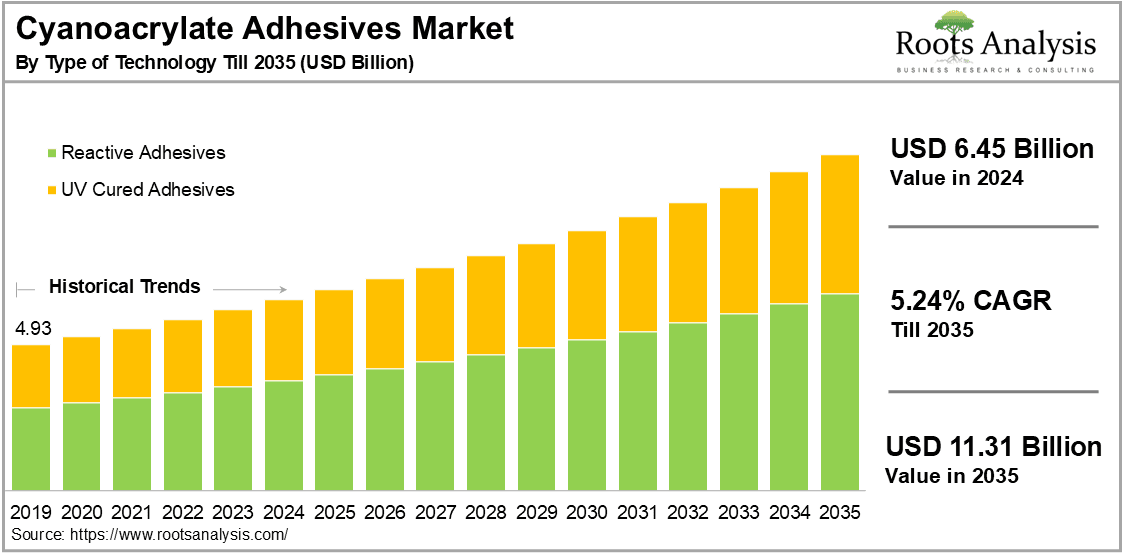
According to the global cyanoacrylate adhesives market size forecast, the market is projected to grow from USD 6.45 billion in 2024 to USD 11.31 billion by 2035, representing a CAGR of 5.24%, during the forecast period 2024-2035.
 |
To learn more about this report, request a free sample copy
The new research study consists of cyanoacrylate adhesives trends 2025 analysis, detailed global cyanoacrylate adhesives growth forecast analysis, and providing actionable strategic recommendations.
Cyanoacrylate adhesive, commonly referred to as super glue, instant glue, or power glue, is a solvent-free acrylate adhesive that cures rapidly upon contact with surfaces. These adhesives are valued across various industries due to their high strength and durability. They can bond a wide range of materials, including wood, plastics, metals, and glass. Applications of cyanoacrylate adhesives span multiple sectors, such as automotive, aerospace and defense, furniture manufacturing, machinery, and consumer goods.
The growth of the automobile manufacturing sector is expected to significantly drive the market for cyanoacrylate adhesives during the forecast period. The increasing demand for these adhesives can be attributed to their extensive applications in areas like architectural bonding, plastic bonding, automotive assembly, and household items such as shower doors and cabinets. Their unique properties, such as rapid curing and high stability, distinguish them from other adhesive types. The furniture manufacturing industry has also embraced cyanoacrylate adhesives, which are increasingly used in the production of electrical and electronic products. Additionally, the demand for compact electronic devices and flexible packaging solutions is further propelling the growth of the cyanoacrylate adhesive market. Notably, polyurethane and silicone-based sealants together account for over 50% of the total demand for sealants.
The cyanoacrylate adhesives industry report presents an in-depth analysis of the various companies that are involved in offering cyanoacrylate adhesives solutions, across different segments, as defined in the table below:
| Key Report Attributes | Details | |
| Historical Trend | Since 2019 | |
| Forecast Period | 2024-2035 | |
| Market Size Value in 2024 | $ 6.45 Billion | |
| Market Size Value by 2035 | $ 11.31 Billion | |
| CAGR (Till 2035) | 5.24% | |
| Type of Adhesives |
|
|
| Type of Technology |
|
|
| Type of Formulation |
|
|
| Type of End-Users |
|
|
| Company Size |
|
|
| Geographical Regions |
|
|
| Leading Market Players |
|
|
| PowerPoint Presentation (Complimentary) |
Available | |
| Customization Scope | 15% Free Customization | |
| Excel Data Packs (Complimentary) |
|
|
Based on the type of adhesives, the global cyanoacrylate adhesives market is split into alkoxy, butyl, ethyl and methyl. Among these categories, the ethyl cyanoacrylate market growth is expected to be the maximum, capturing a market share of 65.34% by 2035. This can be attributed to its rapid curing time, strong bonding capabilities, and versatility across various substrates like plastics and metals. On the other hand, the alkoxy segment is expected to witness rapid growth at a significant CAGR of 9.23% during the forecasted period. This growth is attributed to its lower tissue toxicity and suitability for medical applications (like surgical sutures), it does not currently dominate the market as ethyl does. The increasing demand for healthcare applications of cyanoacrylate is driving growth in this segment, but it remains behind ethyl in overall market share at present.
The market share of cyanoacrylate adhesives is segmented into various types of technologies, such as reactive and UV cured adhesives. According to our global cyanoacrylate adhesives analysis, the reactive segment will augment the segment's growth with the largest market share of over 70.56% by the next decade. The market growth can be attributed to their strong bonding capabilities and versatility across various applications, making them highly sought after in industries such as automotive, electronics, and healthcare. Furthermore, it is worth highlighting that the UV cured adhesives segment is expected to witness the fastest CAGR of around 8.6% during the forecasted period. This growth is attributed to the increasing demand for rapid curing adhesives market in manufacturing processes, particularly in sectors where quick production turnaround is essential.
The global cyanoacrylate adhesives market is segmented into various types of formulation such as high-viscosity cyanoacrylates, low-viscosity cyanoacrylates, medium-viscosity cyanoacrylates. According to our cyanoacrylate adhesives market forecast, the high-viscosity cyanoacrylates segment will augment the segment's growth with the largest market share of over 60.56% by the next decade. The market growth can be attributed to their ability to fill gaps and create strong bonds in applications where precision and strength are critical, making them suitable for various industrial uses. Furthermore, the low-viscosity cyanoacrylates segment is expected to witness the fastest CAGR of around 9.9% during the forecasted period. This growth can be attributed to their rapid curing properties and versatility, allowing them to bond quickly with a wide range of materials, which is particularly advantageous in industries such as electronics and consumer goods where quick assembly and repairs are essential.
The market is segmented into various types of end-users, such as aerospace, automotive, building and construction, consumer goods, electronics, footwear and leather, healthcare, joinery, woodworking. According to our cyanoacrylate adhesives solutions market analysis, the automotive segment will augment the market's growth with a market share of 30.65% during the forecasted period. This growth can be owed to the extensive use of cyanoacrylate adhesives in automobile manufacturing for bonding various components, ensuring structural integrity, and enhancing overall performance. On the other hand, it is worth highlighting that the healthcare segment is expected to witness the fastest CAGR of around 10.67% during the forecasted period. This growth is owed to the rising application of cyanoacrylate adhesives in medical devices, surgical procedures, and wound closure, where their rapid curing properties and strong bonding capabilities are essential.
The global cyanoacrylate adhesives market is fragmented into multiple types of enterprise namely large and small and medium enterprise. Currently, the large enterprise segment is anticipated to dominate the segment with 74.4% of the cyanoacrylate adhesives market share. However, small and medium enterprise segments are expected to witness a relatively higher (9.82%) cyanoacrylate adhesives market growth rate until 2035. This is ascribable to their agility, innovation, focus on niche markets, and ability to adapt to changing customer preferences and market conditions.
This segment highlights the distribution of cyanoacrylate adhesives market share by region, such as North America, Europe, Asia, Latin America, Middle East and North Africa, and the rest of the world. According to our regional analysis of cyanoacrylate adhesives markets, Asia currently exhibits dominance with 37.69% of overall market share. The growth of Asia Pacific cyanoacrylate market can be attributed to the expanding industrial base and robust economic development, which are driving demand for industrial adhesive solutions. High-performance adhesives are utilized across sectors such as transportation, electronics, medical, and manufacturing for assembly and repair tasks, thanks to their strong bonding capabilities, rapid curing times, and versatility.
The “Cyanoacrylate Adhesives Market, Till-2035: Industry Trends and Global Forecasts” report features an extensive study of the current market landscape, market size and future opportunity within the cyanoacrylate adhesives market forecast period. The market report highlights the efforts of several stakeholders involved in this rapidly emerging segment of the service providers industry. Key takeaways of the cyanoacrylate adhesives market report are briefly discussed below.
According to cyanoacrylate adhesives industry trends, growth drivers for cyanoacrylate adhesives are increasing demands for lightweight passenger vehicles. The benefits of cyanoacrylate in automotive industry, including bonding various components, make them essential for the industry particularly as manufacturers adopt modern lightweight designs that necessitate innovative bonding technologies to reduce vehicle weight. By utilizing automotive cyanoacrylate adhesives, companies aim to lower vehicle weight, fuel consumption, and carbon dioxide emissions. Additionally, cyanoacrylates are widely used in the consumer goods and electronics sectors due to their quick curing time, strong bonding capabilities, and electrical insulating properties. They are integral to the assembly of electronic products such as printed circuit boards, motors, and consumer electronics like smartphones and tablets.
With the presence of several small and large companies, the market is experiencing intense competition and changing market dynamics. From large multinational companies to local players, companies are striving to enhance their competitive edge. In terms of market share, large enterprises and multinational companies are dominating the market. The key players are using strategies such as partnerships, acquisitions, ventures, innovations, novel product launches, R&D and geographical expansions in an attempt to solidify their position in the industry. Additionally, the increasing emphasis on sustainability and eco-friendly applications is driving companies to invest in biodegradable materials and technologies, further intensifying the competitive landscape.
For instance, In October 2023, Astral expanded capabilities with the launch of Dahej manufacturing plant. In reference to this expansion, Saumya Engineer, CEO of Adhesives Business at Astral Limited stated that the opening of this manufacturing facility signifies a crucial milestone in the company’s journey to expand business. It fortifies the existing capabilities, streamlines processes, and standardizes production, thereby enhancing Astral’s product delivery. Equipped with substantial storage capacity for raw materials and finished products, we are well-prepared to meet the dynamic demands of the Indian market and our international clients.
Despite the strong market growth projection, there are several challenges in cyanoacrylate adhesive usage. The most common challenge is the easy availability of alternate adhesives. Cyanoacrylate adhesive is one of several adhesive options available in the market, with alternatives like epoxy and polyurethane serving as substitutes. These alternatives share similar chemical properties and performance characteristics, allowing them to bond various materials such as wood, metal, glass, and fiber. However, cyanoacrylate adhesives have a notably short shelf life; they can be stored for up to one year from the manufacturing date if unopened, but once exposed to air, they must be used immediately as they react with moisture and lose effectiveness. Additionally, cyanoacrylate adhesives tend to be more expensive than epoxy and polyurethane options. These factors present significant challenges that hinder the growth of the cyanoacrylate adhesives market.
With respect to regional cyanoacrylate adhesives industry insights, Asia is likely to dominate the market for the forecasted period. The dominance of this region is majorly influenced by increased production capabilities and industrialization in countries including China and India. Furthermore, high sales of consumer electronics and automobiles in this region is expected to boost the adoption of cyanoacrylate adhesives due to their property of quick curing and high strength.
Examples of key cyanoacrylate adhesives manufacturers involved in the cyanoacrylate adhesives market (which have also been captured in this market report, arranged in alphabetical order) include 3M, Aica Kogyo, ALTECO, Arkema, Chemence, DELO Industrie Klebstoffe, DuPont, Dymax, H.B. Fuller, Henkel, Hernon Manufacturing, Illinois Tool Works, Intertronics, Jowat SE, Kangda New Materials, Master Bond, Merck, Nan Pao Resins, Palm Labs Adhesives, Parker Hannifin, Permabond, Pidilite, Royal Adhesives, Sika, Soudal Holding, ThreeBond, Urja Sealants.
At Roots Analysis, we genuinely care about your success and understand that your business requirements are unique. While our cyanoacrylate adhesives research reports provide valuable insights, we recognize that they might not cover every aspect you need to make well-informed strategic decisions. To account for that, we offer 15% free report customization tailored to your specific needs. Whether you require additional quantitative analysis, qualitative insights, or any other information related to the cyanoacrylate adhesives market, reach out us today at: support@rootsanalysis.com