
Lowest Price Guaranteed
Slides
176
Last Updated
February 2025
View Count
14146
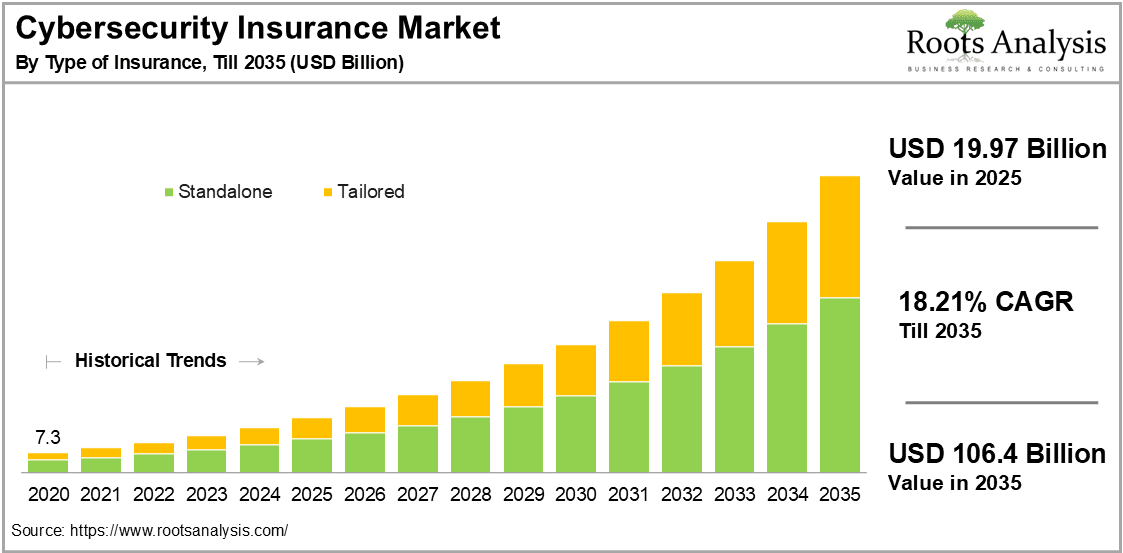
The cybersecurity insurance market size is projected to grow from USD 19.97 billion in 2025 to USD 106.4 billion by 2035, representing a CAGR of 18.21% during the forecast period till 2035.
 |
To learn more about this report, request a free sample copy
The new research study consists of cybersecurity insurance market and trends analysis, detailed market forecast analysis, and provide actionable strategic recommendations.
In today’s digital world, cyber crimes are skyrocketing and generating urgency to find cyber risk management solutions. Cybersecurity insurance or cyber liability insurance is one such effective solutions that help businesses mitigate financial losses resulting from cyber incidents such as data breaches, ransomware attacks, business interruptions, and other cybersecurity threats. The solution has a variety of features including risk coverage, incident response, liability protection, and tailored policies that make them a complete suite of cyber threat protection.
As an effect, the cybersecurity insurance market is evolving speedily stimulated by key factors that underscore its growing significance. The escalating frequency and sophistication of cyberattacks, which have made businesses acutely aware of their vulnerability is a leading factor. As companies increasingly rely on digital infrastructures, the necessity for robust cyber liability coverage becomes undeniable. Also, a rising shift toward policies, catering to diverse sectors and varying risk profiles becoming an industry trend. Businesses are no longer viewing cyber insurance as just an option but rather as an essential component of their overall risk management strategy. This trend is further amplified by the impact of government initiatives on cyber insurance that are aimed at promoting cybersecurity standards and regulations, which inevitably bolster the demand for robust insurance solutions.
Additionally, market dynamics in cyber insurance are also evolving rapidly. Insurers are adapting their offerings to meet new challenges, creating innovative policies that address emerging risks such as ransomware attacks and data breaches. This adaptability not only enhances market resilience but also presents significant opportunities for growth within the sector. For instance, in October 2024, HSB expanded its Home Cyber Protection coverage to include connected vehicles, digital wallets, cybercrime victims, and emerging risks. This updated offering gives protection against online fraud, cyber extortion, identity recovery, data breaches, and more. Overall, the future of cybersecurity insurance looks promising and is predicted to witness an extraordinary growth rate influenced by key factors during this forecast period.
The cybersecurity insurance market report presents an in-depth analysis of the various companies that are involved in offering cybersecurity insurance, across different segments, as defined in the table below:
| Key Report Attributes | Details | |
| Historical Trend | Since 2020 | |
| Forecast Period | Till 2035 | |
| Current Market Size | $ 19.97 Billion | |
| Market Size Value by 2035 | $ 106.4 Billion | |
| CAGR (Till 2035) | 18.21% | |
| Type of Component |
|
|
| Type of Insurance |
|
|
| Type of Coverage |
|
|
| Type of Enterprise Size |
|
|
| Type of End User |
|
|
| Geographical Regions |
|
|
| Leading Market Players | ||
| PowerPoint Presentation (Complimentary) |
Available | |
| Customization Scope | 15% Free Customization | |
| Excel Data Packs (Complimentary) |
|
|
The global cybersecurity insurance market features various solutions and services. As per our research, the solution segment is poised to capture (~66%) of the market share by 2035. Businesses use tools like cyber risk & vulnerability assessment and cybersecurity resilience solutions to evaluate their exposure to cyber threats which are necessary for determining insurance coverage needs. Also, AI and machine learning-based solutions and tools provide predictive insights and help organizations better understand potential risks, thus, boosting market demand. Further, the importance of incident response planning for businesses makes solutions critical to quickly contain and mitigate cyberattacks, thereby, dominating the market. However, the service segment is estimated to experience a higher (21.15%) CAGR in the upcoming years by offering vital support for managing cyber risks and enhancing the effectiveness of insurance policies.
Based on the type of insurance, the market is split into standalone and tailored. This cybersecurity insurance growth forecast report indicates that the standalone insurance segment is likely to hold the largest (~63%) of the market share by 2035. The key feature of standalone policies that offer tailored coverage for a wide range of cyber risks is the leading factor behind the segment growth. These policies often include value-added services like risk assessment and claims management in cyber insurance, strengthening the growth of the market. Nevertheless, the tailored segment is projected to grow at a substantial CAGR of (19.04%) over this forecast period. Tailored cyber insurance policies cater to the unique cyber risks of specific industries from healthcare to retail and government. Consequently, tailored insurance is gaining impressive demand due to the growing businesses preference of insurance that directly align with their operational risks.
The market is fragmented into different types of coverage including business interruption, data breaches, errors and omissions, and network security. According to our projection, data breach coverage is poised to occupy the maximum (~45%) of the cybersecurity insurance market share by 2035. Data breaches are among the most common and costly cyber incidents that affect businesses of all sizes. These data mostly incorporate personally identifiable information, financial data, and intellectual property, hence, making data breach liability coverage essential for all types of organizations, advancing the market expansion. Furthermore, business interruption coverage has gained significant traction due to the financial and operational impacts that businesses face after a cyber incident. As a result, the business interruption coverage is likely to grow at a notable CAGR of (20.11%) during this projection timeframe.
This segment describes the type of enterprise in the market which is segmented into large enterprises and small and medium-sized enterprises. According to our cybersecurity insurance industry analysis, large enterprises are estimated to hold the highest (~65%) of the market share by 2035. The complex IT infrastructure of large enterprises such as multiple departments, global operations, and interconnected systems double the risk of cyber threats and generate need for digital asset protection strategies. Thus, the mounting demand for cyber risk management solutions among large-sized organizations is leading the market segment. On the other hand, small and medium enterprises are poised to foster the market growth at a higher (21.36%) CAGR over this projection period. This growth can be attributed to the significant importance of cybersecurity for SMEs in safeguarding sensitive data, maintaining customer trust, and mitigating the financial and operational risks posed by increasing cyber threats.
On the basis of type of vertical, the market is distributed into a myriad of verticals such as BFSI, healthcare, it & telecom, manufacturing, retail, and others. As per cybersecurity insurance market research, the BFSI segment is likely to capture the majority (~48%) of the market share by 2035. Financial and banking institutions handle vast amounts of sensitive customer data and monetary transactions that make them prime targets for cybercriminals. The sector faces advanced threats like ransomware and fraud schemes. Therefore, the BFSI sector is likely to continue to fuel the demand for ransomware attack protection solutions.
Whereas, the healthcare segment is expected to register the fastest (20.47%) CAGR during this forecast period. In 2024, the healthcare sector was on top in cyberattack cases. This can be attributed to the sensitive patient data and medical information makes them lucrative target for cybercriminals. Also, the widespread use of electronic health records and telemedicine expanded the attack surface, thereby, escalating the market growth.
This segment highlights the distribution of the cybersecurity insurance market across various geographical regions, such as North America, Europe, Asia, Latin America, the Middle East and North Africa, and the rest of the world. In terms of revenue generation, North America cybersecurity insurance market is expected to dominate the global marketplace with the highest (~46%) of the market share till 2035. While, Asia is anticipated to witness (22.14%) continuous growth of during this forecast period driven by rising occurrence of cyberattacks.
As per review, the market for cyber insurance in Asia is expanding at a rate of 50% every year. Wherein, Thailand, Malaysia, Vietnam, and Indonesia are emerging as a significant player in the continent. The proliferation of digital transformation and remote work has amplified the cybersecurity risk across industries. In addition, small and medium-sized enterprises, which dominates the business landscape in Asia increasingly targeted by cybercriminals thus, surging the demand for affordable small business cyber insurance solutions and tools, expanding the market potential.
The “Cybersecurity Insurance Market, Till-2035: Industry Trends and Global Forecasts” report features an extensive study of the current market landscape, market size and future opportunities within the cybersecurity insurance market, during the given forecast period. The market report highlights the efforts of several stakeholders involved in this rapidly emerging segment of the service providers industry. Key takeaways of the cybersecurity insurance market report are briefly discussed below.
The growing frequency of cyberattacks across all sizes of organizations is the primary key driver of the cybersecurity insurance market growth. The prevalence of phishing and data breaches are causing loss of millions of dollars. According to a report, in 2024, organizations faced an average of 1876 cyberattacks which was 75% higher compared to the year 2023. In terms of industry, healthcare was the top target of cyberattacks during this period. Such increased cyberattacks has heightened the need for businesses to protect themselves financially against cyber risks. Therefore, these rising cybercrime and insurance demand are mainly attributed to the acceleration of the market growth.
Besides this, the surge in regulatory compliance in cybersecurity due to stringent data protection laws like GDPR and CCPA mandate organizations to implement robust cybersecurity measures that often include insurance, boosting the market development. Additionally, driven by the high adoption of digital technology like IoT integration and cloud computing, businesses are facing more sophisticated threats like AI-driven attacks and zero-day vulnerabilities. These advanced threats are likely to continue to retain the market growth in the upcoming decade.
Presently, several established companies and new comments are changing the market dynamic. However, traditional insurers such as AXA XL, and Zurich Insurance along with niche cyber insurance providers including Coalition, Beazley and CFC underwriting are dominating the market. These industry players hold significant market positions and are focusing on tailored products and proactive risk management services. In addition, technology providers are shaping the competitive landscape of cybersecurity providers by collaborating with insurers to offer cybersecurity tools alongside insurance coverage.
The market is relatively new and rapidly evolving which limit historical data for insurance to analyze. This scarcity of data leads to difficulty in risk assessment, premium calculation challenges, and uncertainty in loss trends. Therefore, the lack of reliable data exacerbates solution providers’ challenges in creating effective & tailored cyber insurance policies. This limited historical data and varying government regulations on cybersecurity insurance issues can obstruct the market progress during this forecast period.
With regard to regional insight, the US and Canada are remarkably contributing to dominate the market for cybersecurity insurance in North America. These countries experience emerging cyber threats and vulnerabilities, including ransomware, phishing, and data breaches which make organizations prioritize insurance as a protective measure. The highly developed IT infrastructure in the region has elevated the digital transformation and extensive adoption of cloud computing and IoT technologies which increase the exposure to cyber risks and the need for cyber risk assessment tools, driving the market growth. Furthermore, strict regulations like California Consumer Privacy (CCPA) and state-level data breach notification laws strict cybersecurity measures, and heavy fines, support the market demand. For instance, in October 2024, AXA XL introduced a tailored cyber insurance endorsement to offer US construction firms enhanced protection against evolving cyber threats.
Examples of key players involved in the market for cybersecurity insurance (which have also been captured in this market report, arranged in alphabetical order) include Accenture (Ireland), American International (US), AXA XL (US), AXIS Capital Holdings (Bermuda), BCS Financial (US), Beazley (UK), BitSight (US), CAN Financial (US), Chubb (Switzerland), Cisco (US), Cyber Indemnity, CyberArk (Israel), Cylance (US), Microsoft (US), Prevalent (US), RedSeal (US), SecurityScorecard (US), The Hanover Insurance (US), Travelers Indemnity (US), and UpGuard (US), Zurich Insurance (Switzerland). This market report includes an easily searchable excel database of all the companies who have adopted the cybersecurity insurance market.
The market report presents an in-depth analysis, highlighting the capabilities of various companies engaged in this domain, across different segments. Amongst other elements, the market report includes:
At Roots Analysis, we genuinely care about your success and understand that your business requirements are unique. While our market research reports provide valuable insights, we recognize that they might not cover every aspect you need to make well-informed strategic decisions. To account for that, we offer 15% free report customization tailored to your specific needs. Whether you require additional quantitative analysis, qualitative insights, or any other information related to the cybersecurity insurance market, reach out us today at: support@rootsanalysis.com