Desktop Virtualization Market by Type (Virtual Desktop Infrastructure (VDI), Desktop-as-a-Service (DaaS), and Remote Desktop Services (RDS)), Deployment Mode (Cloud and On-Premises), Component (Hardware, Software, and Services), Organization Size (Large Enterprises, and Small and Medium Enterprises (SMEs)), End User Industry (BFSI, Education, Government, Healthcare, IT & ITeS, Manufacturing, Retail, and Others), Geographical Regions, and Key Players - Trends and Forecast 2026-2040
Market Size
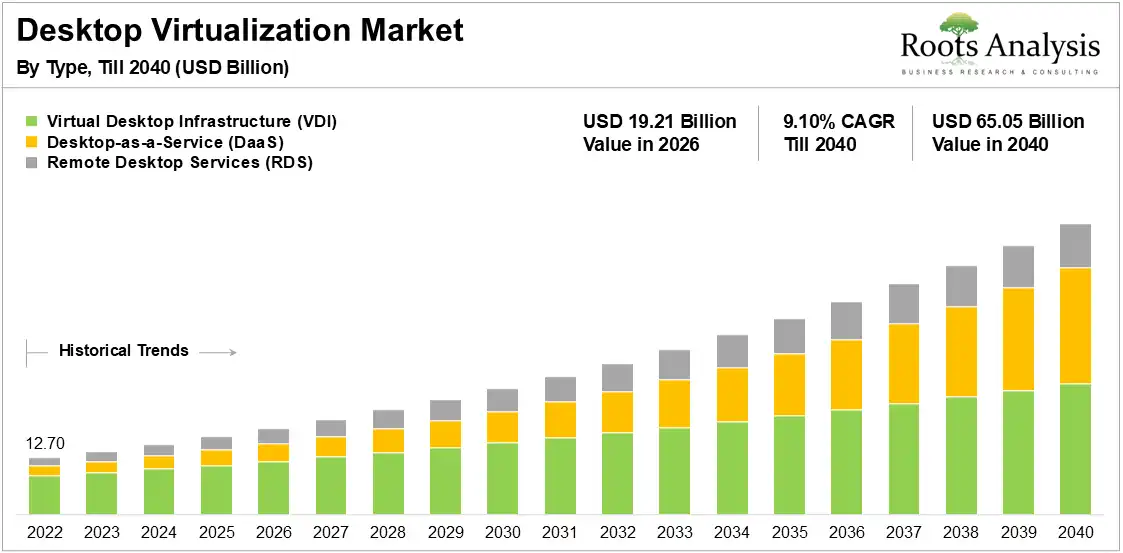
The global desktop virtualization market size is projected to grow from USD 19.21 billion in 2026 to USD 65.05 billion by 2040, representing a CAGR of 9.10% during the forecast period 2026 to 2040.
See What’s in the Full Report – Request Your Complimentary Insights!
Market Report: Key Takeaways
- Based on type, virtual desktop infrastructure (VDI) dominates the market, capturing a 65.8% share in 2026, whereas desktop-as-a-service (DaaS) is projected to experience faster growth at a 12.4% CAGR through 2040 by enabling highly decentralized digital workspaces.
- In terms of deployment mode, on-premises architecture holds the largest share (80.8%) in 2026, while cloud deployments showcase faster growth at an 11.4% CAGR till 2040 abstracting legacy hardware dependencies.
- Based on components, software captures largest market share (65.0%) in 2026 and is also poised to grow at a leading 9.5% CAGR through 2040 driving centralized endpoint security frameworks.
- Focusing on end user industry, IT & ITeS secures a 19.2% share in 2026, and is poised to experience faster growth till 2040. Simultaneously, BFSI secures the second largest share in 2026.
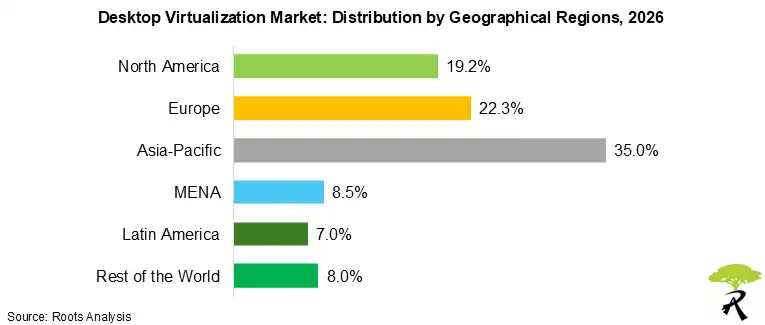
- Regionally, Asia-Pacific maintains the leading position with a 35.0% share in 2026 and is also anticipated to grow at a faster CAGR of 10.6% through 2040. Meanwhile, North America holds 19.2% share in 2026, and European region captures the second largest share (22.3%).
- In terms of organization size, large enterprises secure an 80.8% share in 2026. Conversely, Small and Medium Enterprises (SMEs) are projected to grow at a 10.1% CAGR through 2040, driven by cost-effective managed virtualization integrations.
Desktop Virtualization Market Outlook
Enterprise architecture is transitioning from legacy on-premises networks to cloud-native Desktop-as-a-Service configurations. Corporations globally deploy hybrid-cloud frameworks to consolidate endpoint security and maximize remote accessibility. This structural realignment decouples physical hardware from operating systems, directly enabling dynamic global workforce scaling.
Strict zero-trust mandates and regulatory frameworks are driving current market adoption; for example, EU’s Digital Operational Resilience Act (DORA), effective January 2025, compels financial institutions toward secured virtual environments. Concurrently, Microsoft’s 2025 release of Windows 365 Link directly accelerates cloud-first endpoint optimization and sustainability.
Future market growth trajectories point toward autonomous workspace ecosystems defined by predictive automation, while innovation trends point a shift towards edge-native virtualization specifically addressing low-latency industrial applications. For instance, Omnissa’s 2026 self-healing virtual desktop platform proactively resolves performance bottlenecks, cementing virtualization as a foundational utility ensuring secure, high-performance global commercial operations.
Desktop Virtualization Market Growth Drivers and Restraints
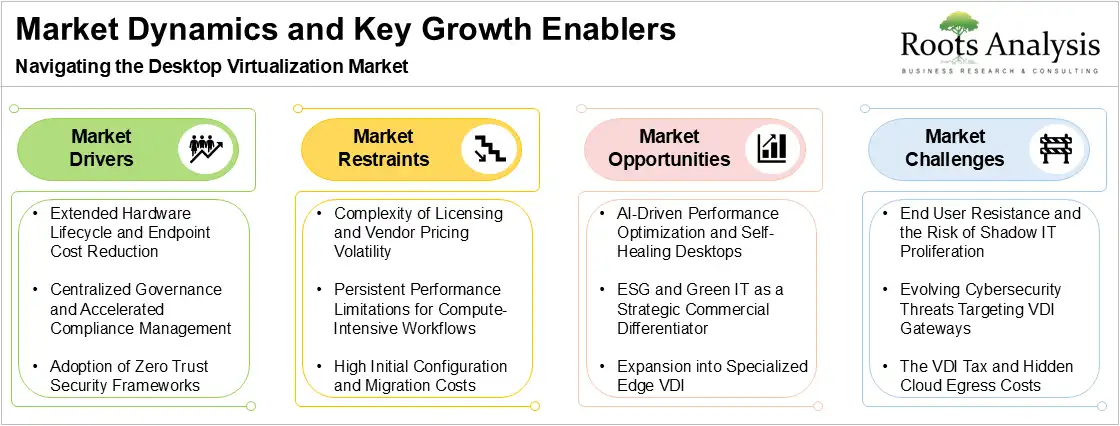
The desktop virtualization industry balances compelling structural cost reductions against hidden cloud egress challenges. Extended hardware lifecycles actively drive enterprise deployments, whereas volatile licensing complexities constrain adoption. Further, capitalizing on ESG-focused green IT presents the defining commercial opportunity in the market overcoming shadow IT proliferation.
Pay Only for What You Need – The Best Way to Optimize
Desktop Virtualization Market Size Estimation Methodology
- To establish the research framework, we defined the market scope by identifying the core components of the desktop virtualization ecosystem, including virtual desktop infrastructure (VDI), desktop-as-a-service (DaaS), and remote desktop services (RDS). This process involved structuring a comprehensive segment hierarchy based on deployment models, organization sizes, and vertical-specific applications across heavily regulated sectors such as BFSI, healthcare, and IT and ITeS.
- We subsequently evaluated enterprise demand dynamics and technology adoption patterns, analyzing the expanding total addressable market of knowledge workers and the increasing global penetration of bring your own device (BYOD) policies. By utilizing adoption S-curves, we modeled the ongoing transition from traditional on-premises VDI to scalable cloud-native DaaS platforms, factoring in legacy infrastructure replacement cycles, regional digital transformation indices, and critical technical constraints like bandwidth limitations in emerging economies.
- Following this analysis, we gathered critical supply-side metrics, including the annual recurring revenue (ARR) and license sales of Tier-1 and Tier-2 vendors, alongside prevailing average selling prices (ASPs) for seat-based subscriptions and managed service fees. This intelligence was captured through primary research with IT decision-makers and Chief Information Security Officers (CISOs), and rigorously cross-validated against secondary sources such as company financial filings, investor presentations, and specialized technology databases.
- Leveraging these triangulated insights, we calculated the global desktop virtualization market size and projected the long-term commercial opportunity. This was accomplished using a robust hybrid forecasting methodology that reconciled bottom-up vendor revenue totals with top-down enterprise expenditure estimates to eliminate statistical outliers, weighing historical growth rates against emerging catalysts like 5G integration and AI-driven workspace automation.
- The total projected market value was then systematically distributed across distinct market segments, allocating revenue by specific technology types and enterprise deployment architectures.
- Finally, in order to assess the sensitivity of our assumptions, we conducted a multivariate sensitivity and scenario analysis (base, optimistic, and conservative) on some of the most important parameters of our forecast methodology, evaluating the potential market impact of critical variables, including fluctuations in global economic stability and evolving regulatory shifts concerning enterprise data privacy.
Desktop Virtualization Market Share Insights
Market Size by Type: Virtual Desktop Infrastructure (VDI) Dominate the Market Revenues in 2026
- Virtual Desktop Infrastructure (VDI) holds the leading market share position in the desktop virtualization market at 65.8% in 2026, underpinned by its deep infrastructure maturity and granular control over individual desktop environments.
- Granular deployment control over individual instances ensures rigid compliance across highly regulated commercial environments. Uncompromising supply chain reliability, coupled with legacy application customization, structurally solidifies deep enterprise ecosystem integrations, directly eliminating localized cloud dependency risks entirely.
- Stringent data sovereignty mandates directly accelerate this adoption trajectory. In February 2026, Fujitsu introduced an advanced sovereign virtual desktop architecture prioritizing domestic data residency for Japanese government and institutional clients. This localized infrastructure deployment guarantees maximum data protection while resolving complex regulatory vulnerabilities for enterprise workloads.
By End User Industry: IT and ITeS Sector Dominates Desktop Virtualization Industry
- IT & ITeS sector dominates the current virtual desktop market share (19.2%) and is also expected to experience the fastest-growing segment with an 11.2% CAGR through 2040, fueled by the sector’s inherently distributed, 24×7 global delivery model that demands scalable, hyperscaler-hosted DaaS platforms.
- Enterprises aggressively transition away from legacy on-premises architecture toward hyperscaler-hosted platforms, directly optimizing distributed engineering operations. This structural pivot centralizes complex software licensing while securing multi-cloud development environments against escalating global cyber security threats seamlessly.
- Through February and April 2026, Infosys successfully published its comprehensive AI-first digital workplace framework, aggressively accelerating sustainable desktop-as-a-service deployments for global ecosystems. This strategic commercial initiative directly centralizes endpoint governance while enabling secure, highly flexible remote productivity metrics for massive, distributed IT engineering and dedicated customer support workforces.
Want Information on Specific Region / Segment?
Desktop Virtualization Market Regional Opportunity
Desktop Virtualization Market Penetration in Asia-Pacific: Virtual Workspace Infrastructure Expansion and Role of Regulatory Compliance Mandates
- The Asia-Pacific region dominates the current market share (35.0%) and is projected to experience the fastest commercial growth (with 10.6% CAGR) through 2040, Asia-Pacific governments aggressively accelerate centralized cloud infrastructure deployments, fundamentally driven by uncompromising new legislative frameworks. For instance, the October 2025 enforcement of Singapore's Cybersecurity Amendment Act expressly classifies outsourced virtual systems as Critical Information Infrastructure, directly forcing essential service providers to completely secure decentralized cloud endpoints against escalating threats.
- Concurrently, the November 2025 operationalization of India's Digital Personal Data Protection Rules aggressively penalizes unmonitored data governance. This strict regulatory mandate restricts non-compliant cross-border processing, immediately compelling multinational corporations to execute massive institutional investments into localized, highly scalable Desktop-as-a-Service architectures strictly guaranteeing uncompromising sovereign data residency.
- Navigating these stringent mandates, Alibaba Cloud significantly expanded its Elastic Desktop Service platform across Asian markets in April 2026. This strategic commercial scaling natively integrates artificial intelligence assistants with high-performance graphics protocols, definitively guaranteeing secure, low-latency remote collaboration while actively optimizing operational expenditures for massive, decentralized workforces.
Market Share Growth Trends in North America and Europe
- North America secures a 19.2% market share in 2026, while the European region captures the second-largest global position at 22.3%. Notably, mature North American enterprise infrastructure aggressively prioritizes advanced operational efficiencies, maintaining stable long-term market retention through intelligent monitoring protocols. In March 2026, ControlUp launched the DaaS IQ analytics platform, directly empowering decentralized IT departments to optimize virtual desktop resource utilization seamlessly.
- Meanwhile, stringent digital sovereignty mandates are governing European desktop virtualization market growth trajectories. This regulatory environment structurally drives secure, localized deployments across highly regulated sectors, despite slightly contracting regional market share projections through 2040. Addressing these rigid data governance requirements, XTIUM aggressively expanded direct European DaaS operations in June 2025, delivering integrated, security-first virtual architectures that strictly satisfy localized residency demands.
Market Ecosystem Analysis
Desktop Virtualization Competitive Landscape: Focus on Infrastructure Modernization
The competitive landscape for desktop virtualization undergoes aggressive structural modernization, directly prioritizing decentralized, cloud-native operational frameworks. Dominant legacy infrastructure providers relentlessly optimize core hypervisor technologies, while agile emerging innovators and startups systematically secure massive venture capital to deploy virtualization-free architectures, directly accelerating seamless global commercial agility. Leading desktop virtualization vendors, incumbents and startups for remote workplace services and solutions include Amazon Web Services, Citrix, Google Cloud, Island, Microsoft, Nerdio, Nutanix, Omnissa, and Parallels.
Dominant Enterprise Incumbents in Desktop Virtualization Industry: Engineering Scalable Digital Workspaces
- Dominant infrastructure providers continuously optimize core hypervisor frameworks to support complex, multi-cloud architectures. Parallels successfully released the Parallels RAS 21.0 update in November 2025, natively integrating Microsoft Windows Server 2025 compatibility alongside advanced multi-cloud scaling capabilities. This directly empowers hybrid workforce deployments while reducing operational support bottlenecks.
- Concurrently, Citrix launched a native Workspace application specifically designed for Apple Vision Pro visionOS architecture in September 2025. This strategic product launch fundamentally transforms immersive spatial computing into a highly secure, scalable commercial endpoint. These synchronized architectural advancements directly accelerate high-performance remote access, ensuring sustained competitive ecosystem dominance for legacy hypervisor providers scaling global infrastructure architectures.
Desktop Virtualization Startups and Innovator Companies: Accelerating Secure Endpoints
- Agile market entrants and startups rapidly attract venture capital by resolving legacy virtualization bottlenecks. Nerdio successfully launched the Nerdio Manager for MSP 6.0 platform in April 2025, fundamentally streamlining unified management protocols for Azure Virtual Desktop ecosystems. This deployment directly accelerates automated cloud scaling while eliminating manual endpoint tracking.
- Concurrently, enterprise browser pioneer Island initiated a massive Series E financing round in March 2025, surging its corporate valuation to USD 4.8 billion. This strategic capital influx heavily accelerates virtualization-free browser architectures, directly bypassing traditional legacy infrastructure overhead. Together, these startup initiatives aggressively drive decentralized operational growth and redefine modern institutional endpoint security frameworks.
Global Desktop Virtualization Industry Analysis and Market Trends
Impact of AI-Driven Automation on Desktop Virtualization Growth and Architecture
- Autonomous workload management fundamentally reshapes enterprise infrastructure capabilities. Corporations systematically modernize frameworks by integrating Hyper-converged Infrastructure (HCI) with Cloud-hosted Desktops or DaaS, directly optimizing complex remote computational performance parameters for global decentralized workforce operations seamlessly.
- Dynamic shifts in VDI software licensing models and market pricing trends compel rapid enterprise subscription transitions. This structural evolution significantly enhances efficient session-based computing deployments, ensuring commercial institutions maximize infrastructure ROI while scaling networks securely.
Advanced Endpoint Governance and Decentralized Workforce Security Infrastructure Optimization Strategies
- Expanding bring your own device (BYOD) policies systematically transform the broader end-user computing (EUC) ecosystem. Consequently, organizations prioritize advanced enterprise mobility management protocols, directly securing diverse endpoints while ensuring uninterrupted commercial productivity across remote environments.
- Stringent regulatory compliance mandates accelerate rigorous zero trust architecture integration across corporate networks. Simultaneously, rapid deployment of GPU-accelerated VDI infrastructures directly empowers engineering workforces, securely processing high-fidelity graphical applications without compromising centralized data protection standards.
Your Business is Unique – Why Shouldn’t Your Report Be?
Market Access Considerations
Virtual Workspace Infrastructure and Connectivity Maturity
High-speed, low-latency broadband proximity fundamentally gates virtual workspace expansion. In emerging geographies, network latency severely hinders enterprise adoption, forcing providers to deploy localized edge computing architectures. Prioritizing high-bandwidth infrastructures alongside strategic telecommunications partnerships actively guarantees viable service delivery and competitive geographic scaling.
Desktop Virtualization Market Data Sovereignty and Compliance Mandates
Strict regional privacy frameworks create formidable market entry barriers while catalyzing specialized institutional adoption. Accessing highly regulated financial or healthcare sectors necessitates rigorous localized data residency controls. Vendors successfully navigating these complex legislative landscapes directly secure high-value institutional contracts and achieve sustained regional ecosystem stability.
Cloud Endpoint Ecosystem Integration and Software Interoperability
Seamless legacy software integration heavily influences long-term cloud endpoint retention. New market entrants face significant barriers unless supporting resource-intensive workflows natively across diverse operating systems. Developing extensive API frameworks and specialized peripheral redirections directly prevent operational silos, ensuring uninterrupted enterprise productivity globally.
How Stakeholders Benefit from the Key Focus Areas of Our Desktop Virtualization Industry Report
The desktop virtualization market is gaining momentum as decentralized workforces and cloud-native architectures scale exponentially. This comprehensive desktop virtualization market research report equips decision-makers with rigorously validated market data, enabling precise investment forecasting, targeted infrastructure expansion, and confident navigation of complex digital workspace transformations.
- Unmet Needs and Commercial Market Gaps in Desktop Virtualization: This section presents critical performance bottlenecks within high-latency network environments and complex legacy system integrations. By pinpointing these exact underserved segments, stakeholders can aggressively align targeted product strategies with validated enterprise security demands, securing a distinct competitive advantage in hybrid workspace deployments.
- Desktop Virtualization Funding and Venture Investment Opportunities: The study maps global capital flows, explicitly highlighting high-growth desktop as a service and VDI infrastructure segments attracting strategic liquidity. Institutional investors leverage these financial baselines to assess risk-adjusted opportunities, validate operational business models, and confidently execute highly lucrative infrastructure consolidation strategies.
- Cloud Endpoint Technology Innovation and Adoption Trajectories: Detailed coverage of competing DaaS modalities and AI-driven resource optimization clarifies exact technological trajectories. Technology officers evaluate proven commercial traction around BYOD policies, ensuring enterprise hybrid-cloud integrations strictly align with validated adoption patterns to maximize operational resilience and bypass proprietary research costs.
- Desktop Virtualization Competitive Landscape and Industry Analysis: This section rigorously analyzes tier-one hypervisor incumbents, startups, and agile cloud-native innovators, providing deep insights into proprietary workspace portfolios. This helps executives to benchmark full-stack integration capabilities, refine go-to-market execution, and orchestrate highly informed mergers, acquisitions, and competitive response frameworks.
- Strategic Partnerships within the Virtual Desktop Ecosystem: This analysis explicitly details commercial synergies forged between specialized hypervisor developers, managed service providers, and hyperscale cloud vendors. Stakeholders extract actionable collaborative blueprints, utilizing these validated ecosystem maps to rapidly expand market reach, enhance native software integrations, and accelerate global commercialization cycles.
- Desktop Virtualization Market Revenue Growth and Expansion Opportunities: Evaluating diverse deployment modes and regulated industry verticals, this comprehensive section on desktop virtualization market forecast and segmentation analysis identifies maximum-yield commercial territories. Global strategists rely on these precise regional growth patterns to orchestrate targeted market penetration, allocate capital efficiently, and navigate localized infrastructure complexities with absolute confidence.
Have Questions? Let’s Get Them Answered.
Desktop Virtualization Market: Scope of the Report
| Key Report Attributes | Details | |
| Forecast Period | Till 2040 | |
| Market Size 2026 | USD 19.21 Billion | |
| Market Size 2040 | USD 65.05 Billion | |
| CAGR (Till 2040) | 9.10% | |
| Segments Covered |
|
|
| Geographical Regions Covered |
|
|
| Key Sections Covered |
|
|
Desktop Virtualization Market Segmentation
The global desktop virtualization industry report presents an in-depth analysis, highlighting the capabilities of various stakeholders, based on different segments such as offering, deployment mode, technology, application, end use industry, geographical regions, and key players.
Market Share by Type
- Virtual Desktop Infrastructure (VDI)
- Desktop-as-a-Service (DaaS)
- Remote Desktop Services (RDS)
Market Share by Deployment Mode
- Cloud
- On-Premises
Market Share by Component
- Software
- Hardware
- Services
Market Share by Organization Size
- Large Enterprises
- Small and Medium Enterprises (SMEs)
Market Share by End User Industry
- BFSI
- Education
- Government
- Healthcare
- IT & ITeS
- Manufacturing
- Retail
- Others
Market Share by Geographical Regions
- North America
- US
- Canada
- Mexico
- Rest of North America
- Europe
- Austria
- Belgium
- Denmark
- France
- Germany
- Ireland
- Italy
- Netherlands
- Norway
- Russia
- Spain
- Sweden
- Switzerland
- UK
- Rest of Europe
- Asia-Pacific
- Australia
- China
- India
- Japan
- New-Zealand
- Singapore
- South Korea
- Rest of Asia-Pacific
- Latin America
- Argentina
- Brazil
- Chile
- Colombia
- Venezuela
- Rest of Latin America
- Middle East and North Africa (MENA)
- Egypt
- Iran
- Iraq
- Israel
- Kuwait
- Saudi Arabia
- UAE
- Rest of MENA
- Rest of the World


