Digital Asset Management Market Overview
What is the Projected Growth of the Digital Asset Management Market?
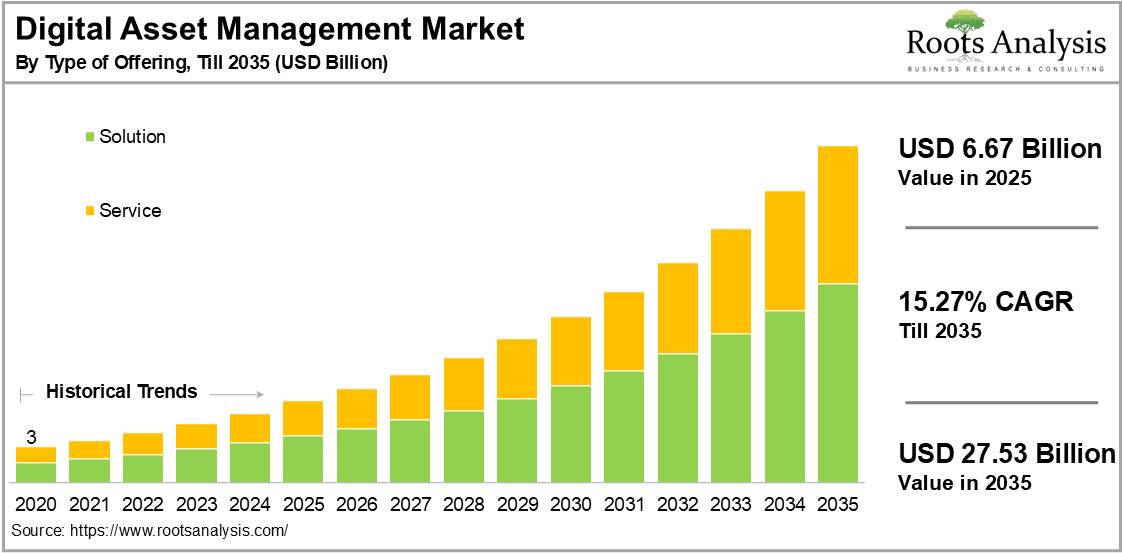
The global digital asset management (DAM) market is expected to grow significantly - from USD 6.67 billion in 2025 to USD 27.53 billion by 2035, representing a robust CAGR of 15.27% during the forecast period. This growth is fueled by digital transformation across industries, as businesses increasingly rely on centralized platforms to organize and manage media-rich assets efficiently.
To learn more about this report, request a free sample copy
This new market research study provides a deep dive into the DAM ecosystem, featuring comprehensive analysis on industry trends, market sizing, competitive forces (Porter’s Five), SWOT insights, value chain mapping, and patent activity - giving stakeholders a complete outlook on the market’s direction through 2035.
Why Are DAM Systems Becoming Critical for Modern Businesses?
The Strategic Role of Digital Asset Management Solutions
Digital asset management solutions allow organizations to centralize the storage, retrieval, and distribution of rich digital content such as images, videos, documents, and brand materials. These platforms play a pivotal role in:
- Ensuring brand consistency across marketing and sales channels
- Improving team collaboration and productivity
- Reducing asset duplication and speeding up content creation workflows
AI and Automation Driving DAM Innovation
Artificial Intelligence (AI) integration is transforming how DAM systems operate. Features like automated tagging, faceted search, and metadata-driven asset discovery are helping organizations gain faster, more accurate access to relevant digital files. This, in turn, enhances marketing agility, speeds up campaign execution, and improves asset governance across enterprise teams.
Digital Asset Management Market Share Insights
The digital asset management industry report presents an in-depth analysis of the various companies that are involved in offering digital asset management solutions, across different segments, as defined in the table below:
Digital Asset Management Market: Report Attributes / Market Segmentations
| Key Report Attributes |
Details |
| Historical Trend |
Since 2020-2024 |
| Forecast Period |
2025-2035 |
| Market Size Value in 2025 |
$ 6.67 Billion |
| Market Size Value by 2035 |
$ 27.53 Billion |
| CAGR (Till 2035) |
15.27% |
| Type of DAM |
- Brand Asset Management System
- Library Asset Management System
- Production Asset Management System
|
| Type of Deployment |
|
| Type of Offering |
|
| Areas of Application |
- Broadcast and Publishing
- Sales and Marketing
- Others
|
| Type of Industry |
- BFSI
- E-Commerce & Retail
- Healthcare
- Manufacturing
- Media & Entertainment
- Travel & Hospitality
- Others
|
| Company Size |
- Large Enterprises
- Small and Medium Enterprises
|
| Geographical Regions |
- North America
- US
- Canada
- Mexico
- Other North American countries
- Europe
- Austria
- Belgium
- Denmark
- France
- Germany
- Ireland
- Italy
- Netherlands
- Norway
- Russia
- Spain
- Sweden
- Switzerland
- UK
- Other European countries
- Asia
- China
- India
- Japan
- Singapore
- South Korea
- Other Asian countries
- Latin America
- Brazil
- Chile
- Colombia
- Venezuela
- Other Latin American countries
- Middle East and North Africa
- Egypt
- Iran
- Iraq
- Israel
- Kuwait
- Saudi Arabia
- UAE
- Other MENA countries
- Rest of the World
- Australia
- New Zealand
- Other countries
|
| Leading Market Players |
- Adobe
- Aprimo
- Adam Software
- Bynder
- Canto
- CELUM
- Cognizant
- Cloudinary
- EMC
- Extensis Portfolio
- Hewlett-Packard
- IBM
- MediaBeacon
- MediaValet
- MerlinOne
- North Plains Systems
- OpenText
- Oracle
- QBank
- Webdam
- Widen
- Wedia
- WoodWing
|
PowerPoint Presentation
(Complimentary) |
Available |
| Customization Scope |
15% Free Customization |
Excel Data Packs
(Complimentary) |
- Competitive Landscape
- Company Competitive Analysis
- Patent Analysis
- Funding Analysis
- Recent Developments
- Market Forecast and Opportunity Analysis
|
Digital Asset Management Market Segmentation
How Is the Market Segmented by DAM Type?
Based on the type of DAM, the market is split into brand asset management system, library asset management system, and production asset management system. The brand asset management segment is expected to lead, capturing 65.34% of the market share by 2035, owing to its vital role in streamlining promotional content and safeguarding brand identity across distributed teams.
Meanwhile, the production asset management segment is poised for the fastest growth, with a CAGR of 16.23%, driven by rising demand in media and entertainment, where production teams rely on DAM tools to manage complex post-production workflows and digital rights.
Which Deployment Models Are Gaining Market Traction?
The global DAM market is segmented into various types of deployment, such as cloud and on-premises. According to our digital asset management industry analysis, the on-premises market segment continues to dominate with over 74.56% of the market, especially in data-sensitive industries such as finance and healthcare, where maintaining local control over digital content remains crucial. The market growth can be attributed to the wide adoption of on-premises deployment in industries like finance and healthcare. These industries maintain a greater control over their digital asset and ensure that sensitive information stays within their physical boundaries, further also mitigating any security risks that can take place with the adoption of cloud-based deployment.
On the other hand, the cloud deployment segment is expected to witness the fastest CAGR growth of around 17.8% during the forecasted period. This growth is owed to the high scalability, multiple layers of security and cost effectiveness provided by cloud storage for digital assets.
What’s Driving Demand by Type of Offering?
The market is segmented into various types of offering such as service and solution. According to our digital asset management market forecast, the solution segment will augment the segment's growth with the largest market share of over 76.56% by the next decade. The market growth can be attributed to the urge to increase organizational productivity by getting maximum information and collaborating with teams and assets. As digital asset management solutions are available in a wide array of shapes and sizes, e-commerce platforms can use them widely for their product imagery.
As a result, the growing worldwide investment in the e-commerce sector is contributing to the market expansion. Furthermore, the services segment is expected to witness the growth of CAGR 16.88% during the forecasted period. This growth is owed to businesses increasingly recognizing the benefits of digital asset management systems as well as the importance of organizing and leveraging digital assets efficiently. This in turn is increasing the need for specialized services to implement and maintain DAM systems.
Which Application Areas Are Driving DAM Usage?
The market is segmented into various areas of application, such as broadcast and publishing, sales and marketing and others. According to our digital asset management statistics, the sales and marketing segment will augment the market's growth with a market share of 70.65% as well as the fastest CAGR of 16.4% during the forecasted period.
This growth can be owed to the increasing need for businesses to efficiently manage their marketing collateral, brand assets and promotional materials for which DAM solutions are highly useful to focus on digital marketing strategies.
Which Industries Are Adopting DAM Solutions?
The market is segmented into various types of industries, such as BFSI, e-commerce and retail, healthcare, manufacturing, media & entertainment, travel & hospitality, and others. According to our digital asset management industry analysis, the media & entertainment segment will augment the market's growth with a market share of 30.65% during the forecasted period.
This growth can be owed to the rise of streaming platforms and digital distribution channels which need secure and centralized repositories that can manage rights, licenses, and versions of media assets. DAM systems provide robust features for metadata tagging, version control, and rights management, ensuring compliance and efficient content monetization.
Market Share by Company Size
The market is fragmented into multiple types of enterprise namely large and small and medium enterprise. Currently:
- Large enterprises dominate the market with a 73.34% share, as they require complex DAM systems to manage large volumes of digital assets across departments.
- However, SMEs are forecasted to grow at a faster pace (CAGR 17.28%), thanks to their agility and increasing awareness of how DAM can support their marketing operations, brand management, and content creation workflows
Regional Outlook – Where is the DAM Market Expanding Most?
North America Leading, Asia-Pacific Rising
This segment highlights the distribution of digital asset management market share by region, such as North America, Europe, Asia, Latin America, Middle East and North Africa, and the rest of the world. According to our regional analysis:
- North America currently holds a 37.69% share, supported by:
- A mature digital infrastructure
- High adoption of cloud technologies
- Strong presence of DAM providers and digital-first businesses
- However, regions like Asia-Pacific and Latin America are expected to record strong growth in the coming decade, fueled by rising e-commerce, digital transformation programs, and increased spending on marketing technology platforms.
Key Insights from the Digital Asset Management (DAM) Market Report
The “Digital Asset Management Market, Till-2035: Industry Trends and Global Forecasts” report features an extensive study of the current market landscape, market size and future opportunity within the digital asset management market forecast period. The market report highlights the efforts of several stakeholders involved in this rapidly emerging segment of the service providers industry. Key takeaways of the digital asset management market report are briefly discussed below.
What’s Fueling Adoption of Digital Asset Management Solutions?
As digital content creation accelerates, so does the demand for enterprise asset management platforms. Several factors are shaping this growth:
- A surge in remote and hybrid work models has highlighted the need for centralized content access and collaboration.
- Businesses in sectors such as media, retail, education, and e-commerce are producing vast volumes of digital assets, including images, video, and documents, to engage customers and streamline operations.
- DAM systems provide structured repositories, enabling quick content retrieval, version control, and brand consistency across multiple teams and locations.
Solutions like Adobe Experience Manager and Bynder are increasingly adopted for their ability to securely organize, store, and share assets, allowing marketing and creative teams to maintain agility and alignment.
Competitive Environment: Porter’s Five Forces in the DAM Market
Porter’s Five Forces analysis within the report offers insight into:
- The intensity of competition among DAM vendors
- Bargaining power of buyers and suppliers
- The threat of new entrants and substitute solutions
- The overall profitability and sustainability of the DAM ecosystem
This framework helps businesses and investors evaluate the strategic positioning of DAM solutions across different verticals and geographies.
How Are DAM Providers Differentiating Themselves?
The digital asset management industry features a mix of established tech giants and emerging innovators. Competitive intensity remains high, with companies vying for market share through:
- Mergers and acquisitions
- Technology partnerships and venture funding
- Product innovation and AI-based features
- Regional and vertical-specific expansions
A notable development occurred in February 2024, when VanEck launched SegMint, a digital asset platform utilizing a novel ‘Lock & Key’ model. Founder Matt Bartlett explained that the solution addresses a major challenge in the digital asset ecosystem - secure asset sharing and decentralized ownership. The Lock & Key model enables individuals to share access without compromising control, a significant advancement for the self-custody digital asset landscape.
What Are the Barriers to Adoption of DAM Platforms?
Despite strong market momentum, several challenges continue to affect adoption rates:
- High implementation costs remain a primary concern, particularly for SMBs. Initial setup expenses, training, and integration efforts create budget pressures.
- Complexity of DAM systems often leads to a steep learning curve, discouraging smaller teams or organizations without dedicated IT support.
- Scalability, data privacy regulations, and integration with legacy systems further complicate widespread deployment.
To overcome these barriers, vendors are focusing on user-friendly interfaces, modular pricing models, and managed service support to improve accessibility across market segments.
Recent Developments in Digital Asset Management Market
- In April 2025, Accenture invested in tGoUpscale to enhance client engagement servies in Asia.
- In March 2025, additiv announced partnership with Trimegah to transform the accessibility of professional investment services in Indonesia.
- In September 2024, Elliptic and Tungsten partnered together for a comprehensive digital asset compliance.
- In July 2024, Oracle Meta Technologies launched innovative crypto index with digital asset management.
- In July 2024, Franklin Templeton and SBI Holdings formed a joint venture to focus on digital assets in Japan.
- In July 2024, BingX launched a pre-market trading for early access to new digital assets.
- In June 2024, State Street Global advisors and Galaxy Asser Management joined forces to introduce investors to the next evolution of digital asset investing.
Digital Asset Management Market Report Coverage
The market report presents an in-depth analysis, highlighting the capabilities of various companies engaged in this domain, across different segments. Amongst other elements, the market report includes:
- A preface providing an introduction to the full report, DAM market, 2020-2024 (Historical Trends) and 2025-2035 (Forecasted Estimates).
- An outline of the systematic research methodology adopted to conduct the study on the DAM market, providing insights on the various assumptions, methodologies, and quality control measures employed to ensure the accuracy and reliability of our findings.
- An overview of economic factors that impact the overall digital asset management market, including historical trends, currency fluctuation, foreign exchange impact, recession, and inflation measurement.
- An executive summary of the insights captured during our research. It offers a high-level view of the current state of the DAM market and its likely evolution in the mid-long term.
- A detailed assessment of the digital asset management market landscape, based on several relevant parameters, including year of experience, company size, location of headquarters, and ownership structure.
- Elaborate profiles of prominent players engaged in the DAM market, featuring information on their year of establishment, location of headquarters, company size, company mission, company footprint, management team, contact details, financial information, operating business segments, digital asset management market portfolio, moat analysis, recent developments, and an informed future of digital asset management technology.
- A qualitative assessment of the various megatrends ongoing in the integration with rising demand for rich media management, integration with ML and AI in digital asset management, and remote work and distributed teams.
- An analysis highlighting the key unmet needs across digital asset management market industry, featuring DAM market research insights generated from real-time data on unmet needs as identified from social media posts, recent publications, industry blogs and the views of key opinion leaders expressed on online platforms.
- An in-depth analysis of various patents that have been filed / granted related to digital asset management market and its components, based on various parameters, such as type of patent, patent publication year, patent age and leading players
- A detailed analysis of recent developments in the DAM market domain, based on relevant parameters such as year of initiative, type of initiative (partnerships and collaborations, expansions, funding and product launches), geographical distribution and most active players (in terms of number of recent developments).
- Key winning strategies framework that helps in analyzing the level of competition within an industry, by tracing the key market activities including partnership, funding, expansion of leading players
- A qualitative analysis, highlighting the five competitive forces prevalent in DAM market industry, including threats for new entrants, bargaining power of suppliers, bargaining power of customers, threats of substitution and rivalry among existing competitors.
- A discussion on affiliated global digital asset management market trends, key drivers and challenges, under a SWOT framework, which are likely to impact the industry’s evolution, along with a Harvey ball analysis, highlighting the relative effect of each SWOT parameter on the overall DAM market.
- A value chain analysis featuring a discussion on various stakeholders involved in the development of the DAM market, from suppliers to end-users.
- A detailed estimate of the current market size and the potential growth future of digital asset management market initiatives over the next decade. Based on multiple parameters we have provided an informed estimate on the market evolution during the forecast period 2025-2035. The report also features the likely distribution of the current and forecasted opportunity within the DAM market. Further, in order to account for future uncertainties and to add robustness to our model, we have provided three forecast scenarios, namely conservative, base, and optimistic scenarios, representing different tracks of the industry’s growth.
- Detailed projections of the current and future market across various types of DAM, such as brand asset management system, library asset management system, production asset management system.
- Detailed projections of the current and future market across various types of deployment such as cloud and on-premises.
- Detailed projections of the current and future market across various types of offering such as service and solution.
- Detailed projections of the current and future market across various areas of application such as broadcast and publishing, sales and marketing and others.
- Detailed projections of the current and future market across various types of industries such as BFSI, E-commerce and retail, healthcare, manufacturing, media & entertainment, travel & hospitality, and others.
- Detailed projections of the current and future digital asset management market across various geographical regions, such as North America (US, Canada, Mexico and other North American countries), Europe (Austria, Belgium, Denmark, France, Germany, Ireland, Italy, Netherlands, Norway, Russia, Spain, Sweden, Switzerland, UK and other European countries), Asia (China, India, Japan, Singapore, South Korea and other Asian countries), Middle East and North Africa (Egypt, Iran, Iraq, Israel, Kuwait, Saudi Arabia, UAE and other MENA countries), Latin America (Brazil, Chile, Colombia, Venezuela and other Latin American countries) and rest of the world (Australia, New Zealand and other countries).
Author: Ronit Sharma and Anmol Bali
Customization Opportunities
At Roots Analysis, we genuinely care about your success and understand that your business requirements are unique. While our digital asset management market research reports provide valuable insights, we recognize that they might not cover every aspect you need to make well-informed strategic decisions. To account for that, we offer 15% free report customization tailored to your specific needs. Whether you require additional quantitative analysis, qualitative insights, or any other information related to the digital asset management market, reach out us today at: support@rootsanalysis.com
Frequently Asked Questions
What is digital asset management?
A digital asset management (DAM) solution provides a streamlined and organized approach to effectively store, manage, organize, retrieve, and distribute a company's digital Asset.How big is the digital asset management market?
In 2025, the digital asset management market size is estimated to be worth $6.67 billion.What is the projected digital asset management market growth forecast?
According to digital asset management market revenue forecast, the market is expected to grow at a compounded annual growth rate (CAGR) of over 15.27% during the forecast till 2035.What are the growth drivers for the digital asset management market?
The rapid growth in digital content production and the rise of remote work are the driving factors for this market.Who are the market players in the digital asset management market industry?
Leading players include Adobe, Adam Software, Aprimo, Bynder, Canto, CELUM, Cognizant, Cloudinary, EMC, Extensis Portfolio, Hewlett-Packard, IBM, MediaBeacon, MediaValet, MerlinOne, North Plains Systems, OpenText, Oracle, QBank, Weden, Webdam, Wedia, WoodWing.What is the leading region in the digital asset management market?
Currently, North America is dominating the digital asset management market.