
Lowest Price Guaranteed
Slides
228
Last Updated
May 2025
View Count
10467
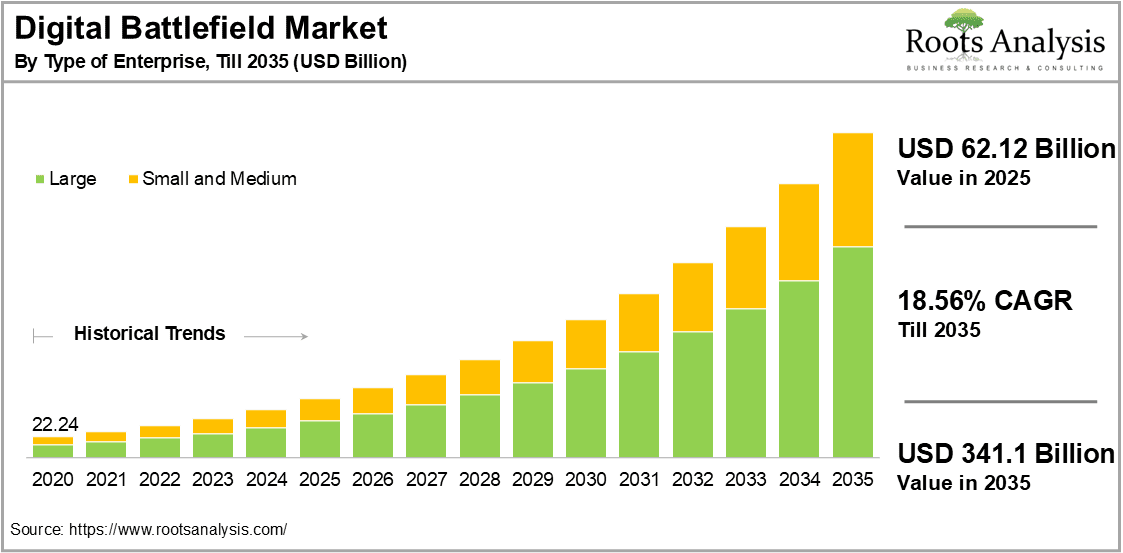
The global digital battlefield market size is estimated to grow from USD 50.58 billion in 2024 to reach USD 62.12 billion in 2025 and USD 341.1 billion by 2035, representing a CAGR of 18.56%, during the forecast period till 2035.
 |
The new research study consists of digital battlefield industry analysis, detailed digital battlefield market analysis, mega trends, patent analysis, porter five forces, SWOT analysis, value chain analysis and other strategic frameworks.
The digital battlefield represents a transformative shift in modern warfare, characterized by the integration of advanced technologies that enhance military operations. Key features of the digital battlefield include the use of artificial intelligence (AI), big data analytics, and robust communication infrastructures that facilitate rapid information sharing among military personnel. Notably, few of the major features include it allows for improved operational effectiveness, enhanced coordination among forces, and the ability to conduct cyber warfare, which can disrupt adversaries without traditional physical confrontations.
The digital battlefield market is emerging as a critical component in the global shift towards innovation and digital transformation in modern warfare technologies. Key developments include the integration of Artificial Intelligence (AI) and Internet of Things (IoT) technologies, which have transformed and fueled market expansion by enhancing security and content surveillance. Additionally, technological advancements, such as data analytics in defense, 5G networks, and autonomous systems, serve as force multipliers, improving interoperability between weapon systems and situational awareness. Consequently, with the future of the digital battlefield market is anticipated to witness noteworthy growth during this forecast period.
For instance, in January 2025, Adarga, a UK AI defense company, partnered with Oracle Cloud to offer its Vantage software via Oracle Cloud Infrastructure and Oracle's distributed cloud. Vantage was initially deployed in the Oracle Cloud for UK Government and Defence. While, discussing about the partnership Bram Couwberghs, Vice President at Oracle EMEA mentioned Armed forces, governments, and defense organizations must continually access, analyze, and respond to intelligence more rapidly than ever, as modern warfare is increasingly waged on a digital front.
The digital battlefield market research report presents an in-depth analysis of the various service providers that are involved in offering digital battlefield market, across different segments, as defined in the table below:
| Key Report Attributes | Details | |
| Historical Trend | Since 2020 | |
| Forecast Period | Till 2035 | |
| Market Size Value in 2025 | $ 62.12 Billion | |
| Market Size Value by 2035 | $ 341.1 Billion | |
| CAGR (Till 2035) | 18.56% | |
| Type of Solution |
|
|
| Type of Technology |
|
|
| Type of Deployment |
|
|
| Vertical |
|
|
| Type of Enterprise |
|
|
| Geographical Regions |
|
|
| Leading Market Players |
|
|
| PowerPoint Presentation (Complimentary) | Available | |
| Customization Scope | 15% Free Customization | |
| Excel Data Packs (Complimentary) |
|
|
Based on the type of solution, the global digital battlefield market is split into hardware, service and software. Among the categories, the software segment is expected to gain nearly 60% of the current market share. Further, this segment is expected to expand with a relatively higher (19.35%) CAGR till 2035. This can be attributed to their ability to integrate and enhance various aspects of military operations. Notably, the increasing demand for advanced analytics, secure communication, and real-time data processing necessitates sophisticated software applications.
The global digital battlefield market is segmented into various type of technology, such as 5G, artificial intelligence, big data, cloud computing for military, cybersecurity and IOT. According to our analysis, the artificial intelligence in military segment will augment the segment's growth with the largest market share of digital battlefield around 45% by 2035.
Further, this segment is expected to grow with a relatively higher CAGR of 19.08% in the near future. This can be ascribed to its unparalleled ability to process real-time data processing, and support decision-making in complex environments, enabling enhanced operational efficiency and effectiveness.
The global digital battlefield market is segmented into various type of deployment, such as cloud-based, hybrid solutions and on-premises. According to our analysis, the cloud-based segment will augment the segment's growth with the largest digital battlefield market share of around 65% by 2035. Further, this segment is expected to grow with the relatively higher CAGR of 19.76% till 2035.
This can be ascribed to their scalability, cost-effectiveness, and ability to quickly adapt to changing operational needs. Notably, cloud solutions improve cybersecurity in defense, agility, and collaboration across military operations, making them essential for modern warfare dynamics.
On the basis of the verticals served, the digital battlefield market is bifurcated into air warfare, cyber warfare, land warfare and naval warfare. As per our research, the land warfare segment is projected to hold the majority of the market shares, nearly 40%, and will drive the segment growth until 2035. This can be attributed to its increasing reliance on advanced technologies for reconnaissance, surveillance and automated response systems.
Further, the naval warfare segment is expected to grow with a relatively higher CAGR of 19.7% in the forecasted period. This can be ascribed to increasing globalization and geopolitical tensions that necessitate advanced naval capabilities.
Based on the types of enterprise, the global digital battlefield market is segmented into large and small and medium enterprise. According to our analysis, the large-scale digital battlefield are leading the segment with the 65% market share and are expected to growth with the fastest CAGR in the forecasted period. This can be attributed to its capacity to invest in advanced occupancy digital battlefield technologies, benefit from substantial resources, increase economies of scale, and drive business growth.
This segment highlights the distribution of digital battlefield across various geographical regions, such as North America, Europe, Asia, Latin America, Middle East and North Africa, and the rest of the world. According to our analysis, North America exhibits dominance in the market with the majority of the digital battlefield market share, nearly 35% in the global marketplace. However, Asia is expected to grow with a relatively higher CAGR.
This can be attributed to the modernization of military forces, increasing defense budgets, and geopolitical dynamics. This growth is further propelled by countries like India and China are heavily investing in advanced technologies, including AI and cyber capabilities, to enhance their military readiness.
The “Digital Battlefield Market, Till-2035: Industry Trends and Global Forecasts” report features an extensive study of the current market landscape, market size and future opportunity within their digital battlefield market dynamics, during the given forecast period. The market report highlights the efforts of several stakeholders involved in this rapidly emerging segment of the service providers industry. Key takeaways of the digital battlefield market report are briefly discussed below.
The digital battlefield market is experiencing robust growth driven by several key factors, including technological advancements like AI, 5G and IoT in defense, which meet the evolving military requirements for real-time data processing and enhanced combat simulations. Additionally, geopolitical factors, including rising global tensions and increased defense budgets, are further propelling growth.
With the presence of several small and large digital battlefield companies, the market is experiencing intense competition and changing market dynamics. From large multinational companies to local digital battlefield players, companies are striving to enhance their competitive edge. In terms of market share, large enterprises and multinational companies are dominating the market. While digital battlefield players are continuously improving their products to cater to niche markets, or they are offering specialized services.
These industry players are focusing on adopting competitive strategies, such as developing innovative digital battlefield techniques, forming strategic alliances and partnerships to expand their portfolios and global footprint, investing in recent developments and new feature launches to enhance their digital battlefield offerings.
Despite strong global digital battlefield market growth projection, digital battlefield market faces numerous challenges in digital battlefield, including cybersecurity risks from potential cyberattacks, high implementation and maintenance costs, and integration complexities among diverse systems that can lead to interoperability issues.
Notably, there is a shortage of skilled professionals in cybersecurity and digital technologies, along with stringent regulatory requirements that complicate development processes. Addressing these mentioned challenges is essential for the expansion of the market in the near future.
With respect to regional digital battlefield market insights, North America is likely to dominate the market for digital battlefield with a 35% market share. Primarily, due to its substantial defense expenditure, advanced technological infrastructure, and increasing geopolitical tensions that necessitate enhanced national security measures. Further, strong government policies further support this growth, positioning the region favorably for continued advancements in digital warfare solutions market.
Examples of key players involved in the digital battlefield market (which have also been captured in this market report, arranged in alphabetical order) include BAE Systems, Elbit Systems, General Dynamics, IBM, Israel Aerospace Industries, L3Harris Technologies, Leonardo, Lockheed Martin, Northrop Grumman, Oracle, Rafael Advanced Defence Systems, Raytheon Technologies and Thales Group. This market report includes an easily searchable excel database of all the companies who are in digital battlefield market.
The market report presents an in-depth analysis, highlighting the capabilities of various companies engaged in this domain, across different segments. Amongst other elements, the market report includes:
At Roots Analysis, we genuinely care about your success and understand that your business requirements are unique. While our market research reports provide valuable insights, we recognize that they might not cover every aspect you need to make well-informed strategic decisions. To account for that, we offer 15% free report customization tailored to your specific needs. Whether you require additional quantitative analysis, qualitative insights, or any other information related to the digital battlefield market, reach out us today at: support@rootsanalysis.com