


 Download Free Sample
 Buy Now
Market Size
The global digital signature market, valued at USD 9.75 billion in 2025, is projected to reach USD 180 billion by 2035, growing at a compound annual growth rate (CAGR) of 33.83% during the forecast period (2025-2035).
Digital signatures are rapidly becoming a critical element in the global digital transformation ecosystem, ensuring the authenticity, integrity, and legality of electronic documents. The growing shift toward paperless workflows, secure online transactions, and regulatory compliance is fueling strong adoption across sectors such as BFSI, healthcare, government, IT, and retail.

See What’s in the Full Report - Request Your Complimentary Insights!
Market Report: Key Takeaways
- Over 183,000 patents related to digital signatures have been filed in the past five years, with 41.5% already granted, reflecting the sector’s rapid innovation and growing technological maturity.
- The top ten companies, including DocuSign, Adobe, Thales, and Zoho, collectively control over 75% of the global digital signature market, emphasizing strong industry consolidation and technological maturity.
- Cloud-based deployment currently accounts for over 55% of the market share, offering scalability and real-time accessibility across devices.
- Software and solution-based offerings dominate the component segment due to the rising adoption of integrated digital signature platforms.
- Among all end users, the BFSI sector leads the market, as financial institutions adopt digital signatures to ensure security, compliance, and speed in online transactions.
- Regionally, North America holds approximately 38% of the global market share, driven by strong regulatory frameworks like the U.S. ESIGN Act and EU eIDAS Regulation, while Asia-Pacific is expected to register the fastest growth due to expanding e-governance and fintech ecosystems.
Market Overview
The digital signature market is evolving as one of the foundational pillars of the global digital economy. With businesses moving toward paperless operations and governments promoting secure e-signature adoption, digital signatures have become essential for ensuring trust and legality in electronic transactions.
A digital signature serves as a cryptographic mechanism that verifies the authenticity, integrity, and non-repudiation of digital documents. It eliminates the need for manual verification while maintaining compliance with regional and international standards such as eIDAS (EU), ESIGN (US), and IT Act (India). Over the past decade, organizations across industries have increasingly adopted digital signatures to accelerate contract approvals, reduce operational costs, and strengthen document security. Sectors such as banking, healthcare, legal, and public administration are leading adopters, leveraging e-signature platforms for tasks ranging from digital onboarding to secure data exchange.
The rapid shift toward remote work and cloud-based workflows has also propelled the use of digital signatures, enabling geographically distributed teams to collaborate seamlessly and authorize critical business documents in real time. Furthermore, the rise of blockchain integrated signature verification and AI-powered fraud detection tools is setting new benchmarks for security and transparency. Looking ahead, the market is expected to witness steady growth as enterprises continue to digitize their workflows, consumers increasingly prefer contactless transactions, and governments establish frameworks that recognize the legal equivalence of electronic and handwritten signatures.
Unlock Deeper Insights – Schedule Your Personalized Workshop Today!
Recent Developments in Digital Signature Market
- In October 2025, Knowit signed a contract to deliver its Signport e-signature service to a Swedish government agency. The deal gives the agency access to both a signature portal and support service, with integration into business systems. Signport adheres to strict Swedish public-sector requirements.
- In August 2025, SigningCloud launched Malaysia’s MSME Digital Grant MADANI 2025, offering 50% subsidy for digital signatures. Eligible small businesses can claim up to RM 5,000 toward implementing e-sign tools, boosting adoption among Malaysian micro and small firms.
- In June 2025, Knowit inked an agreement with the Swedish eHealth Agency for digital signatures and identity services. The project includes on-premises deployment so that documents never leave the agency’s servers, and support for an identity service , providing strong privacy and control.
- In 2025, FDA reiterated guidance on valid use of electronic signatures in regulated industries. The USFDA issued clarification to underscore compliance expectations for e-signatures in regulated manufacturing and clinical workflows
- In September 2024, Docusign, an American software company opened its new technology Centre of Excellence (CoE) in Bangluru, to expand its operation in India.
- In July 2024, Protean eGov Technologies unveiled the latest product eSignPro. This digital signature stamping solution is a new addition to the company’s smart documentation suite that aims to boost the efficiency and security of digital transactions.
- In June 2024, OneSpan presented OneSpan Integration Platform. This platform allows enterprises to integrate eSignatures into applications effortlessly, ensure storing transactions and signing seamlessly.
Unlock Deeper Insights - Schedule Your Personalized Workshop Today!
Market Trends
The digital signature market is witnessing strong momentum as organizations accelerate their digital transformation journeys. The adoption of e-signature solutions has expanded beyond compliance and cost savings, it now serves as a catalyst for business agility, sustainability, and trust in digital ecosystems.
Emerging trends show a convergence of AI, blockchain, and cloud computing, transforming how signatures are authenticated and verified globally. Furthermore, a growing emphasis on data privacy regulations, such as GDPR and CCPA, is influencing enterprises to invest in secure, compliant e-signature platforms that ensure traceability and accountability.
Digital Signature Market Drivers
Global push toward paperless and contactless operations
The growing adoption of remote work, cloud-based documentation, and online service delivery has accelerated demand for secure and legally recognized digital signatures. Governments and corporations are promoting paperless processes to enhance sustainability and operational efficiency.
Stringent compliance and data protection laws
Legal frameworks, such as eIDAS (Europe), ESIGN Act (US), and IT Act (India) have legitimized digital signatures, boosting trust among enterprises and consumers alike.
Integration of blockchain and AI in signature verification
Blockchain provides immutable audit trails, while AI-powered fraud detection improves identity validation and anomaly detection, enhancing both transparency and security.
Rising adoption across BFSI and government sectors
Banks, insurance providers, and public institutions are deploying e-signatures for KYC, contract approvals, and citizen services, driving scalability and faster turnaround times.
Digital Signature Market Challenges
Lack of universal interoperability
Different countries and organizations follow varied standards, complicating cross-border document validation.
Cybersecurity and privacy concerns
Increasing cyberattacks and identity theft incidents compel companies to constantly upgrade encryption and authentication mechanisms.
Limited awareness among SMEs
Many small and medium enterprises perceive digital signatures as complex or costly, hindering adoption in emerging markets.
Integration with legacy IT systems
Enterprises still relying on traditional workflows often face hurdles in seamlessly incorporating e-signature solutions into their existing infrastructure.
Competitive Landscape of Digital Signature Market
The competitive landscape is fragmented yet dynamic, driven by continuous innovation and consolidation.
Market leaders, such as DocuSign, Adobe, OneSpan, and Thales dominate due to their broad product portfolios, compliance-ready solutions, and global presence. Emerging players are differentiating through industry-specific offerings, API-based integrations, and AI-driven risk analytics.
Strategic collaborations, acquisitions, and cloud-native solution launches are common as companies aim to expand geographically and address niche markets. Additionally, regional startups are gaining traction in Asia-Pacific and Latin America, focusing on localized compliance and mobile-first user experiences.
Market Segmentation Analysis
This section breaks the digital signature market into actionable slices so readers can see where demand concentrates and why. Each sub-section gives the segment definition, the current dominance or momentum claim, and a short, strong rationale.
Market Share by Type of Component: Solutions vs Services
Market Insight: Solutions (software / platforms) lead adoption; services (integration, managed services) grow fast.
Market Validation: Organizations buy e-signature platforms to embed into workflows, automate signing, and maintain audit trails. Solutions scale across users and geographies with lower marginal cost, so vendors capture larger recurring revenue. At the same time, complex enterprise rollouts and compliance needs drive demand for professional services (implementation, customization, managed key custody).
Market Share by Type of Deployment: Cloud vs On-Premises
Market Insight: Cloud deployments hold a market lead (cloud >55% share) and will gain further share.
Market Validation: Cloud e-signature offers faster time-to-value, pay-as-you-go pricing, cross-device access, and simplified certificate / PKI management. These traits match the needs of remote work, digital supply chains, and SMEs that lack PKI expertise. Regulated buyers still prefer on-premises for full control, but overall economics and agility push the cloud segment ahead.
Market Share by Type of Level: Simple, Advanced, Qualified Signatures
Market Insight: Advanced electronic signatures (AES) drive most commercial usage; qualified signatures gain traction in regulated sectors.
Market Validation: AES balances strong security with usability and integrates with identity verification and MFA. Many enterprises select AES for contracts, onboarding, and invoicing. Qualified Electronic Signatures (QES) meet the highest legal standard (e.g., eIDAS Qualified) and therefore see concentrated use in government, banking, and cross-border regulated transactions where absolute non-repudiation matters.
Market Share by Type of End User: Which Verticals Lead?
Market Insight: BFSI leads overall adoption; healthcare, government, and legal follow closely for high-value use cases. SMEs accelerate cloud adoption broadly.
Market Validation: Banks and insurers need secure, auditable signatures for KYC, loan origination, and claims, they also operate under strict compliance regimes that favor e-signatures. Healthcare and government require secure consent and records workflows. Meanwhile, SMEs adopt cloud e-signature fast because it reduces paperwork and speeds sales and invoicing.
What This Segmentation Means for Buyers & Vendors
For buyers: Choose cloud-first solutions for speed and scale; consider QES where law or cross-border recognition matters; budget for integration services when replacing legacy workflows.
For vendors: Productize integrations (APIs, connectors), offer tiered signature levels (simple à AES à QES), and build managed PKI / qualified-signature options to capture regulated enterprise spend.
Want Information on Specific Region / Segment?
Market Regional Insights
The adoption of digital signatures is accelerating globally, driven by digital transformation, regulatory mandates, and the shift toward secure paperless operations. However, adoption patterns vary significantly by region, shaped by local legal frameworks, infrastructure maturity, and enterprise digitization initiatives.
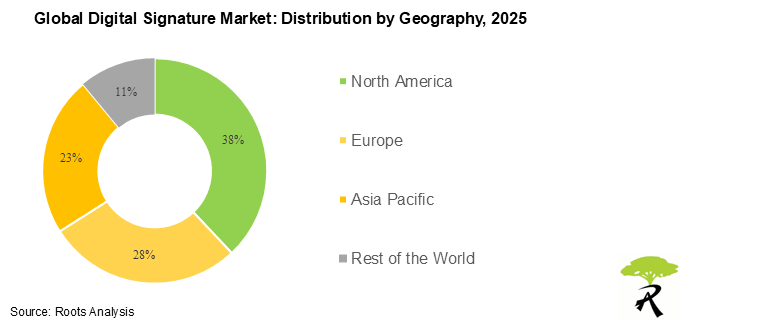
North America: The Most Mature and Legally Structured Market
North America dominates the global digital signature market, accounting for nearly 38-40% share. The market benefits from regulatory clarity, high awareness, and advanced cloud infrastructure, ensuring continued dominance through 2035.
United States: The US remains the world’s largest digital signature market due to the ESIGN Act and UETA, which legally equate electronic and handwritten signatures. Enterprise-grade solutions, such as DocuSign, Adobe Sign, and OneSpan are deeply integrated across banking, insurance, and federal workflows. The rise of remote work and digital customer onboarding post-pandemic has further boosted market penetration.
Canada: Canada’s Personal Information Protection and Electronic Documents Act (PIPEDA) supports strong digital identity and trust frameworks. Financial services and public sector digitization programs are fueling adoption.
Europe: Driven by eIDAS and Cross-Border Trust Services
Europe is the second-largest market, underpinned by strict compliance and interoperability standards set by the EU eIDAS regulation, which legally distinguishes between Simple, Advanced, and Qualified Electronic Signatures (QES). The region’s focus on data sovereignty and trusted digital identities positions it as a high-compliance, high-trust region, making it a lucrative market for QES providers and cloud PKI vendors. Sovereignty
United Kingdom: Despite Brexit, the UK continues alignment with eIDAS standards, promoting secure identity management through GOV.UK Verify and private trust service providers.
Germany and France: Both nations have strong enterprise adoption, particularly in the automotive, industrial, and government sectors, supported by QES for legal validity.
Asia-Pacific: Fastest Growing Market Fueled by Digitization and Mobile Identity
Asia-Pacific (APAC) is projected to record the highest CAGR (36%+) during 2025-2035, driven by rapid digitalization, mobile penetration, and government e-governance programs.
China: Strong policy support for e-contracts, fintech, and digital banking is accelerating local e-signature adoption. Platforms like Esign.cn have integrated e-signatures into supply chain and real estate transactions.
India: The Information Technology Act recognizes electronic signatures as legally binding, supported by Aadhaar-based e-sign. Government programs, such as Digital India and the e-Office initiative have catalyzed large-scale deployment.
Japan and South Korea: Both countries exhibit high adoption in enterprise settings, particularly in finance, logistics, and manufacturing.
Middle East and Africa: Early Adoption Supported by Government Digitization
The Middle East is witnessing steady adoption due to government efforts to modernize public administration and legal frameworks for e-transactions.
United Arab Emirates (UAE): Under its Digital Government Strategy 2025, the UAE mandates e-signatures for official transactions, boosting adoption across sectors.
Saudi Arabia: The E-Transactions Law recognizes digital signatures for commercial and government use, with major banking and oil sector use cases emerging.
Africa: South Africa leads regional adoption, driven by the Electronic Communications and Transactions Act, supporting digital signature enforceability.
Latin America: Emerging Growth Backed by Legal Reforms and Fintech
Latin America is evolving into an attractive growth frontier for digital signature vendors. The region’s digital transformation and fintech ecosystem are opening new opportunities for cloud-based e-signature platforms, particularly in cross-border trade and logistics.
Brazil: The ICP-Brasil framework provides a clear legal foundation for digital certificates, making Brazil a regional leader in enterprise and financial e-signing.
Mexico: Rapid fintech adoption and regulatory modernization (Fintech Law) are fueling e-signature demand across SMEs and BFSI.
Chile and Colombia: Both countries have enacted e-signature laws and are expanding usage in trade, healthcare, and government documentation.
Rest of the World: Gradual Uptake in Developing Economies
Emerging markets in Africa, Central Asia, and parts of Eastern Europe are in the early phase of e-signature adoption. Local governments are introducing data protection and electronic authentication laws, but infrastructure gaps persist.
As digital identity systems mature and international trade digitalization increases, these markets will gradually join the global e-signature ecosystem.
Digital Signature Market: Scope of the Report
| Key Report Attributes | Details | |
| Historical Trend | Since 2019 | |
| Forecast Period | Till 2035 | |
| Current Market Size | $ 7.28 Billion | |
| Market Size Value by 2035 | $ 180 Billion | |
| CAGR (Till 2035) | 33.83% | |
| Type of Component |
|
|
| Type of Deployment |
|
|
| Type of Level |
|
|
| Type of End User |
|
|
| Geographical Regions |
|
|
| Leading Market Players |
|
|
| PowerPoint Presentation (Complimentary) | Available | |
| Customization Scope | 15% Free Customization | |
| Excel Data Packs (Complimentary) |
|
|


